
- Joined
- Feb 5, 2010
- Messages
- 656
- Reaction score
- 551
- Points
- 5,551
- Attending Physician



ASA 5- moribund patient not expected to survive without the operation. Doesn't that automatically make the case an "E" designation as well? In other words, can you give an example of an ASA 5 case that's not time sensitive?

Patient with cardiogenic shock on ecmo coming for let’s say limb amputation, maybe a cath, maybe head mri.ASA 5- moribund patient not expected to survive without the operation. Doesn't that automatically make the case an "E" designation as well? In other words, can you give an example of an ASA 5 case that's not time sensitive?
Probably not. But the ASA classification system is so archaic and poorly-representative of the overall health of a patient (your outpatient 3 days a week HD patient is the same ASA 4 as a septic, intubated 3 pressor dude or dudette?) that it is almost meaningless to me. That being said, our malpractice company says it is very important to note which patients are high risk and which aren't, which they view as ASA 3 and above - my partners tell stories of them calling with complications followed by a sigh of relief over the phone when they report an ASA 4.
N.B. Really don't want to get into the "your healthy outpatient dialysis person isn't an ASA 4" argument here. Had it enough with obnoxious academic attendings in residency, and it drove me up the damn wall.

Patients on dialysis are NOT healthy.Yeah, but your healthy outpatient dialysis patient isn’t an ASA 4... weird example when there are so many true examples you could choose.
I think people get too fixated on the part that the patient has to die with/without the surgery.

Patients on dialysis are NOT healthy.
This is the definition of an ASA IV.
ASA IV A patient with severe systemic disease that is a constant threat to life.
If you need a machine to get rid of K every two days, that is severe systemic disease - and constantly a threat...because the machine is a machine.
People (not the ASA) have tried to use the classification system for things it was never meant for. That doesn't mean it is a bad classification...it just means people use it wrong.
Please note - ASA classification says nothing about functional status, how well a disease process is managed, how well the other systems are working, etc.
Based on the very simple definition, someone could be a marathon runner, the best max VO2 in the word, be pescatarian (best mortality rates), and have known large aneurysms systemically that are very tenuous and could rupture at any second - that would be an ASA IV.
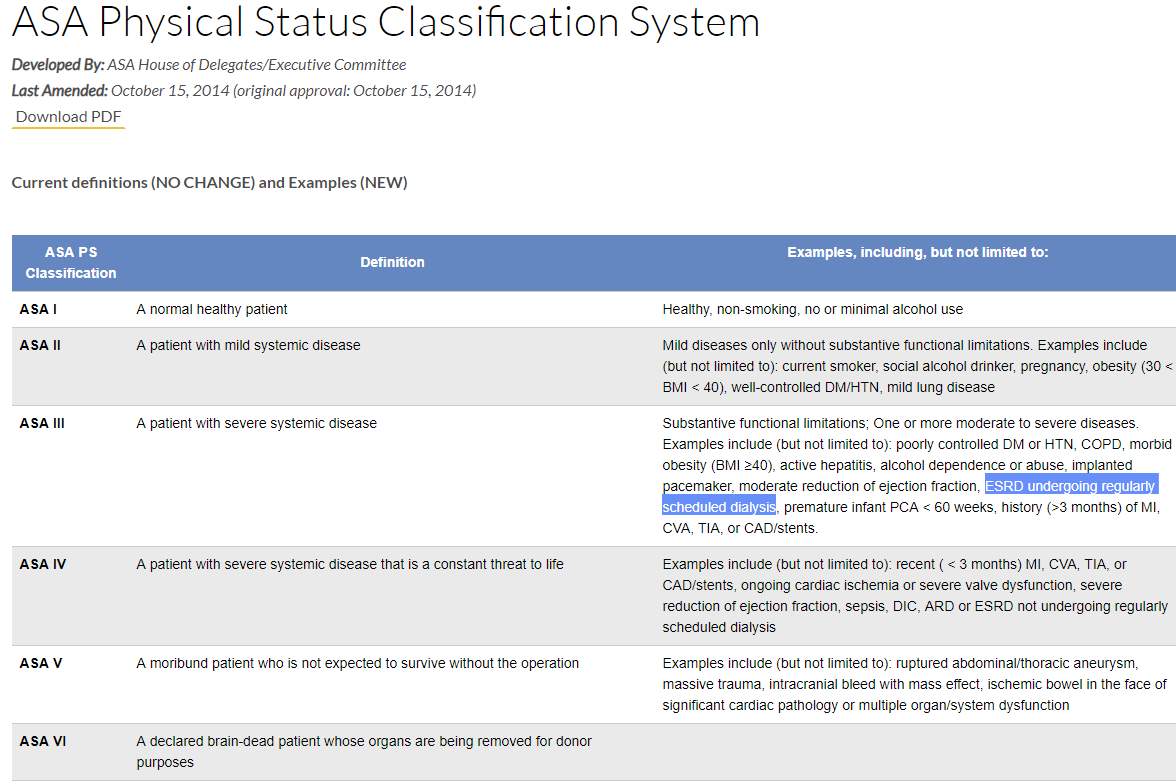

There are so many ways to prolong the death of a sick patient that death within 24hrs is not really a marker of sickness.Well by that definition aren’t we all ASA 5’s?

On a somewhat similar vein. For what types of cases are residents checking "life threatening pathology" when logging things on the ACGME website? I feel like I could easily attribute it to many of the cases I've done in the past.
The open chest on Central VA ECMO going to OR for chest washout or decannulation. The open belly with ischemic bowel in septic shock (or any infection with septic shock requiring source control) The symptomatic critical aortic stenosis.
Just curious about people's thoughts.


What do you make an infant for pylormyotomy? On one hand they are (presumably) otherwise healthy, but then again their pyloric stenosis is a constant threat to life.
What do you make an infant for pylormyotomy? On one hand they are (presumably) otherwise healthy, but then again their pyloric stenosis is a constant threat to life.
Nope. ASA 5 implies that the patient would die without the surgery.Non emergent ASA 5 could be a terminally ill ICU patient coming down for a palliative procedure.
Not a constant threat to life unless some ***** takes the patient to surgery without fixing his lytes first. Just an ASA 2.What do you make an infant for pylormyotomy? On one hand they are (presumably) otherwise healthy, but then again their pyloric stenosis is a constant threat to life.
2What do you make an infant for pylormyotomy? On one hand they are (presumably) otherwise healthy, but then again their pyloric stenosis is a constant threat to life.
1. Maybe 2. That's it.What do you make an infant for pylormyotomy? On one hand they are (presumably) otherwise healthy, but then again their pyloric stenosis is a constant threat to life.
1. Maybe 2. That's it.

It's debatable. I think pyloric stenosis can easily be higher. The baby can't survive unless it's fixed. It won't die immediately but it won't live that long

It's debatable. I think pyloric stenosis can easily be higher. The baby can't survive unless it's fixed. It won't die immediately but it won't live that long
What would you call Lance Armstrong if he went for emergency surgery after being hit by a car?
Yea that was my point, you'd think to make them a 1 or 2 without any thought, but how are they any different than an ESRD patient who needs dialysis? If they go more than a couple days without intervention they'll die. My original point was more about making them a 3 or 4, not a 5.
I disagree. As someone stated before, this is a medical, not surgical, emergency. These patients should never be an “E”. If they aren’t appropriately optimized, they don’t get surgery. By the time we see them, they should be tanked up with normal lytes. No “serious systemic” disease there....
Yea that was my point, you'd think to make them a 1 or 2 without any thought, but how are they any different than an ESRD patient who needs dialysis? If they go more than a couple days without intervention they'll die. My original point was more about making them a 3 or 4, not a 5.
Mr. Armstrong.What would you call Lance Armstrong if he went for emergency surgery after being hit by a car?
If I have to miss dinner or the sun has set, the case gets an “E” designation.

I had been told by attendings that they were a 4. I just checked and you have nailed it. I had no idea.The renal pt question is always interesting to me. I always consider ASA IV to be "would i be surprised if you died tomorrow?" There is plenty of evidence that even "healthy" pts in HD have higher mortality rates than general population. Why aren't they ASA IV now? Their condition is certaintly a constant, daily threat to life.
I had been told by attendings that they were a 4. I just checked and you have nailed it. I had no idea.
They're a 3 when they walk out of the dialysis center on Monday. They're a 4 when they walk back in on Wednesday.
Hypovolemic on Monday or hyperkalemic on Wednesday. Pick your poison.
I have space in my schedule on Tuesday
Patients die during dialysis... Not sure they're a 3 during... Maybe when they walk out haha.They're a 3 when they walk out of the dialysis center on Monday. They're a 4 when they walk back in on Wednesday.
And gods know what they become once they get constipated. With all due respect, guys, nobody gives a crap (pun intended).They're a 3 when they walk out of the dialysis center on Monday. They're a 4 when they walk back in on Wednesday.
Patients on dialysis are NOT healthy.
This is the definition of an ASA IV.
ASA IV A patient with severe systemic disease that is a constant threat to life.
If you need a machine to get rid of K every two days, that is severe systemic disease - and constantly a threat...because the machine is a machine.
People (not the ASA) have tried to use the classification system for things it was never meant for. That doesn't mean it is a bad classification...it just means people use it wrong.
Please note - ASA classification says nothing about functional status, how well a disease process is managed, how well the other systems are working, etc.
Based on the very simple definition, someone could be a marathon runner, the best max VO2 in the word, be pescatarian (best mortality rates), and have known large aneurysms systemically that are very tenuous and could rupture at any second - that would be an ASA IV.
It's debatable. I think pyloric stenosis can easily be higher. The baby can't survive unless it's fixed. It won't die immediately but it won't live that long
Got called to the ED the other night to help with an airway on a lethargic 1mo. old. pH was 7.7 with a bicarb of 66. 😱 That was an impressive pyloric.
What did you do? That's impressive


