
You are using an out of date browser. It may not display this or other websites correctly.
You should upgrade or use an alternative browser.
You should upgrade or use an alternative browser.
question about two reactions
- Thread starter kabtq9s
- Start date


- Joined
- Jun 29, 2004
- Messages
- 203
- Reaction score
- 2
- Points
- 4,571
- Pharmacy Student
this question boils down to Sn1 or Sn2
Yes, And I have been reviewing this topic all day today but still cant figure out this question
- Joined
- Apr 27, 2011
- Messages
- 138
- Reaction score
- 3
- Points
- 4,531
- Pre-Medical
Please help !!
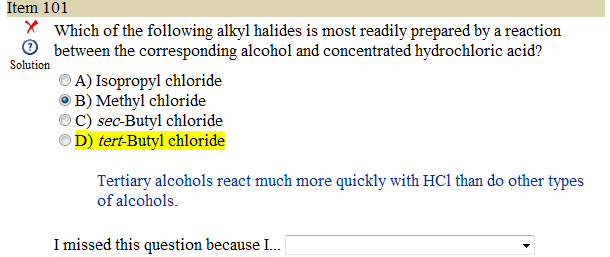
Looking at the reactions below which product is most readily prepared and why ?

Thanks in advance
The first reaction proceeds poorly. A primary alcohol must undergo Sn2, and yet we see no inversion in the stereochemistry of the product, meaning that at best it is an elimination followed by addition.
- Joined
- Jun 29, 2004
- Messages
- 203
- Reaction score
- 2
- Points
- 4,571
- Pharmacy Student
Thanks for your reply GreenRabbit,
However, the first reaction is taken out of my Princeton Review book page 513 and its says that it will proceed via an SN2 Mechanism.
Now I'm super confused
However, the first reaction is taken out of my Princeton Review book page 513 and its says that it will proceed via an SN2 Mechanism.
Now I'm super confused
- Joined
- Apr 27, 2011
- Messages
- 138
- Reaction score
- 3
- Points
- 4,531
- Pre-Medical
Thanks for your reply GreenRabbit,
However, the first reaction is taken out of my Princeton Review book page 513 and its says that it will proceed via an SN2 Mechanism.
Now I'm super confused
Yeah, we should assume it's a typo in the drawing. I also take back the elimination and addition quip, that wouldn't form a primary halide. In any case I believe the tertiary will react faster. Cl- is a crappy nucleophile that won't do much Sn2. Also, this question reminds me of the Lucas test, which distinguishes tertiary / secondary / primary alcohols based on reaction speed in ZnCl2 and conc. HCl.
- Joined
- Jun 29, 2004
- Messages
- 203
- Reaction score
- 2
- Points
- 4,571
- Pharmacy Student
Thanks alot I think I finally get it
I will explain my understanding and please correct me if its flawed.
So according to page 522 of Princeton, SN2 reactions depend on the concentrations of both electrophile and nucleophile and a strong nucleophile is required for an SN2 reaction to take place.
On the other hand an SN1 reaction only depends on the concentration of the electrophile and only an "OKay" nucleophile is needed.
and since we have Cl as our (weak) nucleophile it will be a perfect fit for an SN1 reaction which prefers a tertiary electrophile and the only tertiary electrophile we have is on the second reaction which makes it the most likely to proceed the fastest.
I will explain my understanding and please correct me if its flawed.
So according to page 522 of Princeton, SN2 reactions depend on the concentrations of both electrophile and nucleophile and a strong nucleophile is required for an SN2 reaction to take place.
On the other hand an SN1 reaction only depends on the concentration of the electrophile and only an "OKay" nucleophile is needed.
and since we have Cl as our (weak) nucleophile it will be a perfect fit for an SN1 reaction which prefers a tertiary electrophile and the only tertiary electrophile we have is on the second reaction which makes it the most likely to proceed the fastest.
- Joined
- Aug 10, 2010
- Messages
- 154
- Reaction score
- 1
- Points
- 4,551
- Pre-Medical
it still doesn't answer the original question as to why the tertiary alcohol proceeds faster than the primary alcohol.Yeah, we should assume it's a typo in the drawing. I also take back the elimination and addition quip, that wouldn't form a primary halide. In any case I believe the tertiary will react faster. Cl- is a crappy nucleophile that won't do much Sn2. Also, this question reminds me of the Lucas test, which distinguishes tertiary / secondary / primary alcohols based on reaction speed in ZnCl2 and conc. HCl.
kabtq9s, what did TPR say in its answer explanation?
- Joined
- Apr 27, 2011
- Messages
- 138
- Reaction score
- 3
- Points
- 4,531
- Pre-Medical
Thanks alot I think I finally get it
I will explain my understanding and please correct me if its flawed.
So according to page 522 of Princeton, SN2 reactions depend on the concentrations of both electrophile and nucleophile and a strong nucleophile is required for an SN2 reaction to take place.
On the other hand an SN1 reaction only depends on the concentration of the electrophile and only an "OKay" nucleophile is needed.
and since we have Cl as our (weak) nucleophile it will be a perfect fit for an SN1 reaction which prefers a tertiary electrophile and the only tertiary electrophile we have is on the second reaction which makes it the most likely to proceed the fastest.
👍 Only flaw is that I wouldn't call the alcohol an electrophile.
- Joined
- Jun 29, 2004
- Messages
- 203
- Reaction score
- 2
- Points
- 4,571
- Pharmacy Student
👍 Only flaw is that I wouldn't call the alcohol an electrophile.
Correct, the entire R-OH structure is the electrophile.
I actually made up this question as a simplification of a real mcat question that nobody could really explain it to me
and it did the trick 🙂 thanks again for your help GreenRabbit
- Joined
- Apr 27, 2011
- Messages
- 138
- Reaction score
- 3
- Points
- 4,531
- Pre-Medical
Glad to help.🙂 But it's good not to think that nucleophiles attack electrophiles or that they need each other or anything of that sort. The only electrophile in all of this is the carbocation intermediate or the H+. The alcohol is just an alcohol, nucleophiles can attack it but it's still not an electrophile.Correct, the entire R-OH structure is the electrophile.
- Joined
- Jun 29, 2004
- Messages
- 203
- Reaction score
- 2
- Points
- 4,571
- Pharmacy Student
Glad to help.🙂 But it's good not to think that nucleophiles attack electrophiles or that they need each other or anything of that sort. The only electrophile in all of this is the carbocation intermediate or the H+. The alcohol is just an alcohol, nucleophiles can attack it but it's still not an electrophile.
I dont know if you have the Princeton review books or not but in the Sn1 and Sn2 reactions they keep referring to the ROH as the electrophile.
But I think I will confuse myself if I follow their way.
Thanks again

