I'm a first-year at
UNTHSC-TCOM, so my experiences are limited. With that said, here we go:
Curriculum: Systems-based block schedule. We only do one organ system/unit at a time (ex. cardio, neuroscience, immune) and focus on that. We learn the anatomy, physiology, embryology, pharmacology, some pathophysiology, and radiology. The advantage of this is that you don't drag out courses all year (great for ADD types like me) and you don't have to worry about finals. I really, really like that. Gross anatomy lab runs 2-3 afternoons a week from August until March of first year. OMM lab is one afternoon a week for two hours. In addition to your systems courses, there are a few semester-long courses like OMM lecture, medical ethics, clinical interviewing, clinical medicine (learn how to use diagnostic equipment, physical exams, and write charts), community medical resources (learn about Medicare, Medicaid, indigent health care programs, child abuse agencies, women's health services, etc.), and a scattering of geriatrics lectures. Class is a mixture of lectures and MLMs, where faculty present clinical cases and questions which everyone answers via iClicker (not graded). You typically have an exam every two weeks. As an osteopathic school, we have the longest school year of any Texas medical school due to OMM. Most allopathic medical schools have 8-10 weeks off for summer break, we only get 6. That's just the nature of the beast. Second year has fewer lectures/less required class time but you are expected to read/self-teach a lot more. Lectures are audio-recorded which is great. I don't go to lectures if they are recorded, I listen to them at accelerated speed and I get more out of class that way.
Location: The campus is located in the cultural district which is one of the nicest areas of Fort Worth. We are 3-5 minutes from downtown Fort Worth and have easy access to highways to get around the metroplex. There are a lot of restaurants, museums, bars, and parks close-by. Fort Worth is a large city but has a small-town feel. Traffic is minimal (at least for me) and people are friendly. If you move from a big party town you'll probably be disappointed with the amount of nightlife/concerts/festivals, but it is what it is. Dallas is much more active in that regard and is 30-40 miles away. Lots of my classmates go out in Dallas on the weekends to go to bars or see Stars/Mavericks games. The Cowboys and Rangers are in Arlington which is about 20 minutes away.
Facilities: Very good. TCOM's classes are held in a building that's gorgeous and only a few years old. The whole campus has wireless internet connectivity. Buildings are well-maintained. The gym is in a building that is small and older but well-equipped and not very crowded. I've never been unable to find parking, although that may change as class sizes grow and we open our pharmacy school this fall. The campus is about three blocks by two blocks and is easily walkable.
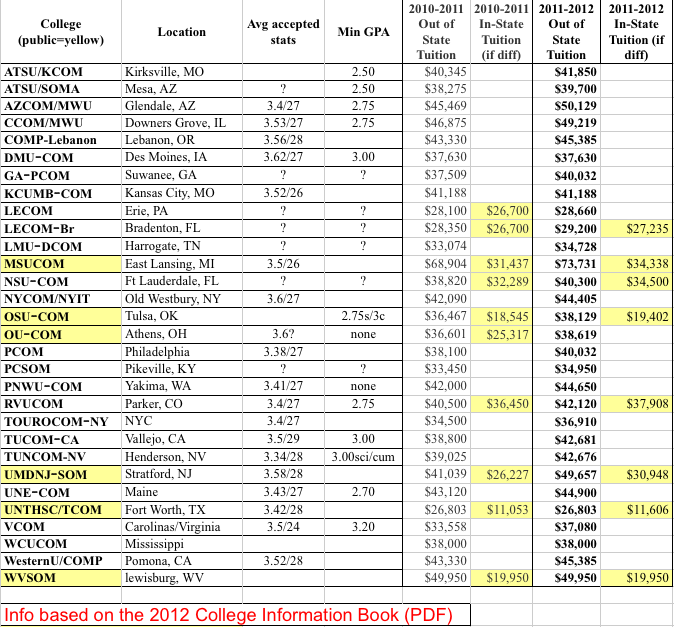
Cost: I understand that TCOM is one of the cheapest (if not the cheapest) DO schools in the country. Cost of attendance is about $44,000 per year for in-state and $60,000 per year for OOS. I'm in-state and that's pretty comparable with Texas allopathic schools which are very cheap compared to other states. Not sure how the OOS cost compares to other schools. TCOM is bound by state law to have at least 90% in-state students, so it's tough to get in if you're OOS.
Faculty: As with any school, we have some great instructors and some not-so-great instructors. I will say that our instructors this semester (spring) seem to be noticeably better than the fall. Objectives are clearly stated in our syllabi and you can expect exam questions to be pulled from those objectives. Faculty tend to be very responsive to questions and TCOM has post-exam reviews to go over questions if students don't know why they missed something or want to state their case for accepting multiple answers. I've had several excellent instructors and only one terrible one, so the good definitely outweighs the bad. Cell science (biochemistry) was mediocre with many heavily-accented instructors and I just didn't enjoy the minutiae. Neuroscience was very challenging due to a terrible lead instructor, I mainly taught myself. I think neuro was the exception to the rule and I hope that that lead instructor will be replaced next year due to numerous student complaints. PhDs are typically very good, clinical faculty (DOs & MDs) are excellent.
OMM: TCOM is big on OMM because we have the National Osteopathic Research Center. We basically lead every DO school in the country in OMM research. There are several federally-funded OMM research studies going at the moment. You can be a TA for OMM during the second year if you so desire (it's paid). OMM isn't so bad, lab is one afternoon a week for two hours.
Administration: We don't have a ton of interaction with administration; at least I haven't had any. Each TCOM class has a Course Director that is responsible for normal things. If you have a question about the schedule, curriculum, need an excused absence, or have something beyond what an instructor can provide, you go to the Curriculum Director who is assigned to the your class for the whole year. The Dean is pretty responsive to our concerns. Every month there's a monthly Dean's Table Meeting where students can air concerns/issues and try to get them resolved. There has been some turmoil lately between UNTHSC and UNT. The UNT system seems to want to merge with UNTHSC, so the health science center would no longer be a separate university. We will see what happens. I'm not sure that it will affect me while I'm here.
Reputation: TCOM has an excellent reputation in Texas and other states. Last year we had a higher USMLE Step 1 average score than some of the Texas allopathic schools. My friends who are in clinical rotations or have graduated remarked that many of their preceptors really liked TCOM grads and had great things to say about TCOM students. The impression I get is that TCOM students are just as capable as Texas allopathic students if not more so (trying to be humble here).
Clinical Rotations: Again, I'm not there yet. Our clinical sites are Fort Worth, Dallas, Longview, Conroe, Baytown, and Corpus Christi. ROME students (rural medicine scholars) are assigned to smaller, more rural areas throughout the state. The vast majority of TCOM students are assigned to Fort Worth, where you will rotate at JPS, Harris Methodist, Cook Children's, and Plaza. Dallas students go to Methodist Dallas. Conroe students go to Conroe Regional Medical Center. Corpus students go to Christus Spohn, Driscoll Children's, and Bay Area Medical Center. I'm not sure where Baytown students go. Conroe/Baytown spots are hard to get due to the Houston folks that want to go back home. Dallas/Longview/Corpus slots don't seem to be hard to get (from what I hear). I've heard good things about JPS and Harris Methodist. JPS is a level 1 trauma center and the county hospital. Harris Methodist is a level 2 trauma center. Plaza gets mixed reviews, depending on what you're rotating there for. I haven't heard anything about rotations at Cook Children's. JPS and Plaza both have residency programs. Methodist Dallas students seem to be happy/satisfied with their rotations. I can't say anything about Longview, Conroe, or Baytown. I hear awesome things about pediatrics rotations at Driscoll in Corpus Christi.
Housing: There's no on-campus housing so everyone lives off-campus. Housing is pretty reasonable although properties very close to the school can get quite pricy. It's very possible to live within 5 minutes of the campus for $500-700/month if you look early/long enough. There are a multitude of apartments, houses, and condominiums for rent. You can find plenty of places close-by and they tend to get cheaper as you get farther away from the campus. I'm living about 0.75 miles from campus and pay $600/month for a one bedroom apartment.
Technology: Each incoming class will be issued brand-new laptops, the brand/model changes each year in response to feedback from the prior year. Everyone in my class was issued a Dell XPS13 Ultrabook (similar to a Macbook Air) and an iPad 3. The whole campus has wireless internet connectivity. We use iClickers to answer questions in class. The library has desktop computers you can use, if you desire.
Study Areas: Adequate, considering that our campus only has ~2,000 students. The library has three levels. The bottom floor has the circulation desk and some couches and study tables. The middle floor is a group collaborative study area and has a bunch of tables and booths, along with some group study rooms. The top floor is a quiet floor where talking is not allowed. It has tables, couches individual carrels and some study rooms. Also, our class building has 15-20 different study rooms on floors 2 and 4 that can be used if not reserved for a class or meeting. The library building is open 24 hours. It can get crowded when more than one program (TCOM, PA, PT) have an exam looming, but I've always been able to find a table to study at.
Social Scene: Decent. If you went to a larger university or moved from a major metropolitan area, Fort Worth will seem pretty sleepy. We have two modest bar districts close-by (West 7th Street and Downtown). Most of the concerts are for country music. Fort Worth is known as "Cowtown" and the city slogan is "Where the West Begins". There are a few good places around for happy hours and we have an unofficial campus pub which is about a block away from my class building. Fort Worth isn't as happening as other cities but you can definitely go out and have a fun time. Unfortunately, my class isn't super sociable and only tends to go out the night after a test or when we are on break. We have a fairly full schedule but there's definitely time to go out as long as you keep on top of your studies.
Local Hospitals: see "clinical rotations" above. The local Fort Worth hospitals are JPS, Harris Methodist, Plaza, and Cook Children's. There's also Baylor All-Saints but I don't know if we do any rotations there.
Board Prep: Second years just finished class last week (first week of May) to study for boards. The school does not provide any formal board prep like Kaplan, but does provide access to Kaplan USMLE and COMLEX Qbanks. Most students take both the USMLE and COMLEX.. TCOM has been in the top 3 schools for COMLEX scores for the past five years, and has been #1 several times in the past ten years.
Specialty Matching: TCOM places students in great residency programs. About ½ of the class stays in Texas for residency and ½ goes OOS. Most of our students match into ACGME residencies and our latest match list speaks for itself:
http://forums.sdn.net/showpost.php?p=13990936&postcount=1276 We do match a lot of students into FM/IM/Peds, but that's because students want to do that and not because they don't have a choice.
Curriculum: A-
Location: A
Facilities: A+
Cost: A+
Faculty: A-
Reputation: A+
Technology: A
Study Space/Library: B+
Library Technology/Resources: A
Rotations: Can't weigh in, not there yet
Social: B
Hospitals: A
Overall Grade: A+




 You hit nail on the head so hard, theres a little piece of nail poking up somewhere in China


