

-
CycleTrack and SDN are teaming up to make medical school admissions more transparent and accessible! Read the announcement to learn how we’re supporting the future of CycleTrack’s free application-tracking tools .
You are using an out of date browser. It may not display this or other websites correctly.
You should upgrade or use an alternative browser.
You should upgrade or use an alternative browser.
AAMC 11 Waves
Started by MedPR
Get help with your application
Use all the free resources available to you from SDN: articles, guides, expert advising, forums discussions, and school research.
I understsand why amplitude is the correct answer, but couldn't you justify frequency and velocity as correct answers as well? Doesn't frequency depend only on the source? And isn't velocity a property of the media?
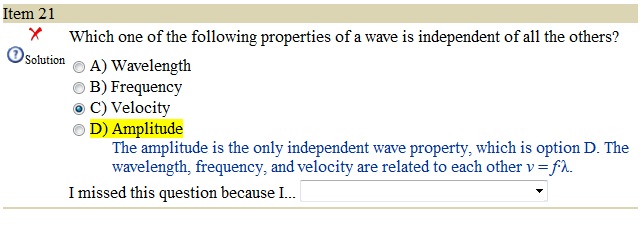
My reasoning was almost the same as yours when I chose frequency. I chose frequency because it only mattered according to the source. But I knew when I was taking the test that it had to either be frequency or amplitude and if it was amplitude, then it was because of the equation. Velocity and wavelength sort of depend on each other though. You could probably only make a case for frequency.
My reasoning was almost the same as yours when I chose frequency. I chose frequency because it only mattered according to the source. But I knew when I was taking the test that it had to either be frequency or amplitude and if it was amplitude, then it was because of the equation. Velocity and wavelength sort of depend on each other though. You could probably only make a case for frequency.
Ah, yea I initially had frequency as my answer, then I started thinking about doppler and the "perceived" frequency, so I went to velocity instead.

I immediately thought of the relational equation involving lambda, velocity, and wavelength. If you think of it that way, amplitude has no effect on either of those relationships. I've noticed the mcat does a lot of testing on relationships of variables in equations we're supposed to know for the test.
Sent from my Nexus S 4G using Tapatalk
Sent from my Nexus S 4G using Tapatalk
Advertisement - Members don't see this ad
I immediately thought of the relational equation involving lambda, velocity, and wavelength. If you think of it that way, amplitude has no effect on either of those relationships. I've noticed the mcat does a lot of testing on relationships of variables in equations we're supposed to know for the test.
Sent from my Nexus S 4G using Tapatalk
Yea, I think this is what I'm going to think about when answering questions like this. Just keep it completely simple and not think about random situations where you could validate other answers. Thank you

Yea, I think this is what I'm going to think about when answering questions like this. Just keep it completely simple and not think about random situations where you could validate other answers. Thank you
This is a key to MCAT success.
Yeah, I thought of v=lambda * f
Then thought of doppler effect.
The only thing that didnt fit was Amplitude.
Just to concrete my understanding. The doppler effect is the only instance where f changes isn't it?
All others either the:
velocity (medium due to decrease wavelength)
wavelength (medium, diffraction pattern)
right?
Then thought of doppler effect.
The only thing that didnt fit was Amplitude.
Just to concrete my understanding. The doppler effect is the only instance where f changes isn't it?
All others either the:
velocity (medium due to decrease wavelength)
wavelength (medium, diffraction pattern)
right?
I just took 11 today. Final of all practice tests in K and AAMC.
Yeah, I thought of v=lambda * f
Then thought of doppler effect.
The only thing that didnt fit was Amplitude.
Just to concrete my understanding. The doppler effect is the only instance where f changes isn't it?
All others either the:
velocity (medium due to decrease wavelength)
wavelength (medium, diffraction pattern)
right?
Well, the frequency doesn't actually change in doppler. The source is emitting the same frequency, but the observer perceives a different frequency as source/observer move relative to each other.
Right, because f^=f(v+-vo/v+-vs).
I guess I just meant cases to keep in mind where the values of the variables change. But like you said bad example because now we have f prime a distinct variable all together. My bad.
I guess I just meant cases to keep in mind where the values of the variables change. But like you said bad example because now we have f prime a distinct variable all together. My bad.
