
So I couldn't care less
Finally. Finally someone who uses that phrase correctly. Please find all the "could care less, your vs. you're, and for all intensive purposes" mopes and school them. Oh....sage advice on the thread as well.

Use all the free resources available to you from SDN: articles, guides, expert advising, forums discussions, and school research.
So I couldn't care less
Why? The head shaking implies you knew it was wrong. I thought you were a moral individual. Do you not have the patient's best interest at heart?I've already done 2 cases just like this one. I had a Cardiology note "clearing him" for surgery at 3 months. In addition, patient had been off Plavix and ASA for 7 days. I did both cases but just shook my head.
Sh_it girl, I got SOB reading this post.Hello, this is America. Most Americans get SOB going up a flight of stairs.
We like to eat and watch TV, not exercise. And this guy is almost 80 for crying out loud.
Nice!Your too wound up, consig. For all intensive purposes I could care less about finding all those mopes and schooling them.

Why is this thread making a big deal over A-lines in a case that probably benefits from having one? Is it laziness or because some of you take too long to place them? It seems often on our board when Arterial line is suggested there’s a handful of people that shun its use.

I don't think people are against a-lines. I think people just realize it's not therapeutic. If you have someone sick, dose your meds appropriately and cycle your NIBP if worried. It won't change what you do if you have an Aline or not.
For this patient, it doesn't sound like they will die on induction. They had their CAD stented and their echo was supposedly normal. It'll be in the middle of the case or after that they have a stent thrombosis. An Aline isn't going to prevent an MI. It'll maybe help you identify it 30 seconds earlier. The treatment is to go to cath lab. How is an Aline going to change your management? Also, if you are worried the patient is gonna have an intraop MI enough that you are putting in an Aline, why are you not worried enough to delay the case?

BingoBtw, the Gupta score doesn't take recent MI or stent into consideration. So I couldn't care less that the supposed "Estimated Risk Probability for Perioperative Myocardial Infarction or Cardiac Arrest" is under 1%.
And how long do you think he will have to be off DAPT after surgery as well?There is no reason to do this case at this time, but more importantly this patient has been off his DAPT for 7 days and now gets to carry that increased risk without having his surgery done. Better than dying on the table or the floor post-op though.
My healthy 65 yo anterior cervical fusion went asystolic in the next case for example.
Must have been the tight eye-taping job by "anesthesia".My healthy 65 yo anterior cervical fusion went asystolic in the next case for example (he did fine).
First of all, the ridiculousness of the A-line discussion here blows my mind.
If you want one then place it. I did and I placed it after induction.
If you don’t want one then fine. Let’s move on and stop posturing.
So to make some points here:
What concerns you and what will get you in trouble here?
Recent MI, The echo was Pretty good for my standards.
DES stent 3 months out. Recent rec’s discuss this and they seem to support going ahead.
What nobody has asked is, “where is the stent”? Does this matter?
What is the 20,000 number in reference to the stress test? What does it mean?
When is this guy most at risk if you do proceed with surgery?
Someone recommended sending him for ESI to bridge the time to surgery. I don’t disagree with this and this pt did have an ESI that helped for a couple days. But remember, he must stop DAPT for an ESI as well. So what’s the real benefit?
Now most of you are smarter than I am. What I’m also trying to present here is a discussion about the pressures to move forward and how we handle them. Many of you would not have done the case even with documentation of urgency and cards blessing. Maybe you are cautious or maybe you are smart as faack or maybe you are in a practice that doesn’t have the usual pressures that others have. Whatever the reason I think it is worth a discussion as to why you would take the stand you take. I did the case obviously. I didn’t have to do the case but I did. It was probably the most stable case I did all day. My healthy 65 yo anterior cervical fusion went asystolic in the next case for example (he did fine).


I don’t know, I think the a-line convo is interesting here. I work in a culture/setting where we get **** for placing them because it may cost the surgeon 3-5min. So this is a real issue we fight almost daily. But outside of that how many of us are placing a-lines for a posterior spinal fusion in a 70yo? These cases are a dime a dozen. I typically don’t.
Aggressive retraction on the carotid. Two full screens before a beat occurred. No meds required to treat it though..
Must have been the tight eye-taping job by "anesthesia".
This is exactly where I was going to take this thread if someone had not brought it up after the “fit for surgery” part of the discussion.Most of the cardiology “clearances” I see lately do not say “cleared for surgery” (justifiably so). Most notes say something along the lines of “intermediate risk for intermediate surgery.” The problem is most surgeons see the cardiology note and assume everything is good to go.
The problem I see here is that these cases come to the attention of the anesthesiologist 15 minutes before the scheduled start. Now you are expected to dig through this guy’s history and properly risk stratify him while the OR clock is ticking. At the very least this should have been brought to the anesthesiology department’s attention the day before. A proper conversation between the cardiologist, anesthesiologist, and surgeon is what is needed here to both determine the real urgency for the procedure and the patient’s perioperative risk. We can all get this patient through the surgery (a-line or no a-line) pretty easily. However, his increased risk does not stop the moment he hits pacu and you run off to see your next patient. This patient probably should have had this surgery postponed, but the morning of the procedure is the wrong time to do it. It’s hard to stop a moving train. The surgeon is less pissed off when a case is cancelled a week before rather than the day of (again, justifiably so).
I would have begrudgingly done the procedure (without an a-line), but explained in full detail all of his increased cardiac risks.
This is exactly where I was going to take this thread if someone had not brought it up after the “fit for surgery” part of the discussion.
We have a periop clinic which is run by the hospitalists because they needed more RVU’s to justify adding staff and we didn’t. This was fine by my group because we didn’t want to sit in a clinic. That’s not why I went into anesthesia. I know some of you will take issue with this. But we made it clear that we needed complete involvement and that we were the final word on if a case went to the OR or not. Things were going pretty well with the hospitalists staffing the clinic and they enjoyed getting off the floor from time to time. Then at some point last year they decided to hire a NP to staff the clinic with physician backup. This has been an eye opening experience for all of us. The NP is good at collecting data and putting together a note. But she has zero understanding. This case should have been seen by an anesthesiologist before surgery, period. To put this on my plate at 7am on a Monday is an impossible task. It is a setup for failure and confrontation. And the fact that we get these pts through their surgery without any issues just makes it worse.
Did you (guys) do anything about it? I think even your run of the mill hospitalist will not get “it”. One of my critiques regarding PSH is that no one will pay for anesthesiologists to be in PAT. But most people who are willing to be in clinic don’t have enough knowledge or advice understanding of anesthesia to give any meaningful recommendations.It is a setup for failure and confrontation. And the fact that we get these pts through their surgery without any issues just makes it worse.
t is a setup for failure and confrontation. And the fact that we get these pts through their surgery without any issues just makes it worse.
What's the liability for the anesthesiologist if a patient has an adverse cardiac event despite clearance from cardiology? What if it's an inappropriate clearance and you still proceed with the case (such as clearing the patient to be off DAPT for an elective surgery too soon after stent placement)?
If the cardiologist accepts responsibility for cardiac clearance, then why not just proceed with all cases we may not feel comfortable with from a cardiac standpoint? "The heart doctors the expert and told me it was fine!"

Most of the cardiology “clearances” I see lately do not say “cleared for surgery” (justifiably so). Most notes say something along the lines of “intermediate risk for intermediate surgery.” The problem is most surgeons see the cardiology note and assume everything is good to go.
The problem I see here is that these cases come to the attention of the anesthesiologist 15 minutes before the scheduled start. Now you are expected to dig through this guy’s history and properly risk stratify him while the OR clock is ticking. At the very least this should have been brought to the anesthesiology department’s attention the day before. A proper conversation between the cardiologist, anesthesiologist, and surgeon is what is needed here to both determine the real urgency for the procedure and the patient’s perioperative risk. We can all get this patient through the surgery (a-line or no a-line) pretty easily. However, his increased risk does not stop the moment he hits pacu and you run off to see your next patient. This patient probably should have had this surgery postponed, but the morning of the procedure is the wrong time to do it. It’s hard to stop a moving train. The surgeon is less pissed off when a case is cancelled a week before rather than the day of (again, justifiably so).
I would have begrudgingly done the procedure (without an a-line), but explained in full detail all of his increased cardiac risks.
So for bare metal one month is ok but 6 months is better?
DAPT should not be stopped in either DES or BMS for 12 months
Depends on what OK means to you
In patients with acute coronary syndrome (ACS) (non-ST elevation [NSTE]-ACS or ST elevation myocardial infarction [STEMI]) treated with DAPT after BMS or DES implantation, P2Y12 inhibitor therapy (clopidogrel, prasugrel, or ticagrelor) should be given for at least 12 months (Class I)."
DAPT should not be stopped in either DES or BMS for 12 months

From ACC guidelines regarding antiplatelet therapy...
CLASS I 1. In patients undergoing urgent noncardiac surgery during the first 4 to 6 weeks after BMS or DES implantation, DAPT should be continued unless the relative risk of bleeding outweighs the benefit of the prevention of stent thrombosis. (Level of Evidence: C) 2. In patients who have received coronary stents and must undergo surgical procedures that mandate the discontinuation of P2Y12 platelet receptor–inhibitor therapy, it is recommended that aspirin be continued if possible and the P2Y12 platelet receptor–inhibitor be restarted as soon as possible after surgery. (Level of Evidence: C) 3. Management of the perioperative antiplatelet therapy should be determined by a consensus of the surgeon, anesthesiologist, cardiologist, and patient, who should weigh the relative risk of bleeding with that of stent thrombosis. (Level of Evidence: C)
So yes, you can come off your DAPT in less than 12 months. It just depends on the surgery and the relative degree of urgency for doing it (and yes it is a class I recommendation)
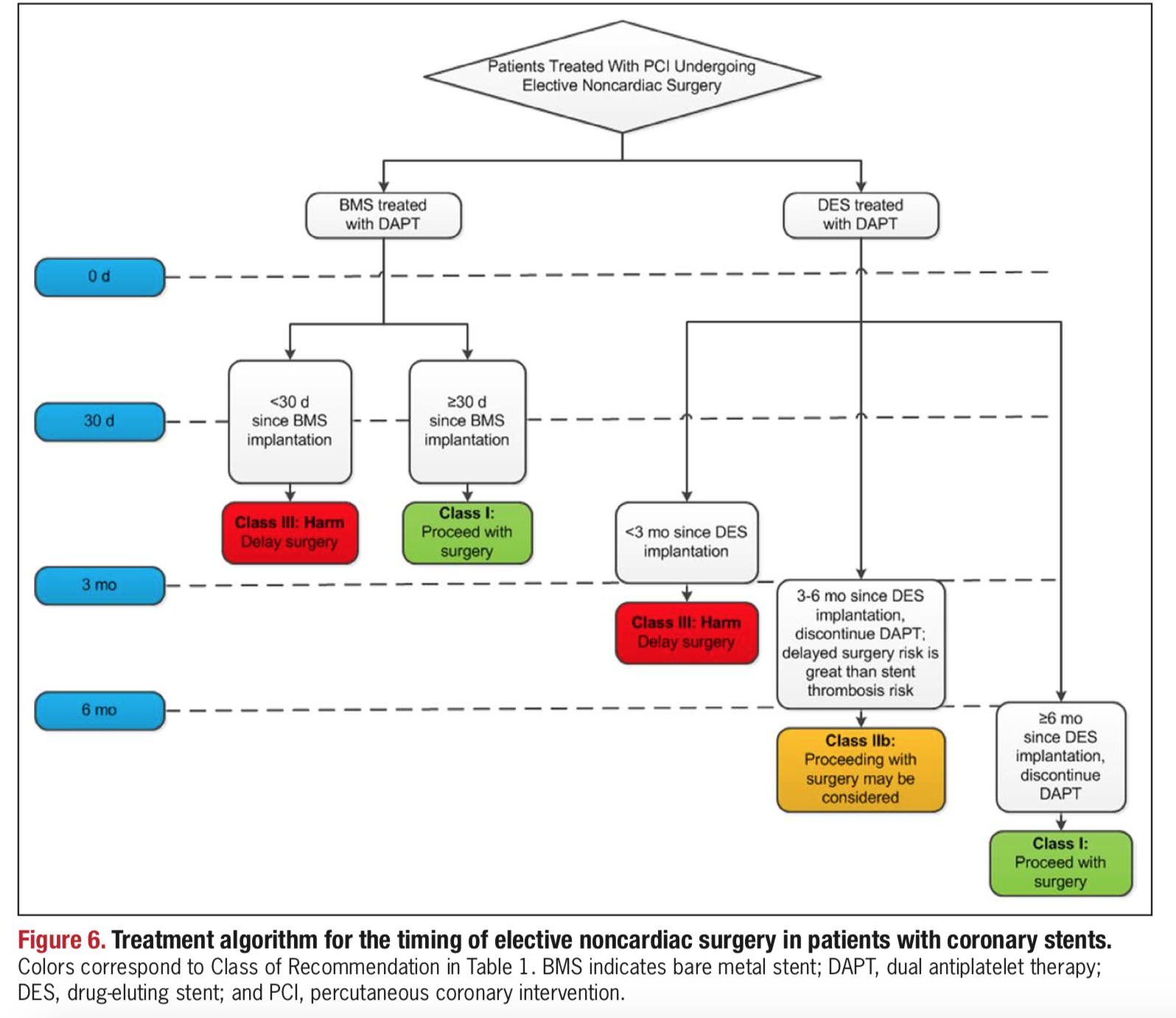
There are different guidelines for patients undergoing elective surgery.
Sorry I meant to reply to @anbuitachiAs I said, for surgeries that aren't purely elective it is different.

On a related note, tell me what you think about this. This was a case I took care of about 1 1/2 years ago.
Elderly female with DES placed 2 months ago, now asymptomatic from cardiac standpoint, going for ERCP with stenting due to obstructive jaundice due to cholangiocarcinoma. Was already taken off plavix x8 days, but kept on ASA. The anesthesiologist the day before cancelled the case pending cardiologist evaluation. Well cardiology never saw thr patient even after 24 hours, and after discussion with GI doc and patient I proceeded with the case. My rationale was multi fold:
1. Pt already off plavix and every hour we wait the higher the risk to this patient. They need to be back on DAPT asap.
2. This is endoscopic case which I expect minimal stress and inflammatory response
3. This was not elective and patient cannot wait until 6 months. Her life expectancy was likely less than that, and this was done under the name of palliative care
Thoughts

Somebody should talk to the guy who cancelled the case.
sounds like academic or kaiser model of a doc kicking the can down the road for the next guy to deal with
sounds like academic or kaiser model of a doc kicking the can down the road for the next guy to deal with
Sorry I meant to reply to @anbuitachi
On a related note, tell me what you think about this. This was a case I took care of about 1 1/2 years ago.
Elderly female with DES placed 2 months ago, now asymptomatic from cardiac standpoint, going for ERCP with stenting due to obstructive jaundice due to cholangiocarcinoma. Was already taken off plavix x8 days, but kept on ASA. The anesthesiologist the day before cancelled the case pending cardiologist evaluation. Well cardiology never saw thr patient even after 24 hours, and after discussion with GI doc and patient I proceeded with the case. My rationale was multi fold:
1. Pt already off plavix and every hour we wait the higher the risk to this patient. They need to be back on DAPT asap.
2. This is endoscopic case which I expect minimal stress and inflammatory response
3. This was not elective and patient cannot wait until 6 months. Her life expectancy was likely less than that, and this was done under the name of palliative care
Thoughts
Would you even take this patient off plavix if patient didn't already have it off? I don't see why it can't be done with DAPT.
Bleeding risk can be minimal to mild. If they do a papulotomy, it will bleed. The question now becomes, who cares? It’s in the small intestine and therefore won’t cause Great concern 7ntil it continues for 3 days or so. Not your issue. If they want to practice as uneducated technicians then who am I to stop them?Good question. I don't know the bleeding risk with this particular procedure if on DAPT.
Is risk of bleeding and its complications so great that they would subject a patient to the risk of in-stent thrombosis?
In my experience lots of the GI docs out there aren't interested in looking at the whole picture
I'm sure this was not a discussion the GI doc had with the patient

So the risk in all of this is re-thrombosis. Let's say this guy SHOULD HAVE stayed on his DAPT, but now is off for 7 days. What is the increased risk of thrombosis of now doing the surgery with anesthesia versus him not being on his DAPT alone? Is it a two-hit hypothesis model where you need both to occur, or is the cat already out of the bag and this guy is already on his road to a clot? At what point do you proceed? I wonder cause we had a guy last month who was getting a purely elective procedure done 6 months after DES placement. (From my memory, I'm pretty sure it was placed for CAD and not for ACS/MI) Cardiology note stated that he was cleared for surgery but he should continue DAPT for procedure. Of course day of surgery at 630am patient states he stopped DAPT for a week because ortho office told him to.
My questions were, why did this guy still need to be on DAPT 6 months after DES. Did he really need to be on them? Why did cards say to continue them? And if he did need to continue them and now that he's stopped, what should we do? Of course no cardiology office is open that early. We ended up postponing the case until we got more details from cards. Ortho got a hold of the office at some point but not sure if they plavix loaded him or not... Ended up moving up an inpatient and only delayed the room by a a few minutes. From a medical standpoint I think it was perfectly fine to proceed, but the fact that the cards consult said one thing and the patient did another and it was an elective case, there wasn't a real reason to push to go. I of course told the patient that our concerns were about possible thrombosis and his daughter was there and she was having NO qualms with postponing if there was any chance he was at increased risk for anything.
On another note, in response to the a-line, I'd probably have placed one.
So the risk in all of this is re-thrombosis. Let's say this guy SHOULD HAVE stayed on his DAPT, but now is off for 7 days. What is the increased risk of thrombosis of now doing the surgery with anesthesia versus him not being on his DAPT alone? Is it a two-hit hypothesis model where you need both to occur, or is the cat already out of the bag and this guy is already on his road to a clot? At what point do you proceed? I wonder cause we had a guy last month who was getting a purely elective procedure done 6 months after DES placement. (From my memory, I'm pretty sure it was placed for CAD and not for ACS/MI) Cardiology note stated that he was cleared for surgery but he should continue DAPT for procedure. Of course day of surgery at 630am patient states he stopped DAPT for a week because ortho office told him to.
/QUOTE]
This is how I look at this case. He was off the DAPT for 7 days already. But we haven’t insulted him with surgery making him hypercoaguable, yet. And if we proceed, he will remain off DAPT for another 10 days (lumbar fusion). These two things really step up the risk in my opinion.
Nobody has asked where the stent is. It’s in the circumflex. Does this matter?
So the risk in all of this is re-thrombosis. Let's say this guy SHOULD HAVE stayed on his DAPT, but now is off for 7 days. What is the increased risk of thrombosis of now doing the surgery with anesthesia versus him not being on his DAPT alone? Is it a two-hit hypothesis model where you need both to occur, or is the cat already out of the bag and this guy is already on his road to a clot? At what point do you proceed? I wonder cause we had a guy last month who was getting a purely elective procedure done 6 months after DES placement. (From my memory, I'm pretty sure it was placed for CAD and not for ACS/MI) Cardiology note stated that he was cleared for surgery but he should continue DAPT for procedure. Of course day of surgery at 630am patient states he stopped DAPT for a week because ortho office told him to.
My questions were, why did this guy still need to be on DAPT 6 months after DES. Did he really need to be on them? Why did cards say to continue them? And if he did need to continue them and now that he's stopped, what should we do? Of course no cardiology office is open that early. We ended up postponing the case until we got more details from cards. Ortho got a hold of the office at some point but not sure if they plavix loaded him or not... Ended up moving up an inpatient and only delayed the room by a a few minutes. From a medical standpoint I think it was perfectly fine to proceed, but the fact that the cards consult said one thing and the patient did another and it was an elective case, there wasn't a real reason to push to go. I of course told the patient that our concerns were about possible thrombosis and his daughter was there and she was having NO qualms with postponing if there was any chance he was at increased risk for anything.
On another note, in response to the a-line, I'd probably have placed one.

Our mission is to provide students with free, unbiased information, resources, and advising for careers in the health professions. We believe every student deserves access to trustworthy guidance, regardless of background or ability to pay.
We use essential cookies to make this site work, and optional cookies to enhance your experience.