Breast is the worstest x5?

This forum made possible through the generous support of SDN members, donors, and sponsors. Thank you.
“As IORT gained acceptance in the 2010s, a worrisome trend was forming among radiation oncologists — their supply was growing faster than patient demand for their services, according to 2016 research in the International Journal of Radiation Oncology, Biology, Physics.”

radiation oncologists are likely to overutilize xrt because of residency expansion and now they are desperate for pts? Interesting if this will continue to be taken up by the media.
I think this is definitely a possibility. Not that IORT is good, but that people will choose to treat more often or longer than they might have if demand was outpacing supply.
 
"After the surgery, she said, she was back at work within two months — a feat that would not have occurred with whole breast irradiation.

WRONG.

Heidi Toplansky, 72, was diagnosed with two different cancers — one in each breast — in 2012. A mother of two living in California, Toplansky received traditional radiation to treat the tumor in one of her breasts because it was not a candidate for IORT. The tumor in the other one was, and she jumped at the chance to get the alternative treatment.

Even though her surgeon ended up detecting cancer cells near where her tumor had been, forcing her to undergo repeated bouts of whole breast radiation after the IORT, she is a huge proponent of the treatment.

“With IORT it’s 30 minutes with that device in the breast cavity,” Toplansky said. “With traditional radiation, this machine travels over your body 20 to 30 minutes every day for two months and you’re burning like a piece of meat on a barbecue grill.”

Traditional radiation treatment has left Heidi Toplansky's left breast with scarring that she has since had reduced with laser treatments.

What the actual ****? This poor 72-year old lady got IORT followed by WBRT. 8 weeks of EBRT?

Also, the reason she has so much left breast telangiectasias is becuase of the 20Gy bomb placed in her cavity which then needed to be followed by WBRT....

Gretchen Morgenson
Gretchen Morgenson is the senior financial reporter in the Investigations unit at NBC News.

This is what happens when you have financial reporters writing articles about medical issues that they don't ****ing understand.
 
Good luck convincing your breast surgeons of that
Well I can’t control the referrals of course

But any pN1 I see will still get full PMRT with full ENI

Variability in treatment volumes, bolus use, etc, was too large in this trial to derive any meaningful conclusion from it, the worse survival w/ PMRT is pure chance and not even worth mentioning, and so on

We can safely and properly ignore SUPREMO imho
 
Well I can’t control the referrals of course

But any pN1 I see will still get full PMRT with full ENI

Variability in treatment volumes, bolus use, etc, was too large in this trial to derive any meaningful conclusion from it, the worse survival w/ PMRT is pure chance and not even worth mentioning, and so on

We can safely and properly ignore SUPREMO imho
Let's say we have two patients with the same tumor:

pT2 (25mm) pN1 (1/5; SLN; 5 mm) cM0 G2 ER90% PR90% Her2new- Ki67 15% Oncotype-score low
both are 58 years old

Patient 1 opts for a mastectomy, her mother died due to breast cancer and her breast is rather small
Patient 2 opts for a BCS

Are both getting (the same) RNI?
 
Well I can’t control the referrals of course

But any pN1 I see will still get full PMRT with full ENI

Variability in treatment volumes, bolus use, etc, was too large in this trial to derive any meaningful conclusion from it, the worse survival w/ PMRT is pure chance and not even worth mentioning, and so on

We can safely and properly ignore SUPREMO imho
this is confusing the **** out of me. Is today opposite day?

Edit: NVM, "the worse survival w/ PMRT is pure chance" clued me in.
 
My breast surgeons are 100% on board with avoiding axillary dissections whenever possible. No one likes lymphedema.

My experience (especially in the younger fellowship trained breast surgeons) is that they will do just about anything to avoid a dissection.

With that said, with this trial I think it's very appropriate to omit PMRT in patients on this trial that had a dissection for whatever reason.

I think the borderline cases with just SLNB wll be hard to know what to do with....like a pT2N1 with LVSI and 1/2 SLNB's +.
 
Two things catch my eye on this:

1. This is another trial where TNBC does worse with RT, similar to B51. How interesting.
1762445576155.jpeg


2. I do wonder about the question of ENI without chestwall in those without full axillary clearance, as alluded to in the discussion. Maybe in patients with particularly high risk, not that that ever will become standard or tested in a meaningful way, given the glacial pace of RT trials here.
 
Let's say we have two patients with the same tumor:

pT2 (25mm) pN1 (1/5; SLN; 5 mm) cM0 G2 ER90% PR90% Her2new- Ki67 15% Oncotype-score low
both are 58 years old

Patient 1 opts for a mastectomy, her mother died due to breast cancer and her breast is rather small
Patient 2 opts for a BCS

Are both getting (the same) RNI?
Of course they are. ENI fields are based on what we feel in our gut. And did you know the gut has more nerve endings than the brain. Which means never trust your brain, always trust your gut. My gut tells me you have to treat the IMNs, sclav and axilla if you want to stay “pure” and get most benefit from ENI. Unfortunately SUPREMO docs trusted their brains and their ENI fields were all over the place.
 
Two things catch my eye on this:

1. This is another trial where TNBC does worse with RT, similar to B51. How interesting.
View attachment 411341

2. I do wonder about the question of ENI without chestwall in those without full axillary clearance, as alluded to in the discussion. Maybe in patients with particularly high risk, not that that ever will become standard or tested in a meaningful way, given the glacial pace of RT trials here.
Don’t fall for the “interesting” survival trend. Next thing you know we will be electing socialists to political offices in America. Pay no attention to the worse RT survival behind the curtain.
 
My experience (especially in the younger fellowship trained breast surgeons) is that they will do just about anything to avoid a dissection.
Probably just in terms of sheer patient volume and resultant improvements in QOLs, one of the most notable “practice flips” I’ve witnessed in my unbrief career
 
So, you would treat a pT2 pN1 (1/5) luminal A patient post-BCS with ENI?

Here's an answer: (Is it a good answer? Is it one I believe? Is it one anyone believes? Am I writing it just to do a little trolling, maybe stir the pot a bit? Who knows?!)

High tangents

(ducks and runs out of the room)
 
Here's an answer: (Is it a good answer? Is it one I believe? Is it one anyone believes? Am I writing it just to do a little trolling, maybe stir the pot a bit? Who knows?!)

High tangents

(ducks and runs out of the room)
I am so ashamed, I deleted my post.

Always good to come home in the evening and realize that I‘ve treated dozens of parients for no reason.
 
My experience (especially in the younger fellowship trained breast surgeons) is that they will do just about anything to avoid a dissection.

With that said, with this trial I think it's very appropriate to omit PMRT in patients on this trial that had a dissection for whatever reason.

I think the borderline cases with just SLNB wll be hard to know what to do with....like a pT2N1 with LVSI and 1/2 SLNB's +.

My experience is the breast surgeons are told radiation is the root of all evil and will do anything to omit it. If you don't, they refer to someone who will. This is what happens in my neck of the woods.
 
There’s either a lot of A cup women in the UK, or a lot of plastic surgeons.

Always good to come home in the evening and realize that I‘ve treated dozens of patients for no reason.

The over treatment here is mastectomy plus ax dissection for T1N1-T2N1 patients.
 
My experience is the breast surgeons are told radiation is the root of all evil and will do anything to omit it. If you don't, they refer to someone who will. This is what happens in my neck of the woods.
That’s a shame.

In my experience if you have an aggressive plastics doc who loves mastectomy/reconstructive cases they of course hate radiation.

But I have been really fortunate to work with a couple of breast surgeons that are very pro breast conservation and do very good oncoplastic procedures and they are very reasonable about radiation. I think the great outcomes of Imrt APBI has helped too - patients cosmetically do great.
 
So taking AMAROS and SUPREMO together, how many are you or will you treat axilla only after masectomy and +SLN bx? Breast really is the worst…
 
So taking AMAROS and SUPREMO together, how many are you or will you treat axilla only after masectomy and +SLN bx? Breast really is the worst…
In every single report, randomized or retrospective, in the history of breast cancer radiotherapy, the chest wall is always at higher risk of recurrence than the axilla. And axillary involvement is a marker for chest wall recurrence. But my gut tells me, as it will most rad oncs I think, that axillary only RT is the right choice if a mastectomy patient gets only a few axillary nodes removed. It just seems like the axilla has gotta be more at risk than the chest wall… it just makes sense. (One nice thing about that gut feeling here is you won’t ever get any conflicting data in the future to challenge this gut feeling.)
 
Does the NCCN have any guidance that suggests chest-walless PMRT is OK or bad? I think it’s sufficiently vague enough to answer “no.”
I agree. I don't do that. Well, I did once to a man. In any case, that was before. My advice pertains to all of breast.
 
1. This is another trial where TNBC does worse with RT, similar to B51. How interesting.

Yeah...I'm starting to buy that there is something real here (fully understanding the risks of Type 1 errors emerging in subgroup analysis)...still, combine with NSABP B-51 results and the Type 1 error found it's way to the exact same subgroup.


We be killing triple negative patients who get mastectomies.

Where are our lymphocyte experts?
 
So taking AMAROS and SUPREMO together, how many are you or will you treat axilla only after masectomy and +SLN bx? Breast really is the worst…

Depends on the presence and volume of LVSI
 
… who get mastectomies AND radiation, right?
Yeah. By we, I meant us, not the breast surgeons.

When I first became aware of the convos regarding B-51, I thought, just ignore the subgroup analysis...it's usually just rando (20 subgroups and chance of a type 1 error in one group is high) and ignoring usually the best thing to do.

However, we have to consider the literature outside of the trial. We now have a second trial indicating a detriment with XRT in triple negative breast cancer., where all other subgroups are pretty neutral or slightly favor the intervention.

We have a somewhat plausible mechanism? TNBC the most immunogenic of the bCa subtypes. (Also, more likely to have a true pCR to chemo relative to HR+ disease).

The data from Supremo is appropriately interpreted as demonstrating equivalence of survival outcomes. However, I would rather be on the non-XRT survival curve myself, and I believe this separation is almost completely driven by TNBC outcomes.
 
What is interesting is looking at the supplementary data, is that it seems local control is about the same, but it is appearance of new metastasis. Maybe we are reviewing important and helpful surveillance local immune cells that then can control the distant meds. It is very strange.
 
Yeah. By we, I meant us, not the breast surgeons.

When I first became aware of the convos regarding B-51, I thought, just ignore the subgroup analysis...it's usually just rando (20 subgroups and chance of a type 1 error in one group is high) and ignoring usually the best thing to do.

However, we have to consider the literature outside of the trial. We now have a second trial indicating a detriment with XRT in triple negative breast cancer., where all other subgroups are pretty neutral or slightly favor the intervention.

We have a somewhat plausible mechanism? TNBC the most immunogenic of the bCa subtypes. (Also, more likely to have a true pCR to chemo relative to HR+ disease).

The data from Supremo is appropriately interpreted as demonstrating equivalence of survival outcomes. However, I would rather be on the non-XRT survival curve myself, and I believe this separation is almost completely driven by TNBC outcomes.
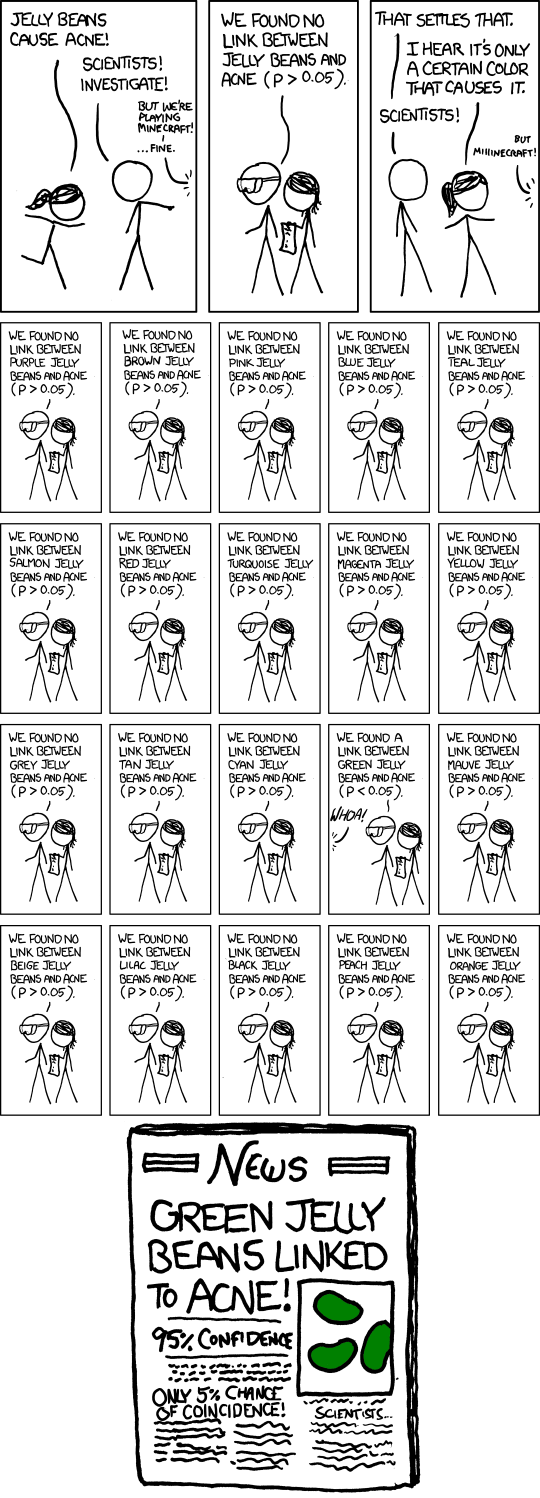
Also, talking about type one error reminds me of this classic comic, fully recognizing we are talking about this not being the case
 
What is interesting is looking at the supplementary data, is that it seems local control is about the same, but it is appearance of new metastasis. Maybe we are reviewing important and helpful surveillance local immune cells that then can control the distant meds. It is very strange.
Yeah, all local outcomes (CW recurrence and locoregional recurrence) favored (not by much) XRT. As you would expect.

My take (speculative and stoopid), is the RNI likely sterilizes low volume nodal metastatic disease in some portion of patients with HR+ disease, which in turn can impact distant recurrences to some degree. Whereas the same (or similar) intervention in TNBC, meaningfully destroys TIL, diminishing a clinically meaningful immune surveillance mechanism and potentiating distant failure.

The cartoon is spot on.

Now if the green jellybeans were the only ones infused with testosterone?
 
I think what you are suggesting makes sense
 
Yeah. By we, I meant us, not the breast surgeons.

When I first became aware of the convos regarding B-51, I thought, just ignore the subgroup analysis...it's usually just rando (20 subgroups and chance of a type 1 error in one group is high) and ignoring usually the best thing to do.

However, we have to consider the literature outside of the trial. We now have a second trial indicating a detriment with XRT in triple negative breast cancer., where all other subgroups are pretty neutral or slightly favor the intervention.

We have a somewhat plausible mechanism? TNBC the most immunogenic of the bCa subtypes. (Also, more likely to have a true pCR to chemo relative to HR+ disease).

The data from Supremo is appropriately interpreted as demonstrating equivalence of survival outcomes. However, I would rather be on the non-XRT survival curve myself, and I believe this separation is almost completely driven by TNBC outcomes.

This seems plausible.

Wasn't there a ?JCO non randomized? huge data set/report that suggested for triple negative breast cancer patients, those that had BCS plus radiation had superior survival than mastectomy? Probably since non-randomized it doesn't hold up as well as this.

Maybe some time around 2010-ish.

Maybe it was a fever dream of mine?
 
This seems plausible.

Wasn't there a ?JCO non randomized? huge data set/report that suggested for triple negative breast cancer patients, those that had BCS plus radiation had superior survival than mastectomy? Probably since non-randomized it doesn't hold up as well as this.

Maybe some time around 2010-ish.

Maybe it was a fever dream of mine?
This happened per my recollection. Also, a retracted trial for early-stage TNBC getting adjuvant XRT after mastectomy was positive for radiation.

But the best retrospective data I am aware of indicates benefit for adjuvant XRT in TNBC is specific to breast conservation in terms of survival outcomes.

 
This happened per my recollection. Also, a retracted trial for early-stage TNBC getting adjuvant XRT after mastectomy was positive for radiation.
There's however a Chinese randomized trial showing a survival benefit after mastectomy with radiation for TNBC stage I-II patients


For me, this was until now the important trial in this patient cohort.
Have things changed since 2011? Apparently.

Yeah, all local outcomes (CW recurrence and locoregional recurrence) favored (not by much) XRT. As you would expect.
I did not expect a 2% chest wall recurrence rate in this population without RT.
I expected something like 2-3% with RT and 6-7% without.
 
There's however a Chinese randomized trial showing a survival benefit after mastectomy with radiation for TNBC stage I-II patients
That was the retracted study!
 
Really? Came out over a decade ago iirc

When was it retracted?
I remember it being retracted within a couple years of publication..."methodological problems".

Will look for sources.
 
Sum Ting Wong et al?

Jianhua Wang, Mei Shi, Rui Ling, Yuesheng Xia, Shanquan Luo, Xuehai Fu, Feng Xiao, Jianping Li, Xiaoli Long, Jianguo Wang, Zengxia Hou, Yunxia Chen, Bin Zhou, Man Xu
 
We can safely and properly ignore SUPREMO imho
Are you SURE we can ignore it? 🤪

Radiation May Be Unnecessary for Many Breast Cancer Patients
Doctors have already begun reducing radiation treatment for women at low risk of recurrence or spread of the disease. A new study finds that some women at greater risk can safely avoid radiation.


Study findings are almost irrelevant to the reduction of radiation in breast cancer. It has already been decided that radiation should be eliminated whenever possible for breast cancer. The will to eliminate us is too strong. It doesn’t help that some of our own are looking to eliminate us as well. Studies showing reduced risk of local recurrence with radiation have already been largely ignored.
 
Have been screaming this from the top of the trees for the last 5 years. Radiation utilization will plummet in breast cancer in the next 15 years, especially early stage.
 
Have been screaming this from the top of the trees for the last 5 years. Radiation utilization will plummet in breast cancer in the next 15 years, especially early stage.
I think this is possible but what if Europa trial looks good at 10 year follow up?
At 5 years no diff between APBI and AI in a low risk population.
 
Are you SURE we can ignore it? 🤪

Radiation May Be Unnecessary for Many Breast Cancer Patients
Doctors have already begun reducing radiation treatment for women at low risk of recurrence or spread of the disease. A new study finds that some women at greater risk can safely avoid radiation.


Every US academic rad onc on twitter is saying the trial hasn’t a single tittynope (pun intended) of practice changing findings …. in other words, we all good! The sky can never fall if you keep it propped up.
 
Every US academic rad onc on twitter is saying the trial hasn’t a single tittynope (pun intended) of practice changing findings …. in other words, we all good! The sky can never fall if you keep it propped up.
1762789380884.png
 

I dunno, I'm good friends with a lot of wealthy/powerful people, and being an oncologist, radiation or not, isn't something that people sniff at/look down at. Quite the contrary from what I've experienced. I haven't seen this movie though so I might be missing the point.
 
I dunno, I'm good friends with a lot of wealthy/powerful people, and being an oncologist, radiation or not, isn't something that people sniff at/look down at. Quite the contrary from what I've experienced. I haven't seen this movie though so I might be missing the point.
I was trying to make the point that "treating breast cancer" as a radiation oncologist in 2030 may be considered something "special".
 
I was trying to make the point that "treating breast cancer" as a radiation oncologist in 2030 may be considered something "special".

Ahhh got it. Does make a little more sense now.
 
Top Bottom