
Seems like a better history and physical exam would be the best way to answer that question. Is pain more neuropathic or mechanical? Does it hurt more to move the neck or the shoulder? As a last resort, I’d inject the should as a diagnostic test rather than the neck. Much lower risk and more likely to give a clear diagnostic picture. A good SNRB will also partially anesthetize the shoulder.What's the injectate volume/concentration. Do you start with lidocaine/numbing medication?
Also, how does this help surgeon?
Question posed was is this her shoulder causing pain or coming from neck at C4-C5 where there was severe narrowing - not sure if injection would help answer that?
-
CycleTrack and SDN are teaming up to make medical school admissions more transparent and accessible! Read the announcement to learn how we’re supporting the future of CycleTrack’s free application-tracking tools .
You are using an out of date browser. It may not display this or other websites correctly.
You should upgrade or use an alternative browser.
You should upgrade or use an alternative browser.
cervical selective nerve root block
Started by SpineandWine
Get help with your application
Use all the free resources available to you from SDN: articles, guides, expert advising, forums discussions, and school research.

There are multiple ways to answer this Q without doing a SNRB.What's the injectate volume/concentration. Do you start with lidocaine/numbing medication?
Also, how does this help surgeon?
Question posed was is this her shoulder causing pain or coming from neck at C4-C5 where there was severe narrowing - not sure if injection would help answer that?

What's the injectate volume/concentration. Do you start with lidocaine/numbing medication?
Also, how does this help surgeon?
Question posed was is this her shoulder causing pain or coming from neck at C4-C5 where there was severe narrowing - not sure if injection would help answer that?
Fine to numb the skin. Once at the cervical nerve root, I inject 0.4ml of 4% lidocaine.
If not just doing the surgeons bidding and you want to help the patient to avoid surgery and they have severe cervical foraminal stenosis, then cervical + catheter can provide more reliable foraminal spread of depomedrol as seen in the attached photo.
Attachments

There are multiple ways to answer this Q without doing a SNRB.
Seems like a better history and physical exam would be the best way to answer that question. Is pain more neuropathic or mechanical? Does it hurt more to move the neck or the shoulder? As a last resort, I’d inject the should as a diagnostic test rather than the neck. Much lower risk and more likely to give a clear diagnostic picture. A good SNRB will also partially anesthetize the shoulder.
Agree with you both. Though there are definitely times where nothing answers the question besides a CESI.
Last edited:

I am agreeing with you all.
That being said, I did the SNRB and she had numbness of shoulder/heavyness to be expected. So I am not sure if I answered that question for him as C5 goes to shoulder.
I do like the catheter approach and will use that instead in future.
That being said, I did the SNRB and she had numbness of shoulder/heavyness to be expected. So I am not sure if I answered that question for him as C5 goes to shoulder.
I do like the catheter approach and will use that instead in future.
Last edited:
Do a glenohumeral injection with 5 mL ropi or any LA really and see if pain goes away. Easiest way to differentiate. Same if differentiating hip vs L2/3 radic.I am agreeing with you all.
That being said, I did the SNRB and she had numbness of shoulder/heavyness to be expected. So I am not sure if I answered that question for him as C5 goes to shoulder.
I do like the catheter approach and will use that instead in future.
That's the MRI, just has shoulder pain/heavyness.
The only question answered by a CESI is “Will a CESI help their pain?”Agree with you both. Though there are definitely times where nothing answers the question besides a CESI.
Agree.The only question answered by a CESI is “Will a CESI help their pain?”
“Can this pt be managed conservatively for now?”
I getcha.Agree.
“Can this pt be managed conservatively for now?”
I wonder how these surgeons make decisions on levels when so many areas of spine may have mild or moderate narrowing. Include too little and you have to go back in
Include too much and they may have more scar tissue and ongoing pain
Couldn’t do it
This is why surgeons bring great interventionalists into the practice, and why fellows should cold call ortho practices and NS practices.I getcha.
I wonder how these surgeons make decisions on levels when so many areas of spine may have mild or moderate narrowing. Include too little and you have to go back in
Include too much and they may have more scar tissue and ongoing pain
Couldn’t do it
The only question answered by a CESI is “Will a CESI help their pain?”
Do a glenohumeral injection with 5 mL ropi or any LA really and see if pain goes away. Easiest way to differentiate. Same if differentiating hip vs L2/3 radic.
I agree in principle. And a peripheral joint injection should be done before a neuroaxial one.
However, medicine is frequently not black and white.
About twice a month, one of my ortho partners sends me a patient to rule lumbar spine or cervical spine radicular pain in a patient with moderate degenerative changes everywhere, and who achieved decent but not definitive relief from a shoulder or hip injection. Such as 50% relief because they have two overlapping pathologies.
In those patients sometimes a diagnostic epidural can be quite helpful…at times.
I went Caudal tilt until I saw disc space (**For a cervical Transforaminal)
55 Oblique, till I saw SAP. Hit SAP, walked off, took AP (lateral to unicnate process)
Made sure pre-op MRI that vert was not in way.
Few questions
- The EJ is often right where I wanted to go. has anyone found this to be problem?
- Critique above pics please. Thanks!
Looks good. Poking EJ not the worst thing, though 5 deg more/less of oblique still probably gives you a good trajectory and off the EJ. Def no more medial.View attachment 384965 View attachment 384966
I went Caudal tilt until I saw disc space (**For a cervical Transforaminal)
55 Oblique, till I saw SAP. Hit SAP, walked off, took AP (lateral to unicnate process)
Made sure pre-op MRI that vert was not in way.
Few questions
- The EJ is often right where I wanted to go. has anyone found this to be problem?
- Critique above pics please. Thanks!
But if it doesn't work, how do you know it's not C6, C7, cord compression, or C5 but treatment failure? Lot of variables. Less so if you do the diagnostic on the shoulder. Agree with bedrock can be both.
I had a patient who loved his lumbar ESI injections because it also cleared his psoriasis for six months.Problem is my cervical epidurals also help knee pain.
Nice job. I try to avoid all vasculature. If you look at your MRI, superficial vessels will be in the way. Try not to penetrate internal carotid, need to look at more than the vertebral artery alone IMO. Reviewing MRI and measuring planned trajectories, there have been a number of times IC in the way, especially upper cervical. Need to be able to identify. For those cases I use a modified lateral approach. Use small gauge needles. What size needle is that by the way? Looks 22 in oblique but 25 in AP.View attachment 384965 View attachment 384966
I went Caudal tilt until I saw disc space (**For a cervical Transforaminal)
55 Oblique, till I saw SAP. Hit SAP, walked off, took AP (lateral to unicnate process)
Made sure pre-op MRI that vert was not in way.
Few questions
- The EJ is often right where I wanted to go. has anyone found this to be problem?
- Critique above pics please. Thanks!
25 2.5Nice job. I try to avoid all vasculature. If you look at your MRI, superficial vessels will be in the way. Try not to penetrate internal carotid, need to look at more than the vertebral artery alone IMO. Reviewing MRI and measuring planned trajectories, there have been a number of times IC in the way, especially upper cervical. Need to be able to identify. For those cases I use a modified lateral approach. Use small gauge needles. What size needle is that by the way? Looks 22 in oblique but 25 in AP.

If you are giving steroid there’s nothing specific about it period.
Just do a transfacet SNRB. If/when the surgeon in my group really insists on cervical SNRB, it's my go to approach.

Those aren’t even good pictures of spill over. I’ve had some that show the contrast dumping anterior over into the neuroforamenJust do a transfacet SNRB. If/when the surgeon in my group really insists on cervical SNRB, it's my go to approach.
Just do a transfacet SNRB. If/when the surgeon in my group really insists on cervical SNRB, it's my go to approach.
FYI that is a very odd link. It says c4/5 but it’s in the c5/6 joint. Also, it says “epidural” but contrast is only in the joint.

The Fluoroscopic-Guided Cervical Transarticular Epidural Steroid Injection - PubMed
The epidural space is commonly accessed via an interlaminar or transforaminal approach to administer corticosteroids for radicular pain. An alternative is a transarticular approach, which may be considered when conventional access to the epidural space is either not desired or contraindicated...
 pubmed.ncbi.nlm.nih.gov
Props to Rolotomassi for introducing this technique on the forum.
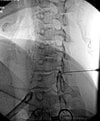
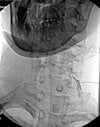
Just asking as question- your posterior to anterior approach makes it point to vert. Was that intent upon?C7 snb 0.3 ml 2% lido

oops, good catch! I use a lazy lateral position for mbb and this.
Just asking as question- your posterior to anterior approach makes it point to vert. Was that intent upon?
