@Cawolf
@mehc012
I believe the "current loop" is a loop that initially has no current but gets a current once it enters the magnetic field (or as Cawolf put it "loop capable of conducting current")
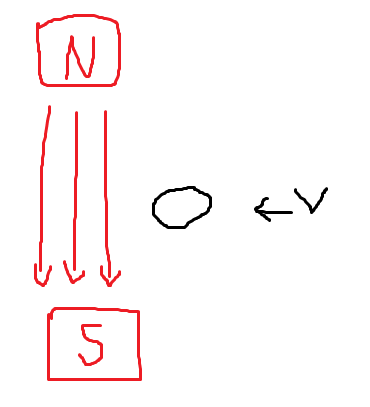
I second mehc012's question (if I understand her question correctly). Where is this force that you (Cawolf) are speaking of? Cawolf, are you that initially when the loop enters the field, it feels a repulsive force (that would push the loop to the RIGHT in this picture). I believe that's what TBR is saying as well but I'm not sure how exactly this "repulsive force" is generated since such a force would be
PARALLEL to the VELOCITY.
Here is the scenario:
The only thing I can think of in terms of a force parallel to the velocity of the loop is very difficult to explain without pictures...
I suppose that, when you initially move the loop in, the magnetic field acts on the
charges inside the loop to generate a current. Thus, the charges begin to move within the conducting material of the loop itself.
Now that there is current, you have a new set of 'moving charges within a magnetic field' to consider: the charges moving in a circle around the loop.
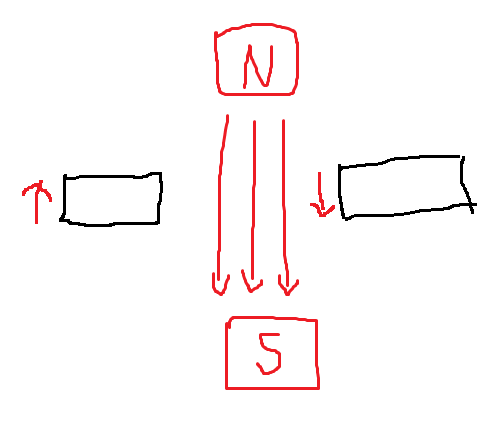
I'll picture a square 'loop' because it's easier. Entering the field you have 2 parallel sides which are also parallel to the original velocity. Any force generated on the current in those sides will be equal in magnitude to each other, yet opposite in direction. Basically, they cancel out.
The other two sides are perpendicular to the velocity of the overall loop...and one is within the magnetic field while the other is still external. The magnetic field will enact a force upon the current moving within the leading edge of that loop...and this force will be perpendicular to the current, and thereby parallel to the velocity of the overall loop.
I know that's a dense word salad, but try drawing a pic, you'll see.
That is the only explanation I can come up with off the top of my head for a force parallel to the velocity of the overall loop - and it would be in opposite directions when the loop enters and leaves the field.