
-
CycleTrack and SDN are teaming up to make medical school admissions more transparent and accessible! Read the announcement to learn how we’re supporting the future of CycleTrack’s free application-tracking tools .
- Home
- Forums
- Physician and Resident Communities (MD / DO)
- Internal Medicine and IM Subspecialties
- Cardiology
You are using an out of date browser. It may not display this or other websites correctly.
You should upgrade or use an alternative browser.
You should upgrade or use an alternative browser.
ECHO Boards 2023

Get help with your application
Use all the free resources available to you from SDN: articles, guides, expert advising, forums discussions, and school research.
WOW 400 views and no reply. Good luck everyone tomorrow. Drop down your experience after the exam!!
Extremely challenging examination that tests truly everything you have or have not learned. Multiple passes of Mayo videos, 2x Klein, brief overview of Pai book (2014 - outdated), wrote the ASE practice tests but not ASE question bank due to time limitations. We have very strong faculty driven echo didactics in fellowship with multiple advanced imagers that teach the general fellowship, and even with all of this, I pray to pass.
Took the exam today and was one of the hardest exams I've ever written, blocks 1 and 2 were killer. Lost momentum and almost ran out of time on the remaining blocks due to the arduous calculations and mental fatigue.
Hopefully the curve / scaling score system works in everyone's favor. Would be interested to hear others thoughts for the 7/18/23 exam.
Took the exam today and was one of the hardest exams I've ever written, blocks 1 and 2 were killer. Lost momentum and almost ran out of time on the remaining blocks due to the arduous calculations and mental fatigue.
Hopefully the curve / scaling score system works in everyone's favor. Would be interested to hear others thoughts for the 7/18/23 exam.
Advertisement - Members don't see this ad
cardio2003
New Member
I also took the recertification Echo boards today. I am a private practice cardiologist. I went through Klein and the 2022 Mayo Clinic videos almost twice over 4 months, mostly in the evenings and on the weekends. I was terrified going into the exam, as I had stumbled over all the 3D echo, ICE, strain, speckle, and other advances since I initially certified in 2003. To my surprise, the actual recertification exam included very little of these advances. There was a huge amount of Hemodynamics and associated calculations. Unfortunately, my math skills are a little rusty and I didn’t finish one of the five sections. I believe that Mayo and Klein are more than adequate but overkill for the recertification exam this year. Just my opinion. Hopefully, this post will alleviate any unnecessary fears for those practicing clinical cardiology.
I took recert today and exam is unrealistic and out of standard echo practice. Am not sure who passing is assessed. Emailed echoboards, that test is poorly made and disappointingExtremely challenging examination that tests truly everything you have or have not learned. Multiple passes of Mayo videos, 2x Klein, brief overview of Pai book (2014 - outdated), wrote the ASE practice tests but not ASE question bank due to time limitations. We have very strong faculty driven echo didactics in fellowship with multiple advanced imagers that teach the general fellowship, and even with all of this, I pray to pass.
Took the exam today and was one of the hardest exams I've ever written, blocks 1 and 2 were killer. Lost momentum and almost ran out of time on the remaining blocks due to the arduous calculations and mental fatigue.
Hopefully the curve / scaling score system works in everyone's favor. Would be interested to hear others thoughts for the 7/18/23 exam.
I took the initial certification exam today. Feeling very defeated. Maybe knew 40-50% of the questions for sure. Hoping the curve is good to us all.
Took initial certifications today:
I guess I feel like most people 🙂 I always score very high on all med exams and was sure I passed but here I honestly feel 50/50 .
Test was hard but doable... I feel like 99% of the question I knew at least what they talking about, might not got them right tho.
After exam I realized at least a few questions that I put a wrong answer.
Basically used all the time per block and almost ran out on one of the blocks. All of them felt equal otherwise. Marked about 5-7 questions per block.
A LOT of calculations, I felt that I had a calculator in my hand most of the time 😉. Physics was very straight forward. Video quality was ok. I think like 1 M mode question and 2 3D questions, few strain questions.
Agree with most people, that Klein is probably the best questions bank, did it at least twice. Mayo videos x2. ASE practice exam (average 70's), ECHO SAP (ok for practice but not as high yield). Did Boardvital also which I think was not bad at all, it was for free so it didn't matter.
Why we need to wait 10-12 weeks its just ridiculous (they give some BS excuse on their website that they need to check the questions for validity or something,,,,,could be done in few weeks. )
I guess I feel like most people 🙂 I always score very high on all med exams and was sure I passed but here I honestly feel 50/50 .
Test was hard but doable... I feel like 99% of the question I knew at least what they talking about, might not got them right tho.
After exam I realized at least a few questions that I put a wrong answer.
Basically used all the time per block and almost ran out on one of the blocks. All of them felt equal otherwise. Marked about 5-7 questions per block.
A LOT of calculations, I felt that I had a calculator in my hand most of the time 😉. Physics was very straight forward. Video quality was ok. I think like 1 M mode question and 2 3D questions, few strain questions.
Agree with most people, that Klein is probably the best questions bank, did it at least twice. Mayo videos x2. ASE practice exam (average 70's), ECHO SAP (ok for practice but not as high yield). Did Boardvital also which I think was not bad at all, it was for free so it didn't matter.
Why we need to wait 10-12 weeks its just ridiculous (they give some BS excuse on their website that they need to check the questions for validity or something,,,,,could be done in few weeks. )

Initial certification. Honestly thought it was a pretty fair test. A lot of calculations using continuity equation / hemodynamics that you had to know cold. Tested a lot of basic echo concepts. Didn't have as much congenital / systemic questions as I expected.
I took the initial certification yesterday.
I studied Klien, EchoSAP, and Mayo. I felt that they only prepared me for about 60% of the exam. There was a question early on with a blatant error in the answer choices which distracted me for the rest of the test. Felt like a lot of time was wasted looking for information (like numbers for calculations).
I'm not certain if the questions were poorly written, I didn't prepare well, or something else. Whatever the reason is- I don't think I did well. Hopefully they are merciful when reviewing the questions.
I studied Klien, EchoSAP, and Mayo. I felt that they only prepared me for about 60% of the exam. There was a question early on with a blatant error in the answer choices which distracted me for the rest of the test. Felt like a lot of time was wasted looking for information (like numbers for calculations).
I'm not certain if the questions were poorly written, I didn't prepare well, or something else. Whatever the reason is- I don't think I did well. Hopefully they are merciful when reviewing the questions.
I lol’ed at your username. I walked in and it was just asians and me (white guy) and I thought oh boy there is going to be no curve on this exam.Initial certification. Honestly thought it was a pretty fair test. A lot of calculations using continuity equation / hemodynamics that you had to know cold. Tested a lot of basic echo concepts. Didn't have as much congenital / systemic questions as I expected.
In all seriousness, exam was quite difficult IMO. First section really hurt my confidence. I should have stuck with the onscreen calculator exclusively because the handheld one they gave me kept dying. I felt time pressure in some sections was too much and I could have gotten certain qs right if I had maybe 5-8 more minutes. Valve calculations required a lot for the time they gave us.
Half of physics I could get from studying other half seemed like it was out of left field.
The wait is just killing it.... and its been 3 days 🤣
numan_ziget
New Member
Tough exam, although the content was fair. ASE wants you to know their guidelines (all of them). Overall prep included ASE videos and Mayo videos (not all of them, and a 2x speed as I started my prep late), ASE practice questions, Klein, Pai (first 6 chapters), Petersen packet for congenital. I was planning to do echosap but I was told it sucks.
-physics: straight forward. I was surprised it was not as esoteric as I thought it would be. Edelman and Klein should be fine. Concepts must be known cold. A few interesting concepts were covered by small Otto.
-hemodynamics: a lot of formulas, again very straight forward. I completely missed one question by not remembering a very famous hemodynamics formula starting with P. Understanding how pericardial disease affects hemodynamics is extremely high yield.
-M-mode: only 2 o 3 M-mode pics. Again, straight forward. I read Feigenbaum paper (I guess same or even more examples are in the actual book) and tried to learn about every possible M-mode finding I found/heard/saw.
-valvular: now things get interesting. I believe the exam content was fair it just required extensive familiarity with multiple/complex valvular disease. I thought every single formula in the ASE guidelines showed up. The valvular regurgitation guidelines in particular were heavily tested. You need to understand what you are calculating: you can memorize the formulas listed in Klein but the exam required a very efficient use of those formulas. I ran out of time by the end of 1st block. All blocks were loaded with same amount of time consuming calculations, maybe blocks 1 and 5 (already fatigued and hungry) were the hardest.
-congenital: my impression is that they tested the “common rare” congenital diseases. Calculations were straight forward, 2DE images were to the point, and there were quite a few questions on epidemiology of these diseases. Last 2 chapters on Klein are golden, and so is Petersen.
-stress testing: people told me the stress testing images had been crystal clear in the exam in the past. I think I took a different exam then. A good 8-10 questions on stress testing, either you can see the affected territory, or you need the additional clinical information provided to decide on it. Only practice in the echo lab can prepare you well for this part of the test.
-miscellaneous findings: common cardiomyopathies and other findings were tested but I felt all of them came with a twist. They will not show the common views of an uncommon (but known by everybody) condition, they will show it in a view that needs basic understanding of the pathophysiology. I think I spent up to 5 minutes on a single question that I was able to answer after realizing what finding they were trying to hide, but sacrificed time for calculations. Again, the more time in the echo lab, the better. The echo atlas by McGraw Hill did a very nice job.
-physics: straight forward. I was surprised it was not as esoteric as I thought it would be. Edelman and Klein should be fine. Concepts must be known cold. A few interesting concepts were covered by small Otto.
-hemodynamics: a lot of formulas, again very straight forward. I completely missed one question by not remembering a very famous hemodynamics formula starting with P. Understanding how pericardial disease affects hemodynamics is extremely high yield.
-M-mode: only 2 o 3 M-mode pics. Again, straight forward. I read Feigenbaum paper (I guess same or even more examples are in the actual book) and tried to learn about every possible M-mode finding I found/heard/saw.
-valvular: now things get interesting. I believe the exam content was fair it just required extensive familiarity with multiple/complex valvular disease. I thought every single formula in the ASE guidelines showed up. The valvular regurgitation guidelines in particular were heavily tested. You need to understand what you are calculating: you can memorize the formulas listed in Klein but the exam required a very efficient use of those formulas. I ran out of time by the end of 1st block. All blocks were loaded with same amount of time consuming calculations, maybe blocks 1 and 5 (already fatigued and hungry) were the hardest.
-congenital: my impression is that they tested the “common rare” congenital diseases. Calculations were straight forward, 2DE images were to the point, and there were quite a few questions on epidemiology of these diseases. Last 2 chapters on Klein are golden, and so is Petersen.
-stress testing: people told me the stress testing images had been crystal clear in the exam in the past. I think I took a different exam then. A good 8-10 questions on stress testing, either you can see the affected territory, or you need the additional clinical information provided to decide on it. Only practice in the echo lab can prepare you well for this part of the test.
-miscellaneous findings: common cardiomyopathies and other findings were tested but I felt all of them came with a twist. They will not show the common views of an uncommon (but known by everybody) condition, they will show it in a view that needs basic understanding of the pathophysiology. I think I spent up to 5 minutes on a single question that I was able to answer after realizing what finding they were trying to hide, but sacrificed time for calculations. Again, the more time in the echo lab, the better. The echo atlas by McGraw Hill did a very nice job.
Anyone knows if there is any "tricks" to see if you passed earlier like it was with STEP 3 exam?
Not that I know ofAnyone knows if there is any "tricks" to see if you passed earlier like it was with STEP 3 exam?
Advertisement - Members don't see this ad
This wait is definitely killing me.
It def is. We got 4 more weeks to wait tho 😵
Worse is I feel like I failed (like everyone else) and put at least 5-10 wrong answers that I walked out I was like WTF did I do that, I knew the right answer 🤓😡
Worse is I feel like I failed (like everyone else) and put at least 5-10 wrong answers that I walked out I was like WTF did I do that, I knew the right answer 🤓😡
I did the same thing. I think we all feel this way and just have to trust in the process.It def is. We got 4 more weeks to wait tho 😵
Worse is I feel like I failed (like everyone else) and put at least 5-10 wrong answers that I walked out I was like WTF did I do that, I knew the right answer 🤓😡
I feel like of all the boards I sat for, I put in the maximum effort to prepare for this test and on test day I felt least prepared for it. Toughest exam I have faced to date. Probably knew about a third of the questions for sure (ironically these were mostly the math questions despite having rusty math skills and the straightforward echo anatomy/valvular disease ones). Rest was me narrowing down the options by elimination and picking best guess and/or total lack of familiarity with the topic being asked and making a random guess. Adding to this, I ran out of time on the first two blocks and missed questions. When I was leaving the test center, I felt dazed. Really have low hope for this one.
PS: I don't even want to comment on the quality of the images provided!
PS: I don't even want to comment on the quality of the images provided!
Do we typically find out on the 8th week or the 10th week after the test?
On the NBE website it states testamur next to ASCE. Just wondering if everyone else’s says that?
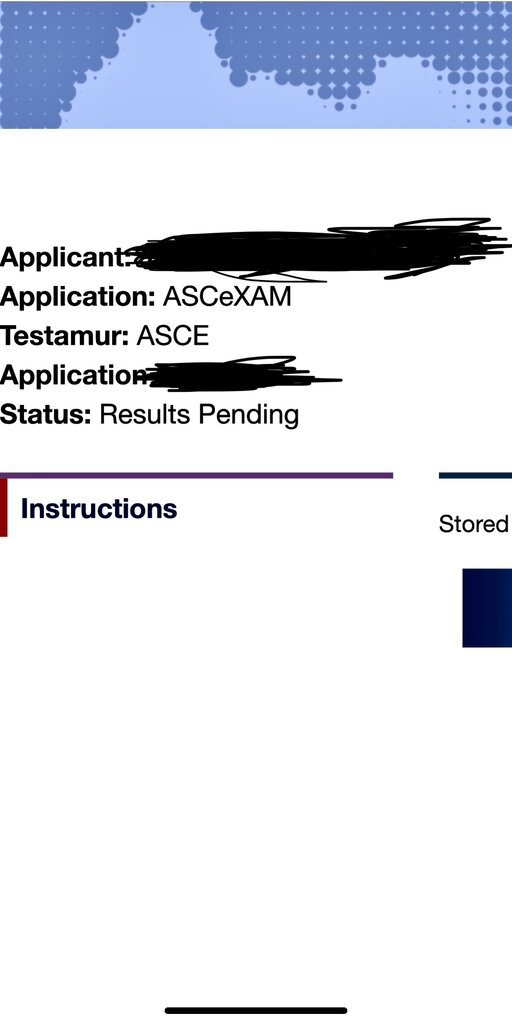
I honestly never checked before now.
Yeah I had it since August I think. Stored Doc: EXAM_RESULTS_PENDING_INST
Hopefully next week we can get it
Hopefully next week we can get it
It says exam results pendingwhen someon click next button on above page( result pending), what comes up for you guys?
Is the general consensus that results should be released this week or will it be the week after? I haven’t been able to fully relax after this exam because of the uncertainty on if I passed or not. Worked my absolute butt off for this test more than any other in my medical career.It says exam results pending
I don’t think anyone knowsIs the general consensus that results should be released this week or will it be the week after? I haven’t been able to fully relax after this exam because of the uncertainty on if I passed or not. Worked my absolute butt off for this test more than any other in my medical career.
Advertisement - Members don't see this ad
😔 how confident do you feel about it in comparison to how much your prepared for the exam?I don’t think anyone knows
I feel terrible about it as do most people.😔 how confident do you feel about it in comparison to how much your prepared for the exam?
Compared to other years, it seems we took it at least a week early so hopefully this week we will know something.Not sure when its out , some years ot came sept 19 or by end of september
yeah lets go....this week for sure 😵👽.
I feel still crappy and think I will fail though👎
I feel still crappy and think I will fail though👎
is there a time comes out? Or its random ?
No clueis there a time comes out? Or its random ?
We are about to be 9 weeks out. I was hoping it would be this week.I think we now more than 8 weeks out of test date
From talking to previous fellows it was in the morningis there a time comes out? Or it’s random ?
Last year it was around 2:30ish I remember from the senior fellows.From talking to previous fellows it was in the morning
Advertisement - Members don't see this ad
Mine came in last year on 9/26 at 11am CST (exam was on 7/26)
Thank you for replying. Hope you got good news. Sounds like we’ll maybe be waiting another week atleastMine came in last year on 9/26 at 11am CST (exam was on 7/26)
Hopefully. We'll see.Monday should be the day everyone, fingers crossed

