

Advertisement - Members don't see this ad
Just need clarification on this please:
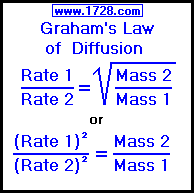
So I remember Graham's Law as this:
What is the speed of a gas particle at 125° C, if it has a speed of 100 m/s at 25° C?
A. 500 m/s
B. 223 m/s
C. 133 m/s
D. 114 m/s
-----------------------------------------------------
D) 114 m/s
The speed is greater at higher temperatures. This doesn't help, because all of the answer choices are greater than 100 m/s. To determine the exact value, the temperature must be converted to kelvins. The temperature increase is from 298 to 398, which means the temperature is 1.33 times greater. Because it is a square root function, the speeds increases by a factor of √(1.33), which when multiplied by 100 m/s yields a value less than 133 m/s.
V2/V1 = √(T2/T1)
----------------------------------------------
Why in this example does TBR say that the rate law is: V2/V1 = √(T2/T1)??
So I remember Graham's Law as this:
What is the speed of a gas particle at 125° C, if it has a speed of 100 m/s at 25° C?
A. 500 m/s
B. 223 m/s
C. 133 m/s
D. 114 m/s
-----------------------------------------------------
D) 114 m/s
The speed is greater at higher temperatures. This doesn't help, because all of the answer choices are greater than 100 m/s. To determine the exact value, the temperature must be converted to kelvins. The temperature increase is from 298 to 398, which means the temperature is 1.33 times greater. Because it is a square root function, the speeds increases by a factor of √(1.33), which when multiplied by 100 m/s yields a value less than 133 m/s.
V2/V1 = √(T2/T1)
----------------------------------------------
Why in this example does TBR say that the rate law is: V2/V1 = √(T2/T1)??


