Impulse graph

Started by Halcyon32
This forum made possible through the generous support of SDN members, donors, and sponsors. Thank you.

Halcyon32

Full Member
7+ Year Member
Advertisement - Members don't see this ad
View attachment 195925
upload_2015-9-6_22-11-13.png

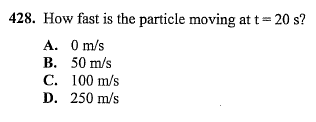
Can you guys explain this for me? Answer is D and the only explanation is the formula Ft=m delta v but how do we figure out what delta v is?
 

Attachments

  • upload_2015-9-6_22-11-10.png
    upload_2015-9-6_22-11-10.png
    6.3 KB · Views: 138
My approach on this is that F = ma = m(deltaV)/t, so F(t) = m(deltaV). That's how they came up with that formula.

From Force of 0->5 and time of 10, solving for deltaV = 250 m/s. Because the graph is congruent, going from F of 5->0 at time of 20 meant delvaV's magnitude must be 250 m/s also.
 
Advertisement - Members don't see this ad
Impulse = change in momentum = J = F(deltaT) = deltaP

Finding J(impulse) means finding area under the triangle from 0-20 seconds so F = J/(deltaT).

Half the triangle = 1/2 (10 x 5) = 25. 25 x 2 = 50, the area of the triangle from 0-20 seconds. 50/20 seconds = 2.5 N
