LR better than NS? Probably

This forum made possible through the generous support of SDN members, donors, and sponsors. Thank you.

BLADEMDA

Full Member
Lifetime Donor
15+ Year Member
Joined
Apr 22, 2007
Messages
22,829
Reaction score
9,888
Normal Saline Is Not Normal, May Be Harmful


By James E. Barone MD
NEW YORK (Reuters Health) Jun 04 - In a study from England published ahead of print in Annals of Surgery, healthy volunteers given two liters of so-called "normal" saline intravenously showed signs of decreased kidney perfusion and increased fluid retention compared to infusion of a balanced salt solution. The work builds on previous research suggesting that normal saline, in use intravenously for over 100 years, is not "normal" and may not be the best fluid to use, especially in patients who are susceptible to renal dysfunction.
In an email to Reuters Health, lead author Dr. Dileep N. Lobo of the University of Nottingham said, "Had normal saline been formulated in recent times, it is debatable whether it would have survived a phase 1 trial."
Dr. Lobo's group carried out a randomized, double-blind cross-over trial involving 12 healthy male volunteers who were given two-liter infusions over one hour of either "normal" 0.9% saline or the balanced salt solution Plasma Lyte-148, several days apart. Plasma Lyte-148 contains sodium and chloride in physiologic amounts, compared to the higher amounts of those two ions found in normal saline.
During the four hours following the infusions, subjects underwent sequential blood and urine tests as well as magnetic resonance imaging (MRI) of their kidneys.
The main results: when the men received normal saline, they retained significantly more fluid in the extravascular space (1,484 vs 1,155 mL; p=0.031) and gained more weight (1.2 vs 0.84 kg, p=0.22). With the balanced solution, they produced significantly higher urine volumes and had a significantly shorter time to first voiding.
Furthermore, in the normal saline trials, serum chloride was significantly higher from the first hour on (p=0.0001), and a low strong ion difference indicated acidemia (p=0.025).
MRI showed that normal saline significantly decreased renal artery flow velocity (p=0.045) and renal cortical tissue perfusion (p=0.008) compared to the balanced solution - differences that could matter in patients with kidney disease.
The authors point out that some 200 million liters of normal saline are used in the U.S. every year. The paper doesn't address the issue of costs, but Dr. Lobo said, "Plasma-Lyte 148 is more expensive but this is likely to be because it is not widely used. Just because a product is more expensive does not mean that it should not be used in the clinical setting."
Dr. Lobo pointed out that a paper this year by Shaw et al, also in Annals of Surgery, showed that complications and resource use are less with Plasma-Lyte than with 0.9% saline.
Another inexpensive option, lactated Ringer's solution, has nearly normal amounts of sodium and chloride. Dr. Lobo said, "It is likely that similar results could be achieved with Ringer's lactate, however, we chose Plasma-Lyte 148 as it has a chloride content in the normal physiological range."
Dr. Laurence Weinberg of the Department of Anesthesia, Austin Hospital and Senior Fellow, Department of Surgery, University of Melbourne was not a contributor to the study. Regarding lactated Ringer's, he said, "It contains lactate. In shock conditions if lactate cannot be metabolized by the liver, it will be unable to be converted to bicarbonate. This can also result in elevated lactate levels which, if being used as a marker of effective resuscitation, can lead to misinterpretation of the cause of the hyperlactatemia."
According to Dr. Lobo, "It is clear that many patients continue to receive large quantities of intravenous fluid especially in the perioperative period. We suggest that large quantities of saline may not be beneficial for those with pre-existing renal disease or those at risk of developing renal impairment."
Dr. Lobo thinks that normal saline is not appropriate for use for resuscitation or in the operating room. He said, "There is an increasing body of evidence to suggest that saline may lead to harmful effects. This study, building on evidence first obtained in animal studies, suggests that hyperchloremia associated with saline infusion may have an unfavorable effect on renal perfusion."
Dr. Weinberg said, "For many operations we only use 1000 mL of fluid. Choice of fluid for these cases is less important. However there is now overwhelming evidence that a balanced solution is better than an unbalanced and given that the costs of normal saline and Ringer's lactate are the same I would advocate Ringer's lactate as a preference."
When massive amounts of fluid are needed, however, Dr. Weinberg would advocate Plasma-Lyte 148 over both normal saline and lactated Ringer's solution. He added, "Many critically ill patients do require significant fluid/volume intervention as part of their care; the type and correct amount of fluid patients receive is paramount. The study by Lobo now gives us information that is clinically important, and I am certain that we will see many more studies examining the clinical effects of different fluid solutions."
Dr. Lobo and one other member of his group have received financial support from Baxter Healthcare, maker of Plasma-Lyte 148. Baxter Healthcare also supported the study but did not participate in its conduct or analysis.
Dr. Weinberg's department has received funding from Baxter Healthcare, which has no input or oversight of its research.

Ann Surg 2012.
 
yeah n=12 with each person as their own control 👎

i would have also liked to see them fast these patients (and maybe even bleed them). we know that a lot of fluid replacement is replacing the extravascular space, so in that setting, saline may actually be beneficial?

also

Dr. Lobo and one other member of his group have received financial support from Baxter Healthcare, maker of Plasma-Lyte 148.
 
+1. For plasma lyte


Back when I was in training our trauma hospital had gotten rid of all of the NS and LR in the OR, all plasmalyte.


On the iPhone

No Normal Saline? No Lactated Ringers? Really? None in the building? Did you give the plasmalyte with PRBCs? You wouldn't give a 1 liter of LR to an ASA 1 patient having a finger I/D? I mean the NNT to make a difference on that has to approach a billion.
 
Did you give the plasmalyte with PRBCs?.

What's your issue with P-lyte with RBCs?

I think Plasmalyte is a superior fluid, but if volumes given are small, I doubt it matters much.

Anytime I'm giving a lot of fluid, it's always Plasmalyte.

I hadn't considered anything before regarding chloride content and renal perfusion- interesting. I'll have to look further into that.
 
What's the big deal? Just avoid giving a lot of NS to your ASA 3 and 4 patients especially those with pre-existing renal dysfunction/disease. I'll use LR and othes can hang plasmalyte.

This small study just adds to the evidence that large amounts of NS is probably not the best choice considering we have LR readily available.
 
Anyone know the cost of a liter of Plasmalyte is vs. LR vs. NS?
 
Anesth Analg. 2008 Jul;107(1):264-9.
The effect of different crystalloid solutions on acid-base balance and early kidney function after kidney transplantation.

Hadimioglu N, Saadawy I, Saglam T, Ertug Z, Dinckan A.
Source

Department of Anesthesiology, Faculty of Medicine, Akdeniz University, Antalya, Turkey. [email protected]

Abstract

BACKGROUND:

This study aimed to quantify changes in acid-base balance, potassium and lactate levels as a function of administration of different crystalloid solutions during kidney transplantation, and to determine the ideal fluid for such patients.
METHODS:

In this double-blind study, patients were randomized to three groups (n = 30 each) to receive either normal saline, lactated Ringer's, or Plasmalyte, all at 20-30 mL x kg(-1) x h(-1). Arterial blood analyses were performed before induction of anesthesia, and at 30-min intervals during surgery, and total IV fluids recorded. Urine volume, serum creatinine and BUN, and creatinine clearance were recorded on postoperative days 1, 2, 3, and 7.
RESULTS:

There was a statistically significant decrease in pH (7.44 +/- 0.50 vs 7.36 +/- 0.05), base excess (0.4 +/- 3.1 vs -4.3 +/- 2.1), and a significant increase in serum chloride (104 +/- 2 vs 125 +/- 3 mM/L) in patients receiving saline during surgery. Lactate levels increased significantly in patients who received Ringer's lactate (0.48 +/- 0.29 vs 1.95 +/- 0.48). No significant changes in acid-base measures or lactate levels occurred in patients who received Plasmalyte. Potassium levels were not significantly changed in any group.
CONCLUSIONS:

All three crystalloid solutions can be safely used during uncomplicated, short-duration renal transplants; however, the best metabolic profile is maintained in patients who receive Plasmalyte.
 
Clinics (Sao Paulo). 2011;66(11):1969-74.
Impact of Plasma-Lyte pH 7.4 on acid-base status and hemodynamics in a model of controlled hemorrhagic shock.

Noritomi DT, Pereira AJ, Bugano DD, Rehder PS, Silva E.
Source

Intensive Care Unit, Hospital Israelita Albert Einstein, São Paulo, SP, Brazil.

Abstract

OBJECTIVE:

Intravenous infusion of crystalloid solutions is a cornerstone of the treatment of hemorrhagic shock. However, crystalloid solutions can have variable metabolic acid-base effects, perpetuating or even aggravating shock-induced metabolic acidosis. The aim of this study was to compare, in a controlled volume-driven porcine model of hemorrhagic shock, the effects of three different crystalloid solutions on the hemodynamics and acid-base balance.
METHODS:

Controlled hemorrhagic shock (40% of the total blood volume was removed) was induced in 18 animals, which were then treated with normal saline (0.9% NaCl), Lactated Ringer's Solution or Plasma-Lyte pH 7.4, in a blinded fashion (n = 6 for each group). Using a predefined protocol, the animals received three times the volume of blood removed.
RESULTS:

The three different crystalloid infusions were equally capable of reversing the hemorrhage-induced low cardiac output and anuria. The Lactated Ringer's Solution and Plasma-Lyte pH 7.4 infusions resulted in an increased standard base excess and a decreased serum chloride level, whereas treatment with normal saline resulted in a decreased standard base excess and an increased serum chloride level. The Plasma-Lyte pH 7.4 infusions did not change the level of the unmeasured anions.
CONCLUSION:

Although the three tested crystalloid solutions were equally able to attenuate the hemodynamic and tissue perfusion disturbances, only the normal saline induced hyperchloremia and metabolic acidosis.
 
There was an RCT of NS vs LR for kidney transplants.. They found greater incidence of hyperkalemia in the NS arm, due to the hyperchloremic metabolic acidosis caused by NS.
 
Anesth Analg. 2005 May;100(5):1518-24, table of contents.
A randomized, double-blind comparison of lactated Ringer's solution and 0.9% NaCl during renal transplantation.
O'Malley CM, Frumento RJ, Hardy MA, Benvenisty AI, Brentjens TE, Mercer JS, Bennett-Guerrero E.
Source
Department of Anesthesia, Columbia University College of Physicians and Surgeons, New York, NY, USA. [email protected]
Abstract
Normal saline (NS; 0.9% NaCl) is administered during kidney transplantation to avoid the risk of hyperkalemia associated with potassium-containing fluids. Recent evidence suggests that NS may be associated with adverse effects that are not seen with balanced-salt fluids, e.g., lactated Ringer's solution (LR). We hypothesized that NS is detrimental to renal function in kidney transplant recipients. Adults undergoing kidney transplantation were enrolled in a prospective, randomized, double-blind clinical trial of NS versus LR for intraoperative IV fluid therapy. The primary outcome measure was creatinine concentration on postoperative Day 3. The study was terminated for safety reasons after interim analysis of data from 51 patients. Forty-eight patients underwent living donor kidney transplants, and three patients underwent cadaveric donor transplants. Twenty-six patients received NS, and 25 patients received LR. There was no difference between groups in the primary outcome measure. Five (19%) patients in the NS group versus zero (0%) patients in the LR group had potassium concentrations >6 mEq/L and were treated for hyperkalemia (P = 0.05). Eight (31%) patients in the NS group versus zero (0%) patients in the LR group were treated for metabolic acidosis (P = 0.004). NS did not adversely affect renal function. LR was associated with less hyperkalemia and acidosis compared with NS. LR may be a safe choice for IV fluid therapy in patients undergoing kidney transplantation.
 
What's your issue with P-lyte with RBCs?

I think Plasmalyte is a superior fluid, but if volumes given are small, I doubt it matters much.

Anytime I'm giving a lot of fluid, it's always Plasmalyte.

I hadn't considered anything before regarding chloride content and renal perfusion- interesting. I'll have to look further into that.


Calcium. Somewhat theoretical risk along the lines of why textbooks say you shouldn't mix LR with PRBCs, but what's the point? Plasmalyte costs a lot more than NS or LR so it's stupid to not have those available to you as well.
 
Calcium. Somewhat theoretical risk along the lines of why textbooks say you shouldn't mix LR with PRBCs, but what's the point? Plasmalyte costs a lot more than NS or LR so it's stupid to not have those available to you as well.

Plasma lyte is a family of fluids, most of which do not contain calcium, although there are a few which have calcium concentrations similar to LR. The common solutions are calcium free.

If I recall correctly it is about $1.75 for PlasmaLyte when bought in bulk on contract and about $0.75 for NS or LR.

I see PlasmaLyte online for $85 per case of 14 ($6.07 per liter) and NS for ~$2.00 per liter so probably in the 2-3x more expensive range.

Of course this is the cost. I have no idea what the patient charge is.

- pod

A little more, but in the grand scheme of things completely inconsequential even when used in large quantities.


In terms of the calcium/ LR with transfusion question, I will repost this.

...(For those of you who don't want to read the whole thing, the evidence suggests that LR and PRBCs are compatible as long as the ratio of LR to PRBCs does not exceed 1:1. A safety margin of 1:2 is probably a good idea)


In 1975, Ryden and Oberman published the first data on the Compatibility of Common Intravenous Solutions with CPD Blood. Working with CPD preserved whole blood, they demonstrated grossly visible clot formation in vitro in samples of LR and whole blood at a citrate: calcium ratio of 4:1 or lower when incubated for 5 minutes. Largely based on these findings, AABB incorporated the prohibition against the combination of LR and blood components when they developed their guidelines.

Then, in 1991, Cull and Lally looked at the Compatibility of (CPD preserved) packed erythrocytes and Ringer's lactate solution.. They examined a variety of ratios of CPD PRBCs: LR from 5:1 to 1:20. Clotting was observed in the 1:1 dilution, but not in the 2:1 or 5:1 dilutions at up to two hours. Units of PRBCs diluted with LR and passed through a 170 micron filter were compared to PRBCs similarly diluted with NS. No difference in flow rate was found.

In 1998, Lorenzo et al advised that blood bank guidelines be revised to allow the use of LR in the rapid transfusion of PRBCs when they assessed infusion time, filter weight, and clot formation after admixing whole blood and PRBCs with NS, LR, and LR with increasing concentrations of added calcium chloride from 1g to 5g. They found no differences except for the presence of visible clot in the LR + 5g calcium chloride mixture.

In 2009, Albert et al found that Ringer's lactate is compatible with the rapid infusion of AS-3 preserved packed red blood cells. when they used ELISA to compare prothrombin activation fragment 1 + 2 (the breakdown products of thrombin generation) levels in units of PRBCs similarly diluted in NS and LR then run through filters and fluid warmers (to simulate intraoperative transfusion practices) and found the levels of F1+2 to be sub-physiologic.

Then last year, Levac et al demonstrated that Ringer's lactate is compatible with saline-adenine-glucose-mannitol preserved packed red blood cells for rapid transfusion.. "Samples from 12 units of SAGM-PRBC were diluted from 0-97.5% with RL and normal saline (NS), incubated for 30 min, and passed through 40 μm filters." F1+2 levels were measured via ELISA. 8 samples were diluted with LR and incubated for 30 to 240 min and analyzed in a similar manner. At 120 minutes and up, some clotting was observed, but there was no clotting at 60 minutes. They concluded that LR/ PRBC co-administration is safe as long as cells are administered over 60 minutes or less.


Though generally resulting in benign hemoglobinemia and hemoglobinuria, there are case reports of serious sequelae from acute non-immune hemolytic transfusion reaction (pseudo-hemolytic transfusion reaction) including renal failure and hypotension. However, lysis of cells was never the concern with LR. It is an accurate concern if red blood cells are diluted/ co-administered in hypotonic solutions like D5W which should never be done.


To my knowledge, there are no papers refuting the safety of PRBC/LR co-administration with modern anticoagulant techniques. If you know of any, please share.

I am not aware of any study of the effect of LR other factors, although platelet activation might occur. That would be an interesting thing to look at.

Personally, I still make a good-faith effort to dilute/ transfuse with NS because the guidelines exist and have not been update to reflect the data (the number one problem with guidelines IMHO). However, I don't go out of my way if there is LR hanging and I need to give products rapidly. I do always run platelets through their own line so the latter is essentially a null issue to me.

- pod
 
I use LR exclusively although I don't bother arguing when my nurse brings my patient with NS hanging or changes out my LR for NS when I drop the patient off in PACU. Not worth the hassle. I would use Plasma lyte if we had it.

- pod
 
No Normal Saline? No Lactated Ringers? Really? None in the building? Did you give the plasmalyte with PRBCs? You wouldn't give a 1 liter of LR to an ASA 1 patient having a finger I/D? I mean the NNT to make a difference on that has to approach a billion.

I just said the OR. The rest of the hospital had lots NS and LR, including pre-op holding and PACU. Floor patients and morning admits pre-op holding usually had LR hanging.

Some of my colleagues now are huge NS fans. I still haven't gotten a straight answer on their rational.
 
Its interesting how regional fluid choice is...
When I work or do clinicals at hospitals in South Dakota, 99% of what I see is NS (n=4) compared to Iowa where 99% of what I see is LR (n=2). I guess Iowa had it right all along.
 
Finally, the LR/NS debate resolved by a N=12, healthy volunteer, crossover study.

Thank you, Blade, for this nuanced discussion and the citations that followed. I will renew my subscription to Clinics (Sao Paulo) immediately.
 
In a study from England published ahead of print in Annals of Surgery, healthy volunteers given two liters of so-called "normal" saline intravenously showed signs of decreased kidney perfusion

Chloride regulates kidney perfusion so it's not a new finding i doubt the clinical significance of this.
 
I believe LR is almost always the crystalloid of choice.

As for calcium and blood transfusion, I'll generally prime the line for massive transfusion with NS, but don't lose any sweat if there happens to be LR in line.
 
So question for blade. Is Normosol-r the same as plasmalyte?

So if you get a renal patient for a fistula, or you gonna use LR, plasmalyte, or normal saline. The normal saline doesn't have potassium in it.

By the way, great topic.
 
Is Normosol-r the same as plasmalyte?


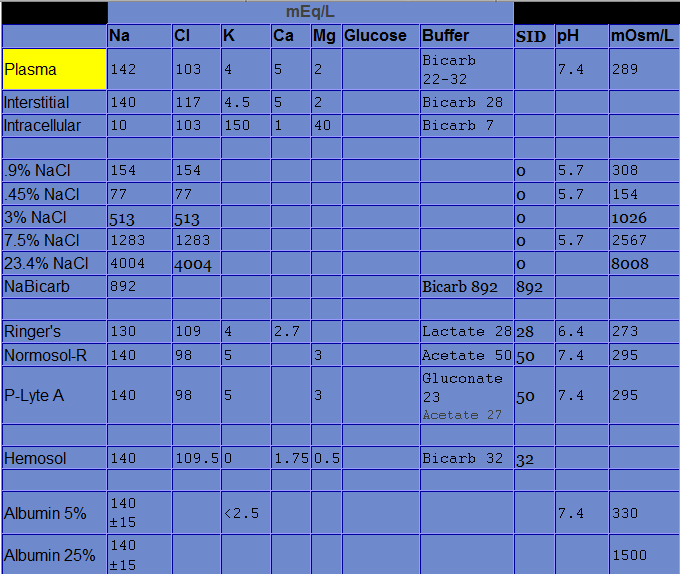
Normosol-r has the same electrolyte composition as Plamalyte A and Plasmalyte 148. It's pH of 6.6 lies between Plasmalyte A (pH 7.4) and Plasmalyte 148 (pH 5.5)


So if you get a renal patient for a fistula, or you gonna use LR, plasmalyte, or normal saline. The normal saline doesn't have potassium in it.

Based largely on the data from the study quoted by PMPMD earlier in this thread, I went to using LR for all procedures on patients with renal failure.

Anesth Analg. 2005 May;100(5):1518-24

A randomized, double-blind comparison of lactated Ringer's solution and 0.9% NaCl during renal transplantation.

O'Malley CM, Frumento RJ, Hardy MA, Benvenisty AI, Brentjens TE, Mercer JS, Bennett-Guerrero E.


Abstract

Normal saline (NS; 0.9% NaCl) is administered during kidney transplantation to avoid the risk of hyperkalemia associated with potassium-containing fluids. Recent evidence suggests that NS may be associated with adverse effects that are not seen with balanced-salt fluids, e.g., lactated Ringer's solution (LR). We hypothesized that NS is detrimental to renal function in kidney transplant recipients. Adults undergoing kidney transplantation were enrolled in a prospective, randomized, double-blind clinical trial of NS versus LR for intraoperative IV fluid therapy. The primary outcome measure was creatinine concentration on postoperative Day 3. The study was terminated for safety reasons after interim analysis of data from 51 patients. Forty-eight patients underwent living donor kidney transplants, and three patients underwent cadaveric donor transplants. Twenty-six patients received NS, and 25 patients received LR. There was no difference between groups in the primary outcome measure. Five (19%) patients in the NS group versus zero (0%) patients in the LR group had potassium concentrations >6 mEq/L and were treated for hyperkalemia (P = 0.05). Eight (31%) patients in the NS group versus zero (0%) patients in the LR group were treated for metabolic acidosis (P = 0.004). NS did not adversely affect renal function. LR was associated with less hyperkalemia and acidosis compared with NS. LR may be a safe choice for IV fluid therapy in patients undergoing kidney transplantation.


- pod
 
Last edited:


Normosol-R is Sodium 140 mEq; chloride 98 mEq; potassium 5 mEq; calcium 0mEq; magnesium 3 mEq; lactate 0mEq; acetate 27 mEq; gluconate 23 mEq; dex 0%; pH 6.6; Osm 294.

We use it in the cardiac room, but I believe it is 3 bucks a bag or so which makes it twice as expensive as plasmalyte and 4 times the cost of LR. Completely insignificant portion of the overall cost of the case. I can check with our pharmacy on actual pricing if anyone cares.

- pod
 
Last edited:
Finally, the LR/NS debate resolved by a N=12, healthy volunteer, crossover study.

Thank you, Blade, for this nuanced discussion and the citations that followed. I will renew my subscription to Clinics (Sao Paulo) immediately.


496_penisenvy.jpg
 
In our study, patients receiving lactated Ringer's showed a significant, progressive increase in lactate levels. Lactate is rapidly metabolized to CO2 and water, which may lead to metabolic alkalosis, despite the fact that the pH of lactated Ringer's is 6.5. The conversion of lactate to glucose may impair glucose control in diabetics. Diabetes is a common underlying problem with renal transplant patients and lactated Ringer's should probably be avoided in patients taking metformin in whom lactate metabolism may be impaired.23
An ideal crystalloid resuscitation solution would resemble the electrolyte content of plasma. Lactated Ringer's is moderately hypo-osmolar, while 0.9% saline may have substantial adverse effects due to the chloride load. By contrast, Plasmalyte is a balanced salt solution having similar electrolyte constitution to that of plasma and is not associated with the same disturbance of the acid-base status caused by sodium chloride-based fluids.11,24 This could be explained by the presence of weak acids, such as lactic acid, acetic acid, and gluconic acid. At pH 7.4 these acids are almost entirely in the base anion forms: lactate, acetate, and gluconate. Acetate and gluconate act as bicarbonate precursors, the conversion occurring predominantly in the liver, although acetate may be converted to bicarbonate in other tissues resulting in less acidosis.25 Furthermore, the lower chloride content of Plasmalyte tends to attenuate the reduction in the strong ion difference compared with saline infusion.26,27
 
But, is plasmalyte better than LR in trauma? The verdict is still out on that one


http://www.ncbi.nlm.nih.gov/pubmed/3080602

we are moving away from crystalloid resuscitation as a whole in trauma, so that question is probably not to be answered. also, that study is from 1986 and absolutely cannot correlate to human exsanguination.
 
we are moving away from crystalloid resuscitation as a whole in trauma, so that question is probably not to be answered. also, that study is from 1986 and absolutely cannot correlate to human exsanguination.

An anesthetist at my hospital who's been doing nights for 25 years (basically only trauma) never uses crystalloid, it's all about replacing the blood pouring out of that gsw to the chest.
 
[/b]

🙄

its not unreasonable for bad trauma. we know that large volume crystalloid resuscitation is not good in trauma, they are losing blood (not insensible evaporative losses) and so generally its blood and blood products rather than clear fluids.
 
[FONT=Arial,Bold][FONT=Arial,Bold]RECOMMENDATIONS
.
.
[FONT=Arial,Bold][FONT=Arial,Bold]..


[FONT=Arial,Bold][FONT=Arial,Bold]Level 1..
[FONT=Arial,Bold][FONT=Arial,Bold]..[FONT=Arial,Bold][FONT=Arial,Bold]..
��

[FONT=Arial,Bold][FONT=Arial,Bold]Despite equivalent efficacy, crystalloids are the resuscitation fluids of choice given the..
[FONT=Arial,Bold][FONT=Arial,Bold]
lack of survival benefit and increased cost associated with albumin.
.
.
[FONT=Arial,Bold][FONT=Arial,Bold]..
��

[FONT=Arial,Bold][FONT=Arial,Bold]Albumin is contraindicated in the initial resuscitation of the traumatically injured...
[FONT=Arial,Bold][FONT=Arial,Bold]..[FONT=Arial,Bold][FONT=Arial,Bold]..
��

[FONT=Arial,Bold][FONT=Arial,Bold]Albumin should be avoided in patients with severe traumatic brain injury (Glasgow..
[FONT=Arial,Bold][FONT=Arial,Bold]
Coma Score (GCS)
.
.[FONT=Arial,Bold][FONT=Arial,Bold]≤ ..[FONT=Arial,Bold][FONT=Arial,Bold]8)...
[FONT=Arial,Bold][FONT=Arial,Bold]..
[FONT=Arial,Bold][FONT=Arial,Bold]..


[FONT=Arial,Bold][FONT=Arial,Bold]Level 2..
[FONT=Arial,Bold][FONT=Arial,Bold]..[FONT=Arial,Bold][FONT=Arial,Bold]..
��

[FONT=Arial,Bold][FONT=Arial,Bold]Non-protein colloids are preferred over albumin based on economic considerations...
[FONT=Arial,Bold][FONT=Arial,Bold]..[FONT=Arial,Bold][FONT=Arial,Bold]..


[FONT=Arial,Bold][FONT=Arial,Bold]Level 3..
[FONT=Arial,Bold][FONT=Arial,Bold]..[FONT=Arial,Bold][FONT=Arial,Bold]..
��

[FONT=Arial,Bold][FONT=Arial,Bold]Colloids may have a secondary role in patients unresponsive to crystalloids or those..
[FONT=Arial,Bold][FONT=Arial,Bold]
who cannot tolerate large-volume crystalloid resuscitation.
.
.
[FONT=Arial,Bold][FONT=Arial,Bold]..
 
Anesth Analg. 2011 Jan;112(1):156-64. Epub 2010 Dec 2.
The efficacy and safety of colloid resuscitation in the critically ill.

Hartog CS, Bauer M, Reinhart K.
Source

Department of Anesthesiology and Intensive Care Medicine, Friedrich-Schiller-University, Jena, Germany.

Abstract

Despite evidence from clinical studies and meta-analyses that resuscitation with colloids or crystalloids is equally effective in critically ill patients, and despite reports from high-quality clinical trials and meta-analyses regarding nephrotoxic effects, increased risk of bleeding, and a trend toward higher mortality in these patients after the use of hydroxyethyl starch (HES) solutions, colloids remain popular and the use of HES solutions is increasing worldwide. We investigated the major rationales for colloid use, namely that colloids are more effective plasma expanders than crystalloids, that synthetic colloids are as safe as albumin, that HES solutions have the best risk/benefit profile among the synthetic colloids, and that the third-generation HES 130/0.4 has fewer adverse effects than older starches. Evidence from clinical studies shows that comparable resuscitation is achieved with considerably less crystalloid volumes than frequently suggested, namely, <2-fold the volume of colloids. Albumin is safe in intensive care unit patients except in patients with closed head injury. All synthetic colloids, namely, dextran, gelatin, and HES have dose-related side effects, which are coagulopathy, renal failure, and tissue storage. In patients with severe sepsis, higher doses of HES may be associated with excess mortality. The assumption that third-generation HES 130/0.4 has fewer adverse effects is yet unproven. Clinical trials on HES 130/0.4 have notable shortcomings. Mostly, they were not performed in intensive care unit or emergency department patients, had short observation periods of 24 to 48 hours, used cumulative doses below 1 daily dose limit (50 mL/kg), and used unsuitable control fluids such as other HES solutions or gelatins. In conclusion, the preferred use of colloidal solutions for resuscitation of patients with acute hypovolemia is based on rationales that are not supported by clinical evidence. Synthetic colloids are not superior in critically ill adults and children but must be considered harmful depending on the cumulative dose administered. Safe threshold doses need to be determined in studies in high-risk patients and observation periods of 90 days. Such studies on HES 130/0.4 are still lacking despite its widespread and increasing use. Because there are safer and equally effective alternatives in the form of crystalloids, use of synthetic colloids should be avoided except in the context of clinical studies.
 
REVIEWERS' CONCLUSIONS:

There is no evidence from randomised controlled trials that resuscitation with colloids reduces the risk of death, compared to resuscitation with crystalloids, in patients with trauma, burns or following surgery. As colloids are not associated with an improvement in survival, and as they are more expensive than crystalloids, it is hard to see how their continued use in these patients can be justified outside the context of randomised controlled trials

http://www.ncbi.nlm.nih.gov/pubmed/15495001
 
J Trauma. 2009 Mar;66(3):676-82.
The early effect of Voluven, a novel hydroxyethyl starch (130/0.4), on cerebral oxygen supply and consumption in resuscitation of rabbit with acute hemorrhagic shock.

Chen S, Zhu X, Wang Q, Li W, Cheng D, Lei C, Xiong L.
Source

Department of Anesthesiology, Xijing Hospital, Fourth Military Medical University, Xi'an, China.

Abstract

BACKGROUND:

Voluven (hydroxyethyl starch [HES] 130/0.4), a new generation of HES product with low molecular weight, has been widely used for the treatment of traumatic and hemorrhagic shock in clinics. However, no data are available whether it affects the balance of cerebral oxygen supply and consumption when applied to resuscitate hemorrhagic shock. The purpose of this study was to address this question in rabbits subjected to a severe hemorrhagic shock.
METHODS:

In New Zealand rabbits, an acute hemorrhagic shock was induced by withdrawing 45% to 50% of total blood volume from the femoral vein in 10 minutes when the mean arterial pressure was reduced to 60% of the baseline level. Thirty minutes after the hemorrhage, animals were infused with either an equal amount of Voluven (group V) or a tripled amount of lactated Ringer's solution (group R). The saturation of oxygen was obtained in arterial (Sao2) and venous (SjvO2) blood samples from the femoral artery and jugular bulb, respectively. Arterial oxygen content (Cao2), jugular oxygen content (CjvO2), arteriovenous oxygen difference (AVDO2), and cerebral oxygen extraction rate (CERO2) were calculated accordingly to evaluate the oxygenation state in the brain.
RESULTS:

Levels of SjvO2 and CjvO2 were decreased after hemorrhagic shock, and there were increases in AVDO2 and CERO2 values. After resuscitation, the SjvO2, AVDO2, and CERO2 levels in group V were quickly recovered to the basal levels, whereas the values in group R remained in the abnormal levels (p < 0.05). There were significant differences between the groups in their SjvO2 and CERO2 levels at 30 minutes after resuscitation. In addition, the mean arterial pressure was restored to the basal levels in group V but not in group R after resuscitation (p < 0.05).
CONCLUSION:

We conclude that early infusion of Voluven is beneficial for maintenance of the hemodynamic stability and for the balance of cerebral oxygen supply and consumption during the resuscitation of acute hemorrhagic shock.
 
The controversy over colloid vs crystalloid has continued for years.1 Against this we need to balance the effects of too much or too little fluid2,3 and the difficulties of comparing critically ill patients. There is also some evidence that early volume restoration before definitive haemostasis may result in accelerated blood loss, hypothermia, and a dilutional coagulopathy in trauma.4,5 If this were not enough, we must also deal with the adverse effects of individual types of colloid, in this case, hydroxyethyl starch (HES) solutions


http://bja.oxfordjournals.org/content/98/2/157.full
 
dude we are talking about blood, not hespan. patients dont bleed hespan and they dont bleed plasmalyte. i agree if you are debating crystalloid vs. synthetic colloid, it isnt much of an argument, but i dont think thats whats being discussed here.

also, is one of your posts an image of a bag of LR?
 
Prompted by new data from combat casualties, an evolution of opinion is occurring in the trauma, emergency medicine, anesthesia, and transfusion medicine communities regarding the optimal resuscitative approach to hemorrhagic shock. Borgman and colleagues22 first described these efforts in their seminal paper relating improved survival in 252 MT combat casualties receiving close to a 1:1 ratio of fresh frozen plasma (FFP):RBC. In 2007, Holcomb and colleagues13 called for a balanced strategy, calling it DCR, emphasizing (a) early and increased use of FFP, platelets, and RBC, while minimizing crystalloid use; (b) hypotensive resuscitation strategies; (c) avoiding hypothermia and acidosis and coagulopathy; (d) use of adjuncts like Ca2+, THAM (tris-hydroxymethyl aminomethane), and recombinant activated clotting factor VII (rFVIIa); and (d) early definitive hemorrhage control. Soon after, Holcomb et al7 described similar FFP😛latelet:RBC ratio results in 466 MT civilian trauma patients. Multiple civilian trauma centers examined their own results and found similar results.23http://asheducationbook.hematologylibrary.org/content/2010/1/465.full#ref-24http://asheducationbook.hematologylibrary.org/content/2010/1/465.full#ref-25&#8211;26 Perkins et al27 focused on platelet ratios in combat casualties, and they clearly described the survival benefit, resulting in the Army Surgeon General establishing a clinical policy of 1:1:1 (FFP😛latelets:RBCs) for combat casualties expected to receive a massive transfusion (platelets are given after 6 units of RBCs, either as 6 units of platelets or a single unit of aphresis platelets). Holcomb and colleagues28 followed with a similar report in 643 civilian MT patients, showing improved survival with increased use of platelets. In summary, the current US military resuscitation practice is to use a balanced approach, using 1:1:1 as the primary resuscitation fluid for the most seriously injured casualties.29 Achieving these exact ratios is extremely difficult, and it is unclear what the optimal ratios actually are. Nevertheless, a significant change has occurred in resuscitation practice. In many centers, crystalloids have become a carrier fluid for blood products, rather than a primary means of resuscitation. Lower volume resuscitation or a hypotensive resuscitation strategy, avoiding "popping the clot" with rapid rise in blood pressure prior to definitive hemorrhage control, is widely practiced. Anecdotally, as the early use of plasma and platelets has increased at trauma centers, the use of rFVIIa has gone down. It appears that rFVIIa may have been used to treat an iatrogenic resuscitation injury associated with overzealous crystalloid therapy. The DCR approach is intended to minimize exacerbating the multifactorial trauma-induced coagulopathy by replacing lost blood with plasma and platelet-containing products instead of early and large amounts of crystalloids and RBCs. Although there are no randomized data utilizing DCR, many centers have adopted these concepts, and it is quickly becoming a common resuscitation approach in severely injured patients.
 
Ann Surg. 2011 Oct;254(4):598-605.
Damage control resuscitation is associated with a reduction in resuscitation volumes and improvement in survival in 390 damage control laparotomy patients.

Cotton BA, Reddy N, Hatch QM, LeFebvre E, Wade CE, Kozar RA, Gill BS, Albarado R, McNutt MK, Holcomb JB.
Source

Department of Surgery, The University of Texas Health Science Center, Houston, TX, USA. [email protected]

Abstract

OBJECTIVE:

To determine whether implementation of damage control resuscitation (DCR) in patients undergoing damage control laparotomy (DCL) translates into improved survival.
BACKGROUND:

DCR aims at preventing coagulopathy through permissive hypotension, limiting crystalloids and delivering higher ratios of plasma and platelets. Previous work has focused only on the impact of delivering higher ratios (1:1:1).
METHODS:

A retrospective cohort study was performed on all DCL patients admitted between January 2004 and August 2010. Patients were divided into pre-DCR implementation and DCR groups and were excluded if they died before completion of the initial laparotomy. The lethal triad was defined as immediate postoperative temperature less than 95°F, international normalized ratio more than 1.5, or a pH less than 7.30.
RESULTS:

A total of 390 patients underwent DCL. Of these, 282 were pre-DCR and 108 were DCR. Groups were similar in demographics, injury severity, admission vitals, and laboratory values. DCR patients received less crystalloids (median: 14 L vs 5 L), red blood cells (13 U vs 7 U), plasma (11 U vs 8 U), and platelets (6 U vs 0 U) in 24 hours, all P < 0.05. DCR patients had less evidence of the lethal triad upon intensive care unit arrival (80% vs 46%, P < 0.001). 24-hour and 30-day survival was higher with DCR (88% vs 97%, P = 0.006 and 76% vs 86%, P = 0.03). Multivariate analysis controlling for age, injury severity, and emergency department variables, demonstrated DCR was associated with a significant increase in 30-day survival (OR: 2.5, 95% CI: 1.10-5.58, P = 0.028).
CONCLUSION:

In patients undergoing DCL, implementation of DCR reduces crystalloid and blood product administration. More importantly, DCR is associated with an improvement in 30-day survival.
 
Whereas component therapy does convey logistical, financial, and inventory management benefits, it is uncertain if it is clinically superior or even equivalent to whole blood, especially in the MT patients. Recent retrospective data from the ongoing conflict suggests that whole blood is superior to component therapy in the MT trauma patient.12 Although whole blood is an approved and regulated product (by both the AABB and the US Food and Drug Administration, respectively), it is largely not available in civilian practice; instead, clinicians have moved to a balanced transfusion strategy of increased ratios of plasma😛latelets:RBCs, utilizing an approach developed in Iraq called damage control resuscitation (DCR).13
 
M5320111-Pint_bag_of_whole_blood-SPL.jpg


Used in WWI and WWII with good success. Perhaps, we are simply going back to the right solution?

i wish we could do this for routine elective procedures, too, not just trauma. maybe when synthetic whole blood becomes a viable option? i really hate the thought of giving any crystalloids for most patients. as far as i'm concerned it's just a carrier for my iv drugs. most healthy patients don't need intravenous resuscitation just for npo "losses" or whatever. but if i brought my lap choles out to pacu having given only 50-100cc of fluid, my colleagues and pacu nurses would look at me funny.
 
i dont hate IV fluids at all, they are comprised of the basic components of intra and extracellular fluids that exist naturally in the human body, are infection-free, have zero risk of tranfusion reaction, and dont significantly suppress the immune response.

i could argue that you arent providing optimal filling conditions and possibly are comprimising renal and cerebral perfusion by aggressively limiting intraoperative volume replacement, especially when your volatile anesthetic vasodilates and your laproscopy decreases preload further. how do you treat any hypotension - with phenylephrine?
 
M5320111-Pint_bag_of_whole_blood-SPL.jpg


Used in WWI and WWII with good success. Perhaps, we are simply going back to the right solution?

it was easy and convenient to have battlefield transfusions - you had a kept donor population and could hang the blood in a manner of minutes or hours. absolutely could not work in our current system. also, i suspect the incidence of TRALI would be significantly higher due to more female donors needed (currently about 95% of transfused FFP is from male donors)
 
Top