Math Question Involving Unions

Get help with your application

Use all the free resources available to you from SDN: articles, guides, expert advising, forums discussions, and school research.

Hi guys. Can someone please explain this problem from bootcamp. How are we supposed to arrive at the answer? I know it involves picking numbers and seeing which answer choice satisfies for both G and F (or something like that). Thanks in advance
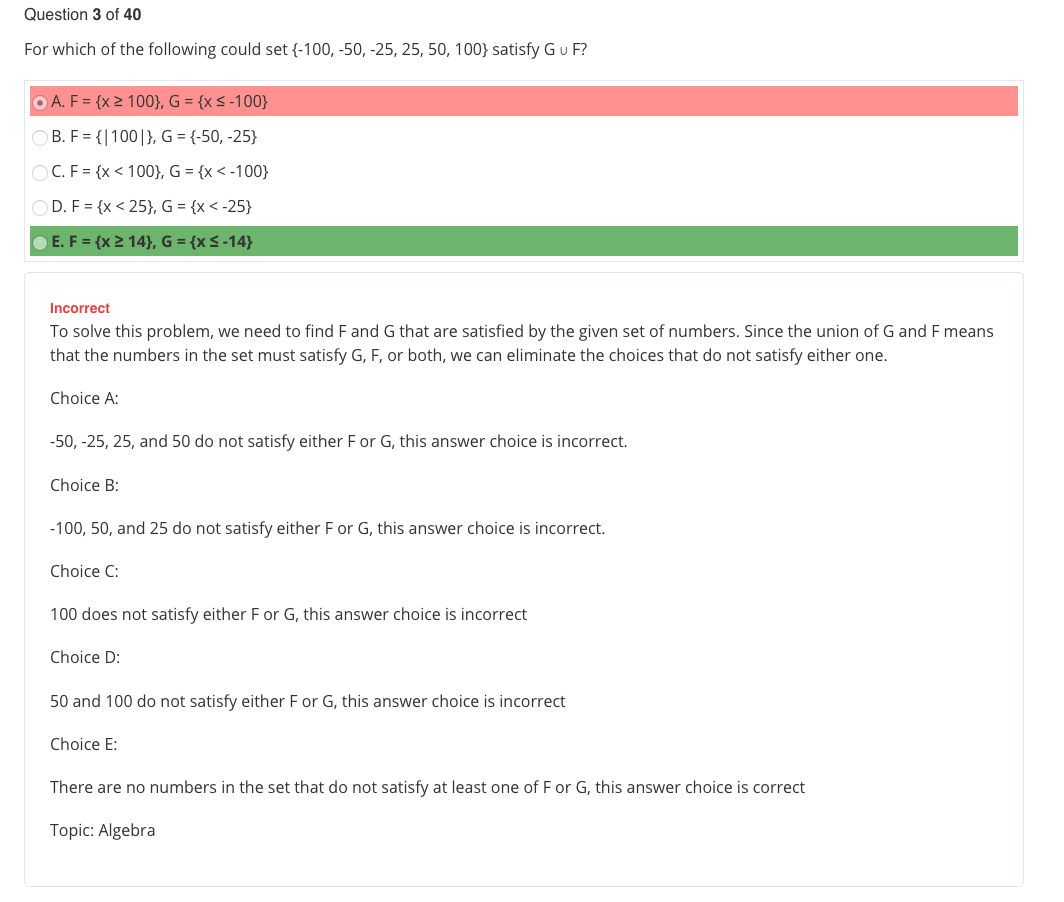
g9YCZRC.png
 
Hi guys. Can someone please explain this problem from bootcamp. How are we supposed to arrive at the answer? I know it involves picking numbers and seeing which answer choice satisfies for both G and F (or something like that). Thanks in advance

g9YCZRC.png

Review
G = {1, 2, 3} and F = { 2, 3, 4}
So G U F = {1, 2, 3 ,4}
and G ∩ F = {2, 3}
------------------------------

G = {x <= -14} or G = {-14, -15, -16 ... -inf}
F = {x => 14} or F = {14, 15, 16 ... +inf}

So G U F = {-inf ... -16, -15, -14, 14, 15, 16 ... +inf}

Given set { -100, -50, -25, 25, 50, 100}. All of these numbers are included in G U F, so E is correct.

------------------------------
B:
F = {|100|} or F = {-100, 100}
G = {-50, -25}

G U F = {-100, -50, -25, 100}
Choice B is wrong since it does not include 25, 50.

A, C and D can be done by similar approach.

That BC explanation kinda gives me a headache :hungover:
 
Last edited:
When you're dealing with UNION, the numbers in the set given can be in EITHER F OR G but not necessarily BOTH, but if given INTERSECTION then those number in the question have to be in BOTH F AND G, in other words common elements.
