
What would you say the top 5-10 are?
How about radiology, otolaryngology, and ophthalmology?
How about radiology, otolaryngology, and ophthalmology?
Last edited:



What would you say the top 5-10 are?
How about radiology and oncology?

Is heme-onc a tough fellowiship to land, by the way? I mean is it in cards and GI territory, or less competitive?
I would say derm, plastics, rad onc, radiology, optho.
By oncology if you meant rad onc, it is very competitive, if you meant heme-onc (an IM subspecialty) not the same at all.

I don't see why general rads is in the same category as these others. Sure the average Step scores are up, but because there are over 1000 spots, it isn't that hard to get into (U.S. acceptance rate is 90%). According to the NRMP, over 70% of applicants with a 202 Step 1 score get into rads.
Because of numbers and demand, I'd say derm, plastics, rad-onc, and surgical subspecialties (ophtho, ENT, uro, etc.) are easily the hardest to get into.
Did you know that the average accepted rad-onc student has 6 research presentations/publications?

Competitiveness depends on a number of factors: specialty and also LOCATION. It can be analyzed by scores, AOA status, number of programs available and number of slots for students.
Trying to get a psych residency at Bellevue might be just as competitive as trying to match into derm.
Just do what you find most interesting and competitiveness is a secondary consideration.
I am speeking only from word-of-mouth. I have no interest in the field. Rumor has it that heme-onc is becoming more competitive because salaries are on the rise and recruiting is up. Still, it is not yet as competitive as cards and GI.


Dermatology
Plastic surgery
Neurosurgery
Otolaryngology
Radiation oncology

Pathology is getting more competetive every year, and recieves a big portion of their recruits from the MD PhD pool. This is even more true with Rad-Onc.

just an M2 here....and just curious...do you guys think it is all lifestyle?
i mean...can't you tailor your lifestyle as an internist and make less money?
it is probably a combo of lifestyle + money...or was this presumed when you mention "lifestyle"
Some of this needs to be taken in context. Path and Rad-Onc attracting MD-PhD doesn't necessarily speak to the desirability of these specialties to the masses. I think the predominant selection factor for mudphuds is finding a field they can be a successful (largely, academic) scientist in. Path certainly fits this bill. While there's certain to be a handful of MD-PhDs shunning careers as academic researchers and choosing lifestyle, I'd say judging competitiveness or desirability of a specialty based on the influx of MD-PhDs is a tenuous proposition.

Dermatology
Plastic surgery
Neurosurgery
Otolaryngology
Radiation oncology
I really don't understand how radiology is making your lists. There may be a place for ophtho somewhere on this list, but I'd be hard-pressed to bump one of these.
Did you know that the average accepted rad-onc student has 6 research presentations/publications?

Kind of sad when you think about what specialties get the best and the brightest.
Kind of sad when you think about what specialties get the best and the brightest.
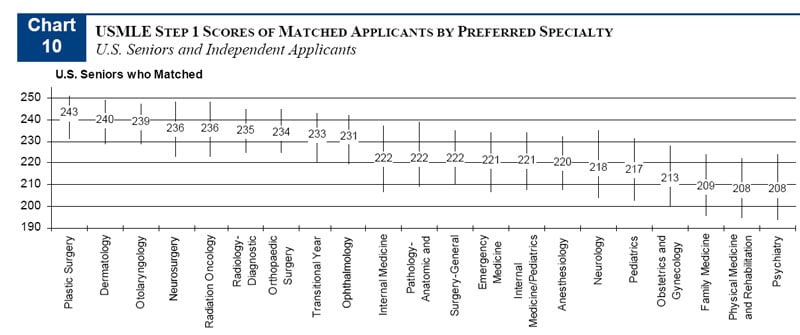
Kind of sad when you think about what specialties get the best and the brightest.
I would say that it's sad what specialties DON'T seem to attract the best and brightest. Psych and PM&R come to mind.
Although if you look at the data from Charting Outcomes there are still quite a few top students going into each of those specialties.

Generally yeah, but you also have to look at the number of spots available. I'd say definitely ortho and maybe ophtho are more competitive than rads, mainly because there are far fewer spots.Competitiveness = avg step 1 score
Heck, forget psych and PM&R; how about FAMILY MEDICINE? Those guys are the ones on the front lines. If we could get preventive medicine ratcheted up a couple notches we could make a sizable dent in our "health care crisis."
I don't see anything sad about it at all. All of those fields, even plastics and derm, significantly improve the lives of patients. A patient who undergoes reconstructive surgery following bad facial trauma, is a much bigger 'win' in my opinion than the gomer whose life critical care was able to extend by a week by putting him on a vent.
Maybe it's because the people who CAN match into residencies with:
1. Higher salaries
2. Less bickering with insurance companies
3. Less non-compliant patients
will.

Heck, forget psych and PM&R; how about FAMILY MEDICINE? Those guys are the ones on the front lines. If we could get preventive medicine ratcheted up a couple notches we could make a sizable dent in our "health care crisis."
Complex reconstructive surgery is not the bread and butter of plastics. Derm improves the lives of patients who would better be treated by a psychiatrist, who, sadly, tends to have lower Step1 scores. Gomers who are going to die in a week are not the bread and butter of critical care.
Basically, one would think that you would want the smartest to go to the specialties where the patients are the sickest/have the complex diseases. It's pretty intuitive I would think.
Not necessarily. You could have a lot of smart people go into a specialty but still have a 1:1 residency:applicant ratio, meaning that everyone that applies would in theory get in. That isn't very competitive.Competitiveness = avg step 1 score
You might "want" the smartest students in these specialties, but that will never happen. The "smartest" students would be the ones who pick a field where they will actually make enough money to live comfortably after training for 20+ years without having to worry about government health care (Medicare) cutting their reimbursements every year, while at the same time still feel like they are doing enough good to justify it. Anyone who borrows $250,000 and takes a yearly salary of $120,000 would not, in my opinion, be the "smartest" student.
Not necessarily. You could have a lot of smart people go into a specialty but still have a 1:1 residency:applicant ratio, meaning that everyone that applies would in theory get in. That isn't very competitive.
And even with self selection, plastics gets 2x the number of available spots...Didn't L2D explain self selection to you? Its not like people are free to apply to whatever they want, they apply to what they feel they can match in.
And even with self selection, plastics gets 2x the number of available spots...

You might "want" the smartest students in these specialties, but that will never happen. The "smartest" students would be the ones who pick a field where they will actually make enough money to live comfortably after training for 20+ years without having to worry about government health care (Medicare) cutting their reimbursements every year, while at the same time still feel like they are doing enough good to justify it. Anyone who borrows $250,000 and takes a yearly salary of $120,000 would not, in my opinion, be the "smartest" student.
OMG SO THATS WHY THEY PICK DERM AND PLASTICS
🙄

That is teh sole reason I am going into plastodermopaedics.For any medical student the most competitive specialty (and therefore the one he/she should be concerned about) is the one they are applying for.
There are no ego points or prizes given how for entering specialties for the sole reason that they are competitive.
Maybe it's because the people who CAN match into residencies with:
1. Higher salaries
2. Less bickering with insurance companies
3. Less non-compliant patients
will.
It does surprise me that internal med and peds have such average scores - both fields are the gateway to some awesome specialties, many of which are paid quite well.


