

-
CycleTrack and SDN are teaming up to make medical school admissions more transparent and accessible! Read the announcement to learn how we’re supporting the future of CycleTrack’s free application-tracking tools .
You are using an out of date browser. It may not display this or other websites correctly.
You should upgrade or use an alternative browser.
You should upgrade or use an alternative browser.
Opiate billing
Started by SommeRiver

Get help with your application
Use all the free resources available to you from SDN: articles, guides, expert advising, forums discussions, and school research.
I've read in this forum that management of opiates impacts billing clinic visits.
My question is (1) whether or not that is true, and (2) if so in what way?
Does it increase complexity?
yes. You check pdmp , labs and hopefully address issues like side effects etc.
yes. You check pdmp , labs and hopefully address issues like side effects etc.
...and the end result of all that back breaking work is...
Advertisement - Members don't see this ad
99213 becomes 99214...and the end result of all that back breaking work is...
99213 becomes 99214
That's what I thought but it feels gross.
Dont feel guilty about billing a level 4. You did the work -- and its not all that much money.That's what I thought but it feels gross.
Feeling gross about rx opioids is a different story which i totally understand
When billing based on complexity the "risk" score is considered "high" when dealing with controlled substances:
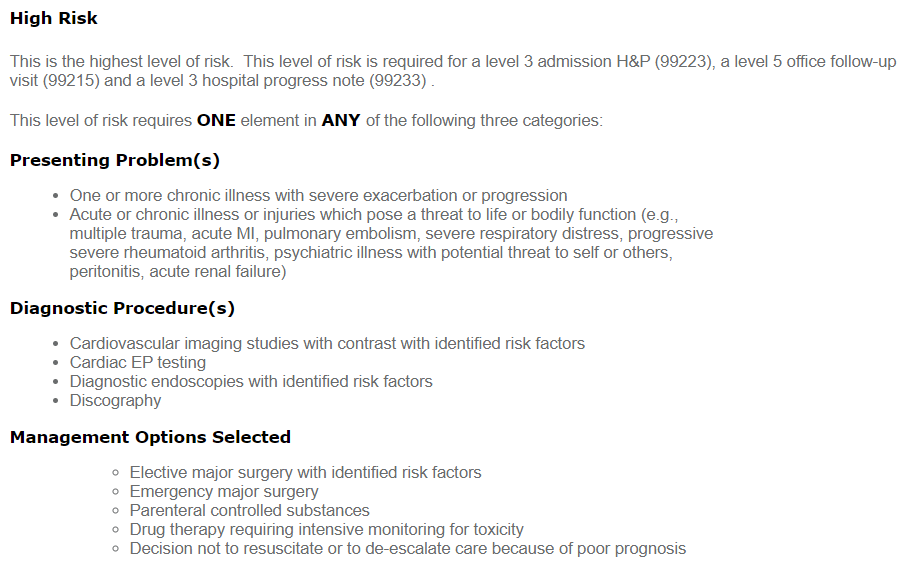
 emuniversity.com
Page No Longer Available - E/M University
emuniversity.com
If I send someone home on opiates with a 3 month follow up how is that considered high risk?
That medication requires monitoring so close that 3 months is appropriate? Come on...
Edit - That link couldn't be right. You can bill a level 5 visit? What?
That medication requires monitoring so close that 3 months is appropriate? Come on...
Edit - That link couldn't be right. You can bill a level 5 visit? What?
why not see them once a year then?If I send someone home on opiates with a 3 month follow up how is that considered high risk?
That medication requires monitoring so close that 3 months is appropriate? Come on...
why not see them once a year then?
Ever heard of the DEA? I can't send you home on 12 months of Norco.
Why not? Because the medicine is high risk and requires monitoring ...?Ever heard of the DEA? I can't send you home on 12 months of Norco.
D
deleted131481
If I send someone home on opiates with a 3 month follow up how is that considered high risk?
That medication requires monitoring so close that 3 months is appropriate? Come on...
Edit - That link couldn't be right. You can bill a level 5 visit? What?
99214 requires moderate risk - all that requires is prescription drug management and is easily satisfied by opioids (in addition to 3 data points or problem points). The discussion of high risk above is more pertinent to 99215 vs 99214.
Agree that opioid management can be a 4/5 visit if you're doing it thoroughly. I would drop down to 3 for low dose, low risk patients psychologically and medically, on low risk agents such as tramadol/buprenorphine. I bump back up though for polypharmacy with sedating agents such as gabapentinoids, muscle relaxers, etc.
Why not? Because the medicine is high risk and requires monitoring ...?
Because they don't want 900 tablets of Percocet on the street

Bill too many 99215s and you'll get the attention of people who will audit you.
99214 is completely reasonable for opiate refills.
Every 3 month visits is legal, but standard of care, at least in my area, is every month for schedule 2 meds.
99214 is completely reasonable for opiate refills.
Every 3 month visits is legal, but standard of care, at least in my area, is every month for schedule 2 meds.
Advertisement - Members don't see this ad
99214 all the way. Don’t feel bad. We take on medicolegal risk putting our pen to paper and signing a opioid rx. You deserve to get compensated fairly for your work.
Ever heard of the DEA? I can't send you home on 12 months of Norco.
The DEA does not mandate how often you need to see a patient on COT. However, your state or clinic may.
Question: I write controlled substance prescriptions to my patient. Does Federal law require that I see the patient every 30 days?
Answer: No. Neither the CSA nor DEA regulations require a practitioner to see a patient every 30 days. Nonetheless, the CSA and DEA regulations do require that a prescription for a controlled substance to be effective must be issued for a legitimate medical purpose by an individual practitioner acting in the usual course of his professional practice. See 21 CFR 1306.04(a). As DEA has previously stated, "practitioners who prescribe controlled substances must see their patients in an appropriate time and manner so as to meet their obligation to prescribe only for a legitimate medical purpose in the usual course of professional practice and to thereby minimize the likelihood that patients will abuse, or become addicted to, the controlled substances." Issuance of Multiple Prescriptions for Schedule II Controlled Substances, 72 FR 64921, 64928 (2007). EO-DEA093, June 23, 2020
DEA FAQ

The DEA does not mandate how often you need to see a patient on COT. However, your state or clinic may.
Question: I write controlled substance prescriptions to my patient. Does Federal law require that I see the patient every 30 days?
DEA FAQ
DEA mandates not more than 90 days on schedule 2 drugs. Federal register November 2005.
DEA mandates not more than 90 days on schedule 2 drugs. Federal register November 2005.
|
Exactly, no more than 90-day supply via 3 separate scripts.
However, DEA does not mandate that the patient needs to be seen every 90-days.
| |
| |
|
PART 1306 -- PRESCRIPTIONS
Controlled Substances Listed in Schedule II
| Sec. 1306.12 Refilling prescriptions; issuance of multiple prescriptions. |
| (a) The refilling of a prescription for a controlled substance listed in Schedule II is prohibited. (b)(1) An individual practitioner may issue multiple prescriptions authorizing the patient to receive a total of up to a 90-day supply of a Schedule II controlled substance provided the following conditions are met: (i) Each separate prescription is issued for a legitimate medical purpose by an individual practitioner acting in the usual course of professional practice; (ii) The individual practitioner provides written instructions on each prescription (other than the first prescription, if the prescribing practitioner intends for that prescription to be filled immediately) indicating the earliest date on which a pharmacy may fill each prescription; (iii) The individual practitioner concludes that providing the patient with multiple prescriptions in this manner does not create an undue risk of diversion or abuse; (iv) The issuance of multiple prescriptions as described in this section is permissible under the applicable state laws; and (v) The individual practitioner complies fully with all other applicable requirements under the Act and these regulations as well as any additional requirements under state law. (2) Nothing in this paragraph (b) shall be construed as mandating or encouraging individual practitioners to issue multiple prescriptions or to see their patients only once every 90 days when prescribing Schedule II controlled substances. Rather, individual practitioners must determine on their own, based on sound medical judgment, and in accordance with established medical standards, whether it is appropriate to issue multiple prescriptions and how often to see their patients when doing so. [72 FR 64929, Nov. 19, 2007] |

I don't think this is correct as it's only a tiny slice of the billing process.When billing based on complexity the "risk" score is considered "high" when dealing with controlled substances:
View attachment 318411
Page No Longer Available - E/M University
This is right to a degree but I'm not sure why you would say prescribing opioids easily satisfies the moderate risk requirements. How do you get to the 3 points? I find it's not that easy and most opioid refills are a 99213 at best if there are no changes. I'm pretty fluent in billing and have been doing it for a long time.99214 requires moderate risk - all that requires is prescription drug management and is easily satisfied by opioids (in addition to 3 data points or problem points). The discussion of high risk above is more pertinent to 99215 vs 99214.
Prescription meds get you a moderate on the table of risk but you still need a 3 from either the number of diagnoses and/or management options or amount and/or complexity of data reviewed or ordered.
Regardless of what you feel your visit is worth or how much risk you feel you are assuming, there are clear cut guidelines on how to bill that must be met.
[Code of Federal Regulations] [Title 21, Volume 9] [Revised as of April 1, 2019] [CITE: 21CFR1306.12]
Exactly, no more than 90-day supply via 3 separate scripts.
However, DEA does not mandate that the patient needs to be seen every 90-days.
DEPARTMENT OF JUSTICE
PART 1306 -- PRESCRIPTIONS
Controlled Substances Listed in Schedule II
Sec. 1306.12 Refilling prescriptions; issuance of multiple prescriptions.
(a) The refilling of a prescription for a controlled substance listed in Schedule II is prohibited.
(b)(1) An individual practitioner may issue multiple prescriptions authorizing the patient to receive a total of up to a 90-day supply of a Schedule II controlled substance provided the following conditions are met:
(i) Each separate prescription is issued for a legitimate medical purpose by an individual practitioner acting in the usual course of professional practice;
(ii) The individual practitioner provides written instructions on each prescription (other than the first prescription, if the prescribing practitioner intends for that prescription to be filled immediately) indicating the earliest date on which a pharmacy may fill each prescription;
(iii) The individual practitioner concludes that providing the patient with multiple prescriptions in this manner does not create an undue risk of diversion or abuse;
(iv) The issuance of multiple prescriptions as described in this section is permissible under the applicable state laws; and
(v) The individual practitioner complies fully with all other applicable requirements under the Act and these regulations as well as any additional requirements under state law.
(2) Nothing in this paragraph (b) shall be construed as mandating or encouraging individual practitioners to issue multiple prescriptions or to see their patients only once every 90 days when prescribing Schedule II controlled substances. Rather, individual practitioners must determine on their own, based on sound medical judgment, and in accordance with established medical standards, whether it is appropriate to issue multiple prescriptions and how often to see their patients when doing so.
[72 FR 64929, Nov. 19, 2007]
It is stated in a way that is not as clear as it needs to be. The bold above is to let everyone know that you should see them monthly to every 3 months. But not more than 3 months. You cannot Rx for more than 90 days without seeing them back before prescribing. If you do, you better have documented mitigating circumstances and this better not be routine.
Keep in mind the entire billing process will likely be changed in 2021 for the first time in over 20 years.
I don't think this is correct as it's only a tiny slice of the billing process.
This is right to a degree but I'm not sure why you would say prescribing opioids easily satisfies the moderate risk requirements. How do you get to the 3 points? I find it's not that easy and most opioid refills are a 99213 at best if there are no changes. I'm pretty fluent in billing and have been doing it for a long time.
Prescription meds get you a moderate on the table of risk but you still need a 3 from either the number of diagnoses and/or management options or amount and/or complexity of data reviewed or ordered.
Regardless of what you feel your visit is worth or how much risk you feel you are assuming, there are clear cut guidelines on how to bill that must be met.
If you review imaging, review the PDMP, review the last UDS, do any teaching, discuss more than one pain complaint, those all count as points.
D
deleted131481
This is right to a degree but I'm not sure why you would say prescribing opioids easily satisfies the moderate risk requirements. How do you get to the 3 points? I find it's not that easy and most opioid refills are a 99213 at best if there are no changes. I'm pretty fluent in billing and have been doing it for a long time.
Prescription meds get you a moderate on the table of risk but you still need a 3 from either the number of diagnoses and/or management options or amount and/or complexity of data reviewed or ordered.
Regardless of what you feel your visit is worth or how much risk you feel you are assuming, there are clear cut guidelines on how to bill that must be met.
Perhaps I wasn't clear, but in my statement I meant opioids easily satisfy the "moderate" on the table of risk specifically. Independently the 3 data points or problem points should be justified/documented - I do find these fairly straightforward to get to though on opioid visits.
If you review imaging, review the PDMP, review the last UDS, do any teaching, discuss more than one pain complaint, those all count as points.
Good point but unfortunately Number of diagnoses and/or management options (SECTION A) is not cumulative with Data Reviewed or Ordered (SECTION B)
Data Reviewed or Ordered (SECTION B)
PDMP +1
UDS +1
Does not add up to 3
...and Section A1 is not cumulative with Section A2, it is the higher of the two
Number of diagnoses and/or management options (SECTION A)
Section A1 Diagnoses
Need 3 plausible differential diagnoses, comorbidities or complications for 3 points
Section A2 Management
Patient Ed +1
So, if you have 3 separate issues I agree, otherwise you're SOL.
How so? I'd like to know so I can start documenting them and billing Level 4. Please give me an example so I can see if I agree. I'll be the first to admit that I know I underbill. I also know I get pushed around by the payers because I'm a solo practitioner and have minimal leverage with them. I don't like to get bullied but honestly, it's like a calculated war of attrition and they've won with me.Perhaps I wasn't clear, but in my statement I meant opioids easily satisfy the "moderate" on the table of risk specifically. Independently the 3 data points or problem points should be justified/documented - I do find these fairly straightforward to get to though on opioid visits.
3 issues is VERY easy. I usually have near 10 diagnoses for any patients that receive opiates.Good point but unfortunately Number of diagnoses and/or management options (SECTION A) is not cumulative with Data Reviewed or Ordered (SECTION B)
Data Reviewed or Ordered (SECTION B)
PDMP +1
UDS +1
Does not add up to 3
...and Section A1 is not cumulative with Section A2, it is the higher of the two
Number of diagnoses and/or management options (SECTION A)
Section A1 Diagnoses
Need 3 plausible differential diagnoses, comorbidities or complications for 3 points
Section A2 Management
Patient Ed +1
So, if you have 3 separate issues I agree, otherwise you're SOL.
D
deleted131481
How so? I'd like to know so I can start documenting them and billing Level 4. Please give me an example so I can see if I agree. I'll be the first to admit that I know I underbill. I also know I get pushed around by the payers because I'm a solo practitioner and have minimal leverage with them. I don't like to get bullied but honestly, it's like a calculated war of attrition and they've won with me.
To Ferrismonk point - I nearly always have 3+ diagnoses: their primary dx (may be multiple), chronic continous opioid use, comorbidities (CKD, anticoag, obesity, anxiety) that are contributors or affect therapy. Example from the one COT on my list today:
- primary hip OA
- chronic, continuos use of opioids
- bilateral knee OA
- obesity
I just don't know about this. Each Dx requires diagnostic evaluation or confirmation. I can understand if you're evaluating each issue. Say positive painful arc and Hawkin's for a shoulder and you're referring the pt to a surgeon for end stage knee OA after a failed injection, etc. I can see these as being two separate diagnoses but just to list them and the treatment is the same with opioids, I just don't know. Perhaps you're right but I just don't think so..... Either way, I don't think you'd get audited going for the 99214.
Chronic pain syndrome
Long term use of opiate analgesic drug
Chronic low back pain
Lumbar spondylosis without myelopathy
Lumbar Degenerative Disc Disease
This is 5 diagnoses for what is really just axial back pain that you give an opiate to. You are evaluating all this at a simple refill visit.
Long term use of opiate analgesic drug
Chronic low back pain
Lumbar spondylosis without myelopathy
Lumbar Degenerative Disc Disease
This is 5 diagnoses for what is really just axial back pain that you give an opiate to. You are evaluating all this at a simple refill visit.
Advertisement - Members don't see this ad
Chronic pain syndrome
Long term use of opiate analgesic drug
Chronic low back pain
Lumbar spondylosis without myelopathy
Lumbar Degenerative Disc Disease
This is 5 diagnoses for what is really just axial back pain that you give an opiate to. You are evaluating all this at a simple refill visit.
BS list of Dx...
You have 2 actual Dx on that list. What is the difference in spondylosis and DDD?
Spondylosis is posterior elements. DDD is anterior elements.BS list of Dx...
You have 2 actual Dx on that list. What is the difference in spondylosis and DDD?
How often do you see spondylosis without DDD? They are not separated by posterior elements vs disk.
Also in the setting of a pt with chronic pain on opiates...How does this change management or deserve extra points for billing?
...a BS game.
Also in the setting of a pt with chronic pain on opiates...How does this change management or deserve extra points for billing?
...a BS game.
How often do you see spondylosis without DDD? They are not separated by posterior elements vs disk.
Also in the setting of a pt with chronic pain on opiates...How does this change management or deserve extra points for billing?
...a BS game.
Doesn’t change anything.
M47.817 means MBB.
M51.36 means exercises.
Doesn’t change anything.
M47.817 means MBB.
M51.36 means exercises.
It's all the same process and captured nicely by calling it spondylosis alone, especially considering DDD is a normal finding and you may have facet-mediated pain independent of imaging abnormalities.
opioid therapy and risk of opioid therapy should qualify for a level 4 visit, if you are reviewing the 5 As...
i think you are making a lot more out of the complexities of billing 99214 and E/M University, the way it is stated, is too confusing.
These visits must meet two of three key components listed below:
if you state "chronic severe (8 out of 10) radicular lower back pain without bowel or bladder dysfunction, worse with walking", you have 5-6 elements of HPI in 1 sentence.
see the examples given in this article for moderate complexity for medical decision making.
99213 or 99214? Three Tips for Navigating the Coding Conundrum
btw, "chronic lower back pain" is itself the BS diagnosis. the others are verifiable on imaging and advanced imaging. i would not rely on "back pain" to "justify" opioid prescribing. spondylosis without radiculopathy; degenerative spinal stenosis, lumbar; failed back syndrome; V91.07 (burn due to water skis on fire) are more apropos.
i think you are making a lot more out of the complexities of billing 99214 and E/M University, the way it is stated, is too confusing.
These visits must meet two of three key components listed below:
| History | Exam | Medical decision making | |
|---|---|---|---|
| 99213 key components | Expanded problem focused | Expanded problem focused | Low |
| 99214 key components | Detailed | Detailed | Moderate |
if you state "chronic severe (8 out of 10) radicular lower back pain without bowel or bladder dysfunction, worse with walking", you have 5-6 elements of HPI in 1 sentence.
see the examples given in this article for moderate complexity for medical decision making.
99213 or 99214? Three Tips for Navigating the Coding Conundrum
Three options for moderate risk. The risk component doesn’t have points assigned to it, so it is more subjective and difficult to identify, but here’s what to look for in moderate risk consistent with a 99214 (remember, you need just one of the following for moderate risk, which is one of three factors overall for medical decision making):
- A presenting problem such as a chronic condition with mild exacerbation, side effects, or inadequate response to treatment; two or more stable chronic conditions; an acute illness with systemic symptoms; an acute complicated injury; or an undiagnosed new problem with uncertain prognosis.
- A diagnostic procedure such as a stress test, diagnostic endoscopy without risk factors, or a deep needle or incisional biopsy.
- A management option such as prescription drug management, which could include prescribing a new medication, changing existing medications, or reviewing and confirming the patient’s existing medication regimen. Other examples include minor surgery with identified risk factors, intravenous fluids with additives, and closed treatment of fracture or dislocation without manipulation.
btw, "chronic lower back pain" is itself the BS diagnosis. the others are verifiable on imaging and advanced imaging. i would not rely on "back pain" to "justify" opioid prescribing. spondylosis without radiculopathy; degenerative spinal stenosis, lumbar; failed back syndrome; V91.07 (burn due to water skis on fire) are more apropos.

you guys are overthinking it.
I bill a level 4 for everything but a f/u in which the patient did great after PT or a procedure, and doesn't need anything from me for a while.
Never had a problem with these level 4s in over a decade of practice.
They go after people billing level 5s. What we do is level 4, 90% of the time in comparison with a 5 min ortho visit which is clearly a level 3.
I bill a level 4 for everything but a f/u in which the patient did great after PT or a procedure, and doesn't need anything from me for a while.
Never had a problem with these level 4s in over a decade of practice.
They go after people billing level 5s. What we do is level 4, 90% of the time in comparison with a 5 min ortho visit which is clearly a level 3.
What if you have a patient who takes an opiate very intermittently. As in 30 tramadol last them a year and a half Or 30 5mg norco last 6 months to a year. Are you supposed to see these people still every 90 days? That seems excessive.
Billing a level 4 followup is relatively easy, you're probably over documenting already, and technically--depending on how you document the interval history and physical exam--medical decision making doesn't even need to be a part of it. It's easy to reach three diagnoses: bilateral chronic knee pain gets you there immediately.
If I am adding or increasing/decreasing a medication, it typically gets a level 4. PT and injections and patient is doing well with those? A 3. Opioid management and monitoring? Automatic 4.
I've only billed a level 5 visit once in my short career and that was an initial at the end of the day who liked to talk, and we made it there on time versus anything else.
At the end of the day, if you're doing the work, get paid for it.
If I am adding or increasing/decreasing a medication, it typically gets a level 4. PT and injections and patient is doing well with those? A 3. Opioid management and monitoring? Automatic 4.
I've only billed a level 5 visit once in my short career and that was an initial at the end of the day who liked to talk, and we made it there on time versus anything else.
At the end of the day, if you're doing the work, get paid for it.
Established patient with a new problem area, new imaging to review, new intervention planned can easily make it to level 5Billing a level 4 followup is relatively easy, you're probably over documenting already, and technically--depending on how you document the interval history and physical exam--medical decision making doesn't even need to be a part of it. It's easy to reach three diagnoses: bilateral chronic knee pain gets you there immediately.
If I am adding or increasing/decreasing a medication, it typically gets a level 4. PT and injections and patient is doing well with those? A 3. Opioid management and monitoring? Automatic 4.
I've only billed a level 5 visit once in my short career and that was an initial at the end of the day who liked to talk, and we made it there on time versus anything else.
At the end of the day, if you're doing the work, get paid for it.
Agreed, and I should be on the lookout for that more often.Established patient with a new problem area, new imaging to review, new intervention planned can easily make it to level 5
It's all the same process and captured nicely by calling it spondylosis alone, especially considering DDD is a normal finding and you may have facet-mediated pain independent of imaging abnormalities.
Lol. Your combination of ignorance and arrogance on posts sometimes is really amusing. Thank you
Lol. Your combination of ignorance and arrogance on posts sometimes is really amusing. Thank you
Go on...
Established patient with a new problem area, new imaging to review, new intervention planned can easily make it to level 5
Okay walk me through this...
Patient with chronic facetogenic LBP and starts getting radicular pain, so you send for an MRI and PT.
They follow up for the MRI results and you schedule an epidural after a focused physical exam...Those are the bones of the visit - Where does that get you a Level 5 visit?
What fluff are you throwing in there needlessly to upcode your visit?
I just don't get it...
Patient previously seen for low back pain. Comes in for neck pain - new problem, additional work up planned, 4 points. Get x ray, review, decide to get MRI. Probably also reviewed old notes. 4+ points for data review. Given we probably also discussed the low back, that’s multiple chronic problems as wellOkay walk me through this...
Patient with chronic facetogenic LBP and starts getting radicular pain, so you send for an MRI and PT.
They follow up for the MRI results and you schedule an epidural after a focused physical exam...Those are the bones of the visit - Where does that get you a Level 5 visit?
What fluff are you throwing in there needlessly to upcode your visit?
I just don't get it...
Advertisement - Members don't see this ad
Go on...
Sit down. Be Humble
Patient previously seen for low back pain. Comes in for neck pain - new problem, additional work up planned, 4 points. Get x ray, review, decide to get MRI. Probably also reviewed old notes. 4+ points for data review. Given we probably also discussed the low back, that’s multiple chronic problems as well
That's like 85% of my visits.
I guess I'm about to become a million dollar baller...
Sit down. Be Humble
Separating spondylosis and DDD for the sake of additional Dx is BS. Sorry...
Separating spondylosis and DDD for the sake of additional Dx is BS. Sorry...
Man! If clinical practice ever fails you I’m sure an insurance carrier would hire you in a heart beat!
you guys are overthinking it.
I bill a level 4 for everything but a f/u in which the patient did great after PT or a procedure, and doesn't need anything from me for a while.
Never had a problem with these level 4s in over a decade of practice.
They go after people billing level 5s. What we do is level 4, 90% of the time in comparison with a 5 min ortho visit which is clearly a level 3.
this is pretty much exactly what i do
