
-
CycleTrack and SDN are teaming up to make medical school admissions more transparent and accessible! Read the announcement to learn how we’re supporting the future of CycleTrack’s free application-tracking tools .
You are using an out of date browser. It may not display this or other websites correctly.
You should upgrade or use an alternative browser.
You should upgrade or use an alternative browser.

Get help with your application
Use all the free resources available to you from SDN: articles, guides, expert advising, forums discussions, and school research.
Nope. Got pushed to next year. Reach out to me if you have thoughts/ideas on how to make it more meaningful/useful!Is Astro putting on a “masterclass” or other seminar in “leadership” this year? .

Nope. Got pushed to next year. Reach out to me if you have thoughts/ideas on how to make it more meaningful/useful!
Don't do it at all. Rad onc "leadership" is running our specialty into the ground.
If you are going to do it, invite experts from outside radiation oncology like business school types who actually study leadership.
Advertisement - Members don't see this ad
Last thing we need is more MBAs telling us what to do.Don't do it at all. Rad onc "leadership" is running our specialty into the ground.
If you are going to do it, invite experts from outside radiation oncology like business school types who actually study leadership.
Last thing we need is more MBAs telling us what to do.
I'd rather those who study leadership for a living in academics tell me how to lead than rad onc MDs who managed to make chair and now congratulate themselves on their stellar leadership opening satellites and underpaying faculty.
Who do you think is incentivizing them? How many MD CEOs are there? How many CFOs have MDs? Why are rad onc departments opening satellites and underpaying faculty if not to pay for the administrative bloat of all the stellar leadership (and lack of any profit center) that MBAs bring to the health care table.I'd rather those who study leadership for a living in academics tell me how to lead than rad onc MDs who managed to make chair and now congratulate themselves on their stellar leadership opening satellites and underpaying faculty.
Why kind of sick, f— attends a talk by Lou Harrison, mikey steinberg, etc about how to be a leader? Would love to know about the lapdogs who sit in the front row?I'd rather those who study leadership for a living in academics tell me how to lead than rad onc MDs who managed to make chair and now congratulate themselves on their stellar leadership opening satellites and underpaying faculty.
Last edited:

I don't recall seeing this posted yet (apologies if it's a repeat), but I just saw this on Twitter and thought it was well done:
Trends of Radiation Oncology residency applicants over time (from the AAMC ERAS Statistics)

Thankfully, medical students seem to be able to do basic math and realize that it's probably not a solid career move to join a specialty producing 200 new grads a year while only 100 people retire/leave the specialty per year (according to the best available/only available CMS data), in the setting of nearly every clinical trial aimed at reducing or omitting radiation therapy, while the government forces almost 50% of practices to enroll in an experimental reimbursement model explicitly designed to reduce RadOnc spending by a few hundred million dollars...before invariably deciding that 100% of practices will need to be enrolled in that model in 5 years. Nevermind the fact that this model imposes requirements that seemingly expressly target small, community practices in a way which might threaten their ability to stay solvent, while writing a proton loophole big enough that Bezos could fly his spaceship through it.
I'm literally begging the ensconced leadership who think I'm a hyperbolic misanthrope: please prove me wrong. Please publish evidence that those numbers - all of which are well known at this point and easily verifiable - don't mean we need to take coordinated action to address our workforce. Barring that, please just own the fact that you're trying to create a world where you can hire attending physicians, call them "Instructors", pay them $100-$150k per year, while raking in technical revenue so a handful of Chairs and Vice-Chairs can spend their days writing emails to each other between the hours of 10AM and 2PM, 4 days a week, congratulating themselves on the new SurveyMonkey publication just accepted into Advances.
Trends of Radiation Oncology residency applicants over time (from the AAMC ERAS Statistics)
Thankfully, medical students seem to be able to do basic math and realize that it's probably not a solid career move to join a specialty producing 200 new grads a year while only 100 people retire/leave the specialty per year (according to the best available/only available CMS data), in the setting of nearly every clinical trial aimed at reducing or omitting radiation therapy, while the government forces almost 50% of practices to enroll in an experimental reimbursement model explicitly designed to reduce RadOnc spending by a few hundred million dollars...before invariably deciding that 100% of practices will need to be enrolled in that model in 5 years. Nevermind the fact that this model imposes requirements that seemingly expressly target small, community practices in a way which might threaten their ability to stay solvent, while writing a proton loophole big enough that Bezos could fly his spaceship through it.
I'm literally begging the ensconced leadership who think I'm a hyperbolic misanthrope: please prove me wrong. Please publish evidence that those numbers - all of which are well known at this point and easily verifiable - don't mean we need to take coordinated action to address our workforce. Barring that, please just own the fact that you're trying to create a world where you can hire attending physicians, call them "Instructors", pay them $100-$150k per year, while raking in technical revenue so a handful of Chairs and Vice-Chairs can spend their days writing emails to each other between the hours of 10AM and 2PM, 4 days a week, congratulating themselves on the new SurveyMonkey publication just accepted into Advances.
Exactly, Just combine the specialty with something else if the plan is for residents to do several years of Instructorships.$100-150k a year is an interesting number
You could just restart as a PGY-2 in radiology and do a few linac locums gigs every year or do preliminary CT reads for an ER

In my humble opinion the results reported at this year's ASTRO are simply premature.The results of 0815 will be presented at ASTRO Plenary next week. I won't reproduce them here but the ARR of OS is very small. 95% of deaths were due to something other than prostate cancer and based on the update from 9408 the OS curves are not likely to converge further as follow-up continues. Competing comorbidities...
RTOG0815 was designed to test if short-duration ADT impacts overall survival in patients with intermediate risk prostate cancer receving dose escalated RT.
Here is the abstract:

Dose Escalated Radiotherapy Alone or in Combination With Short-Term Androgen Suppression for Intermediate Risk Prostate Cancer: Outcomes From the NRG Oncology/RTOG 0815 Randomized Trial
Androgen suppression can improve outcomes when added to radiotherapy (RT) for intermediate risk prostate cancer, but no study to date has reported its…
Bear in mind this trial included both favorable and unfavorable intermediate risk cancer patients.
So, we have a median follow-up of 6.2 years and there is no difference in overall survival. Is that surprising? I find not.
These patients have intermediate risk prostate cancer, a disease that has the potential to kill a patient only many years down the road. It is the same disease, we do not offer radiotherapy at all if the overall prognosis of the patients (due to age and comorbidities) is <10 years.
I would even advocate that if RTOG 0815 was a randomized trial testing RT or no RT in the very same patients, there would be no difference in OS at 6 years.
What is more interesting than OS are the differences in PFS.
It seems that 16% of patients in the no-ADT arm suffered a recurrence, while that number was 9% in the ADT arm.
The question is if that 7% difference in PFS will result into an OS-difference with an adequate follow-up. It's possible, but it depends on age of recruited patients and their comorbidities.
We have already omitted ADT for favorable intermediate risk cancer in our clinic for several years and RTOG 0815 does support this practice. I am looking forward to seeing how many of the patients in RTOG0815 were favorable or unfavorable risk, all the abstract tells us is that two thirds had only one intermediate-risk factor.
Are you using decipher Rx at all for those decisions?In my humble opinion the results reported at this year's ASTRO are simply premature.
RTOG0815 was designed to test if short-duration ADT impacts overall survival in patients with intermediate risk prostate cancer receving dose escalated RT.
Here is the abstract:
Dose Escalated Radiotherapy Alone or in Combination With Short-Term Androgen Suppression for Intermediate Risk Prostate Cancer: Outcomes From the NRG Oncology/RTOG 0815 Randomized Trial
Androgen suppression can improve outcomes when added to radiotherapy (RT) for intermediate risk prostate cancer, but no study to date has reported its…www.sciencedirect.com
Bear in mind this trial included both favorable and unfavorable intermediate risk cancer patients.
So, we have a median follow-up of 6.2 years and there is no difference in overall survival. Is that surprising? I find not.
These patients have intermediate risk prostate cancer, a disease that has the potential to kill a patient only many years down the road. It is the same disease, we do not offer radiotherapy at all if the overall prognosis of the patients (due to age and comorbidities) is <10 years.
I would even advocate that if RTOG 0815 was a randomized trial testing RT or no RT in the very same patients, there would be no difference in OS at 6 years.
What is more interesting than OS are the differences in PFS.
It seems that 16% of patients in the no-ADT arm suffered a recurrence, while that number was 9% in the ADT arm.
The question is if that 7% difference in PFS will result into an OS-difference with an adequate follow-up. It's possible, but it depends on age of recruited patients and their comorbidities.
We have already omitted ADT for favorable intermediate risk cancer in our clinic for several years and RTOG 0815 does support this practice. I am looking forward to seeing how many of the patients in RTOG0815 were favorable or unfavorable risk, all the abstract tells us is that two thirds had only one intermediate-risk factor.
Unfortunately not, it's not reimbursed over here.Are you using decipher Rx at all for those decisions?

You make good points. I wonder how they came up with a 93.3% vs 90% OS improvement at 5 years. That's a NNT of 30, which is a pretty low NNT in oncology--and a kind of a high impact intervention. And I wouldn't expect that OS bump from 6 mos AAS in a high-surviving population. That's a 33% drop in the death rate. But if they had chosen 92% vs 90% OS improvement, they'd need about 3000 patients in the study; 91% vs 90% (a 10% drop in death rate), maybe 5-6000. (And in fact they did see a 91% vs 90% survival improvement, p=0.22, almost good enough in SABR-COMET-land.) So I guess they had to choose 93.3 vs 90 to keep accrual numbers manageable. On the MSKCC nomogram, a T2b, Gleason 3+4 (3/18 cores positive), PSA 9 fellow has a 99% chance of 10 year cancer-specific survival after RP (no hormone therapy). I'd give an RT patient those odds too I think. In summary, 93.3% vs 90% OS improvement at 5 years was NEVER going to happen; ultimately, I'm saying the trial was under-powered IRL (but properly powered in the authors' minds/on paper). So the results weren't premature per se, just expected. The trial was set up over-optimistically... by the prostate "experts" no less.In my humble opinion the results reported at this year's ASTRO are simply premature.
RTOG0815 was designed to test if short-duration ADT impacts overall survival in patients with intermediate risk prostate cancer receving dose escalated RT.
Here is the abstract:
Dose Escalated Radiotherapy Alone or in Combination With Short-Term Androgen Suppression for Intermediate Risk Prostate Cancer: Outcomes From the NRG Oncology/RTOG 0815 Randomized Trial
Androgen suppression can improve outcomes when added to radiotherapy (RT) for intermediate risk prostate cancer, but no study to date has reported its…
Bear in mind this trial included both favorable and unfavorable intermediate risk cancer patients.
So, we have a median follow-up of 6.2 years and there is no difference in overall survival. Is that surprising? I find not.
These patients have intermediate risk prostate cancer, a disease that has the potential to kill a patient only many years down the road. It is the same disease, we do not offer radiotherapy at all if the overall prognosis of the patients (due to age and comorbidities) is <10 years.
I would even advocate that if RTOG 0815 was a randomized trial testing RT or no RT in the very same patients, there would be no difference in OS at 6 years.
What is more interesting than OS are the differences in PFS.
It seems that 16% of patients in the no-ADT arm suffered a recurrence, while that number was 9% in the ADT arm.
The question is if that 7% difference in PFS will result into an OS-difference with an adequate follow-up. It's possible, but it depends on age of recruited patients and their comorbidities.
We have already omitted ADT for favorable intermediate risk cancer in our clinic for several years and RTOG 0815 does support this practice. I am looking forward to seeing how many of the patients in RTOG0815 were favorable or unfavorable risk, all the abstract tells us is that two thirds had only one intermediate-risk factor.
You mean it was a trial designed to "prove" the equivalence of de-escalation?You make good points. I wonder how they came up with a 93.3% vs 90% OS improvement at 5 years. That's a NNT of 30, which is a pretty low NNT in oncology--and a kind of a high impact intervention. And I wouldn't expect that OS bump from 6 mos AAS in a high-surviving population. That's a 33% drop in the death rate. But if they had chosen 92% vs 90% OS improvement, they'd need about 3000 patients in the study; 91% vs 90% (a 10% drop in death rate), maybe 5-6000. (And in fact they did see a 91% vs 90% survival improvement, p=0.22, almost good enough in SABR-COMET-land.) So I guess they had to choose 93.3 vs 90 to keep accrual numbers manageable. On the MSKCC nomogram, a T2b, Gleason 3+4 (3/18 cores positive), PSA 9 fellow has a 99% chance of 10 year cancer-specific survival after RP (no hormone therapy). I'd give an RT patient those odds too I think. In summary, 93.3% vs 90% OS improvement at 5 years was NEVER going to happen; ultimately, I'm saying the trial was under-powered IRL (but properly powered in the authors' minds/on paper). So the results weren't premature per se, just expected. The trial was set up over-optimistically... by the prostate "experts" no less.
Advertisement - Members don't see this ad
I think it demonstrates (ie "proves") de-escalation looks statistically un-different from escalation if not enough patients are given not enough time to have measurable events in a study. The revealing of the effects of minor interventions in CaP (adjuvant tx's e.g.) takes a lot of time. And patients. And patience.You mean it was a trial designed to "prove" the equivalence of de-escalation?
It's that time of year again!
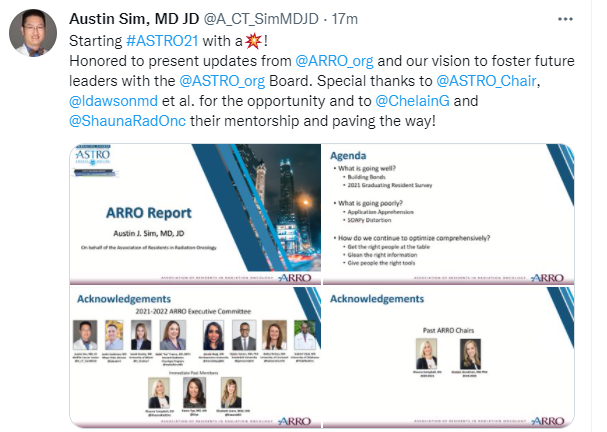
I decided against personally attending ASTRO or paying however much money they wanted for the virtual event this year, so on the off chance it doesn't make it to Twitter, hopefully someone can post the results on SDN for the rest of us to see.
Prediction: based on my experience and conversations with the Class of 2021, I expect unemployment to remain low. I expect this to be spun as a good thing, of course, and people will say the negative projections/worry about the job market are wrong because of it.
If that is indeed the messaging academia chooses to use with us:
In no other sector of the economy would a survey sent by the trainee arm of a professional organization to 200 people before they even leave residency and start the jobs which they may have marked as "satisfactory" be held up as the best available evidence of a robust job market.
(I could obviously be wrong about what they're going to say, but I noticed on the "Agenda" slide the survey is listed under "what is going well", so I have a suspicion about where this will go)
It's that time of year again!
View attachment 344877
I decided against personally attending ASTRO or paying however much money they wanted for the virtual event this year, so on the off chance it doesn't make it to Twitter, hopefully someone can post the results on SDN for the rest of us to see.
Prediction: based on my experience and conversations with the Class of 2021, I expect unemployment to remain low. I expect this to be spun as a good thing, of course, and people will say the negative projections/worry about the job market are wrong because of it.
If that is indeed the messaging academia chooses to use with us:
In no other sector of the economy would a survey sent by the trainee arm of a professional organization to 200 people before they even leave residency and start the jobs which they may have marked as "satisfactory" be held up as the best available evidence of a robust job market.
(I could obviously be wrong about what they're going to say, but I noticed on the "Agenda" slide the survey is listed under "what is going well", so I have a suspicion about where this will go)
Does employment include Instructorships and fellowships? Even in early 2000s almost no grads had jobs lined up by astro. It would not be surprising if these guys are signalling chairmen for their own job search ie. “Hire me and I will be your most vocal yes man ever”
Last edited:
Does employment include Instructorships and fellowships?
I believe this is a true statement, it seems like many places are hiring this year. My personal observations are that there have been a lot of people changing jobs, places that were in hiring freezes last year have been thawed, and everyone knows this is one of the last of the "superstar" classes before the bubble burst.
What I have not personally seen is many people retiring or otherwise leaving the specialty, or that any of these job offers indicate that the health of the specialty is improving. By that I mean salaries/packages are stagnant-to-decreased compared to previous years.
Now, these are just my personal observations and we all know that the "plural of anecdote is not data". However, I really don't have access to any more robust data except for the resident survey that's about to be unveiled, which, don't forget: is filled out by kids before they even start their job.
So looks like I'm sticking with anecdote!
I’ve heard multiple residents coming through our process cite 80-150k for many of these entry level jobs at academic institutions.
Like totally unprompted, offered up this info with an element of disgust and an element of grim acceptance.
Enough unconnected people that I have to believe it’s true.
Assuming this is true, it’s all just a Ponzi scheme to keep graduates employed and prevent the complete collapse of these residencies. However, at some point you can’t find a spot to put a person, even at 100k. How long? My bet is <5 years.
Doesn't look much much changes to ACGME case log requirements?
Doesn't look much much changes to ACGME case log requirements?
Lot to unpack on these slides but yeah - what's the impact of these changes? I feel like this is when an intern sees a potassium of 3.4 and "repletes" it to 3.6. You can tweak the numbers, but what does it mean clinically?

Lot to unpack on these slides but yeah - what's the impact of these changes? I feel like this is when an intern sees a potassium of 3.4 and "repletes" it to 3.6. You can tweak the numbers, but what does it mean clinically?
It means absolutely nothing, except to some academic types justifying to themselves the time and effort they have spent on the RRC. But from a practical point of view, it means nothing.

This. Median survival in the latest trials of de novo METASTATIC disease is 7 years. Only going to go up with parp inhibitors and other new agents. To see a CSM or OS benefit of local therapy you need probably a minimum of 15 years for any reasonably sized trial.I think it demonstrates (ie "proves") de-escalation looks statistically un-different from escalation if not enough patients are given not enough time to have measurable events in a study. The revealing of the effects of minor interventions in CaP (adjuvant tx's e.g.) takes a lot of time. And patients. And patience.
You can look at Mets free survival as a reasonable surrogate, but that is tricky in looking at ADT, as the time on ADT essentially creates “immortal time” for progression to Mets which leads to immortal time bias. Also tricky with the definition of metastatic disease changing as PSMA becomes more widespread.
In my opinion, nearly every prostate trial I have seen is remarkably underpowered with very unrealistic expectations for differences in survival. There is a reason that Stampede provides the best data in terms of survival for localized prostate treatment (in a patient population with non-localized disease) and it is all about the competing risk story.I wonder how they came up with a 93.3% vs 90% OS improvement at 5 years.
When your subject age is 70, when biochemical failure happens 5-10 years down the road, when survival expectation for de-novo metastatic disease is 4+ years, next to impossible to demonstrate survival benefit.
As @Chartreuse Wombat mentioned on another thread, in real life, feasibility impacts estimated effect size to make the power calculations work out.
Correction: missed above post. 7 years with de-novo metastatic disease!
Indeed.I think it demonstrates (ie "proves") de-escalation looks statistically un-different from escalation if not enough patients are given not enough time to have measurable events in a study. The revealing of the effects of minor interventions in CaP (adjuvant tx's e.g.) takes a lot of time. And patients. And patience.
The trial was designed as a superiority trial, because a non-inferiority trial would have demanded even more patients. So, strictly speaking, the researchers cannot claim that ommitting ADT is non-inferior to giving it on top RT for intermediate risk prostate cancer. It does become evident though, that the benefit, concerning 5-years OS, is small.
Running the trial with both favorable and unfavorable intermediate risk cancer patients is a shortcoming, especially if the majority of the patients were favorable intermediate risk patients. Many of us have ommitted ADT in these patients, I guess I am not the only one?
Can we extrapolate the lacking OS benefit to patients with unfavorable intermediate risk disease too?
We saw that "issue" as well in RADICALS. Patients were randomized to adjuvant or salvage radiotherapy and came back negative for superiority of adjuvant irradiation. Salvage radiotherapy looked fine. But looking closely into inclusion criteria and into which patients were randomized, it was striking to see that there were awfully many GS7 and pT2 patients and not so many high-risk patients.
Patients were actually eligible for RADICALS if they had a PSA>10ng/ml prior to surgery or GS7, no need for pT3/R1! Who in the world would have told a patient coming back from surgery with a pT2b pN0 R0 tumor and negative postoperative PSA, that he should undergo adjuvant irradiation cause he has GS7 tumor or his PSA prior to surgery was 12 ng/ml? That's crazy!
So, can I extrapolate results of RADICALS to a pT3b cN0 GS 5+4=9 R1 patient safely too and claim that he will certainly not benefit from adjuvant radiotherapy post prostatectomy? 🤔
It's a trade-off: keeping inclusion criteria wide, overestimating the effect of an intervention or choosing the more convenient design to achieve accrual in the trial.
I totally agree with DoctwoB's statement. MFS would have made a better endpoint. Even with all the issues that come with it because of palliative ADT being initiated upon biochemical progression and not before mets turn up on imaging, in the end what matters is how many patients will benefit from an ADT added to their local treatment so that they will never experience CRPC.
Perhaps a composite endpoint of metastatic disease AND CRPC-state would have been a good idea?
Last edited:

20 Meq, damn man saved a life!Lot to unpack on these slides but yeah - what's the impact of these changes? I feel like this is when an intern sees a potassium of 3.4 and "repletes" it to 3.6. You can tweak the numbers, but what does it mean clinically?

ARRO is posting the 2021 survey results on their Twitter account, including first/second year salaries. Mostly good news for this most recent group of grads, bit AFAIK they never posted the numbers online before. Seems a little uncouth…
Right. My point is, our field has decided to design trials in a way that biases results towards less treatment. This is why I think "trending towards" is a viable statement when evaluating the results. They're all underpowered or reported too soon.I think it demonstrates (ie "proves") de-escalation looks statistically un-different from escalation if not enough patients are given not enough time to have measurable events in a study. The revealing of the effects of minor interventions in CaP (adjuvant tx's e.g.) takes a lot of time. And patients. And patience.
Last edited:
Advertisement - Members don't see this ad
This is crazy. You can make significantly more as a travel nurse now.I’ve heard multiple residents coming through our process cite 80-150k for many of these entry level jobs at academic institutions.
Like totally unprompted, offered up this info with an element of disgust and an element of grim acceptance.
Enough unconnected people that I have to believe it’s true.
Assuming this is true, it’s all just a Ponzi scheme to keep graduates employed and prevent the complete collapse of these residencies. However, at some point you can’t find a spot to put a person, even at 100k. How long? My bet is <5 years.
Store managers at In n' Out make $130k a yearThis is crazy. You can make significantly more as a travel nurse now.
I used to make 12/hour in high school. Big money back then, but now totally sick of their food- could never eat it again.Store managers at In n' Out make $130k a year
5 guys and shake shack stole their magic.Lies. One can never tire of animal style fries.
Different markets. If I want a 10$ burger I can do a lot better then all 3. Though I do like 5 guys Cajun fries.5 guys and shake shack stole their magic.
How it will have started
How it will be going
How it will be going
How it will have started
How it will be going
What is that from Potters? n=49? so of the 49 that responded nationally, around 43 will have openings? is that a fair extrapolation?
View attachment 344927
Long gone will soon be the days of me smiling inside when the urologists pushed for RPE in high-risk patients, knowing I would be getting a post-op referral for 33 fractions and not a primary one for 20 fractions. 🤔 🤔 🤔
In America at ASTRO this year we now have data that with fewer fractions there are more jobs, better salaries, and better job satisfaction.
So this is a WIN.
What was the hypothesized toxicity difference in this non-inferiority trial meant to accrue <300 men?

In America at ASTRO this year we now have data that with fewer fractions there are more jobs, better salaries, and better job satisfaction.
So this is a WIN.
Just convince your admin to pay you $150/RVU and we'll all be okay! Nothing to see here folks
Basically medoncs are getting rates that approach this because of the shortage.Just convince your admin to pay you $150/RVU and we'll all be okay! Nothing to see here folks
View attachment 344927
Long gone will soon be the days of me smiling inside when the urologists pushed for RPE in high-risk patients, knowing I would be getting a post-op referral for 33 fractions and not a primary one for 20 fractions. 🤔 🤔 🤔
CONCLUSION: Your trial was underpowered to detect a toxicity difference
What was the hypothesized toxicity difference in this non-inferiority trial meant to accrue <300 men?
Attachments
Advertisement - Members don't see this ad
What are your thoughts on this? What would your thoughts be if the current numerical difference were statistically significant? As in, would that difference be clinically meaningful?
My thoughts are that QOL endpoints are difficult to study. SDN is not the place to provide a complete answer but the issue is how does one define a clinically meaningful difference in a QOL endpoint also considered as "minimally important difference (MID)".What are your thoughts on this? What would your thoughts be if the current numerical difference were statistically significant? As in, would that difference be clinically meaningful?
There are (at least) two ways.
One relies on simple statistics and generally uses 0.5 of a standard deviation (0.5SD) as a MID (this is what GU003 used).
The other is "anchoring" which is more complicated and involves patient focus groups where patients have a distribution of scores and they are asked to rate themselves-is Joe worse off than Bob...more expensive and time consuming.
The paper attached describes some of the problems with studying QOL as endpoints
Attachments
Seriously, there is numerically almost twice as much GU toxicity but it is not statistically significant?CONCLUSION: Your trial was underpowered to detect a toxicity difference
It's criminal that we as a field are so ready to accept non-inferiority as the benchmark for success. It does our patients an immense disservice. We could hide behind the statistics and say "toxicity is not significantly different" in order to push a narrative we want to push, but ask yourself if you'd feel comfortable receiving that treatment.

Randomized trial of hypofractionated external-beam radiotherapy for prostate cancer - PubMed
The hypofractionation regimen did not result in a significant reduction in BCDF; however, it is delivered in 2.5 fewer weeks. Men with compromised urinary function before treatment may not be ideal candidates for this approach.
 pubmed.ncbi.nlm.nih.gov
In 2013 Alan Pollack published his hypofractionation trial. This was published less than 10 years ago. The endpoint was "To determine if escalated radiation dose using hypofractionation significantly reduces biochemical and/or clinical disease failure (BCDF) in men treated primarily for prostate cancer." The conclusion was that BCDF was similar and "there were no statistically significant differences in late toxicity between the arms; however, in subgroup analysis, patients with compromised urinary function before enrollment had significantly worse urinary function after HIMRT."
And you know what? This wasn't adopted as a standard of care.
As a field we keep shifting the goalposts and designing trials so that they can show a POSITIVE outcome rather than designing clinical trials that show a MEANINGFUL outcome. Having a poorly designed trial with a positive outcome, such as this one, actually does our patients a disservice and sets the field back. It gives us latitude to provide treatments that have worse toxicity at the expense of our patients and for the sole purpose of advancing someone's academic career. Maybe it's not an issue right now when we're still paid per fraction, but get ready to see some wild **** in a few years when APM hits.
Btw Pollack doesn’t use a lot of hypofract off protocol. If a regimen can be used to capture distant pts (5 treatments etc) it will be roundly endorsed.Seriously, there is numerically almost twice as much GU toxicity but it is not statistically significant?
It's criminal that we as a field are so ready to accept non-inferiority as the benchmark for success. It does our patients an immense disservice. We could hide behind the statistics and say "toxicity is not significantly different" in order to push a narrative we want to push, but ask yourself if you'd feel comfortable receiving that treatment.
Randomized trial of hypofractionated external-beam radiotherapy for prostate cancer - PubMed
The hypofractionation regimen did not result in a significant reduction in BCDF; however, it is delivered in 2.5 fewer weeks. Men with compromised urinary function before treatment may not be ideal candidates for this approach.
In 2013 Alan Pollack published his hypofractionation trial. This was published less than 10 years ago. The endpoint was "To determine if escalated radiation dose using hypofractionation significantly reduces biochemical and/or clinical disease failure (BCDF) in men treated primarily for prostate cancer." The conclusion was that BCDF was similar and "there were no statistically significant differences in late toxicity between the arms; however, in subgroup analysis, patients with compromised urinary function before enrollment had significantly worse urinary function after HIMRT."
And you know what? This wasn't adopted as a standard of care.
As a field we keep shifting the goalposts and designing trials so that they can show a POSITIVE outcome rather than designing clinical trials that show a MEANINGFUL outcome. Having a poorly designed trial with a positive outcome, such as this one, actually does our patients a disservice and sets the field back. It gives us latitude to provide treatments that have worse toxicity at the expense of our patients and for the sole purpose of advancing someone's academic career. Maybe it's not an issue right now when we're still paid per fraction, but get ready to see some wild **** in a few years when APM hits.
How it will have started
How it will be going
They are both bad, but the last line of that second tweets slide. Just wow
