
- Joined
- Aug 21, 2007
- Messages
- 8,611
- Reaction score
- 15,226
- Points
- 7,276
- Location
- On a box.
- Attending Physician



Diagnosing SSPE is probably important, sadly. It seems as though they have an elevated risk for subsequent VTE, and will probably be candidates for anticoagulation rather than observation.
That said, it's a small study, and the risk for subsequent VTE is heterogenous – seems to go up with age, up if multiple SSPE are diagnosed. Probably still OK to send a young person (<65) home without commencing anticoagulation with an isolated SSPE and clean legs at index visit and follow-up. Over 65 and/or multiple SSPE, probably the balance of benefit vs. harm tilts towards anticoagulation.
Hot off the presses for @RustedFox
Clinical question: The nurse comes to you about the elderly nursing home resident who's awaiting admission for a hip fracture. She's getting agitated, can we give her some ativan?
Answer: PLEASE DON'T
In residency I was taught that ativan is a very safe drug. Used alone it is hemodynamically stable and doesn't cause respiratory depression. Conversely, opioids kill people and you can only give little old ladies baby doses or else you'll totally zonk them out. THIS IS BACKWARDS. But, in the ED we don't see why. We see opioid OD's all the time, but fail to appreciate that none of those were people in acute pain who got weight-based morphine in a monitored setting. Contrariwise, when we give a dose or two of ativan in the ED, the nurse stops bothering us, and the patient goes upstairs - works for me!
What we don't see is that the elderly patient we gave ativan to often goes on to be in hypoactive delirium for 3 days, and then goes into agitated delirium until their pain gets adequately addressed.
Clinical pearl: Untreated pain is a leading cause of agitation and delirium in the elderly AND doses of 0.05-0.1mg/kg of IV morphine are well tolerated in elderly folks with OK to not-so-great renal function who are in acute pain. In the above-linked article the authors found ZERO increase in delirium (OR = 1.00) in patients who received opioids (but no benzos) while significant increases in delirium were observed in those who got benzos or benzos + opioids.
In summary: Benzodiazepines are a terrible analgesic. Do your hospitalists a favor - if you have an agitated elderly patient in the ED, make sure to treat pain before reaching for the benzos. By avoiding delirium you might shave a couple days off of their LoS, which may even decrease your ED boarding.

This is very true. Nursing facilities won't take patients on 1:1 obs, which is exactly what the floor RN will insist on for agitated delirium.By avoiding delirium you might shave a couple days off of their LoS, which may even decrease your ED boarding.

Diagnosing SSPE is probably important, sadly. It seems as though they have an elevated risk for subsequent VTE, and will probably be candidates for anticoagulation rather than observation.
I'm postcall. It took me about 30 seconds of thinking how subacute sclerosing panencephalitis and VTE were associated and why the hell it was pertinent to the ED to realize what you were actually talking about
Hot off the presses for @RustedFox
Clinical question: The nurse comes to you about the elderly nursing home resident who's awaiting admission for a hip fracture. She's getting agitated, can we give her some ativan?
Answer: PLEASE DON'T
In residency I was taught that ativan is a very safe drug. Used alone it is hemodynamically stable and doesn't cause respiratory depression. Conversely, opioids kill people and you can only give little old ladies baby doses or else you'll totally zonk them out. THIS IS BACKWARDS. But, in the ED we don't see why. We see opioid OD's all the time, but fail to appreciate that none of those were people in acute pain who got weight-based morphine in a monitored setting. Contrariwise, when we give a dose or two of ativan in the ED, the nurse stops bothering us, and the patient goes upstairs - works for me!
What we don't see is that the elderly patient we gave ativan to often goes on to be in hypoactive delirium for 3 days, and then goes into agitated delirium until their pain gets adequately addressed.
Clinical pearl: Untreated pain is a leading cause of agitation and delirium in the elderly AND doses of 0.05-0.1mg/kg of IV morphine are well tolerated in elderly folks with OK to not-so-great renal function who are in acute pain. In the above-linked article the authors found ZERO increase in delirium (OR = 1.00) in patients who received opioids (but no benzos) while significant increases in delirium were observed in those who got benzos or benzos + opioids.
In summary: Benzodiazepines are a terrible analgesic. Do your hospitalists a favor - if you have an agitated elderly patient in the ED, make sure to treat pain before reaching for the benzos. By avoiding delirium you might shave a couple days off of their LoS, which may even decrease your ED boarding.


Afib RVR management:
1. I love giving Mag. It's probably the safest anti-arrhythmic and is so underused in my department. There's moderate evidence to support it as an adjunct. I'll order 4 g over 2 hours.
2. Why do people underdose diltiazem? 0.25 mg/kg followed by 0.35 mg/kg. I'll often tell the nurse to put it in a 50 cc bag and run it over 10 minutes. The highest dose that I've given at once was 50 mg and I've yet to have a patient become hypotensive during infusion.
3. Every now and then I'll mix diltiazem and metoprolol. HR 140 on dilt gtt? 2.5 mg metoprolol brings them down to 70 bpm.
4. I used to dig load people with CHF and AF RVR more often in residency.
5. I'll often think "Hm this hypotensive afib RVR who failed cardioversion would probably be better on a phenylephrine gtt". But then I put them on levophed anyway because I know that the intensivist will be judge me and change my orders 30 minutes later.
Try the IV piggyback! It's voodoo but I swear by it.I don't do #1 because I give adequate doses of the drug in #2. For the average person I start with 20 mg dilt IV, and then will go to 25 - 30 mg for the second dose.
Problem is sometimes these little old 82 yo ladies who are going at 165 and have a BP of 115/70. They weigh 50 kg and are not shocky. However when you give them diltiazem 0.25 mg / kg (like for instance ~15 mg), their BP becomes 82/51, everybody freaks out, and it takes like 6 hours for the systolic to climb above 100
Try the IV piggyback! It's voodoo but I swear by it.
Ya I just have them run a 50 cc bag wide open. If they raise an eyebrow I just say "Well, it should be a 5-10 minute push so if you want to do that instead.."Dood it's not voodoo. I love it!!! But if I do that kind of thing it has to be "under the counter". I can't order it that way because Pharmacy says "THIS ISN'T A PROTOCOL."
So the nurse has to feel fine doing it. You don't put it on a pump, do you? Just let it drip in over 10 mins?

 pubmed.ncbi.nlm.nih.gov
I love haldol… I wish it was in the cities water supply sometimes.
2.5 to 5mg IM for anything related to GI (and obviously the psychotic fella flinging poop). But Haldol 5 mg IM has been my go to for intractable N and V, Gastroparesis, cannabinoid hyperemesis. I try to get the EKG in most if not all patients who I give it to ahead of time. But otherwise very safely tolerated and safe profile 🙂.
Haloperidol undermining gastroparesis symptoms (HUGS) in the emergency department - PubMed
The rate of admission and ME was found to be significantly reduced in patients with GP secondary to diabetes mellitus who received HP. HP may represent an appropriate, effective, and safe alternative to traditional analgesia and antiemetic therapy in the ED management of GP associated N/V/AP.

I love haldol… I wish it was in the cities water supply sometimes.
2.5 to 5mg IM for anything related to GI (and obviously the psychotic fella flinging poop). But Haldol 5 mg IM has been my go to for intractable N and V, Gastroparesis, cannabinoid hyperemesis. I try to get the EKG in most if not all patients who I give it to ahead of time. But otherwise very safely tolerated and safe profile 🙂.
Haloperidol undermining gastroparesis symptoms (HUGS) in the emergency department - PubMed
The rate of admission and ME was found to be significantly reduced in patients with GP secondary to diabetes mellitus who received HP. HP may represent an appropriate, effective, and safe alternative to traditional analgesia and antiemetic therapy in the ED management of GP associated N/V/AP.

Droperidol is easier and tends to work better in my experience. We see a lot of cannabinoid hyperemesis in my shop. Capsaicin works on maybe 60%. 1.25-2.5mg IV droperidol works on 95+%.Why not capsaicin cream for the pot smokers

Yep, use it all the time. Had a lady stuttering last night from her anxiety complaining of abdominal pain and nausea/vomiting. 0.625 of droperidol did the trick. Discharged shortly afterwards (already received labs from waiting room).Droperidol is easier and tends to work better in my experience. We see a lot of cannabinoid hyperemesis in my shop. Capsaicin works on maybe 60%. 1.25-2.5mg IV droperidol works on 95+%.
I presented a lecture on droperidol to the paramedics. In my review of the literature and FDA reports of "adverse events," many of the deaths attributed to droperidol were complex patients with sepsis, traumatic brain injury, and end organ damage prior to administration of droperidol. It is highly unlikely that droperidol caused their death. Furthermore, the patients who did develop Torsades received doses I would never administer to a patient. One patient received almost 300 mg of droperidol in a 24 hour period before going into Torsades. The FDA blackboxed droperidol for 90 cases of prolongation of the QTc, all of which received >200 mg of droperidol. The majority of these had other reasons for QTc prolongation (cardiac disease, antiarrhythmics, etc.).Let's say Dr. Genius orders droperidol 1.25 mg IV for a young, seemingly healthy patient with n / v. 20 minutes later the pt goes into VT, is shocked several times and ended up intubated in the ICU. The subsequent EKG shows a prolonged QTc.
Is there precedent for Hospital Pharmacists to be successfully sued / settle for an adverse outcome from a drug ordered by a doctor at a hospital? I'm trying to figure out why our Pharmacy department is reticent to stock droperidol.

Let's say Dr. Genius orders droperidol 1.25 mg IV for a young, seemingly healthy patient with n / v. 20 minutes later the pt goes into VT, is shocked several times and ended up intubated in the ICU. The subsequent EKG shows a prolonged QTc.
Is there precedent for Hospital Pharmacists to be successfully sued / settle for an adverse outcome from a drug ordered by a doctor at a hospital? I'm trying to figure out why our Pharmacy department is reticent to stock droperidol.

#5: I had thought persistent tachycardia is precisely one of the reasons people theoretically trialed phenylephrine over norepinephrine for hypotense afib rvr.Afib RVR management:
1. I love giving Mag. It's probably the safest anti-arrhythmic and is so underused in my department. There's moderate evidence to support it as an adjunct. I'll order 4 g over 2 hours.
2. Why do people underdose diltiazem? 0.25 mg/kg followed by 0.35 mg/kg. I'll often tell the nurse to put it in a 50 cc bag and run it over 10 minutes. The highest dose that I've given at once was 50 mg and I've yet to have a patient become hypotensive during infusion.
3. Every now and then I'll mix diltiazem and metoprolol. HR 140 on dilt gtt? 2.5 mg metoprolol brings them down to 70 bpm.
4. I used to dig load people with CHF and AF RVR more often in residency.
5. I'll often think "Hm this hypotensive afib RVR who failed cardioversion would probably be better on a phenylephrine gtt". But then I put them on levophed anyway because I know that the intensivist will be judge me and change my orders 30 minutes later.
pubmed.ncbi.nlm.nih.gov
When I last reviewed the literature, the doses of droperidol that were followed by adverse events were 10-20x what I'd use in the ED.Let's say Dr. Genius orders droperidol 1.25 mg IV for a young, seemingly healthy patient with n / v. 20 minutes later the pt goes into VT, is shocked several times and ended up intubated in the ICU. The subsequent EKG shows a prolonged QTc.
Is there precedent for Hospital Pharmacists to be successfully sued / settle for an adverse outcome from a drug ordered by a doctor at a hospital? I'm trying to figure out why our Pharmacy department is reticent to stock droperidol.
That's what I'm talking about. I've never come CLOSE to 10mg, let alone 20mg of droperidol. Those are PACU doses.A large multi-center study of over 1,000 patients (Ann Emerg Med, 2015;66(3):230-238.e1) used 10-20 mg droperidol IV/IM and noted 1.3% had QTc prolongation with 50% of those having another cause for QTc prolongation. None developed Torsades.

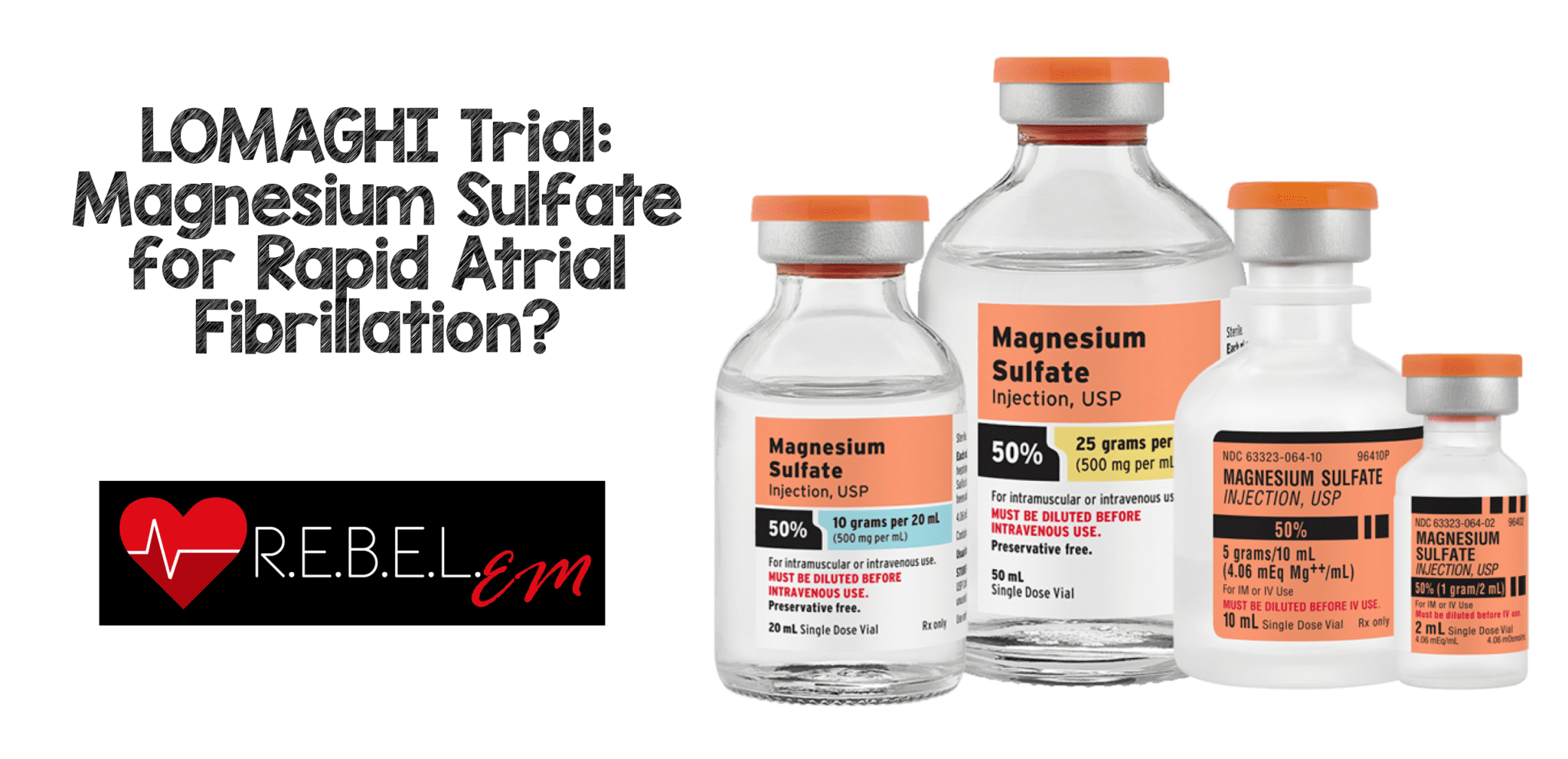
Completely agree. I give adjuvant Mg liberally in rapid AF. This is supported by a pragmatic multicenter RCT called LOMAGHI. The trial arm with the best outcome received 4.5g over 30 minutes. Often times I just push it at the beside. Works even better in post-operative AF.Afib RVR management:
1. I love giving Mag. It's probably the safest anti-arrhythmic and is so underused in my department. There's moderate evidence to support it as an adjunct. I'll order 4 g over 2 hours.
 rebelem.com

Cost is one issue. Been told by one of the medical directors it’s 12 times the cost of haldol!
Why bother to sue the pharmacist when you can sue the hospital?Let's say Dr. Genius orders droperidol 1.25 mg IV for a young, seemingly healthy patient with n / v. 20 minutes later the pt goes into VT, is shocked several times and ended up intubated in the ICU. The subsequent EKG shows a prolonged QTc.
Is there precedent for Hospital Pharmacists to be successfully sued / settle for an adverse outcome from a drug ordered by a doctor at a hospital? I'm trying to figure out why our Pharmacy department is reticent to stock droperidol.


data point of N=1 - I have a friend who was on a lawsuit for some completely stupid lawsuit and had to give a deposition for approving an order were the pt ended up leaving the ED and passing - I think the hospital settled even thou from what I know there was no basis for a lawsuit. That being said, there is a reason our malpractice insurance is only a couple of hundred bucks a year for $2 million coverage - bc we aren't the center of many lawsuits - even thought rph's are the most anal people I know and always insist "I want to keep my license" - other than narcotic diversion or just blantant idocracy, I don't know of any cases of a Rph losing their license while working in good faith.Let's say Dr. Genius orders droperidol 1.25 mg IV for a young, seemingly healthy patient with n / v. 20 minutes later the pt goes into VT, is shocked several times and ended up intubated in the ICU. The subsequent EKG shows a prolonged QTc.
Is there precedent for Hospital Pharmacists to be successfully sued / settle for an adverse outcome from a drug ordered by a doctor at a hospital? I'm trying to figure out why our Pharmacy department is reticent to stock droperidol.
20mg of nitro?!?! Is that a typo?High dose nitroglycerin bolus in crashing heart failure patients.
That also includes patients with normal blood pressures.
I'll usually give 2mg but sometimes do up to 20mg boluses.
Haven't intubated a CHF patient in six years and almost everyone gets admitted to a floor bed on supplemental oxygen.
Nowadays I mostly hate working in the United States but one of the few joys I still have is watching the medicine residents face when they're freaking out asking for intubation and I'm like nope and push the meds and the patient is almost completely symptom free after a couple hours.

Totally unrelated to the case at hand, or the OP, but I have personally experienced this twice now. I'm peripheral in both cases (saw patient once or twice for 2nd opinion, pursued treatment with another physician) but plaintiffs aren't naming individual physicians in the suits, just the hospital.Why bother to sue the pharmacist when you can sue the hospital?
From what I am hearing the trend is to not even naming the physician in malpractice suits. Go after the deep pockets and don’t have a sympathetic physician as defendant.
Hah, I figured an ED group might think "PE" before "measles", but, oh well. 🙃
I'm not ED, I'm sure your target audience wasn't confused!
Weingart has a great lecture on SCAPE and high dose nitro pushes, don't remember what he "maxed" at though
$4 for 2.5 mg of droperidol vs $3.75 for a 5 mg vial of haloperidol.Cost is one issue. Been told by one of the medical directors it’s 12 times the cost of haldol!
Counsel for the plaintiff does this when unbeknownst to you, they try to use you as a witness against the hospital. Most ED docs have a $1/3 policy. Not naming you is leaving money on the table. Be careful though, your deposition could get you named into litigation (i.e., they don't name you initially, you think you're in the free and clear, give a deposition and say something you shouldn't, and then you get named). Always make sure you have representation for yourself provided by your malpractice carrier and not the hospital unless you are employed by the hospital.Totally unrelated to the case at hand, or the OP, but I have personally experienced this twice now. I'm peripheral in both cases (saw patient once or twice for 2nd opinion, pursued treatment with another physician) but plaintiffs aren't naming individual physicians in the suits, just the hospital.
The only reason I've heard about either of these is through hospital risk management. In neither case have I been deposed or spoken to plaintiff or their counsel. I do a lot of dumb s***, but talking to lawyers who aren't mine, without mine present, isn't on the list.Counsel for the plaintiff does this when unbeknownst to you, they try to use you as a witness against the hospital. Most ED docs have a $1/3 policy. Not naming you is leaving money on the table. Be careful though, your deposition could get you named into litigation (i.e., they don't name you initially, you think you're in the free and clear, give a deposition and say something you shouldn't, and then you get named). Always make sure you have representation for yourself provided by your malpractice carrier and not the hospital unless you are employed by the hospital.
There is nothing to leave on the table. You do not get any more damages by suing more people.Counsel for the plaintiff does this when unbeknownst to you, they try to use you as a witness against the hospital. Most ED docs have a $1/3 policy. Not naming you is leaving money on the table. Be careful though, your deposition could get you named into litigation (i.e., they don't name you initially, you think you're in the free and clear, give a deposition and say something you shouldn't, and then you get named). Always make sure you have representation for yourself provided by your malpractice carrier and not the hospital unless you are employed by the hospital.
I disagree. This has not been my experience from my own litigation as well as being an expert witness/peer reviewer.There is nothing to leave on the table. You do not get any more damages by suing more people.
No plaintiff can recover more than their actual damages. An attorney sues multiple physician defendants to add up all the $1M policy limits. That is not necessary when the hospital is a defendant because their assets - heck, their cash reserves - are enough to simply write a check for damages. A physician's liability is capped at the policy limit; even though a hospital has insurance, it bears no relation to their ability to pay and what an attorney will seek. An attorney does not want to get into a situation where they won a $10M verdict and liability was split 50/50 with the hospital and the physician. Ah! but they could only get $1M from the physician. So they left $4M on the table by suing the physician. Far better to sue just the hospital and have them write a $10M check. (Reality is a little more complicated.)
The only exception would be if the hospital is bankrupt or near to it.
Looks like he recommended a 400mcg/min x 2 min load, which is a practice that I preach to my residents. That's 0.8mg - 1/25th of the 20mg cited above. 2mg seems believable to me (500mcg SL q5 x 3 is a standard order and that adds up to 1.5mg), though the nurses would probably give me a side eye.I'm not ED, I'm sure your target audience wasn't confused!
Weingart has a great lecture on SCAPE and high dose nitro pushes, don't remember what he "maxed" at though
Wouldn't the $4 million come out of the physician's pocket in that case? (Or if personal assets are less than $4 million then however much they have)An attorney does not want to get into a situation where they won a $10M verdict and liability was split 50/50 with the hospital and the physician. Ah! but they could only get $1M from the physician. So they left $4M on the table by suing the physician.
What are you ? Peds?
High dose nitroglycerin bolus in crashing heart failure patients.
That also includes patients with normal blood pressures.
I'll usually give 2mg but sometimes do up to 20mg boluses.
Haven't intubated a CHF patient in six years and almost everyone gets admitted to a floor bed on supplemental oxygen.
Nowadays I mostly hate working in the United States but one of the few joys I still have is watching the medicine residents face when they're freaking out asking for intubation and I'm like nope and push the meds and the patient is almost completely symptom free after a couple hours.
Minutes and hours are the same units. Did you mean mcg/kg/min?100 mcg/min/hr

There was a study recently on high dose nitro in CHFLooks like he recommended a 400mcg/min x 2 min load, which is a practice that I preach to my residents. That's 0.8mg - 1/25th of the 20mg cited above. 2mg seems believable to me (500mcg SL q5 x 3 is a standard order and that adds up to 1.5mg), though the nurses would probably give me a side eye.
20mg sounds like a typo.
pubmed.ncbi.nlm.nih.gov
yea yeaMinutes and hours are the same units. Did you mean mcg/kg/min?


