- Joined
- Nov 3, 2012
- Messages
- 165
- Reaction score
- 107
- Points
- 4,651
- Medical Student (Accepted)
Advertisement - Members don't see this ad
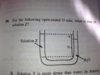
In this problem, we were given a U-tube with water and solution Z. Here is a picture of the diagram:
The question asks about the density of solution Z, and the answer is: (b/(a+b))*density of H2O.
The logic they used in the explanation is that since a<b, the density of Z is less that H2O. Later they say, since b>a, Z is more than 1/2 the density of water. How did they come to these conclusions based on the heights of a and b?
Also, how would the problem change if a>b?
The question asks about the density of solution Z, and the answer is: (b/(a+b))*density of H2O.
The logic they used in the explanation is that since a<b, the density of Z is less that H2O. Later they say, since b>a, Z is more than 1/2 the density of water. How did they come to these conclusions based on the heights of a and b?
Also, how would the problem change if a>b?