
You are using an out of date browser. It may not display this or other websites correctly.
You should upgrade or use an alternative browser.
You should upgrade or use an alternative browser.
Top Clinical Trials from ESTRO
Started by Gfunk6

Get help with your application
Use all the free resources available to you from SDN: articles, guides, expert advising, forums discussions, and school research.

Which brings back the question: when is ENI more beneficial in terms of bPFS and MFS?
a) In a patient with a CT-staged cN0 pelvis, who does have 6mm big nodes that would have been positive on PSMA-PET-CT
b) In a patient with a PSMA- & CT-staged cN0 pelvis
I would say likely A. That patients would develop BCR if he was treated only to the prostate and likely quite soon after completion of ADT. And that the BCR event may have led to a dip in his MFS endpoint.
POP-RT however showed us that B also applies.
So perhaps, BOTH patient populations benefit?
I couldn't see inclusion/exclusion criteria, but I presume previous radiacal therapy doesn't include prior elective nodal RT.STORM- Prostate cancer s/p RP/XRT with biochemical failure and positive disease on PSMA PET
Most of patient had a solitary lymph node
Arm 1: ENRT to regional nodes + 6 mo ADT
Arm 2: SBRT to positive nodes + 6 mo ADT
3 year biochemical relapse free survival:
Arm 1: 69%
Arm 2: 47%
Locoregional repulse free survival
Arm 1: 90%
Arm 2: 70%
In the setting of previous radical therapy for prostate cancer ENRT appears superior to SBRT.
——————————
It should be pointed out that the systemic therapy in this trial is considered inferior by modern day standards. EMBARK used ADT + enzalutamide (median duration 17 mo). In this scenario, SBRT is favored for oligomets and ENRT for locoregional failure (bed +- LNs).
Advertisement - Members don't see this ad
That is correct. Patients in STORM, who had ENI during their primary treatment, were excluded from the trial.I couldn't see inclusion/exclusion criteria, but I presume previous radiacal therapy doesn't include prior elective nodal RT.
The next question that comes to mind, is if that cCR rate of 50% could be "boosted" up to 60-70% when combined with oxaliplatin-based chemotherapy, delivered sequentially to the CRT. Of course, not all patients are fit and many will suffer during multiple months of oxaliplatin, but such a package may become a true alternative.The real question is durable organ preservation, local regrowth, salvageability, late bowel function, and whether patients actually avoid TME without paying for it later.
Pithy version:
APHRODITE makes 62 Gy boost for early rectal organ preservation look reasonable. It changes the tumor board conversation. It does not end the conversation.

Does anyone else foresee pushback from CRS re: rectal SIB? It may be great for those that get a cCR, but for the folks who don't my surgeons are particularly fixated on how higher doses of RT lead to more challenging surgery.
This is a good question. Did these patients receive RT and FOLFOX à la OPRA or RT alone?Does anyone else foresee pushback from CRS re: rectal SIB? It may be great for those that get a cCR, but for the folks who don't my surgeons are particularly fixated on how higher doses of RT lead to more challenging surgery.
With similar CCR to OPRA i suspect many practices will maintain the TNT paradigm with moderate dose XRT and FOLFOX rather than rushing to dose escalate especially in context of phase 2 data only and no information yet on late effects in patients with - or without - intact rectum.

Are they fixated on it based onDoes anyone else foresee pushback from CRS re: rectal SIB? It may be great for those that get a cCR, but for the folks who don't my surgeons are particularly fixated on how higher doses of RT lead to more challenging surgery.
1) irrationality
2) data
3) personal experience
I remember when postop RT was standard of care colorectal surgeons resisted preop because they all said RT made surgery harder. Then the data showed preop RT was perfectly safe, even safer than postop. Preop may kind of make a surgeon’s life more challenging, but it makes the patient’s life less so.

Are they fixated on it based on
1) irrationality
2) data
3) personal experience
I remember when postop RT was standard of care colorectal surgeons resisted preop because they all said RT made surgery harder. Then the data showed preop RT was perfectly safe, even safer than postop. Preop may kind of make a surgeon’s life more challenging, but it makes the patient’s life less so.
#3. Everyone protects their turf except radonc.
We actively try to reduce and eliminate our turf through trials#3. Everyone protects their turf except radonc.
Honestly, no largely because they don’t care about those details of what we do. I suspect most of the folks that will scoff at an SIB probably already scoff at conventional radiation.Does anyone else foresee pushback from CRS re: rectal SIB? It may be great for those that get a cCR, but for the folks who don't my surgeons are particularly fixated on how higher doses of RT lead to more challenging surgery.
I’ll be the first to say I have potential concerns. We know that using standard chemoradiation approaches within the context of TNT and that somewhere in the ball park of 25-35% of patients have long term bothersome GI symptoms that mimic LAR syndrome. That’s a good bit less than in surgical cohorts and is acceptable in my mind. But anything that ends up further decreasing QoL could legitimize the argument “whats the point of organ preservation!” I’m not saying that an SIB worsens toxicity because I don’t have experience. Some very smart and reasonable folks I know are doing some of these trials and I hope they are right. I’m just saying I don’t think we have as much wiggle room to accept added toxicity as some would lead you to believe.

@Gfunk6 Dude/Dudette - AMAZING! This is why #SDNRocks (/sarcasm)
Being so confident about this take when there is conflicting data is... wrong.the takeaway IMO should be to STOP using pelvic RT. it doesn't do anything, shown over and over again.
@Gfunk6 Dude/Dudette - AMAZING! This is why #SDNRocks (/sarcasm)
Being so confident about this take when there is conflicting data is... wrong.
the data is not really all that conflicting in my view. I'm in the camp of Dan Spratt, Sean McBride, Andrew Lobular, Pierre Blanchard and others.
there is a camp that will always be in favor of pelvic RT
this debate goes back over 30 years now. mack roach etc. we just have more trials now.
Last edited:
POP-RT is not conflicting?the data is not really all that conflicting in my view. I'm in the camp of Dan Spratt, Sean McBride, Andrew Lobular, Pierre Blanchard and others.
there is a camp that will always be in favor of pelvic RT
this debate goes back over 30 years now. mack roach etc. we just have more trials now.
Saw a case recently- 60 yo with G10 and diuctal carcinoma. Only an evidence based iidiot would forego pelvic radiation.
Maybe many high risk cases don’t heed pelvic radiation, but to claim that no cases will benefit is not logical. I am willing to omit pelvic xrt in typical high risk with several cores of Gleason 8 and psa under 20, not for ultra high risk where chance
of nodal involvement is over 50%
Maybe many high risk cases don’t heed pelvic radiation, but to claim that no cases will benefit is not logical. I am willing to omit pelvic xrt in typical high risk with several cores of Gleason 8 and psa under 20, not for ultra high risk where chance
of nodal involvement is over 50%
Last edited:
Advertisement - Members don't see this ad
Saw a case recently- 60 yo with G10 and diuctal carcinoma. Only an evidence based iidiot would forego pelvic radiation.
Maybe many high risk cases don’t heed pelvic radiation, but to claim that no cases will benefit is not logical. I am willing to omit pelvic xrt in typical high risk with several cores of Gleason 8 and psa under 20, not for ultra high risk where chances of nodal involvement is over 50%
You’re ignoring that this patient has an incredibly high risk of distant Mets also. The question is whether in the context of modern drug therapy treating the nodes moves the needle for the patient overall. If it was just about nodal risk we would treat entire mediastinum for every single locally advanced lung cancer patient
That’s why we have trials
Lots of assumptions make all of us ‘idiots’ in the past present and future of cancer care
Last edited:
We don’t have trials for all scenarios and by the time they are complete often the systemic therapy landscape has shifted, so we have to extrapolate. To declare that under no circumstances you would treat the nodes is very rigid.You’re ignoring that this patient has an incredibly high risk of distant Mets also. The question is whether in the context of modern drug therapy treating the nodes moves the needle for the patient overall. If it was just about nodal risk we would treat entire mediastinum for every single locally advanced lung cancer patient
That’s why we have trials
Lots of assumptions make all of us ‘idiots’ in the past present and future of cancer care
It’s is safe to teats pelvic nodes and if they have 80% of involvement, it is more than reasonable to treat them. More importantly, what is the downside here.
By your logic, why even treat the primary? What evidence do we have to radiate the primary in g10 w/ductal carcinoma? Should we treat the lymph nodes when they actually are involved- that is stage 4 disease. I have had this debate in tumor board and we don’t have highe level evidence.
(Btw in lung cancer the rational was that 60 gy has low chance of controlling the primary so why worry abt elective regions (lung cancer is the only site where we used to regularly kill pts with xrt toxicity) , especially when systemic therapy fails 80% of the time.)
Last edited:
How much higher is the toxicity with the addition of pelvic nodal RT?
I would imagine not much. And if not much, why TF are we so focused on this?
I would imagine not much. And if not much, why TF are we so focused on this?
I think the question of treating or not the pelvic nodes in prostate cancer is classic radonc debate, that became a debate because of the poor-quality evidence that was produced over decades.How much higher is the toxicity with the addition of pelvic nodal RT?
I would imagine not much. And if not much, why TF are we so focused on this?
Yes, several trials have produced negative results, but taking a closer look at those trials, some of them were very poorly designed.
For instance, the early GETUG trial (GETUG-01) assumed that ENI of the pelvis would increase PFS by a solid absolute 15% (from 60% to 75%).

The investigators then included ... pretty much everyone in the trial with prostate cancer, scheduled to undergo primary RT.
Almost 60% of the patients had a LN-involvement risk <15% based on the Roach formula.
Almost 60% of the patients received a dose <70 Gy to the prostate and almost 60% got ADT.

This was simply a poorly conducted Phase-III-trial and total waste of resources.
It's trials like this, that ony cause confusion and add little to field.
And, the roach formula probably over estimates nodal involvement in the modern era.I think the question of treating or not the pelvic nodes in prostate cancer is classic radonc debate, that became a debate because of the poor-quality evidence that was produced over decades.
Yes, several trials have produced negative results, but taking a closer look at those trials, some of them were very poorly designed.
For instance, the early GETUG trial (GETUG-01) assumed that ENI of the pelvis would increase PFS by a solid absolute 15% (from 60% to 75%).
The investigators then included ... pretty much everyone in the trial with prostate cancer, scheduled to undergo primary RT.
Almost 60% of the patients had a LN-involvement risk <15% based on the Roach formula.
Almost 60% of the patients received a dose <70 Gy to the prostate and almost 60% got ADT.
This was simply a poorly conducted Phase-III-trial and total waste of resources.
It's trials like this, that ony cause confusion and add little to field.
India doesn’t do PSA screening routinely. POP-RT is not our patients. If you have a patient walking in with non PSA screened locally advanced prostate cancer, sure. But, it’s not really our population.POP-RT is not conflicting?
India doesn’t do PSA screening routinely. POP-RT is not our patients. If you have a patient walking in with non PSA screened locally advanced prostate cancer, sure. But, it’s not really our population.
when it's the only trial that shows a benefit and it's very different in result from every other trial in magnitude, it raises this question.
Sounds like POP-RT supports a benefit to pelvic RT in some patients. Guess I'll just use my clinical judgement. Good to have the option. If I had GS 10 disease at 46, I'd treat my pelvis. At 75, I wouldn't.
In addition, POP-RT was the smallest trial by far. As above, not our patients (locally advanced, dx'd by symptoms).
I am a "believer" but the evidence just isn't there. If I get a clinically advanced high risk patient diagnosed via obstructive symptoms and not PSA screened and is high/very high risk, I'd consider. It has been many years since I've had that, as I don't work in highly underserved/developing regions. Everyone else, it seems to be anti-EBM to keep treating the pelvis.
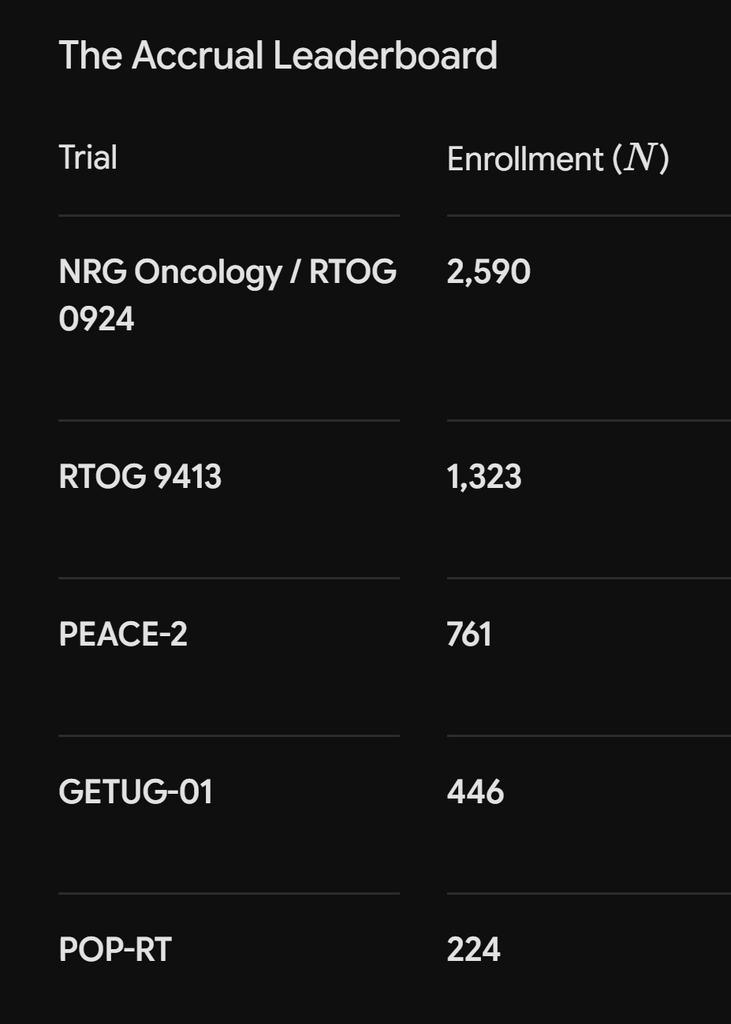
I am a "believer" but the evidence just isn't there. If I get a clinically advanced high risk patient diagnosed via obstructive symptoms and not PSA screened and is high/very high risk, I'd consider. It has been many years since I've had that, as I don't work in highly underserved/developing regions. Everyone else, it seems to be anti-EBM to keep treating the pelvis.
The most mental gymnastics/reality distortion field moment I recall in my career at a meeting presentation was Roach stridently explaining the ENI benefit along with first results from RTOG 9413. It was wild. Felt kind of like a guy showing all the scientific evidence that the earth is 6000 years old. In retrospect I also recall him saying something like hey ENI works in breast and other cancers of course it works for prostate. In the meantime in the last twenty years, ENI and breast……..In addition, POP-RT was the smallest trial by far. As above, not our patients (locally advanced, dx'd by symptoms).
I am a "believer" but the evidence just isn't there. If I get a clinically advanced high risk patient diagnosed via obstructive symptoms and not PSA screened and is high/very high risk, I'd consider. It has been many years since I've had that, as I don't work in highly underserved/developing regions. Everyone else, it seems to be anti-EBM to keep treating the pelvis.
View attachment 419677

Elective Nodal Radiotherapy in Localized Prostate Cancer: A Meta-Analysis - PubMed
This aggregate meta-analysis did not demonstrate any meaningful benefit of WPRT over prostate-only radiotherapy in unselected localized prostate cancer. Individual patient data meta-analysis is warranted to understand if any subgroup consistently derives benefit from WPRT.
 pubmed.ncbi.nlm.nih.gov


what's known about PEACE-2 and ENI at this point?

surprised to not see more buzz for aglatimagene from you guys. 39% reduction in prostate cancer RFS is nothing to sneeze at in an era where most research is tip-toing around the edges of fractionation schedules and robotics for surgery. Plus likely to get plenty of urology buy in as its administered via TRUS q 2 weeks during treatment for 3 injections. Also interesting for you all since the trial used conventional fractionation, so provides justification for longer xrt courses as we would be extrapolating data in trying to apply it to hypofractionation.
still awaiting the final publication, but the data presented at AUA was quite compelling.
still awaiting the final publication, but the data presented at AUA was quite compelling.
Wasn’t aware of this data, but this is super cool. Any physician scientists want to comment on whether this therapy specific to prostate cancer biology, or if it can be tried in other tumors? The company’s press release description almost sounds histology agnostic.surprised to not see more buzz for aglatimagene from you guys. 39% reduction in prostate cancer RFS is nothing to sneeze at in an era where most research is tip-toing around the edges of fractionation schedules and robotics for surgery. Plus likely to get plenty of urology buy in as its administered via TRUS q 2 weeks during treatment for 3 injections. Also interesting for you all since the trial used conventional fractionation, so provides justification for longer xrt courses as we would be extrapolating data in trying to apply it to hypofractionation.
still awaiting the final publication, but the data presented at AUA was quite compelling.
Advertisement - Members don't see this ad
Wasn’t aware of this data, but this is super cool. Any physician scientists want to comment on whether this therapy specific to prostate cancer biology, or if it can be tried in other tumors? The company’s press release description almost sounds histology agnostic.
Not a PS, but its a viral gene therapy that is injected directly into the tumor. Ive seen this tried in sarcoma and brain tumors without success. There are a few comments in this press summary that are like... kinda weird? For example, two prostate cancer related deaths in intermediate risk disease at only median 58 months follow up.
Nevertheless, other parts are really exciting. Looking forward to the paper.
3 intraprostatic injections is a lot!
Not a PS, but its a viral gene therapy that is injected directly into the tumor. Ive seen this tried in sarcoma and brain tumors without success. There are a few comments in this press summary that are like... kinda weird? For example, two prostate cancer related deaths in intermediate risk disease at only median 58 months follow up.
Nevertheless, other parts are really exciting. Looking forward to the paper.
This was presented at ASTRO last year too. From what I remember, they included positive prostate biopsy at 2 years as an event in their calculation of PCA RFS, which I also find kind of weird. So that 39% reduction in PCA RFS was almost entirely driven by the difference in positive biopsy rate at 2 years.
It's a bit specious. If they didn't do the biopsy, the curves would look almost identical through 72 months.So that 39% reduction in PCA RFS was almost entirely driven by the difference in positive biopsy rate at 2 years.
An interesting concept, but something a bit short of honesty in terms of presenting data. TTM? with a miniscule number of mets in the whole cohort?
Curve below 100% consistent with incorporation of biopsy results in the PCRFS endpoint. Data is too sparse beyond this time point to make serious inferences.
is it really gonna be called ProstAtak?
PEACE-2 abstract:
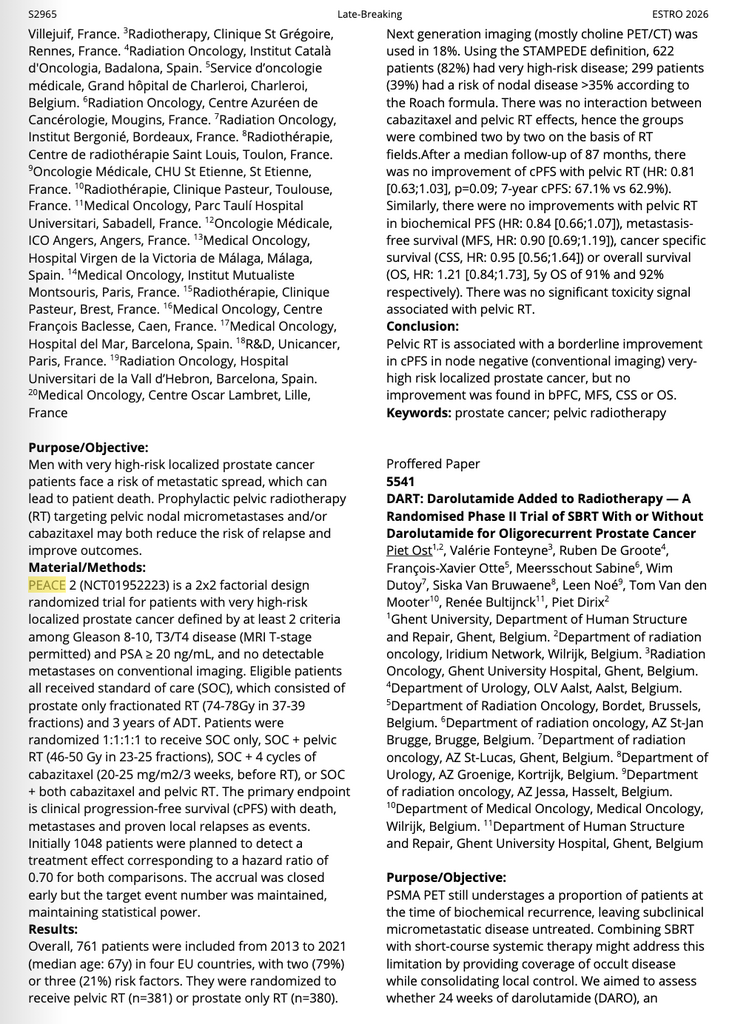
It's a bit specious. If they didn't do the biopsy, the curves would look almost identical through 72 months.
An interesting concept, but something a bit short of honesty in terms of presenting data. TTM? with a miniscule number of mets in the whole cohort?
Curve below 100% consistent with incorporation of biopsy results in the PCRFS endpoint. Data is too sparse beyond this time point to make serious inferences.
View attachment 419844
Interesting. did not know that, they were including positive biopsies. Definitely want to see the manuscript when published, as at this point we're just going on company approved abstracts/press releases.
That said, hard to imagine that patients with + biopsy for grade group 2+ disease 2 years post RT will not become biochemical failures with time. If we start ignoring post-treatment biopsy data, then HIFU and other forms of focal therapy for prostate cancer start looking a lot more attractive . . .
Last edited:
3 intraprostatic injections is a lot!
i suppose, though frankly its probably a 2 minute process in the office and can probably be done with two punctures to minimize infection risk.
The main issue i see is the main ADR is immune-mediated flu-like symptoms. Not a huge deal on their own, but immediately after an intraprostatic injection will be hard to differentiate infection vs. drug side effect.
So there is
is it really gonna be called ProstAtak?
Presumably, any phase 3 trial for approval could not rely on this endpt.It's a bit specious. If they didn't do the biopsy, the curves would look almost identical through 72 months.
An interesting concept, but something a bit short of honesty in terms of presenting data. TTM? with a miniscule number of mets in the whole cohort?
Curve below 100% consistent with incorporation of biopsy results in the PCRFS endpoint. Data is too sparse beyond this time point to make serious inferences.
View attachment 419844
So there is
Presumably, any phase 3 trial for approval could not rely on this endpt.
What should the endpoint be?
BCR free survival is pretty nebulous post XRT. Ditto for ADT/treatment free survival.
Mets free survival is definitely the best non mortality hard endpoint, but in an 85% intermediate risk cohort that would be an insane sample size to get the power to detect a difference.
Out of curiosity this had me look up data on typical biopsy positivity post XRT and its prognostic meaning. Interesting read from OpenEvidence
Post-Radiation Prostate Biopsy Studies
The most extensive data come from studies performing protocol-mandated prostate biopsies after definitive EBRT. A systematic review and meta-analysis by Singh et al. (2021) found a weighted-average positive biopsy rate of 32% (95% CI: 25–39%) across 22 studies (n = 3,017), meaning approximately 68% of patients had negative biopsies (i.e., no residual viable cancer) at ≥2 years post-EBRT. In the subgroup of studies using NCCN-guideline-concordant dosing, the positive biopsy rate was lower at 22%. Key findings from individual studies include:
• Crook et al. (1995): In 226 patients with routine post-RT biopsies, 69.5% had negative biopsies by 30 months. Tumor clearance was time-dependent, with some patients converting from positive to negative biopsies at a median of 26 months.
• Zelefsky et al. (2019): Among 382 patients biopsied after EBRT, 48% had negative biopsies, 22% had adenocarcinoma with severe treatment effect, and 30% had positive biopsies. A positive biopsy was associated with a 2.6-fold higher risk of distant metastasis and 2-fold higher cause-specific mortality.
• Zelefsky et al. (2021) — SBRT biopsies: Among 257 patients biopsied ~2 years after SBRT, the positive biopsy rate was 15.6%, with 57.6% negative and 26.8% showing treatment effect. At doses ≥40 Gy, the positive biopsy rate was only 10.9%.
• Kestin et al. (2002): After combined EBRT + HDR brachytherapy, 49% had negative biopsies at a median of 1.5 years. Biopsy positivity was dose-dependent: 73% positive at <80 Gy vs. 39% at ≥92 Gy.
A positive post-RT biopsy is strongly prognostic: patients with positive biopsies had 10-fold higher odds of biochemical failure, 3-fold higher odds of distant metastasis, and 5-fold higher odds of prostate cancer-specific mortality compared to those with negative biopsies.
It is, but if treating to biopsy negativity, one would go with surgery always.A positive post-RT biopsy is strongly prognostic
We anticipate close to zero biopsy negativity with active surveillance, yet observation is not associated with significant changes in mortality for most intermediate risk patients.
We anticipate close to zero biopsy positivity after surgery, yet surgery seems to offer no significant OS differences over radiation in massive longitudinal studies with diverse disease severity.
I suspect that the more aggressive the initial treatment (whether dose escalation, adjunctive systemic therapy, brachy boost, surgery), the more significant is post-therapeutic biopsy positivity.
So here, the question remains, were those additional positive biopsies in the control arm really very meaningful clinically.... they clearly are not through 6 years. They may become more significant later, although this trial is not well powered to determine this. (70-year-old men will be censored from analysis 10 years down the road...I wonder why).
All of the above can be said about biochemical failure as well.
For me, I am extraordinarily suspicious of prostate cancer specific mortality outcomes (particularly when other cause mortality seems to consistently even things out). The death with biochemical failure number is just a bad number. I've got a bunch of 80+ year olds with indolent biochemical failures years after surgery that I will not treat unless PSA kinetics indicate a threat...these men will all die of prostate cancer per this endpoint.
The best outcomes to measure (and the hardest) are OS and QOL.
Am I willing to adopt an intervention that includes 3 TRUS injections and associated acute malaise during the course of therapy for these patients based on this data?
It's not that the procedure takes long or is horrendous. It's just over the years dose escalated prostate RT has gone from a non-invasive procedure (that was kinda toxic, I'll admit, early in my career) to one that involves a lot more interventions - spacers, fiducials and MRI before tx and often after spacers placed and that's in addition to hormone shots. It's not that much to a proceduralist like yourself. But, it definitely changes the invasiveness of what I'm offering patients.i suppose, though frankly its probably a 2 minute process in the office and can probably be done with two punctures to minimize infection risk.
The main issue i see is the main ADR is immune-mediated flu-like symptoms. Not a huge deal on their own, but immediately after an intraprostatic injection will be hard to differentiate infection vs. drug side effect.
Historically, endpoints for initialWhat should the endpoint be?
BCR free survival is pretty nebulous post XRT. Ditto for ADT/treatment free survival.
Mets free survival is definitely the best non mortality hard endpoint, but in an 85% intermediate risk cohort that would be an insane sample size to get the power to detect a difference.
Out of curiosity this had me look up data on typical biopsy positivity post XRT and its prognostic meaning. Interesting read from OpenEvidence
Post-Radiation Prostate Biopsy Studies
The most extensive data come from studies performing protocol-mandated prostate biopsies after definitive EBRT. A systematic review and meta-analysis by Singh et al. (2021) found a weighted-average positive biopsy rate of 32% (95% CI: 25–39%) across 22 studies (n = 3,017), meaning approximately 68% of patients had negative biopsies (i.e., no residual viable cancer) at ≥2 years post-EBRT. In the subgroup of studies using NCCN-guideline-concordant dosing, the positive biopsy rate was lower at 22%. Key findings from individual studies include:
• Crook et al. (1995): In 226 patients with routine post-RT biopsies, 69.5% had negative biopsies by 30 months. Tumor clearance was time-dependent, with some patients converting from positive to negative biopsies at a median of 26 months.
• Zelefsky et al. (2019): Among 382 patients biopsied after EBRT, 48% had negative biopsies, 22% had adenocarcinoma with severe treatment effect, and 30% had positive biopsies. A positive biopsy was associated with a 2.6-fold higher risk of distant metastasis and 2-fold higher cause-specific mortality.
• Zelefsky et al. (2021) — SBRT biopsies: Among 257 patients biopsied ~2 years after SBRT, the positive biopsy rate was 15.6%, with 57.6% negative and 26.8% showing treatment effect. At doses ≥40 Gy, the positive biopsy rate was only 10.9%.
• Kestin et al. (2002): After combined EBRT + HDR brachytherapy, 49% had negative biopsies at a median of 1.5 years. Biopsy positivity was dose-dependent: 73% positive at <80 Gy vs. 39% at ≥92 Gy.
A positive post-RT biopsy is strongly prognostic: patients with positive biopsies had 10-fold higher odds of biochemical failure, 3-fold higher odds of distant metastasis, and 5-fold higher odds of prostate cancer-specific mortality compared to those with negative biopsies.
fda drug approval are a very high bar and not the same as expanding indications for existing drug or what we think is clinically salient: ie. os or less toxicity. This is not to say bx negativity is not a meaningful endpt, but hard to foresee fda approving 200k drug w/ toxicity risks from adenovirus for this endpt that has never been used for a drug in prostate before, a disease that largely is not fatal.
Give an adenovirus to enough people and someone will die from immune overactivation- and that’s when the vinay Prassads will emerge and go ape sh—
Last edited:
Similar threads


- Replies
- 24
- Views
- 2K


