


*******
New Member
Advertisement - Members don't see this ad
Hey guys, i came up with a question when studying Immunology. I have asked my professor,but he just,u know,said something ambiguous and walked through it.
Here is my question
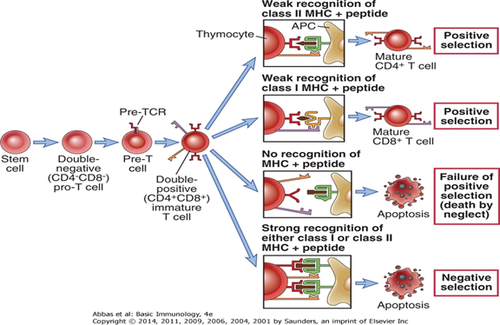
It is already known that T cells need go through positive and negative selection,so that they can develop into mature T cell; In positive selection , TCR in the surface of T cell need to recognise and combine the Antigen peptide-MHC complex from the thymic epithelium to a medium extent , and in negative selection those recogising Self-Antigen peptide-MHC complex will turn into apoptpsis .
We should take notice that thymic epithelium could almost express all self-antigen peptide in our body. So in this way ,every T cell or TCR, which passes the positive selection,should recognise and combine at least one kind of self-Antigen peptide-MHC complex,because of the rule of positive selection.
Then, how could this T cell pass negative selection? There is at least one kind of self-pMHC existing for every T cell!
Here is my question
It is already known that T cells need go through positive and negative selection,so that they can develop into mature T cell; In positive selection , TCR in the surface of T cell need to recognise and combine the Antigen peptide-MHC complex from the thymic epithelium to a medium extent , and in negative selection those recogising Self-Antigen peptide-MHC complex will turn into apoptpsis .
We should take notice that thymic epithelium could almost express all self-antigen peptide in our body. So in this way ,every T cell or TCR, which passes the positive selection,should recognise and combine at least one kind of self-Antigen peptide-MHC complex,because of the rule of positive selection.
Then, how could this T cell pass negative selection? There is at least one kind of self-pMHC existing for every T cell!


