
You are using an out of date browser. It may not display this or other websites correctly.
You should upgrade or use an alternative browser.
You should upgrade or use an alternative browser.
AAMC 3 No.99
Started by SaintJude

Wait, Kaplan says this regarding choice C. Is that really how the cell looks like after the S phase? This looks more like a cell with polyploidy to me...
This nucleus has 4n chromosomes; this is similar to a cell's appearance after the, which occurs before cell division. However, in this phase, although the amount of DNA is also double , the cell still contains a diploid number.

Wait, Kaplan says this regarding choice C. Is that really how the cell looks like after the S phase? This looks more like a cell with polyploidy to me...
as an embryo it's at whatever n and will no longer be 1/2 n (if it undergoes sexual reproduction)
Ex
Zygote is 2n when the animal is at the 64 cell stage during development every cell will still be 2n
Advertisement - Members don't see this ad
Wait, Kaplan says this regarding choice C. Is that really how the cell looks like after the S phase? This looks more like a cell with polyploidy to me...
you remember that S phase duplicates the chromosomes, right? the number of chromosomes goes from 46 to 92.
however, haploid/diploid tells us how many sets of independent chromosomes the organism has. if it is haploid, it has only one type of chromosome 1. if it is diploid, it has two chromosome 1's.
since we just made more copies of the chromosome, but did not introduce new sets chromosome 1's, the cell remains diploid.
although the number of chromatids have doubled, and there are more chromosome 1's, they are connected to their sister chromatid so they are not independent chromosomes. they are not an indepedent set of chromosomes. it is not considered polyploidy for this reason.
the only edit id make is the number of chromosomes do NOT become 92. Rather the number of chromatids is 92 after dna replication (s phase). the number of chromosomes remains at a constant levelyou remember that S phase duplicates the chromosomes, right? the number of chromosomes goes from 46 to 92.
however, haploid/diploid tells us how many sets of independent chromosomes the organism has. if it is haploid, it has only one type of chromosome 1. if it is diploid, it has two chromosome 1's.
since we just made more copies of the chromosome, but did not introduce new sets chromosome 1's, the cell remains diploid.
although the number of chromatids have doubled, and there are more chromosome 1's, they are connected to their sister chromatid so they are not independent chromosomes. they are not an indepedent set of chromosomes. it is not considered polyploidy for this reason.
its a common mistake found on the internet you DO NOT go 2n > 4n > 2n during mitosis you go 2n > 2n >2n (interphase, during mitosis, cytokinesis)
yep but "n" isn't the correct term they usually use c because n refers to the number of chromosomes in a haploid individual or gameteRight....DNA content amount is 4n, but it's still considered a diploid 2n during S phase. That's what you're saying, I think.

The 64 cell stage is just a point further in development than the 2 cell stage. Like chiddler said, you just have to realize that the number of chromosomes within an organism does not change at any point in development. If our cells are diploid, they are always diploid.
The 64 cell stage is just a point further in development than the 2 cell stage. Like chiddler said, you just have to realize that the number of chromosomes within an organism does not change at any point in development. If our cells are diploid, they are always diploid.
Unless they're in the gonads.
Advertisement - Members don't see this ad
Unless they're in the gonads.
Yes, but an embryo has the ploidy number of somatic cells, not germ cells.

I don't get it. What's the "64-cell stage" referring to?
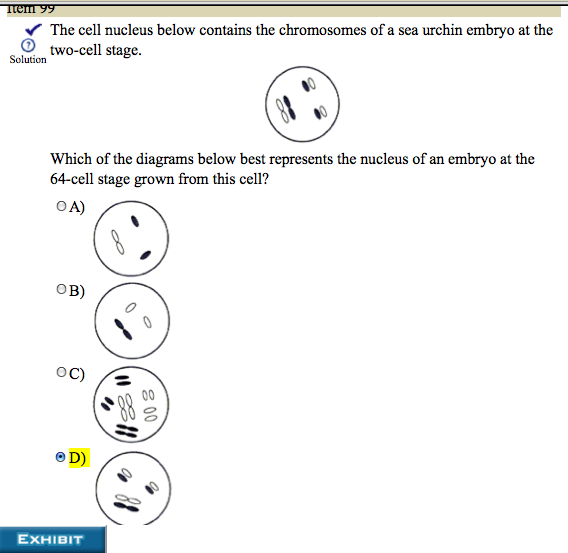
I just took this test and guessed correctly on this one. I chose it because the passage states something about sea urchin two celled embryos containing enough DNA information to produce their own organisms by themselves. So at a random number like 64 cells the DNA distribution should be the same? Keep in mind this is total BS and I just tried to justify my answer while guessing (not too bad of a strategy while guessing on the MCAT)
While I understand that somatic cells won't change their chromosome number during development, can someone explain why germ cells are? Are we referring to meiosis when we say this about germ cells?Unless they're in the gonads.

Germs cells are the cells used for reproduction. Yes, germ cells are the cells that undergo meiosis. In mitosis, the number of chromosome stays the same. In meiosis, we are left with half the number of chromosomes which are normally distinct from their parent chromosome. This is main point you should get away about mitosis vs meiosis. If you wanted to more in depth, you should know what takes place during meiosis 1 and meiosis 2 and how they differ from mitosis. I would also QUICKLY look through diploid and haploid numbers in meiosis so you are familiar with them.
Does this make sense?
Does this make sense?
Thank you for this answer! It makes complete sense, but i do have one question - the chromosome number during S phase in mitosis doesn't change either? Is it the same before and after DNA replication?Germs cells are the cells used for reproduction. Yes, germ cells are the cells that undergo meiosis. In mitosis, the number of chromosome stays the same. In meiosis, we are left with half the number of chromosomes which are normally distinct from their parent chromosome. This is main point you should get away about mitosis vs meiosis. If you wanted to more in depth, you should know what takes place during meiosis 1 and meiosis 2 and how they differ from mitosis. I would also QUICKLY look through diploid and haploid numbers in meiosis so you are familiar with them.
Does this make sense?
Similar threads
- Replies
- 0
- Views
- 3K

- Replies
- 3
- Views
- 12K


