
You are using an out of date browser. It may not display this or other websites correctly.
You should upgrade or use an alternative browser.
You should upgrade or use an alternative browser.


I believe subset analysis of one breast-hypo fractionated trials showed worse hypofractionation outcomes with patients with the EIC (extensive intraductal component) subset. When I was in residency, my breast attending would conventionally fractionate those by hypo frac all others. In my current practice, my colleagues and I hypofrac just about everything except for pre-menopausal women who need RNI. In those cases we sometimes conventionally fractionate.

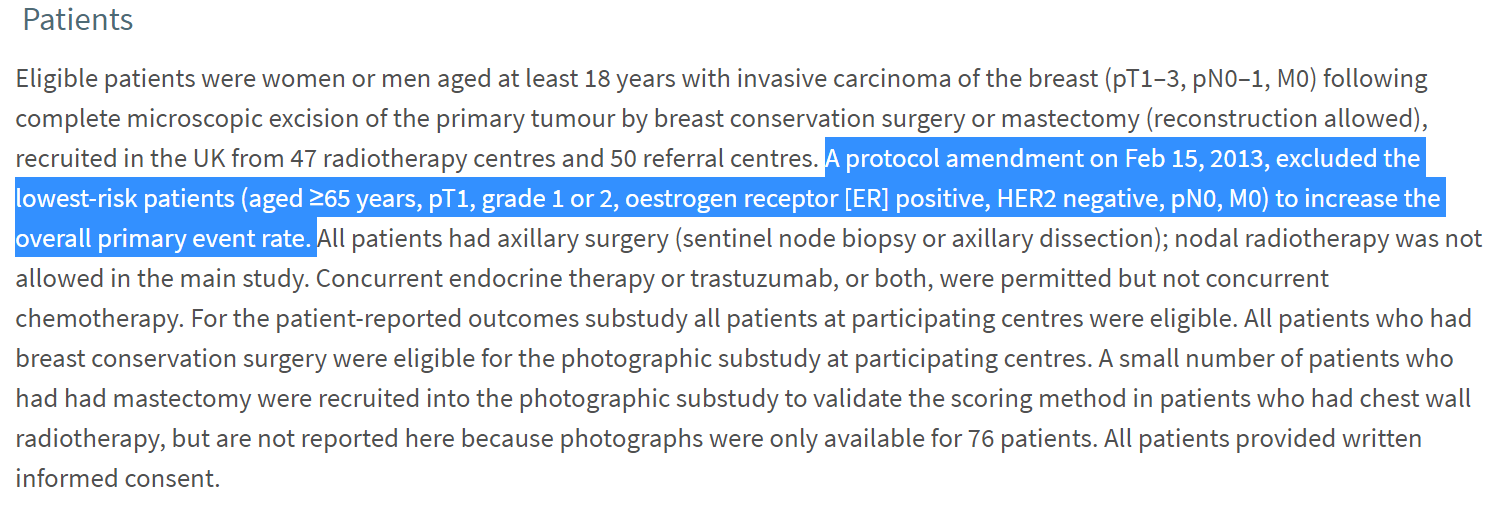
If I recall and read correctly in FAST-forward toward the end of the study they actually loaded up on ER- (and triple negative, and Her2+) to try and increase the power of the study to catch a difference because so few events were being seen.Does anyone look at receptors to determine fractionation for early stage breast cancer?
Say T1N0M0 - s/p segmental mastectomy, margins widely negative.
Would you not offer 5 or 16 fx (and offer 1.8 - 2.0 Gy/fx) based on receptor status?
I would have 0 hesitation to offer 5 fractions. It's literally current standard of care in the UK right now for any whole breast pt. fast forward had plenty of tumors with less than favorable features.Does anyone look at receptors to determine fractionation for early stage breast cancer?
Say T1N0M0 - s/p segmental mastectomy, margins widely negative.
Would you not offer 5 or 16 fx (and offer 1.8 - 2.0 Gy/fx) based on receptor status?
FWIW from ASTRO evidence-based guideline ...
Statement KQ1C. The decision to offer HF-WBI may be independent of hormone receptor status, HER2 receptor status, and margin status. Recommendation strength: Conditional Quality of evidence: Moderate Consensus: 100%*
Statement KQ1C. The decision to offer HF-WBI may be independent of hormone receptor status, HER2 receptor status, and margin status. Recommendation strength: Conditional Quality of evidence: Moderate Consensus: 100%*

Ah yes, EIC. While I also choose to hypofrac most every breast case, some of the older docs really grumble at me when they see patients with EIC getting hypofrac.I believe subset analysis of one breast-hypo fractionated trials showed worse hypofractionation outcomes with patients with the EIC (extensive intraductal component) subset. When I was in residency, my breast attending would conventionally fractionate those by hypo frac all others. In my current practice, my colleagues and I hypofrac just about everything except for pre-menopausal women who need RNI. In those cases we sometimes conventionally fractionate.
I have not seen convincing evidence about EIC and fractionation, but if anyone has a compelling argument otherwise, I would love to hear it.
(well, not really, because the amount of "I told you so" I would have to hear at the next chart rounds would be embarrassing)

FWIW from ASTRO evidence-based guideline ...
Statement KQ1C. The decision to offer HF-WBI may be independent of hormone receptor status, HER2 receptor status, and margin status. Recommendation strength: Conditional Quality of evidence: Moderate Consensus: 100%*
This is for Moderate Hypofx (if referencing most recent WBI guidelines), not for 5Fx regimens.
Regardless, I would not not let ER negative patients get 5Fx WBI if I was doing that routinely in clinical practice. Currently, for me, I offer 26/5 in those who are also candidates for observation per CALGB/PRIME-II.
D
deleted1111261
Yes, it's for "moderate hypofx", also called "modern fractionation" 🙂This is for Moderate Hypofx (if referencing most recent WBI guidelines), not for 5Fx regimens.
Regardless, I would not not let ER negative patients get 5Fx WBI if I was doing that routinely in clinical practice. Currently, for me, I offer 26/5 in those who are also candidates for observation per CALGB/PRIME-II.
Not routinely for ER-. What holds you back, though, for ER-? Is there data showing difference with regards to recurrence rates based on fractionation?
I would point out again that in FAST-forward over the 2011-14 recruitment period, patients from 2013 onward who were 65+yo, T1, Gr1/2, were EXCLUDED from the study if ER positive and could only be enrolled if ER-.Yes, it's for "moderate hypofx", also called "modern fractionation" 🙂
Not routinely for ER-. What holds you back, though, for ER-? Is there data showing difference with regards to recurrence rates based on fractionation?
D
deleted1111261
Florence study included ER- for 5fx PBI. I wonder why people use that as a reason to not use hypoFX or APBI. Where the tumor recurs within the breast or how sensitive it is to a dose hasn't been shown to correlate with receptor status (AFAIK).I would point out again that in FAST-forward over the 2011-14 recruitment period, patients from 2013 onward who were 65+yo, T1, Gr1/2, were EXCLUDED from the study if ER positive and could only be enrolled if ER-.

Yes, it's for "moderate hypofx", also called "modern fractionation" 🙂
Not routinely for ER-. What holds you back, though, for ER-? Is there data showing difference with regards to recurrence rates based on fractionation?
Double negative in my previous post - I was trying to say that ER negative would not stop me from giving 5Fx.
In short, I would give ER negative 5Fx if I was otherwise considering 5Fx. Agreed that there is no data suggesting ER negative specifically cannot get 5Fx.
So a 65yo+ patient ER- could get offered 26/5.
D
deleted1111261
"not not" - that was confusing! Got it.Double negative in my previous post - I was trying to say that ER negative would not stop me from giving 5Fx.
In short, I would give ER negative 5Fx if I was otherwise considering 5Fx. Agreed that there is no data suggesting ER negative specifically cannot get 5Fx.
So a 65yo+ patient ER- could get offered 26/5.


