

-
CycleTrack and SDN are teaming up to make medical school admissions more transparent and accessible! Read the announcement to learn how we’re supporting the future of CycleTrack’s free application-tracking tools .
You are using an out of date browser. It may not display this or other websites correctly.
You should upgrade or use an alternative browser.
You should upgrade or use an alternative browser.
cervical selective nerve root block
Started by SpineandWine

Get help with your application
Use all the free resources available to you from SDN: articles, guides, expert advising, forums discussions, and school research.
To be fair from this forum it sounds like ortho groups are getting to be more equitable with pain docs than my own experience working for one 15 years ago.I've had the opposite experience.
They have. I am currently in a pain only group, but just signed with a neurosurgical group. Best contract I have ever been offered and they were very receptive to why I will or won’t do certain things.To be fair from this forum it sounds like ortho groups are getting to be more equitable with pain docs than my own experience working for one 15 years ago.
Advertisement - Members don't see this ad

"patient's moving!"I just change it to the appropriate procedure. Give them what they want,
not what they say they want.
[injects saline]"how's that?"
"much better, thanks"
In an ortho group, you won't take call and they don't want to be called at 2AM over MS Contin Rx. Also, no one wants those pts in their waiting room.
Plenty of ortho groups where the pain docs take call for them.

How does that work exactly?Plenty of ortho groups where the pain docs take call for them.
My group, the Ortho docs rotate their own call and I take calls on my own patients. I don’t do any opiate management so I maybe 1 call a month on average. As stated above, it’s usually either go to the ER, or call in the morning for an appointment. Occasional post-procedure pain.
How does that work exactly?
Ask Taus. I know rothman uses that formula

No calls as there are no pain emergencies except infected SCS implant, etc-

I hear you. I think it is overblown in some cases, though esp in a city or place with other specialities.No calls as there are no pain emergencies except infected SCS implant, etc-
I’d say even that should be handled by someone who is a surgeons like ortho spine or neurosurgery.
Before that IM and ID should be managing labs and abxs while in the hospital.
Our job is to stay on top of the patient, see them frequently, and manage the best we can as an outpatient before evaluating them and sending them to the hospital.
If someone is rural or doesn’t have other specialities in town then it is different of course.
Nothing emergent could happen after an epidural injection?No calls as there are no pain emergencies except infected SCS implant, etc-
Advertisement - Members don't see this ad
Nothing an anesthesiologist or physiatrist can fix besides a PDPH.Nothing emergent could happen after an epidural injection?
Can minimize it by not putting local in the therapeutic solution. Incidence of hematoma/infection/permanent nerve damage if proper precautions are taken are extremely low.Nothing emergent could happen after an epidural injection?
Of course… I’m not talking about needing to physically come in…. but if your patients have an after-hours issue (real or bs) they are told what? Go to ED?Can minimize it by not putting local in the therapeutic solution. Incidence of hematoma/infection/permanent nerve damage if proper precautions are taken are extremely low.
Of course… I’m not talking about needing to physically come in…. but if your patients have an after-hours issue (real or bs) they are told what? Go to ED?
At my job, yes, go to ED
Nothing emergent could happen after an epidural injection?
Hasnt in 15 years and probably 20k injections..... but stranger things have happened. Like doctodd actually displaying he has a soul...
Ye
Think you need to have a talk with the gray hairs upstairs..... no need for you to have your phone on after you leave work. Or god forbid... a beeper...Thats burnout material.
Yeah. Plenty of them in philly.Of course… I’m not talking about needing to physically come in…. but if your patients have an after-hours issue (real or bs) they are told what? Go to ED?
Think you need to have a talk with the gray hairs upstairs..... no need for you to have your phone on after you leave work. Or god forbid... a beeper...Thats burnout material.
Q1-2 months… meh…Ye
Yeah. Plenty of them in philly.
Think you need to have a talk with the gray hairs upstairs..... no need for you to have your phone on after you leave work. Or god forbid... a beeper...Thats burnout material.
One night every 2 months? Or 1 week?Q1-2 months… meh…
And are the ortho guys covering your call? Taking calls on your patients?
1 night q 1-2 months. Outpatients only. Ortho handles all ER/inpatient call stuff.One night every 2 months? Or 1 week?
And are the ortho guys covering your call? Taking calls on your patients?
Its really not more than a rare annoyance. I also prefer that my patients can reach a doc or NP/PA after hours when needed.
Just saw a patient last week, referred to me from neurosurgery for discussion of injection options. Had a CESI, developed an epidural hematoma requiring emergent decompression. Good neurologic outcome from the decompression but persistent neck pain.Yet to see an emergent post ESI, RFA or SCS complication.
She had a mild thrombocytopenia, around 100k, nothing I would have worried about, but then also went on to tell me she had cirrhosis due to NASH. Also was told that during surgery she bled a lot. I sent her to heme.
Just saw a patient last week, referred to me from neurosurgery for discussion of injection options. Had a CESI, developed an epidural hematoma requiring emergent decompression. Good neurologic outcome from the decompression but persistent neck pain.
She had a mild thrombocytopenia, around 100k, nothing I would have worried about, but then also went on to tell me she had cirrhosis due to NASH. Also was told that during surgery she bled a lot. I sent her to heme.
Any idea needle gauge size?
Extremely unlikely using the 25g technique.Just saw a patient last week, referred to me from neurosurgery for discussion of injection options. Had a CESI, developed an epidural hematoma requiring emergent decompression. Good neurologic outcome from the decompression but persistent neck pain.
She had a mild thrombocytopenia, around 100k, nothing I would have worried about, but then also went on to tell me she had cirrhosis due to NASH. Also was told that during surgery she bled a lot. I sent her to heme.
No, I didn’t have the procedure note for this patient but have seen some procedure notes from him in the past using a catheter for CESI, so I’m guessing he does an 18g.Any idea needle gauge size?
Advertisement - Members don't see this ad
18g Tuohy and a catheter...This is the type hardware you'd use that would increase the likelihood of unnecessary complications.No, I didn’t have the procedure note for this patient but have seen some procedure notes from him in the past using a catheter for CESI, so I’m guessing he does an 18g.
Use a 25g and never receive a phone call.

Do you do cervical epidural in office or Asc, with or without anesthesia, cardiac monitoring or no? Post-procedure lying flat or no? Thanks.18g Tuohy and a catheter...This is the type hardware you'd use that would increase the likelihood of unnecessary complications.
Use a 25g and never receive a phone call.
Clinic procedure room with no monitoring. I give Valium 2mg x 2 tabs. Take 30 min prior.Do you do cervical epidural in office or Asc, with or without anesthesia, cardiac monitoring or no? Post-procedure lying flat or no? Thanks.
Me, C-Arm, XRAY tech and an MA.
When the needle is removed, you get up and walk to the chair you were sitting in before the procedure, we check your BP one more time and you go home.
Laying flat?
These procedures should be minimally intrusive overall. It's just a shot. You do not need to do anything extra and turn this into something.
No monitoring. No IVs. No laying flat. Get your shot and leave my facility. You don't need anything. Go home and live your life.
Thanks, I wonder if this applies to most providers in this forum, the group I am in, makes a big fuss about cervical epidural, Mac monitoring with anesthesia, lying flat for 30 Minutes post-injection, I personally never heard it, it is an overkill, i heard there was some serious complications happened before.Clinic procedure room with no monitoring. I give Valium 2mg x 2 tabs. Take 30 min prior.
Me, C-Arm, XRAY tech and an MA.
When the needle is removed, you get up and walk to the chair you were sitting in before the procedure, we check your BP one more time and you go home.
Laying flat?
These procedures should be minimally intrusive overall. It's just a shot. You do not need to do anything extra and turn this into something.
No monitoring. No IVs. No laying flat. Get your shot and leave my facility. You don't need anything. Go home and live your life.
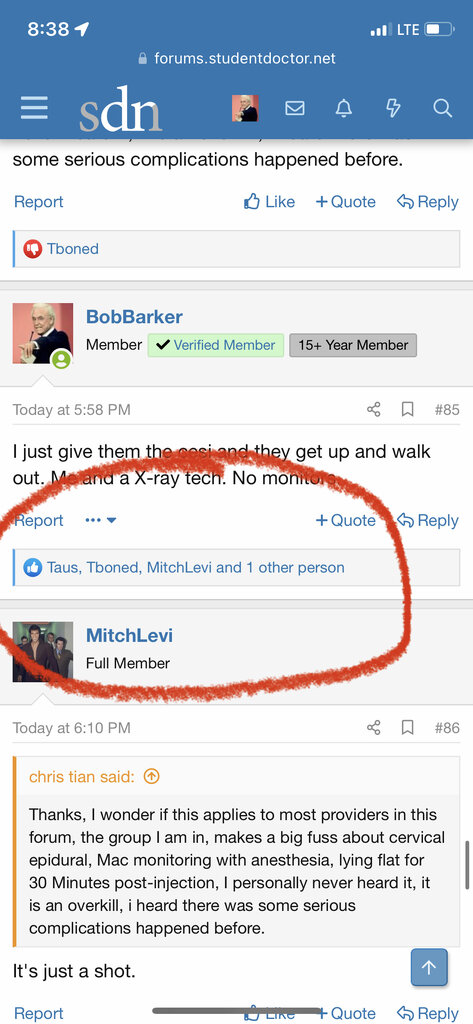
I just give them the cesi and they get up and walk out. Me and a X-ray tech. No monitors.
It's just a shot.Thanks, I wonder if this applies to most providers in this forum, the group I am in, makes a big fuss about cervical epidural, Mac monitoring with anesthesia, lying flat for 30 Minutes post-injection, I personally never heard it, it is an overkill, i heard there was some serious complications happened before.
Seems overkillThanks, I wonder if this applies to most providers in this forum, the group I am in, makes a big fuss about cervical epidural, Mac monitoring with anesthesia, lying flat for 30 Minutes post-injection, I personally never heard it, it is an overkill, i heard there was some serious complications happened before.
Read this as a sentence. 😂
I'm coming to see you under private insurance good sir.
Edit - Abysmal failure...I meant to write personal injury...
Last edited:
Great! I will get you set up with our in house chiropractor also.I'm coming to see you under private insurance good sir.
It would only be a failure for all parties involved if you saw them under work compI'm coming to see you under private insurance good sir.
Edit - Abysmal failure...I meant to write personal injury...
whoa, thats way overkill, and adds cost to the patientThanks, I wonder if this applies to most providers in this forum, the group I am in, makes a big fuss about cervical epidural, Mac monitoring with anesthesia, lying flat for 30 Minutes post-injection, I personally never heard it, it is an overkill, i heard there was some serious complications happened before.
I was able to take SIS course on cervical TFESI.
Did 2 or 3 in practice
Does anyone do this to help predict surgical level in practice and what’s their protocol. What is Amt numbing used?
Please don’t send furman paper on how it’s not selective, etc or how one should not do it.
Did 2 or 3 in practice
Does anyone do this to help predict surgical level in practice and what’s their protocol. What is Amt numbing used?
Please don’t send furman paper on how it’s not selective, etc or how one should not do it.
I was able to take SIS course on cervical TFESI.
Did 2 or 3 in practice
Does anyone do this to help predict surgical level in practice and what’s their protocol. What is Amt numbing used?
Please don’t send furman paper on how it’s not selective, etc or how one should not do it.
it is not selective. it should not be done

Injectate volumes needed to reach specific landmarks in s1 transforaminal epidural injections - PubMed
This study demonstrates injectate volumes needed to reach specific anatomic landmarks in S1-TFEIs. A volume of 3.0 mL of contrast reaches the superior aspect of the L5-S1 intervertebral disc 92% of the time.
 pubmed.ncbi.nlm.nih.gov
if you know that this is wrong, then why are you even going down this road?
i can swallow a CTFESI maybe once or twice a year for a C4-5 foraminal HNP or severe NF stenosis pretty high up in the cervical spine.
it should NOT be used as a diagnostic tool. it just gives the surgeons more reasons to operate. it tells you nothing.
a better way to predict a surgical level would be with a good EMG (not easy to find however). or better yet, get a good look at the MRIs and do a good exam. there is no shortcut with SNRBs. if the surgeons try to refer over for it, either dont do the shot, do a THERAPEUTIC injection, or have a reasonable talk with them
i can swallow a CTFESI maybe once or twice a year for a C4-5 foraminal HNP or severe NF stenosis pretty high up in the cervical spine.
it should NOT be used as a diagnostic tool. it just gives the surgeons more reasons to operate. it tells you nothing.
a better way to predict a surgical level would be with a good EMG (not easy to find however). or better yet, get a good look at the MRIs and do a good exam. there is no shortcut with SNRBs. if the surgeons try to refer over for it, either dont do the shot, do a THERAPEUTIC injection, or have a reasonable talk with them
Last edited:
Advertisement - Members don't see this ad
There are multiple renowned SIS faculty that utilize this approach for surgical level prediction with benefit. I think it’s a tool. Don’t want to state name here on forum.
If I can help reduce a 3 level fusion to 2 level fusion, may be worth it. Helps some surgeon with planning at times when ambiguity arises. Adds some info one way or another.
EMG/NCS not specific either, but adds info one way or another at times
Anyone on forum who does this in practice?
If I can help reduce a 3 level fusion to 2 level fusion, may be worth it. Helps some surgeon with planning at times when ambiguity arises. Adds some info one way or another.
EMG/NCS not specific either, but adds info one way or another at times
Anyone on forum who does this in practice?
Last edited:
SMH. ok.There are multiple renowned SIS faculty that utilize this approach for surgical level prediction with benefit. I think it’s a tool. Don’t want to state name here on forum.
If I can help reduce a 3 level fusion to 2 level fusion, may be worth it. Helps some surgeon with planning at times when ambiguity arises. Adds some info one way or another.
EMG/NCS not specific either, but adds info one way or another at times
Anyone on forum who does this in practice?
its just not the right thing to do, and i think you know that. or at least you should. the test provides no information

There are multiple renowned SIS faculty that utilize this approach for surgical level prediction with benefit. I think it’s a tool. Don’t want to state name here on forum.
If I can help reduce a 3 level fusion to 2 level fusion, may be worth it. Helps some surgeon with planning at times when ambiguity arises. Adds some info one way or another.
EMG/NCS not specific either, but adds info one way or another at times
Anyone on forum who does this in practice?
Taus and I both were trained on Ctfesi in fellowship. I wouldn’t feel comfortable only after a course.
Both of us will do cervical SNRB by touching bone at posterior foramen and then directing the needle anterior to the nerve root. Safer than entering the foramen for a full CTFESI.
I still don’t advise that you do cervical snrb but if you do, this technique is safer.
What's the injectate volume/concentration. Do you start with lidocaine/numbing medication?Taus and I both were trained on Ctfesi in fellowship. I wouldn’t feel comfortable only after a course.
Both of us will do cervical SNRB by touching bone at posterior foramen and then directing the needle anterior to the nerve root. Safer than entering the foramen for a full CTFESI.
I still don’t advise that you do cervical snrb but if you do, this technique is safer.
Also, how does this help surgeon?
Question posed was is this her shoulder causing pain or coming from neck at C4-C5 where there was severe narrowing - not sure if injection would help answer that?
What's the injectate volume/concentration. Do you start with lidocaine/numbing medication?
Also, how does this help surgeon?
Question posed was is this her shoulder causing pain or coming from neck at C4-C5 where there was severe narrowing - not sure if injection would help answer that?
severe central or neuroforaminal stenosis?
if you move her shoulder and her shoulder hurts, its a shoulder problem
if you move her neck and her neck hurts is a neck problem


