
You are using an out of date browser. It may not display this or other websites correctly.
You should upgrade or use an alternative browser.
You should upgrade or use an alternative browser.
Do Med Students Believe In God
Started by EmmaNemma

Get help with your application
Use all the free resources available to you from SDN: articles, guides, expert advising, forums discussions, and school research.

I also find it hilarious that almost every culture in history has had some form of divine being, whether god, gods, ancestors, spirits, mother earth, etc, yet we are so convinced that "our" god is right and theirs are wrong. There is no more evidence for our judeo-christian monotheistic deity than any other god out there.
I also find it hilarious that almost every culture in history has had some form of divine being, whether god, gods, ancestors, spirits, mother earth, etc, yet we are so convinced that "our" god is right and theirs are wrong. There is no more evidence for our judeo-christian monotheistic deity than any other god out there.
Exactly. It's very annoying when people think their religion is the "right" religion.
I grew up in a Muslim family, and I can easily see absurdity in all Abrahamic faiths. I have yet to openly tell anyone that I don't fully agree with the religion, because I am very aware of the social rejection that would result if I told such a thing. I have to put up this facade, as I think many of us with religious upbringings do.
Last edited:
Advertisement - Members don't see this ad
The whole logic and reasoning behind the concept of God and how religious people can manipulate and cherry pick ideals, while creating their own sub-religious beliefs and assumptions (for instance, the body is too complex to just have evolved) is astounding to watch.
With the whole body is complex instance, is that not jumping to conclusions on something we do not fully understand? "I dunno why ______ happened; therefore, Godditit"
Caveman: Fire is hot, but we can not make fire yet, therefore I believe the fire-god has created this divine phenomenon.
What exactly is God? Different religions has different views. Don't you just love inconsistencies? Why do people need a God? Comfort? Statements people hear: God gives life - people believe it. Why not go even further to analyze life. People see the world as God's creation. Well the body perceives different wavelengths of light into different color. What is the world - just a bunch of elements and molecules. Beautiful sound is nothing but changes in sound frequencies that hairs deep in your ears convert to a signal your brain will understand.
And the concept of a "soul" people will bend over backwards to defend, even without the presence of evidence to support. Imagine having no senses or control of muscles. You'd just become thought in void of everything else. And without thought or being dead, you will live again...but first you'll enter through a golden gate in the clouds. Even if you're not religious, rather just believe in a God, humans should not even come close to knowing the plans, details, thought level or any conscious level about something clearly beyond the grounds of comprehending. The worst is when people attribute human characteristics to a supreme being.
The concept behind science offers me more comfort than pure speculation of something purely without evidence. Taking a leap-of-faith of that magnitude screams of intellectual dishonesty.
Now, religion, does offer great things to people who rely on it, which is great. I just wished people critically thought about things more, let alone why people believe in what they do.
With the whole body is complex instance, is that not jumping to conclusions on something we do not fully understand? "I dunno why ______ happened; therefore, Godditit"
Caveman: Fire is hot, but we can not make fire yet, therefore I believe the fire-god has created this divine phenomenon.
What exactly is God? Different religions has different views. Don't you just love inconsistencies? Why do people need a God? Comfort? Statements people hear: God gives life - people believe it. Why not go even further to analyze life. People see the world as God's creation. Well the body perceives different wavelengths of light into different color. What is the world - just a bunch of elements and molecules. Beautiful sound is nothing but changes in sound frequencies that hairs deep in your ears convert to a signal your brain will understand.
And the concept of a "soul" people will bend over backwards to defend, even without the presence of evidence to support. Imagine having no senses or control of muscles. You'd just become thought in void of everything else. And without thought or being dead, you will live again...but first you'll enter through a golden gate in the clouds. Even if you're not religious, rather just believe in a God, humans should not even come close to knowing the plans, details, thought level or any conscious level about something clearly beyond the grounds of comprehending. The worst is when people attribute human characteristics to a supreme being.
The concept behind science offers me more comfort than pure speculation of something purely without evidence. Taking a leap-of-faith of that magnitude screams of intellectual dishonesty.
Now, religion, does offer great things to people who rely on it, which is great. I just wished people critically thought about things more, let alone why people believe in what they do.
The whole logic and reasoning behind the concept of God and how religious people can manipulate and cherry pick ideals, while creating their own sub-religious beliefs and assumptions (for instance, the body is too complex to just have evolved) is astounding to watch.
With the whole body is complex instance, is that not jumping to conclusions on something we do not fully understand? "I dunno why ______ happened; therefore, Godditit"
Caveman: Fire is hot, but we can not make fire yet, therefore I believe the fire-god has created this divine phenomenon.
What exactly is God? Different religions has different views. Don't you just love inconsistencies? Why do people need a God? Comfort? Statements people hear: God gives life - people believe it. Why not go even further to analyze life. People see the world as God's creation. Well the body perceives different wavelengths of light into different color. What is the world - just a bunch of elements and molecules. Beautiful sound is nothing but changes in sound frequencies that hairs deep in your ears convert to a signal your brain will understand.
And the concept of a "soul" people will bend over backwards to defend, even without the presence of evidence to support. Imagine having no senses or control of muscles. You'd just become thought in void of everything else. And without thought or being dead, you will live again...but first you'll enter through a golden gate in the clouds. Even if you're not religious, rather just believe in a God, humans should not even come close to knowing the plans, details, thought level or any conscious level about something clearly beyond the grounds of comprehending. The worst is when people attribute human characteristics to a supreme being.
The concept behind science offers me more comfort than pure speculation of something purely without evidence. Taking a leap-of-faith of that magnitude screams of intellectual dishonesty.
Now, religion, does offer great things to people who rely on it, which is great. I just wished people critically thought about things more, let alone why people believe in what they do.
Agree. I think many people read Scripture as a scientific textbook, when it should be read as a moral guidebook of sorts.
The bolded also questions the existence of free will. Because, since we are just a bunch of molecules put together, how could such molecules have the ability to make "decisions" on how the body should act, on how to think. All of our complex behaviors and thoughts are the result of chemical reactions we have no control over.

Ah but the realm of science is a religion/faith unto itself. It is a belief in mankind. His mind and knowledge, which has been shown many times to be flawed and faulty and tinged with more than a little bit of self promotion/pride.
It takes faith to surrender yourself to concepts such as evolution because there is no real evidence for interspecies evolution. But the church of the enlightened has declared that this is what is required of its disciples. So the followers embrace the doctrine by faith. It's the same thing you are saying about Christians.
But why is it so hard to beleive in God? Can you look out into this universe and be content that we are just a cosmic accident? Why is that so appealing? Can you look at the millions of biochemical pathways in a human body and write it off to a series of fortunate combinations over billions of years? To me, that takes some real strong faith to believe.
It is not worth addressing the comment of interspecies evolution, as posters below have pretty much summed that up, but your comments on the complexity of science are extremely flawed.
It is very easy to believe in god, but it is much more difficult to look at the complexity of the universe or even some biochemical pathways and say "we don't know." God is not the default answer for the scientific unknown. Past decades are riddled with concepts once attributed to god that are now adequately explained by scientific evidence. Is it possible that a god created the universe? Sure, but there is not a shred of evidence to support that at this time. Sometimes it is difficult for humans to come to grips with the fact that there is a great deal we do not understand or may never understand even in our lifetime, but science offers a means to provide actual explanations and evidence, despite how slowly it progresses.
The "church of the enlightened" as you describe it is not required to believe anything. If actual evidence shows a theory is incorrect, the scientific community adjusts...this happens every year in medicine. This has nothing to do with faith. Faith in some instances limits your ability to search or accept alternate explanations if they conflict with preconceived world views...and this is where science and faith actually have a dangerous interplay. For example, I have classmates that are advocates of evidence based medicine, participate in research and search for answers to medical questions based on biologic understanding, yet have an unwavering belie that the world is 6,000 years old because that is what their faith dictates.
Again, if you choose to inject the concept of a divine being into a scientific conversation, you have to be willing to subject your beliefs to the same scrutiny that scientific theory receives. It is not enough to say I have a strong faith, so it must be true. "The church of the enlightened" is comfortable with "we don't know" in regards to the unknowns of the universe (actually, this has been quite motivating in terms of research), but to say "we don't know, so it must be god" is clearly flawed.

The whole logic and reasoning behind the concept of God and how religious people can manipulate and cherry pick ideals, while creating their own sub-religious beliefs and assumptions (for instance, the body is too complex to just have evolved) is astounding to watch.
With the whole body is complex instance, is that not jumping to conclusions on something we do not fully understand? "I dunno why ______ happened; therefore, Godditit"
Caveman: Fire is hot, but we can not make fire yet, therefore I believe the fire-god has created this divine phenomenon.
What exactly is God? Different religions has different views. Don't you just love inconsistencies? Why do people need a God? Comfort? Statements people hear: God gives life - people believe it. Why not go even further to analyze life. People see the world as God's creation. Well the body perceives different wavelengths of light into different color. What is the world - just a bunch of elements and molecules. Beautiful sound is nothing but changes in sound frequencies that hairs deep in your ears convert to a signal your brain will understand.
And the concept of a "soul" people will bend over backwards to defend, even without the presence of evidence to support. Imagine having no senses or control of muscles. You'd just become thought in void of everything else. And without thought or being dead, you will live again...but first you'll enter through a golden gate in the clouds. Even if you're not religious, rather just believe in a God, humans should not even come close to knowing the plans, details, thought level or any conscious level about something clearly beyond the grounds of comprehending. The worst is when people attribute human characteristics to a supreme being.
The concept behind science offers me more comfort than pure speculation of something purely without evidence. Taking a leap-of-faith of that magnitude screams of intellectual dishonesty.
Now, religion, does offer great things to people who rely on it, which is great. I just wished people critically thought about things more, let alone why people believe in what they do.

imo people aren't advanced enough in their understanding of science or anything else to be able to feel really strongly one way or the other. I say to each their own. Enjoy it while it lasts and I guess we'll all find what (if anything) comes next.
imo people aren't advanced enough in their understanding of science or anything else to be able to feel really strongly one way or the other. I say to each their own. Enjoy it while it lasts and I guess we'll all find what (if anything) comes next.
I assume you're referring to this life and the possible afterlife?
As previously mentioned, religion is a comfort system. Comfort centuries ago involved the need to believe in a heaven because you were a peasant with a crappy life and the noble class didn't want you to revolt. Today, people fear death, so medicine gives them something to look forward to (hint: notice how the average age of people in church is 60+)
Belief in God just doesn't make a damn bit of senseto me. There is no logic justifying any of it, which is what makes it confusing in my opinion that scientists and those with scientific minds (physicians) could believe in it. Why are people proud of blind faith? Its a placebo effect, and God is never at fault. Something goes right, oh thank god. Something goes wrong, oh its God's plan.
And then Religion: I can't see how any physician could be proud of being catholic when you have the pope telling Africa not to use condoms, you have bishops excommunicating the family of a girl in south america who got her an abortion because she was 9, pregnant with twins thanks to her rapist uncle, whose pregnancies would have killed her.
Now don't get me wrong, I realize that many future patients are going to be spiritual and especially in desperate health crises will be clinging to their faith. I have no problem praying with a patient or their families because its not about me, its about the patient and what makes them comfortable. And contrary to the lunatic atheists who start massive protests because somebody put up a christmas tree decoration in the office, I'm not looking to convert anybody to my beliefs. You're free to believe what you believe, as long as you're not stuffing it in my face.
Someone once said to me "What kind of doctor could you possibly be without your faith?" The way I see it, I can be the kind of doctor that doesn't require the validation of an invisible entity and the threat of hell-fire and torture for eternity in order to act like a decent human being
This is one of the best posts I ever read, and it pretty much summed up my thoughts. I have no issues with what others believe in, as long as their liberties do not conflict with mine. I have the right to feel the way I feel or think the way I think, about any particular subject, as long as my actions do not affect negatively others.
Not to mention that I also believe that, if He does exist, he won't value the fact we believe in him as much as the fact we act "Good/Bad". Religion has a lot of flaws, but also the merit of establishing a reasonably good moral compass. To be honest, I think it's far more honorable to be "Good" for Good itself, than being "Good" with a goal of not being burnt to ashes on post-life.
Just like engineeredout, I have no trouble praying with a patient or talking to him about his beliefs. He is, like I am, entitled to his own ideas and faiths. If he feels that talking/praying will ease his pain, make his disease more bearable, or simply enjoy a bit more the awful experience that is being stuck in an hospital bed, then by all means, it's worth it.
I could try to shove my beliefs (or lack of them) through other men's throats; However, I find that behaviour to be extremely immature, contraproducent, and perhaps even irrational. I do not feel offended or attacked by antagonist thoughts, exactly because I am not insecure about my own.
P.S. On a more humorous note, and on a sort of anti-religion joke: ever noticed how when something goes right, it's "Thank God", but if something goes wrong, it's "Thanks to the Doctor"? 😀
Please do not take offense to what I am about to ask. Also, I'm just a pre-med so please excuse me.
To those of you that want/are going to be physicians and also fervently believe in god: Isn't medicine, in general, contrary to god's will? When a doctor gives you a pill, he's interfering with the "natural" process of crippling disease. Does this not, by definition, go against god's will? When you're a doctor, you are basically playing god which is appropriate, since (as previously inferred) many doctor's seem to think that they are god.
What about in surgery? When heart transplants first started, I'm sure many people thought that ripping somebody's chest open and replacing the heart was pretty devastating, and that it went against god's will, simply because of the very nature of the transplant. They were not only interfering with the natural process of the body, but surgeon's were basically ripping out their patient's "god given" organs. You can be sure there was a lot of controversy surrounding heart transplants because of god and religion in general.
What about Anesthesia? It had been around centuries before modern surgical procedure came to fruition, yet patients undergoing surgery went without this for years. Patients often had to suffer mental and physical trauma of being cut open! In summation, patients were basically being cut open while they were awake! Why? Because of religious dogma, and that a god almighty merely willed us to suffer. If he wills it, then surely we must follow it. Right?
The very nature of medicine seems to go against god's will. Why then do you believe in one and still want to be a physician?
To those of you that want/are going to be physicians and also fervently believe in god: Isn't medicine, in general, contrary to god's will? When a doctor gives you a pill, he's interfering with the "natural" process of crippling disease. Does this not, by definition, go against god's will? When you're a doctor, you are basically playing god which is appropriate, since (as previously inferred) many doctor's seem to think that they are god.
What about in surgery? When heart transplants first started, I'm sure many people thought that ripping somebody's chest open and replacing the heart was pretty devastating, and that it went against god's will, simply because of the very nature of the transplant. They were not only interfering with the natural process of the body, but surgeon's were basically ripping out their patient's "god given" organs. You can be sure there was a lot of controversy surrounding heart transplants because of god and religion in general.
What about Anesthesia? It had been around centuries before modern surgical procedure came to fruition, yet patients undergoing surgery went without this for years. Patients often had to suffer mental and physical trauma of being cut open! In summation, patients were basically being cut open while they were awake! Why? Because of religious dogma, and that a god almighty merely willed us to suffer. If he wills it, then surely we must follow it. Right?
The very nature of medicine seems to go against god's will. Why then do you believe in one and still want to be a physician?
Last edited:

Agreed.Exactly. It's very annoying when people think their religion is the "right" religion.
That said, I do believe in a God. I was raised Catholic, and still identify as such (my disagreement with some of the stances the Church has notwithstanding), but I don't think God gives half an omnipotent crap if you're Catholic, Protestant, Jewish, Muslim, Hindu, Pagan, Pastafarian, etc., as long as you're generally a good person and not a giant, hateful A-hole.
Also, thank you for the link to the Einstein article. Fascinating read.

xkcd says it better than I ever could. (second to last panel)
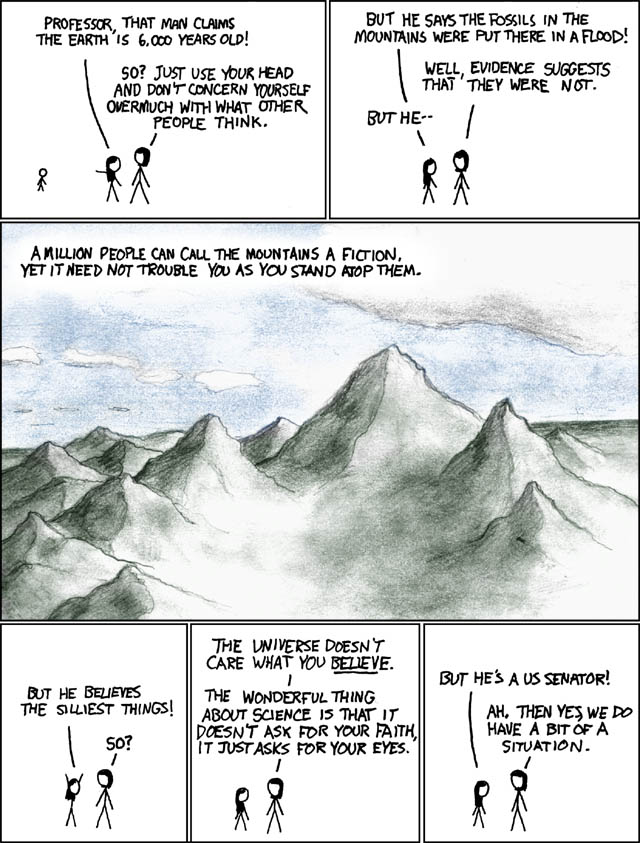
Well, a NASA report stated that 95.6% of the "universe" is made up of an invisible dark matter/energy - a glue that directs the integrity of what we can see/feel/etc, which is 4.4%. That 4.4% is the combination of the hundreds of millions of the stars in each galaxy with their own solar systems and the hundreds of millions of galaxies that we assume to exist. But, we sit on this little planet and haven't even discovered 1% of the microbe species living on it. My point, science is a neutral tool developed from limited observation, with the rest filled in with faith..
Agreed.
That said, I do believe in a God. I was raised Catholic, and still identify as such (my disagreement with some of the stances the Church has notwithstanding), but I don't think God gives half an omnipotent crap if you're Catholic, Protestant, Jewish, Muslim, Hindu, Pagan, Pastafarian, etc., as long as you're generally a good person and not a giant, hateful A-hole.
Also, thank you for the link to the Einstein article. Fascinating read.
Same here. I'm Muslim...but I don't agree with everything in the Quran. I don't think any real God would condemn anyone to Hell for not belonging to religion X. You can find good and bad in all religions if you're looking for it. But what's important, like you said, is being a good person, and I think most people have an idea of what a good person is, whether they belong to a religion or not.
"Some parallels between Horus and Jesus Christ:
1. Horus born of a virgin. <> Jesus born of a virgin.
2. The foster father of Horus was Seb or Seph. <> Jesus was fostered by Joseph.
3. Horus was of royal descent. <> Jesus was of royal descent.
4. Horus birth accompanied by three solar deities [star gazers] who followed by the morning star of Sirius bearing gifts. <> Jesus birth accompanied by three wise men [Zoroastrian star gazers] who followed by a star in the east bearing gifts.
5. The birth of Horus announced by angels. <> The birth of Jesus announced by angels.
6. Herut tried to murder the infant Horus. <> Herod slaughtered every first born in an attempt to kill Jesus the forthcoming messiah.
7. Horus is baptized at age 30 by Anup the Baptiser at a river. <> Jesus is baptized at age 30 by John the Baptist at a river.
8. Horus resists temptation by the evil Sut [Sut was to be the precursor for the Hebrew Satan] on a high mountain. <> Jesus resists temptation by Satan on a high mountain.
9. Horus had 12 followers. <> Jesus had 12 disciples.
10. Horus performed miracles like healing the sick and walking on water. <> Jesus performed miracles like healing the sick and walking on water.
11. Horus raised someone from the grave [his father Osiris] <> Jesus raised Lazarus [notice the name similarity] from the grave. Lazarus is short for Elasarus - the us on the end is romanized. Elasarus was derived from El-Asar which was the name given to Osiris.
12. Horus was buried and resurrected in the city of Anu. <> The place Bethany mentioned in John was a derivative of the words Bet and Anu which translates the house of Anu. The y on the end of bethany is interchangeable with the letter u.
13. Horus was killed by crucifixtion. <> Jesus was crucified.
14. Horus was accompanied by two thieves at the crucifixtion. <> Jesus was crucified with two thieves.
15. Horus was buried in a tomb at Anu. <> Jesus was buried in a tomb located in Bethany [Bet-Anu].
16. Horus was resurrected after 3 days. <> Jesus was said to resurrected after over a period of three days.
17. The resurrection of Horus was announced by three women. <> The resurrection of Jesus was announced by three women.
18. Horus was given the titel KRST which means anointed one <> Jesus was given the title Christ [Christos] meaning anointed one"
Horus is like a bajillion years older, btw
That's amazing. I honestly never knew that.... (the more you know...)
Advertisement - Members don't see this ad

That's amazing. I honestly never knew that.... (the more you know...)
That story has been floating around the Mediterranean for millenia.
Every December I hear that "Jesus is the reason for the season", when in actuality the solstice is the reason for the winter holiday. You know, the period where the "Sun/Son" reaches it's lowest point in the horizon, maintains it's position, and then "raises" 3 days later? Lot's of things to think about.
Not to take anything away from the comfort religions bring people, but I find this stuff terribly interesting.


Well, a NASA report stated that 95.6% of the "universe" is made up of an invisible dark matter/energy - a glue that directs the integrity of what we can see/feel/etc, which is 4.4%. That 4.4% is the combination of the hundreds of millions of the stars in each galaxy with their own solar systems and the hundreds of millions of galaxies that we assume to exist. But, we sit on this little planet and haven't even discovered 1% of the microbe species living on it. My point, science is a neutral tool developed from limited observation, with the rest filled in with faith..
We 'assume' galaxies exist? What is this "rest" that is filled in with faith?
To anyone interested in the subject (religious or not) I highly suggest The God Delusion by Richard Dawkins. Amazing book.
Two of my favorite quotes (I was reminded of them reading through this thread) are "Religion is regarded by the common people as true, by the wise as false, and by the rulers as useful" (Seneca the Younger) and "I do not fear death. I had been dead billions and billions of years before I was born, and had not suffered the slightest inconvenience from it" (Mark Twain).
Two of my favorite quotes (I was reminded of them reading through this thread) are "Religion is regarded by the common people as true, by the wise as false, and by the rulers as useful" (Seneca the Younger) and "I do not fear death. I had been dead billions and billions of years before I was born, and had not suffered the slightest inconvenience from it" (Mark Twain).

"I do not fear death. I had been dead billions and billions of years before I was born, and had not suffered the slightest inconvenience from it" (Mark Twain).
👍
Death is something to be embraced...not feared. I'm curious to see (or not) how many would lose their "good" nature once all emotional and physical crutches are taken away and are faced with death. That's why good nature has to be accountable to a higher power...not particularly for when times are cozy, but for times that test our humanity.
Ive been having a hard time grasping the initial creation. Something can't come from nothing right? People have this dichotomy-type thinking where its believe in Evolution or God. Human evolution: one has to believe some bacterium was placed on this earth. but before that, an amino acid had to be brought about, allowing a perfect string of amino acids to create a cell which has all the complexities such as DNA and the biochemistry that goes with it, all forming due to random guess and try. Even the miller experiment had to have the right atmosphere to create an amino acid with unlikely circumstances ( constant elictrical impulse) just to create on AA, not to mention the right string of AA for one little but complex cell to exist. I believe instead for all the right things to happen, some external intelligence had to be there i guess guiding it to make the right decisions like evolution. Kind of like every design has a designer. Every watch maker has a watch. Every cell phone had some intelligence that put it together. I've never seen any scientific experiment showing order coming from disorder. Denying the existence seems to me as absurd as denying your great great grandmother. Yes I cant physically prove to you she ever existed, but logically, I wouldn't even have to. Same way, we either came from nothing, or had a creator.
I think the problem is that religion has been manipulated in the past, used to control others, people of power manipulating their positions, so we have
just equated everything God related to be bogus. But if we believe in simply one creator, there's really only one solution out there that fits the needs of this belief, a belief you dont need anything other than thinking and reflecting on your own.
I think the problem is that religion has been manipulated in the past, used to control others, people of power manipulating their positions, so we have
just equated everything God related to be bogus. But if we believe in simply one creator, there's really only one solution out there that fits the needs of this belief, a belief you dont need anything other than thinking and reflecting on your own.

If God created us, then who created God. Doesn't this just lead back to evolution?
The nature of his existence lies beyond the realm of human understanding (according to most theists). Kind of like the Big Bang. How could something have arose from nothing? As a child, I used to ask this question a lot.
God is the cause of the big bang. he formed the world out of nothing in a very small space which blew up.
The problem with infinite regression is that you will never find a satisfactory answer. Ever. Some say God exists outside the confines of time and space and so therefore has "always" existed in what we think of as a linear timeline. But since he is outside of that linear idea of time, he simply exists and therefore has "always" existed. But then you have the problem of the identity of God. How does one know this creator is the Judeo-Christian God? Why not the Muslim Allah or any other of the thousands of gods who have existed.
In the absence of God, one finds infinite regression frustrating because you get back to the big bang. Random gaseous stars with centers of gravity. Okay, before that? and that? and that? etc etc.
What it comes down to for me is what is more probable and scientifically believable. Dawkins uses the example of a teacup in space. If I tell you that there is a teacup somewhere in space millions of miles away orbiting an unknown planet you have no way of disproving my theory. You'll most likely roll your eyes after the "are you kidding?" phase and leave me be with my strange belief. Why would you have that reaction? Because it is completely unlikely that there is actually a teacup orbiting somewhere in space millions of miles away. Same thing with the idea of a creator. We do not understand exactly how things happened to form our universe so in order for us to satisfy our need to "understand" make up a creator (there have been thousands throughout history) and the case is settled. Only scientists can really say with comfort "I don't know what really happened" at the same time saying "I'm fairly certain that it did not happen THAT way".
Sorry for butchering the teacup example. Dawkins is a much more effective writer ;-) Seriously, read his book The God Delusion. It is the book that "broke the straw on the camel's back" for me as far as a faith in God. Was Christian for my entire life. Church 4x a week, leading Bible studies, "witnessing", church camps, etc etc etc. But started doubting a lot when I went to school and majored in Biochemistry. A year later I read the book and couldn't be intellectually dishonest with myself anymore. Anyway, that's another issue
In the absence of God, one finds infinite regression frustrating because you get back to the big bang. Random gaseous stars with centers of gravity. Okay, before that? and that? and that? etc etc.
What it comes down to for me is what is more probable and scientifically believable. Dawkins uses the example of a teacup in space. If I tell you that there is a teacup somewhere in space millions of miles away orbiting an unknown planet you have no way of disproving my theory. You'll most likely roll your eyes after the "are you kidding?" phase and leave me be with my strange belief. Why would you have that reaction? Because it is completely unlikely that there is actually a teacup orbiting somewhere in space millions of miles away. Same thing with the idea of a creator. We do not understand exactly how things happened to form our universe so in order for us to satisfy our need to "understand" make up a creator (there have been thousands throughout history) and the case is settled. Only scientists can really say with comfort "I don't know what really happened" at the same time saying "I'm fairly certain that it did not happen THAT way".
Sorry for butchering the teacup example. Dawkins is a much more effective writer ;-) Seriously, read his book The God Delusion. It is the book that "broke the straw on the camel's back" for me as far as a faith in God. Was Christian for my entire life. Church 4x a week, leading Bible studies, "witnessing", church camps, etc etc etc. But started doubting a lot when I went to school and majored in Biochemistry. A year later I read the book and couldn't be intellectually dishonest with myself anymore. Anyway, that's another issue
oh Vishna, you had me at Dawkins.
I was atheist until I met this airforce pilot who mentioned humanism and how it's sort of the "transcended" atheism. I found it beautiful, and have since taken on that philosophy for living.
I was atheist until I met this airforce pilot who mentioned humanism and how it's sort of the "transcended" atheism. I found it beautiful, and have since taken on that philosophy for living.
The nature of his existence lies beyond the realm of human understanding (according to most theists). Kind of like the Big Bang. How could something have arose from nothing? As a child, I used to ask this question a lot.
Quantum fluctuations. It is not against the laws of physics for something to come from nothing. That is a hypothesis that we do not fully understand - we know fairly well what happened post Big Bang but not prior (if we can use that term as time as a concept may not have existed but that too is a poorly understood concept). Think of it this way - we know time slows down as gravity increases - at the point of big bang, there was the mass of the entire universe compressed into a volume that was infinitely small (density =m/v) so a lot of mass in zero volume = infinite density and thus infinite gravity and thus time moves infinitely slowly. This is why our physics falls apart at the center of black holes and at the beginning of the universe. You end up dividing by zero volume (which is undefined). However time may have been effectively been infinitely slow at the point of the big bang. We don't know though - our physics start working from the fraction of a second post big bang though physicists are hoping for the theory of everything which combines relativity with quantum mechanics which will hopefully let us use our physics in a singularity.
Whatever the answer is, you cannot explain complexity by positing the existence of an even more complex entity (eg God) because then you need to explain that as well. If you're not willing to, then you need to remove yourself from reasonable or scientific discussion and instead discuss it in Church.
I don't know is a valid answer and in fact is the root of all scientific progress. However if you put forward the God hypothesis then you better attempt to explain the origin of infinite complexly that is God and why randomly adding infinite complexity makes the problem simpler or it's not a real hypothesis. Otherwise you're no different than the cavemen who said God was responsible for lightning and for every other phenomena he did not understand.
Last edited:
oh Vishna, you had me at Dawkins.
I was atheist until I met this airforce pilot who mentioned humanism and how it's sort of the "transcended" atheism. I found it beautiful, and have since taken on that philosophy for living.
I see. Are the two mutually exclusive? I thought humanism had more to do with where you derive your ethics from. Does that still make you an atheist or...? Sorry. No real reason except curiosity now that it was brought up.
No they aren't. I'm an atheist and a secular humanist.
Advertisement - Members don't see this ad
No they aren't. I'm an atheist and a secular humanist.
Know of a good book on secular humanism? For a novice though, please 🙂
http://en.wikipedia.org/wiki/Secular_humanism 😛.
My first foray away from religion was Russel's brilliantly scathing "Why I am not a Christian."
My first foray away from religion was Russel's brilliantly scathing "Why I am not a Christian."
Your right, after you get to the point that, you have to humble yourself in knowing that we know very little. about our existence. We'll keep going in circles with infinite regression because its like the soldier example who wanting to fire his gun, awaiting orders from his commander, who awaits order from his commander ad infinitum, the gun will never be fired, and likewise if this type of infinite regress was possible, the world would not be in existence.
But not knowing how we came into being exactly still doesn't take away from the fact that were just too perfectly formed down to a minute cell for 'mother nature' to just figure itself out in creating complex DNA.
So yea were still at square one in that He probably exists but we dont know enough so forget about it. And thats all you can really get to on your own. Thats where I find solace in a book that tells you about Him, a book unchanged that explained the big bang, stages of development of a human being thousands of years ago and calls to knowing that there is One creator that explains our existence. It was either made up and happened to be right. but thats just my belief, thought I'd share if anyone was interested.
But not knowing how we came into being exactly still doesn't take away from the fact that were just too perfectly formed down to a minute cell for 'mother nature' to just figure itself out in creating complex DNA.
So yea were still at square one in that He probably exists but we dont know enough so forget about it. And thats all you can really get to on your own. Thats where I find solace in a book that tells you about Him, a book unchanged that explained the big bang, stages of development of a human being thousands of years ago and calls to knowing that there is One creator that explains our existence. It was either made up and happened to be right. but thats just my belief, thought I'd share if anyone was interested.
The problem with infinite regression is that you will never find a satisfactory answer. Ever. Some say God exists outside the confines of time and space and so therefore has "always" existed in what we think of as a linear timeline. But since he is outside of that linear idea of time, he simply exists and therefore has "always" existed. But then you have the problem of the identity of God. How does one know this creator is the Judeo-Christian God? Why not the Muslim Allah or any other of the thousands of gods who have existed.
In the absence of God, one finds infinite regression frustrating because you get back to the big bang. Random gaseous stars with centers of gravity. Okay, before that? and that? and that? etc etc.
What it comes down to for me is what is more probable and scientifically believable. Dawkins uses the example of a teacup in space. If I tell you that there is a teacup somewhere in space millions of miles away orbiting an unknown planet you have no way of disproving my theory. You'll most likely roll your eyes after the "are you kidding?" phase and leave me be with my strange belief. Why would you have that reaction? Because it is completely unlikely that there is actually a teacup orbiting somewhere in space millions of miles away. Same thing with the idea of a creator. We do not understand exactly how things happened to form our universe so in order for us to satisfy our need to "understand" make up a creator (there have been thousands throughout history) and the case is settled. Only scientists can really say with comfort "I don't know what really happened" at the same time saying "I'm fairly certain that it did not happen THAT way".
Sorry for butchering the teacup example. Dawkins is a much more effective writer ;-) Seriously, read his book The God Delusion. It is the book that "broke the straw on the camel's back" for me as far as a faith in God. Was Christian for my entire life. Church 4x a week, leading Bible studies, "witnessing", church camps, etc etc etc. But started doubting a lot when I went to school and majored in Biochemistry. A year later I read the book and couldn't be intellectually dishonest with myself anymore. Anyway, that's another issue
But not knowing how we came into being exactly still doesn't take away from the fact that were just too perfectly formed down to a minute cell for 'mother nature' to just figure itself out in creating complex DNA

Quantum fluctuations. It is not against the laws of physics for something to come from nothing. That is a hypothesis that we do not fully understand - we know fairly well what happened post Big Bang but not prior (if we can use that term as time as a concept may not have existed but that too is a poorly understood concept). Think of it this way - we know time slows down as gravity increases - at the point of big bang, there was the mass of the entire universe compressed into a volume that was infinitely small (density =m/v) so a lot of mass in zero volume = infinite density and thus infinite gravity and thus time moves infinitely slowly. This is why our physics falls apart at the center of black holes and at the beginning of the universe. You end up dividing by zero volume (which is undefined). However time may have been effectively been infinitely slow at the point of the big bang. We don't know though - our physics start working from the fraction of a second post big bang though physicists are hoping for the theory of everything which combines relativity with quantum mechanics which will hopefully let us use our physics in a singularity.
Whatever the answer is, you cannot explain complexity by positing the existence of an even more complex entity (eg God) because then you need to explain that as well. If you're not willing to, then you need to remove yourself from reasonable or scientific discussion and instead discuss it in Church.
I don't know is a valid answer and in fact is the root of all scientific progress. However if you put forward the God hypothesis then you better attempt to explain the origin of infinite complexly that is God and why randomly adding infinite complexity makes the problem simpler or it's not a real hypothesis. Otherwise you're no different than the cavemen who said God was responsible for lightning and for every other phenomena he did not understand.
I agree. I'm saying most theists believe God to be above scientific inquiry/explanation, and so yeah, they should remove themselves from scientific discussion. And yeah...just because something can't be explained with current scientific evidence doesn't mean it should be attributed to God or something supernatural.
http://www.livescience.com/379-scientists-belief-god-varies-starkly-discipline.html
according to this study 76% of physicians believe in a god and most scientists in general.
according to this study 76% of physicians believe in a god and most scientists in general.
http://www.livescience.com/379-scientists-belief-god-varies-starkly-discipline.html
according to this study 76% of physicians believe in a god and most scientists in general.
Polls show somewhere around 90% of the general public believes in a god. You say 76% of physicians do. Yet 93% of the National Academy of Science do not. This only goes to show that intelligence, education, and scientific thinking tend to lead people away from religion.
http://www.livescience.com/379-scientists-belief-god-varies-starkly-discipline.html
according to this study 76% of physicians believe in a god and most scientists in general.
This is a horribly written article. No details are given as far as the statistical analysis used, how the physicians or scientists were selected, etc. Assuming that the 76% number is true (which I don't doubt entirely), tehdude's observation is still true. The more educated an individual is the less likely he or she is to believe in the supernatural.
I love Intelligence Squared debates.
http://intelligencesquaredus.org/index.php/past-debates/america-is-too-damn-religious/
http://intelligencesquaredus.org/index.php/past-debates/america-is-too-damn-religious/
But not knowing how we came into being exactly still doesn't take away from the fact that were just too perfectly formed down to a minute cell for 'mother nature' to just figure itself out in creating complex DNA.
So yea were still at square one in that He probably exists but we dont know enough so forget about it. And thats all you can really get to on your own. Thats where I find solace in a book that tells you about Him, a book unchanged that explained the big bang, stages of development of a human being thousands of years ago and calls to knowing that there is One creator that explains our existence. It was either made up and happened to be right. but thats just my belief, thought I'd share if anyone was interested.
1. "too perfectly formed" is nearly as bad as the "too complex" argument to explain the existence of a creator.
2. The bible is not unchanged, this includes both new and old testaments. It has been extensively revised, edited and changed throughout its existence. The biblical apocrypha is a prime example, as entire gospels have been added and removed over the years. This does not even take into consideration the issues authorship, scribes and translation of the current King James version.
3. "thousands of years ago"...really?
I'd still like to know the answers as they have some sort of relevance toward this thread (I would've been called out on it if it wasn't). Thanks. 🙂*previous question*
Quantum fluctuations. It is not against the laws of physics for something to come from nothing. That is a hypothesis that we do not fully understand - we know fairly well what happened post Big Bang but not prior (if we can use that term as time as a concept may not have existed but that too is a poorly understood concept). Think of it this way - we know time slows down as gravity increases - at the point of big bang, there was the mass of the entire universe compressed into a volume that was infinitely small (density =m/v) so a lot of mass in zero volume = infinite density and thus infinite gravity and thus time moves infinitely slowly. This is why our physics falls apart at the center of black holes and at the beginning of the universe. You end up dividing by zero volume (which is undefined). However time may have been effectively been infinitely slow at the point of the big bang. We don't know though - our physics start working from the fraction of a second post big bang though physicists are hoping for the theory of everything which combines relativity with quantum mechanics which will hopefully let us use our physics in a singularity.
Whatever the answer is, you cannot explain complexity by positing the existence of an even more complex entity (eg God) because then you need to explain that as well. If you're not willing to, then you need to remove yourself from reasonable or scientific discussion and instead discuss it in Church.
I don't know is a valid answer and in fact is the root of all scientific progress. However if you put forward the God hypothesis then you better attempt to explain the origin of infinite complexly that is God and why randomly adding infinite complexity makes the problem simpler or it's not a real hypothesis. Otherwise you're no different than the cavemen who said God was responsible for lightning and for every other phenomena he did not understand.
You're awesome. This has to be the best post I've ever read...and it makes complete sense. I wish I was as eloquent when explaining my beliefs, however.

It kills me when people try to debate faith. If God wanted you to know he existed you would know. It's hard to believe in something when there isn't any solid proof. That's the point of religion. Faith. Believing in something when you can't prove it.
Also you can't use laws of this world to prove the presence of an omnipotent being. Natural laws only apply to things in the natural world. Supernatural beings require a different set of laws that we don't know yet. But this is all just a thought, take it as you want.
Also you can't use laws of this world to prove the presence of an omnipotent being. Natural laws only apply to things in the natural world. Supernatural beings require a different set of laws that we don't know yet. But this is all just a thought, take it as you want.
It kills me when people try to debate faith. If God wanted you to know he existed you would know. It's hard to believe in something when there isn't any solid proof. That's the point of religion. Faith. Believing in something when you can't prove it.
Also you can't use laws of this world to prove the presence of an omnipotent being. Natural laws only apply to things in the natural world. Supernatural beings require a different set of laws that we don't know yet. But this is all just a thought, take it as you want.
I don't think a lot of people are debating faith. People are entitled to their beliefs...although it is not out of line to question if faith / religious belief is an ideal. That was a question I asked myself when I was younger...why is faith a good thing?
If you believe that a supernatural realm/ being exists and is not subject to the laws of the natural world, that is fine. What I (and I assume others) take issue with is when people mix the two realms and try to inject the laws of the supernatural into the laws of nature. As I said, just because we don't know the answer to something in nature doesn't mean we can immediately attribute it to the supernatural. For example, a previous poster noting that life is thousands of years old because that is what his/her beliefs include.
Part of the problem is that the creation of life / the universe often blurs the line between what people consider the natural world and the supernatural. People that consider a belief in the supernatural to be a type of magical thinking also make an argument that there is only a "natural" world, even if we have not yet been able to fully explain it. Again this returns to the idea of being comfortable with the unknown without relying on speculation to provide answers. You can see how this gets complicated.
The poster did not say that life was thousands of years old, just that human beings are only thousands of years in development. He may have meant what you think he meant but he didn't say it.
Although I believe the original message of the prophets before were the same(theres one creator), I wasn't referring to the bible. But i don't want this to turn into preaching. To each his own, as long as were trying to be true to ourselves, and truth seekers. pm me
Initial creation can never be explained because we were never witnesses to the big bang. I am taking the 'leap of faith' that everything created with complexity and a purpose...had a creator. Others see it as it being something we don't know, so take the 'leap of faith' that in this instance, there was no creator.
Initial creation can never be explained because we were never witnesses to the big bang. I am taking the 'leap of faith' that everything created with complexity and a purpose...had a creator. Others see it as it being something we don't know, so take the 'leap of faith' that in this instance, there was no creator.
1. "too perfectly formed" is nearly as bad as the "too complex" argument to explain the existence of a creator.
2. The bible is not unchanged, this includes both new and old testaments. It has been extensively revised, edited and changed throughout its existence. The biblical apocrypha is a prime example, as entire gospels have been added and removed over the years. This does not even take into consideration the issues authorship, scribes and translation of the current King James version.
3. "thousands of years ago"...really?
Advertisement - Members don't see this ad
Initial creation can never be explained because we were never witnesses to the big bang. I am taking the 'leap of faith' that everything created with complexity and a purpose...had a creator. Others see it as it being something we don't know, so take the 'leap of faith' that in this instance, there was no creator.
So if you went home to find your mother's door busted down and her body decapitated and gutted, who could say what happened to her, because you were never witness to it. Some may look at the bloody knife next her body with DNA matching her ex-husband and take a leap of faith and assume she was murdered, but really how her head left her body can never be explained. 😴
Last edited:
Note the number of people that chose "I am certain that God exists"
The fallacy of choosing that answer stems from the certainty of knowing a god exists when no evidence is available. Not only that, but the word certain by definition is it is as fact, beyond all doubt.
If that was the case, then you should be God's elite disciples since you know a supreme deity exists!
The fallacy of choosing that answer stems from the certainty of knowing a god exists when no evidence is available. Not only that, but the word certain by definition is it is as fact, beyond all doubt.
If that was the case, then you should be God's elite disciples since you know a supreme deity exists!
You need to look up what faith means.Although I believe the original message of the prophets before were the same(theres one creator), I wasn't referring to the bible. But i don't want this to turn into preaching. To each his own, as long as were trying to be true to ourselves, and truth seekers. pm me
Initial creation can never be explained because we were never witnesses to the big bang. I am taking the 'leap of faith' that everything created with complexity and a purpose...had a creator. Others see it as it being something we don't know, so take the 'leap of faith' that in this instance, there was no creator.
We don't know is not a leap of faith. It's simply means that.....we don't know. Eg we do not have enough data to come up with a conclusion that is logical. A infinite complexity diety is not logical because it explains nothing. You could have (and people did) used it to explain lightning and fire and the seasons by saying we can never know so god must have done it.

I believe in evolution and am a devote Catholic. I also believe in Devine Initiation.
"In his encyclical Humani Generis (1950), my predecessor Pius XII has already affirmed that there is no conflict between evolution and the doctrine of the faith regarding man and his vocation, provided that we do not lose sight of certain fixed points.... Today, more than a half-century after the appearance of that encyclical, some new findings lead us toward the recognition of evolution as more than a hypothesis. In fact it is remarkable that this theory has had progressively greater influence on the spirit of researchers, following a series of discoveries in different scholarly disciplines. The convergence in the results of these independent studieswhich was neither planned nor soughtconstitutes in itself a significant argument in favor of the theory." - Pope John Paul II
"Science can purify religion from error and superstition. Religion can purify science from idolatry and false absolutes." - Pope John Paul II
"In his encyclical Humani Generis (1950), my predecessor Pius XII has already affirmed that there is no conflict between evolution and the doctrine of the faith regarding man and his vocation, provided that we do not lose sight of certain fixed points.... Today, more than a half-century after the appearance of that encyclical, some new findings lead us toward the recognition of evolution as more than a hypothesis. In fact it is remarkable that this theory has had progressively greater influence on the spirit of researchers, following a series of discoveries in different scholarly disciplines. The convergence in the results of these independent studieswhich was neither planned nor soughtconstitutes in itself a significant argument in favor of the theory." - Pope John Paul II
"Science can purify religion from error and superstition. Religion can purify science from idolatry and false absolutes." - Pope John Paul II
So if you went home to find your mother's door busted down and her body decapitated and gutted, who could say what happened to her, because you were never witness to it. Some may look at the bloody knife next her body with DNA matching her ex-husband and take a leap of faith and assume she was murdered, but really how her head left her body can never be explained. 😴
Wow that's disturbing. This was the only situation you could think of to demonstrate your point??? When will this thread just die already?
Last edited:
Similar threads
- Replies
- 5
- Views
- 967

- Replies
- 0
- Views
- 791

- Replies
- 0
- Views
- 671

