


Advertisement - Members don't see this ad
Source: https://jamanetwork.com/journals/jamanetworkopen/fullarticle/2849140
Firstly the good things I have to say: it's a paper written mostly by non-podiatrists about how important podiatrists are.
However, I think the "lies, damn lies, and statistics" quote is relevant here. Much as I really do like all scientific studies saying good things about podiatrists, the 19.1 figure is suspicious, so I had to take a look.
The key qualifier is that it only applies in markets with 1 or fewer podiatrists per 10k medicare beneficiaries. In regions with 4 podiatrists per 10k beneficiaries, the reduction in odds is only 6.6%. So in an underserved area, adding one podiatrist reduces the odds 19.1% but then add 2 more and they're only making a 6.6% difference in the odds. The paper doesn't address this diminishing returns, and I think that's a pretty important takeaway for the conversation on job market saturation.
The other thing I dislike about a lot of public health studies is that they take a 30,000 foot view of a problem without getting granular about causal mechanisms. OK fine, it's population medicine, the paper wasn't designed to do that. But what specifically are the preventative services that we provide that lead to this odds reduction? I use a multimodal approach to DFUs, and I'd be interested to know which interventions have a greater return.
Other fun facts, they have a map of all the wound-treating DPMs in the continental US.
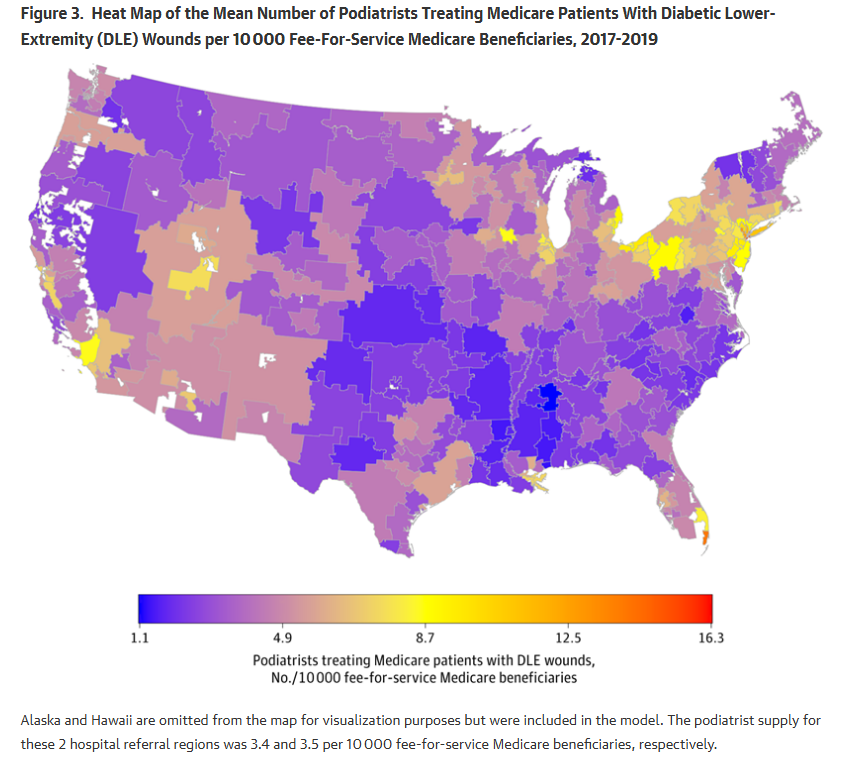
Basically all the hotspots are the cities with podiatry schools, plus New Orleans and Salt Lake City. Imagine that.
But yeah if the conclusion is "we need more podiatrists," maybe we should be thinking instead what preventative services to podiatrists offer that lead to this 19.1% odds reduction? And why can't non-podiatrists do it?
Firstly the good things I have to say: it's a paper written mostly by non-podiatrists about how important podiatrists are.
However, I think the "lies, damn lies, and statistics" quote is relevant here. Much as I really do like all scientific studies saying good things about podiatrists, the 19.1 figure is suspicious, so I had to take a look.
The key qualifier is that it only applies in markets with 1 or fewer podiatrists per 10k medicare beneficiaries. In regions with 4 podiatrists per 10k beneficiaries, the reduction in odds is only 6.6%. So in an underserved area, adding one podiatrist reduces the odds 19.1% but then add 2 more and they're only making a 6.6% difference in the odds. The paper doesn't address this diminishing returns, and I think that's a pretty important takeaway for the conversation on job market saturation.
The other thing I dislike about a lot of public health studies is that they take a 30,000 foot view of a problem without getting granular about causal mechanisms. OK fine, it's population medicine, the paper wasn't designed to do that. But what specifically are the preventative services that we provide that lead to this odds reduction? I use a multimodal approach to DFUs, and I'd be interested to know which interventions have a greater return.
Other fun facts, they have a map of all the wound-treating DPMs in the continental US.
Basically all the hotspots are the cities with podiatry schools, plus New Orleans and Salt Lake City. Imagine that.
But yeah if the conclusion is "we need more podiatrists," maybe we should be thinking instead what preventative services to podiatrists offer that lead to this 19.1% odds reduction? And why can't non-podiatrists do it?


