
You are using an out of date browser. It may not display this or other websites correctly.
You should upgrade or use an alternative browser.
You should upgrade or use an alternative browser.
fulcrum question
Started by Oh_Gee


0.5 m is the distance from the fulcrum to the center of mass of the plank.

0.5 m is the distance from the fulcrum to the center of mass of the plank.
could you explain how to center of mass in this problem?
A "see-saw" apparatus was set up such that the fulcrum is 3/4 of the length of the uniform bar (x) from one end. A person of mass 2 m sits at the end of the side closer to the fulcrum while another person of mass m sits on the other side of the fulcrum. How far away from the end must the lighter person sit in order for the system to be in equilibrium assuming that the mass of the bar is 1/2 m?
a. 1/4x
b. 1/2 x
c. 3/8 x
d. 5/16x
Answer: C
On the Surface: Under conditions of equilibrium, the force vectors in the y and x directions must sum up to 0. In this case, let's arbitrarily set the upward direction as negative and the fulcrum as the pivot point (a fulcrum is the point about which something balances). We have 3 forces at work:
- the torque of the first person sitting near the fulcrum, whose torque will be given by: L = Force x lever arm (distance from the pivot point) = (2m)g x 1/4 ;
- the torque of the second person sitting at a distance r: L = F x r = (mg) x (r);
- the torque of the bar (in the upward direction) = F x r = -(1/2m)g x 1/4.
Σ L = Σ Fy + Σ Fx = 0 (where Σ Fx = 0 in this case)
[(2m)g x 1/4] + [(mg) x r] + [-(1/2m)g x 1/4] = 0
2/4 mg + mgr - 1/8 mg = 0 --> 4/8 mg - 1/8 mg = -mgr --> 3/8 mg = - mgr --> r = -3/8
Therefore, the person must be 3/8 x from the bar for the system to be in equilibrium.
Going Deeper: Two rules will allow you to solve any MCAT problems dealing with torque (turning) forces: translational and rotational equilibria.
For translational equilibrium:
Σ Fx = 0 and Σ Fy = 0
The forces acting on the bar are the weights (mg). We can arbitrarily say all downward forces are positive and upward forces are negative. Substituting values for the 2 people, the bar and the upward force (xg) which maintains equilibrium at the fulcrum, we get:
Σ Fy = (2m)g + (m)g + (1/2m)g - xg = 0
Thus
x = 7/2 m
For rotational equilibrium:
Σ L = 0
The sum of the torque forces L (the force mg multiplied by the perpendicular distance from the pivot point) acting on the bar must add to zero. A uniform bar has its center of mass acting at the mid-point of the bar. Thus the line diagram is as follows:

Taking point a as our pivot point (arbitrary) and clockwise as the positive direction (arbitrary; cf. PHY 4.1.1), we get:
Σ L = (2 m) g (x) + (-7/2 m) g (3/4)x + (1/2 m) g (1/2x) + (m) g (rx) = 0
Eliminating mgx we get:
2 + (21/8) + 1/4 + r = 0
or
r = 21/8 - 2/8 - 16/8 = 3/8.
Last edited:
you mean you want to see this problem done using center of mass?
Advertisement - Members don't see this ad

Since the plank is in equilibrium, the sums of the torques on either side of the fulcrum must be equal to each other:
Tleft = Tright, where T is torque = (force)(distance to fulcrum)
You have to ask yourself a few things:
(1) Where is the fulcrum?
It's 0.5m from the left end.
(2) What are the forces acting on either side of the fulcrum?
Left: Weight of the 4kg mass 0.3m from the left end (or 0.2m to the left of the fulcrum)
Right: Weight of the uniform plank, but where? An object exerts its weight on its center of mass which, for a uniform plank, is in the center (1.0m from the left end or 0.5m to the right of the fulcrum)
Equation Set-Up
Tleft = Tright
Fr = Fr
mgr = mgr
mr = mr
(4)(0.2) = (x)(0.5)
Solve for x
You can see that g drops out for this problem. You can simplify the problem to mr = mr for both the left and right sides of the fulcrum. This is pretty much true for all plank equilibrium type problems. Obviously this isn't true if you have a problem where Person X exerts a constant force F a distance d away from the fulcrum.
If you're having problems, then draw a picture with all the forces being exerted on the plank! Don't forget about the weight of the plank either. I often forget to do this when it's a problem involving two objects already.
Tleft = Tright, where T is torque = (force)(distance to fulcrum)
You have to ask yourself a few things:
(1) Where is the fulcrum?
It's 0.5m from the left end.
(2) What are the forces acting on either side of the fulcrum?
Left: Weight of the 4kg mass 0.3m from the left end (or 0.2m to the left of the fulcrum)
Right: Weight of the uniform plank, but where? An object exerts its weight on its center of mass which, for a uniform plank, is in the center (1.0m from the left end or 0.5m to the right of the fulcrum)
Equation Set-Up
Tleft = Tright
Fr = Fr
mgr = mgr
mr = mr
(4)(0.2) = (x)(0.5)
Solve for x
You can see that g drops out for this problem. You can simplify the problem to mr = mr for both the left and right sides of the fulcrum. This is pretty much true for all plank equilibrium type problems. Obviously this isn't true if you have a problem where Person X exerts a constant force F a distance d away from the fulcrum.
If you're having problems, then draw a picture with all the forces being exerted on the plank! Don't forget about the weight of the plank either. I often forget to do this when it's a problem involving two objects already.
but shouldn't r on the right side be 1.5 meters? since the fulcrum divides the plank into a .5 m and 1.5 segments. is center of gravity always midpoint of a bar even if the pivot point/fulcrum isn'tSince the plank is in equilibrium, the sums of the torques on either side of the fulcrum must be equal to each other:
Tleft = Tright, where T is torque = (force)(distance to fulcrum)
You have to ask yourself a few things:
(1) Where is the fulcrum?
It's 0.5m from the left end.
(2) What are the forces acting on either side of the fulcrum?
Left: Weight of the 4kg mass 0.3m from the left end (or 0.2m to the left of the fulcrum)
Right: Weight of the uniform plank, but where? An object exerts its weight on its center of mass which, for a uniform plank, is in the center (1.0m from the left end or 0.5m to the right of the fulcrum)
Equation Set-Up
Tleft = Tright
Fr = Fr
mgr = mgr
mr = mr
(4)(0.2) = (x)(0.5)
Solve for x
You can see that g drops out for this problem. You can simplify the problem to mr = mr for both the left and right sides of the fulcrum. This is pretty much true for all plank equilibrium type problems. Obviously this isn't true if you have a problem where Person X exerts a constant force F a distance d away from the fulcrum.
If you're having problems, then draw a picture with all the forces being exerted on the plank! Don't forget about the weight of the plank either. I often forget to do this when it's a problem involving two objects already.
i don't understand how to get the answer the way they did. is there a simpler way?you mean you want to see this problem done using center of mass?
but shouldn't r on the right side be 1.5 meters? since the fulcrum divides the plank into a .5 m and 1.5 segments. is center of gravity always midpoint of a bar even if the pivot point/fulcrum isn't
No, the r on the right side is 0.5m. The center of gravity is always the midpoint for a uniformly dense bar.
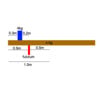
Take a look at this poorly drawn diagram haha
You can see that to the left of the fulcrum the only force there is the weight of the 4kg mass, which is 0.2m away from the fulcrum.
On the right, the only force is the weight of the plank being exerted at the center of gravity, which is the midpoint or 0.5 away from the fulcrum.
Attachments
so let me collect my thoughtsNo, the r on the right side is 0.5m. The center of gravity is always the midpoint for a uniformly dense bar.
Take a look at this poorly drawn diagram haha
You can see that to the left of the fulcrum the only force there is the weight of the 4kg mass, which is 0.2m away from the fulcrum.
On the right, the only force is the weight of the plank being exerted at the center of gravity, which is the midpoint or 0.5 away from the fulcrum.
the center of mass in a plank/pivot system is always the midpoint of the length of plank even if the pivot is not at the midpoint of the plank
so in this problem the torque on the right side (torque=Force x r) would be (X kg)(gravity)(distance from pivot point to the center of mass)
torque right side= (X kg)(10)(1-.5)
is that right?
so let me collect my thoughts
the center of mass in a plank/pivot system is always the midpoint of the length of plank even if the pivot is not at the midpoint of the plank
so in this problem the torque on the right side (torque=Force x r) would be (X kg)(gravity)(distance from pivot point to the center of mass)
torque right side= (X kg)(10)(1-.5)
is that right?
Yep!
Here's an intuitive example. Try to balance a pencil on your finger. You'll realize that it'll balance pretty close to the middle. Why? It's because your finger (the fulcrum) is at the midpoint of the pencil (let's just assume that it will be the center of gravity). The torque exerted by the weight of the pencil is as follows:
L = Fr = mgr where r = 0 (the center of gravity is directly above the fulcrum)
Thus, we see that there is no torque and that the pencil is balanced on out finger.
so in the third post of this thread i posted another questionYep!
Here's an intuitive example. Try to balance a pencil on your finger. You'll realize that it'll balance pretty close to the middle. Why? It's because your finger (the fulcrum) is at the midpoint of the pencil (let's just assume that it will be the center of gravity). The torque exerted by the weight of the pencil is as follows:
L = Fr = mgr where r = 0 (the center of gravity is directly above the fulcrum)
Thus, we see that there is no torque and that the pencil is balanced on out finger.
with my newfound knowledge, let me know if i solved this other problem correctly. i'll leave out gravity like you suggested
so the forces of the people on top of the seesaw should equal the force of the seesaw on the people
(2m)(.25) + (1m)(r) = (.5m)(.25)
r=3/8
r for the plank is always the distance between the fulcrum and the center of mass?
You've done the math correctly. Just make sure you're using the correct terminology. For rotational equilibrium, we are talking about torque, not force. Torque is the equivalent of force for rotational motion.
And yes, r is always the distance between the fulcrum and the plank's center of mass.
And yes, r is always the distance between the fulcrum and the plank's center of mass.


could you guys kindly help with these 2. they have me completely lost
You have everything you need to do these two problems. Just follow the steps I mentioned earlier. Look at everything to the right of the fulcrum and look at everything to the left of the fulcrum. Set them equal to each other.
In questions like these, when there is no fulcrum explicitly given, assume the center of mass to be the fulcrum. Every point of an object in rotational equilibrium will have a constant rotational velocity. The center of mass is the easiest fulcrum to pick because like I said before, if the center of mass is at the fulcrum, then L = Fr = 0 because r = 0.
If I'm going to be honest with you, you should definitely try watching some Khan Academy videos for the topic. It's a great resource when I'm faced with a concept I don't understand.


