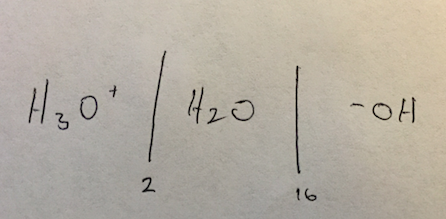
The best way to think about it for the DAT is this: If the pH is less than the pKa, it will be protonated. If the pH is higher than the pKa, it will be deprotonated.
For example, the pKa of H30+ is ~2. If the H3O+ is put into a solution with a pH lower than 2, then it stays as H3O+. If it is put into a solution with a pH higher than 2, it is deprotonated and becomes H2O. Now, water has a pKa of ~16. So once you get to a pH higher than 16 it becomes OH-.
Make sense?