

You are using an out of date browser. It may not display this or other websites correctly.
You should upgrade or use an alternative browser.
You should upgrade or use an alternative browser.
Intraoperative A fib
Started by Noyac
Let's say you are doing a case and your pt goes into A fib.
What's your treatment approach?
What if your pt has had A fib in the past and is scheduled for a long case. Do you do anything to prevent it from occurring?
1) rate control
2) rhythm control
3) prophylaxis against recurrence
at least that's the order I think about things. 1st step is usually beta blockade to slow them down and most of the time they will convert to NSR. If that don't, I'll consider antiarrhythmic therapy, maybe with 100 mg of iv lidocaine and then potentially step it up to things like amiodarone if they are unstable. If they BP stable and rate controlled I tend to get overly concerned.
Once the problem is solved, if the case will go for a while I'll consider loading them up with more beta blocker if tolerated to prevent recurrence.
1) rate control
2) rhythm control
3) prophylaxis against recurrence
at least that's the order I think about things. 1st step is usually beta blockade to slow them down and most of the time they will convert to NSR. If that don't, I'll consider antiarrhythmic therapy, maybe with 100 mg of iv lidocaine and then potentially step it up to things like amiodarone if they are unstable. If they BP stable and rate controlled I tend to get overly concerned.
Once the problem is solved, if the case will go for a while I'll consider loading them up with more beta blocker if tolerated to prevent recurrence.
It's been awhile since I reviewed it, but is lidocaine useful in atrial arrhythmias?
Advertisement - Members don't see this ad

Let's say you are doing a case and your pt goes into A fib.
What's your treatment approach?
What if your pt has had A fib in the past and is scheduled for a long case. Do you do anything to prevent it from occurring?
Depends, if they are normotensive and rate controlled, I likely wouldn't do anything. If in rvr, titrate b blockers. Hypotensive then amiodarone.
New onset with no prior history and they're tanking, consider cardioversion.
Mman, can you tell us what actual drugs you will use? Sleepalday, can you tell me which betablocker?
Cardizem 25 mg IV over 15 minutes.
Sent from my iPad using Tapatalk
Sent from my iPad using Tapatalk
if stable and rate controlled watch it. If RVR esmolol is fastest. Cardiazem is the new thing everyone likes... I guess but over 15 minutes? I don't get the preference over esmolol or lopressor. Someone care to explain this preference? Esmolol is readily available to me, in the drawer, so that's my go to. Pharmacy takes forever. new onset and unstable cardio version but it seems like most r stable RVR. Amio is a good drug too and I've used it before when the crash cart is already in the room - that's where it's kept here.... Especially good for the patient with borderline Bp that the beta blocker might mess with. One staff I knew in residency preferred esmolol and neo if needed to keep Bp up over amio.
Lidocaine has a variable effect on a fib and can even increase the ventricular response - not part of my repertoire - also lidocaine has the potential to raise the threshold on subsequent cardio version attempts should things spiral downward. I don't give it in my elective cardio versions and wouldn't in an emergent one either. Just mho.

Be careful with this approach, especially in a sick pt. Think about the physiologyOne staff I knew in residency preferred esmolol and neo if needed to keep Bp up over amio.
If rate uncontrolled, I'll try beta blockade but I have a low threshold for amio. In my experience, amio also makes electrical cardioversion if needed later on much more likely to be successful. Just make sure the pt doesn't get discharged on PO amio for the rest of their lives. I've seen this happen many times.
D
deleted171991
If AFib, I don't dream about rhythm control, just rate control till the surgery is done. A high percentage of new onset AFibs will convert back to sinus on their own.Let's say you are doing a case and your pt goes into A fib.
What's your treatment approach?
What if your pt has had A fib in the past and is scheduled for a long case. Do you do anything to prevent it from occurring?
If RVR, I would try an esmolol drip, see how it works. If not, try diltiazem on a pump (that's what I used to in internship). Obviously, if the patient is unstable, electrical cardioversion. I have never used amio, so I am not sure I would try it intraop, unless I had no other choice.
Also, I would tell the surgeon immediately about the AFib and the need to finish the surgery as soon as possible (i.e. no teaching). I would also check if there any sympathetic stimulants I could fix, that could be related to the AFib (HTN, hypervolemia, hypercarbia, inadequate anesthesia etc.). I might get blood for electrolytes and cardiac enzymes. I would also watch out for PE and MI (a cardiac echo would be nice if available), and let the surgeon know that one of these could be the potential cause (so hurry up).
If the patient had recurring AFib in the past and it's a long case, I would try to find out what prompted it and what it responded to. Maybe even put Zoll pads on. Again, I would try to avoid any potential precipitating factor.
Last edited by a moderator:
Advertisement - Members don't see this ad
I'll start with esmolol or metoprolol. Which for a patient? Probably depends on my mood for the day more than anything else. Diltiazem isn't in our pyxis in the room so it's further down my list as it'd have to come from pharmacy. Now if I had to start them on a drip to maintain rate control, then I'd go with diltiazem.
I have never used amio, so I am not sure I would try it intraop, unless I had no other choice.
Never?
D
deleted171991
I used it once under cardiology guidance, in internship. But never on my own. I know how to do it, but it's not my first goto drug. Never had intraop/postop AFib either. 🙂Never?
I once had a post-induction SVT in the cardiac room. Adenosine, baby! That was fun.
I used it once under cardiology guidance, in internship. But never on my own. I know how to do it, but it's not my first goto drug. Never had intraop/postop AFib either. 🙂
I once had a post-induction SVT in the cardiac room. Adenosine, baby! That was fun.
My favorite use of adenosine was in a woman in labor on L&D with SVT and a rate of about 190. It drew quite a crowd of onlookers to L&D.
Very good. Those of you using beta blockers, whats your success rate with this approach? I'm assuming it is low but no bridges burned and it is readily available as mentioned.
I also have never used/needed amio in this situation. Nor have I needed to cardiovert.
Im a bigger fan of cardizem. It seems to work better in my hands. I will bolus 10mg (20mg if rapid a fib) and the start a drip at 10mg/hr.
So on to my next question, what do you do if you have a pt that is prone to A fib? Do you just wait to see if it occurs or do you preempt the event?
I also have never used/needed amio in this situation. Nor have I needed to cardiovert.
Im a bigger fan of cardizem. It seems to work better in my hands. I will bolus 10mg (20mg if rapid a fib) and the start a drip at 10mg/hr.
So on to my next question, what do you do if you have a pt that is prone to A fib? Do you just wait to see if it occurs or do you preempt the event?

Succes rate with bb is pretty low in my experience and i've never seen cardizem work. We have a low threshold for using amiodarone but the problem is that's is rough on p.ivs : 600mg bolus over 30min and 2g/24h
using amiodarone but the problem is that's is rough on p.ivs : 600mg bolus over 30min and 2g/24h
huh??? That's a massive dose. I think the ACLS dose is 150 mg which can be repeated once. I can't imagine giving 600 mg as a bolus (even over 30 minutes) and I think the full "load" is 1000mg in the first 24 hours.
Very good. Those of you using beta blockers, whats your success rate with this approach? I'm assuming it is low but no bridges burned and it is readily available as mentioned.
What do you define as success rate? My success rate at controlling the ventricular rate is probably 90%+. It's usually not hard to slow them down to 90-100 or so. If you mean success converting to NSR, well that depends heavily on the patient and their heart.
You are right, I was unclear.What do you define as success rate? My success rate at controlling the ventricular rate is probably 90%+. It's usually not hard to slow them down to 90-100 or so. If you mean success converting to NSR, well that depends heavily on the patient and their heart.
I mean converting them back to NSR. I understand that many don't attempt to do this but I prefer to convert them if I can. I find betablockers don't do this very well. But Diltiazem can. I don't like their HR in the 90's in these pts. It's the supply and demand of the myocardium I'm trying to optimize. I figure if they just went into A fib then there is no better time to convert them back to NSR.
D
deleted162650
As an intern I was told by the cards guys that PO B-blockers work well for AF rate control but IV B-blockers tend not to work so well and that the opposite was true of the CCB's (most notably Dilt). Dilt was always the drug of choice for the seemingly nightly AF/RVR call I would get as medicine intern and it always seemed to do the trick. I do agree though B-blockers are a good 1st choice in the OR due to their immediate availability.
Something to consider with Amio: often times amio will chemically cardiovert the patient back to NSR. This may not be a good thing if you are dealing with a chronic AF pt who's been off his anticoag. for surgery just long enough to have formed some mural thrombi.
Something to consider with Amio: often times amio will chemically cardiovert the patient back to NSR. This may not be a good thing if you are dealing with a chronic AF pt who's been off his anticoag. for surgery just long enough to have formed some mural thrombi.
Advertisement - Members don't see this ad

I was an ER doc for a few years and my go to drug was diltiazem. It seemed to work better than beta blocker for rate control. I would give metoprolol until the cows came home with minimal effect. The trickiest part of treating rapid afib with meds is when the pressure is only mildly low. Do you have the stones to give someone cardizem with a systolic in the upper 80's hoping that better rate control usually equals more filling time and better cardiac output?
As an intern I was told by the cards guys that PO B-blockers work well for AF rate control but IV B-blockers tend not to work so well and that the opposite was true of the CCB's (most notably Dilt).
I literally cannot fathom an explanation that would make that true. Once the drug is in the plasma at a given concentration, it doesn't matter how it got there.

Noyac, your answer depends on what their heart looks like if tight AS then I would have zoll pads on the patient. If any conditions that would be dependant on the atrial kick portion of preload then I would pre empt and have zollpads. Prophalactically beta block never seen that approach unless they already are on beta blockers. Ensure euvolemia minimize hypoxia/hypercarbia make sure lytes are good preop......

My favorite use of adenosine was in a woman in labor on L&D with SVT and a rate of about 190. It drew quite a crowd of onlookers to L&D.
My favorite was during a craniotomy after an "oops" that caused a deep and vigorous bleeder. Bled too fast for the surgeon to suck and see it well enough to control it. A short span of asystole courtesy of adenosine gave him a window of visibility. Pretty cool.
Many of the agents suggested above (BB, CaCB, adenosine, dig), although good, might kill a patient with WPW. Also, they are mostly nodal acting > rhythm controlling, so more likely to slow the RVR rather than convert.
D
deleted87051
Question to all. In an anesthetized patient what is the downside of cardioverting new onset afib? Especially if you have tee available to rule out LAA thrombus. I don't understand why this is not first line treatment.
No it's not, ACLS has nothing in common with new onset a-fibhuh??? That's a massive dose.
No it's not, ACLS has nothing in common with new onset a-fib
is new onset a-fib more acutely dangerous than a pulseless patient?
I mean the ACLS dose of vasopressin is 40 units, but you won't catching me giving that to a patient who is a little vasodilated from an ACE inhibitor. I was also once an intern on a cardiology service for 2 months and I started plenty of patients on amiodarone for new onset afib and never gave anything remotely close to the doses you describe.
Question to all. In an anesthetized patient what is the downside of cardioverting new onset afib? Especially if you have tee available to rule out LAA thrombus. I don't understand why this is not first line treatment.
Because the surgeon is trying to operate on a patient and me rolling the code cart in and finding room to slap the pads on and yelling clear probably isn't helping them finish their case any faster.

I also have never used/needed amio in this situation. Nor have I needed to cardiovert.
I have. Sick pt with low ef. Went into a fib with somewhat unstable pressures. 80s/40s. Wasnt in RVR. Causually threw some pads on chest and fired away at 50 J. Flipped back into sinus. Easy as cake. Pressures resolved, a fib never came back.
Im suprised we dont do it more often in the ORs. Its simple, its fast, pt already anesthetized, and I believe unlike floor patients, the majority of time a fib develops in the OR its from something immediately reversible. Although I can see it freaking out surgeons and we naturally like to fix things in a passive, quiet way.
Advertisement - Members don't see this ad
D
deleted87051
Because the surgeon is trying to operate on a patient and me rolling the code cart in and finding room to slap the pads on and yelling clear probably isn't helping them finish their case any faster.
You can do this with minimal disruption in many cases. The cardioversion itself only takes a moment.
Is there a medical reason why this is not a good thing to do?

The use of Lidocaine in AFIB is an interesting approach but not the greatest option in my humble opinion.
Since I am old and I do things the old fashion way I still use Verapamil IV instead of Diltiazem for intra-op afib onset or exacerbation, since it has a longer half life and as a result does not require a pump or infusion.
Since I am old and I do things the old fashion way I still use Verapamil IV instead of Diltiazem for intra-op afib onset or exacerbation, since it has a longer half life and as a result does not require a pump or infusion.
I recall verapamil works wellThe use of Lidocaine in AFIB is an interesting approach but not the greatest option in my humble opinion.
Since I am old and I do things the old fashion way I still use Verapamil IV instead of Diltiazem for intra-op afib onset or exacerbation, since it has a longer half life and as a result does not require a pump or infusion.

The argument against cardioverting is embolism of a LAA thrombus. Kinda CYAish, but it is what it is. So I wouldn't do it unless unstable.
I generally try and rate control with esmolol, and if I have success with that I'll titrate in some metoprolol. I think CCBs are a fine choice as well, I know some who even swear by digoxin, but I tend to be a beta blocker guy.
I realize this isn't widely applicable, but because I have easy access to echo machines, I would TEE the patient myself if I planned on cardioverting.
I generally try and rate control with esmolol, and if I have success with that I'll titrate in some metoprolol. I think CCBs are a fine choice as well, I know some who even swear by digoxin, but I tend to be a beta blocker guy.
I realize this isn't widely applicable, but because I have easy access to echo machines, I would TEE the patient myself if I planned on cardioverting.
You can do this with minimal disruption in many cases. The cardioversion itself only takes a moment.
I'm not sure what your definition of minimal disruption is, but it doesn't really fit mine. Now I'd do it at the end of the case when drapes are down if that was the plan and there was no indication to do it more urgently.
Last edited:
The argument against cardioverting is embolism of a LAA thrombus. Kinda CYAish, but it is what it is. So I wouldn't do it unless unstable.
That's only for a-fib that has been of duration long enough to form a clot (I think 48 hours is the teaching). If they are NSR the entire case and then flip into a-fib, there really isn't a risk of a LAA thrombus.
Correct.That's only for a-fib that has been of duration long enough to form a clot (I think 48 hours is the teaching). If they are NSR the entire case and then flip into a-fib, there really isn't a risk of a LAA thrombus.
I'm talking about pts that go into A fib right in front of your eyes. Not those that come to us in A fib.
D
deleted87051
But then isn't the thinking that they could have done it before and you don't know if they are paroxysmal a fib, which still is at risk for clot ?
That's a valid point, but if they have paroxysmal afib they were at risk of throwing an embolus the entire time they were in sinus rhythm before they started to fibrillate, not just during and after cardioversion.
Last edited by a moderator:
Yup but they're not doing it on my watch!
Advertisement - Members don't see this ad
NopeBut then isn't the thinking that they could have done it before and you don't know if they are paroxysmal a fib, which still is at risk for clot ?
So the reason I posted this thread was to see were everyone was on them spectrum. As I imagined' most use betablockers first mostly because of availability. Nobody has actually claimed the BB works to convert but as many said they are not so interested in conversion but more in rate control. I was talking with a colleague of mine the other day who had this occur in the OR and he used esmolol without any effect and then cardizem which had more effect. It got the rate controlled but didn't convert the pt which was no big deal. Pt remained stable.
I had a case a month ago. It was a robotic nephrectomy on a guy with ischemic cardiomyopathy and an EF of 25%. 5 1/2 hrs into the case he went into Afib and his BP suffered from lack of atrial kick. I could keep his rate well controlled with neo but this wasn't gonna do the guy any good. I couldn't easily place pads on him and cardiovert him due to robot **** everywhere. I did try esmolol ( the entire bottle) while waiting for the cardizem. I gave 10mg bolus of cardizem and started the infusion and 30 minutes latter he was in sinus rhythm again. The funny thing is that the urology douchebag said I gave the guy too much fluid. At 4 1/2 hrs he had less than a liter. When he went into Afib he had about 1200cc. At the end of the case (6 1/2hrs ) he had 3l. It's hard to pump drugs into a hypotensive guy without giving fluids. I nearly strangled that f*cker. Worst part of the entire case was that while I was trying to maintain some decent vitals, I forgot to turn the vecuronium drip off soon enough to have him fully reversed at the end of the case. I extubated him but he needed some support for about an hour. Arrgghhh! Now that case is going to review. But more for the pt selection process I think. The pt did fine.
I had a case a month ago. It was a robotic nephrectomy on a guy with ischemic cardiomyopathy and an EF of 25%. 5 1/2 hrs into the case he went into Afib and his BP suffered from lack of atrial kick. I could keep his rate well controlled with neo but this wasn't gonna do the guy any good. I couldn't easily place pads on him and cardiovert him due to robot **** everywhere. I did try esmolol ( the entire bottle) while waiting for the cardizem. I gave 10mg bolus of cardizem and started the infusion and 30 minutes latter he was in sinus rhythm again. The funny thing is that the urology douchebag said I gave the guy too much fluid. At 4 1/2 hrs he had less than a liter. When he went into Afib he had about 1200cc. At the end of the case (6 1/2hrs ) he had 3l. It's hard to pump drugs into a hypotensive guy without giving fluids. I nearly strangled that f*cker. Worst part of the entire case was that while I was trying to maintain some decent vitals, I forgot to turn the vecuronium drip off soon enough to have him fully reversed at the end of the case. I extubated him but he needed some support for about an hour. Arrgghhh! Now that case is going to review. But more for the pt selection process I think. The pt did fine.

Just finishing my intern year, so obviously no OR experience but I typically try a few boluses of metoprolol (the floors carry it and I've used it enough IV to have some idea of what that 5mg is going to do) and then I'll go to 10mg of diltiazem. That is typically followed by a drip starting at 10mg/hr, titrate to HR <110, MAPs withstanding. If they are unstable or very low normotensive (only happened to be me once that I was forced to change agents) I bolus 150mg of amio. Repeat if necessary. Start drip after that.

So the reason I posted this thread was to see were everyone was on them spectrum. As I imagined' most use betablockers first mostly because of availability. Nobody has actually claimed the BB works to convert but as many said they are not so interested in conversion but more in rate control. I was talking with a colleague of mine the other day who had this occur in the OR and he used esmolol without any effect and then cardizem which had more effect. It got the rate controlled but didn't convert the pt which was no big deal. Pt remained stable.
I had a case a month ago. It was a robotic nephrectomy on a guy with ischemic cardiomyopathy and an EF of 25%. 5 1/2 hrs into the case he went into Afib and his BP suffered from lack of atrial kick. I could keep his rate well controlled with neo but this wasn't gonna do the guy any good. I couldn't easily place pads on him and cardiovert him due to robot **** everywhere. I did try esmolol ( the entire bottle) while waiting for the cardizem. I gave 10mg bolus of cardizem and started the infusion and 30 minutes latter he was in sinus rhythm again. The funny thing is that the urology douchebag said I gave the guy too much fluid. At 4 1/2 hrs he had less than a liter. When he went into Afib he had about 1200cc. At the end of the case (6 1/2hrs ) he had 3l. It's hard to pump drugs into a hypotensive guy without giving fluids. I nearly strangled that f*cker. Worst part of the entire case was that while I was trying to maintain some decent vitals, I forgot to turn the vecuronium drip off soon enough to have him fully reversed at the end of the case. I extubated him but he needed some support for about an hour. Arrgghhh! Now that case is going to review. But more for the pt selection process I think. The pt did fine.
I was thinking...Ischemic cardiomyopathy with an EF of 25% for an all day robotic nephrectomy? Sounds like crappy patient choice from the get go
I too use BBs first due to easy access-esmolol and then am quick to cardizem if needed-it just seems to give lasting rate control better than metoprolol for me and can easily go as an infusion (to PACU/ICU or wherever they end up) if needed. I'm more about rate control than conversion, if they're stable of course.
Last edited:

Egads, man!...5 1/2 hrs into the case .
The funny thing is that the urology douchebag said I gave the guy too much fluid.
They ALL say that...it must be part of their training.
Noy,
The clueless comment from your urology '**** reminded me of this Gary Larson cartoon except replace "Equine Medicine" with "Complications from Surgery" and have a list of complications with the cause being "anesthesia gave too much fluids."
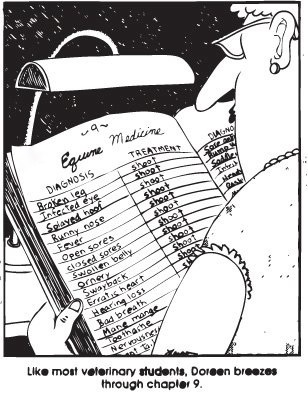
The clueless comment from your urology '**** reminded me of this Gary Larson cartoon except replace "Equine Medicine" with "Complications from Surgery" and have a list of complications with the cause being "anesthesia gave too much fluids."
I was taught intern year that there is a roughly 50% conversion rate at 24 hours using a diltiazem drip.
No idea the accuracy of the statement, but the guy had written a cardiology textbook, so I trusted him. This seems in keeping with the anecdotal stories here of infrequent cardioversion with dilt drips intraoperative, so I will continue to believe this.
I personally will rate control with esmolol while I obtain diltiazem drip. I do nothing to prevent a fib routinely in people with paroxysmal a fib.
I only have used amiodarone on cardiac cases, 150 followed by possible second dose of 150. Then start on drip.
No idea the accuracy of the statement, but the guy had written a cardiology textbook, so I trusted him. This seems in keeping with the anecdotal stories here of infrequent cardioversion with dilt drips intraoperative, so I will continue to believe this.
I personally will rate control with esmolol while I obtain diltiazem drip. I do nothing to prevent a fib routinely in people with paroxysmal a fib.
I only have used amiodarone on cardiac cases, 150 followed by possible second dose of 150. Then start on drip.
That's your problem here: should be 2-3h case.At the end of the case (6 1/2hrs ) he had 3l.
Mman, i overstated the bolus dose because of the different dosage between p.o and iv but 300mg bolus + 1-2g over 24h is standard.
D
deleted682700
Digoxin used to work. Old is gold. Even with amio running, the rate is not controlled. May have to use cardizem on the top of amio. Of course if the patient is not stable will need to shock only as A last resort. The cardiologists do TEE before they shock for a reason
Digoxin used to work. Old is gold. Even with amio running, the rate is not controlled. May have to use cardizem on the top of amio. Of course if the patient is not stable will need to shock only as A last resort. The cardiologists do TEE before they shock for a reason
Of course they do a TEE. You are supposed to check for a clot if they've been in a-fib for > 48 hours. They don't do a TEE if the patient went into a-fib in the ICU and has been in it for a short duration. If they are getting a TEE in somebody that has been in a-fib for a short time, they are doing it to evaluate cardiac function or because they can bill for it.
Advertisement - Members don't see this ad


