
-
CycleTrack and SDN are teaming up to make medical school admissions more transparent and accessible! Read the announcement to learn how we’re supporting the future of CycleTrack’s free application-tracking tools .
You are using an out of date browser. It may not display this or other websites correctly.
You should upgrade or use an alternative browser.
You should upgrade or use an alternative browser.
Naming compound question
Started by shefv

Get help with your application
Use all the free resources available to you from SDN: articles, guides, expert advising, forums discussions, and school research.

No, they both have four substituents. They would be achiral if C-1 and C-4 BOTH had an ethyl or BOTH had an isopropyl--making the molecule symmetric-- but they don't, hence the chirality.
The "biggest" substituent or the most oxidized substituent have the highest priority. ...Meaning ethyl should be at C-4 and not C-1. So I'm not sure why they switched the two. Where is this picture from?
The "biggest" substituent or the most oxidized substituent have the highest priority. ...Meaning ethyl should be at C-4 and not C-1. So I'm not sure why they switched the two. Where is this picture from?

I understand how to assign R or S configurations but when looking at the two carbons that have been assigned R configuration here, aren't they attached to the same substituents?
For the C-4, going towards the right or the left on the ring - it is bound to the same thing, plus an ethyl group and hydrogen atom. I don't see how it is a chiral carbon.
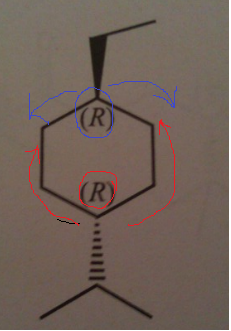
For the C-4, going towards the right or the left on the ring - it is bound to the same thing, plus an ethyl group and hydrogen atom. I don't see how it is a chiral carbon.
Advertisement - Members don't see this ad

No, they both have four substituents. They would be achiral if C-1 and C-4 BOTH had an ethyl or BOTH had an isopropyl--making the molecule symmetric-- but they don't, hence the chirality.
I actually don't think those are chiral carbons, the mirror image of this molecule is identical. And if you trace going around, each path inevitably leads to the same CIP for the ring carbons. You cant have two identical R groups on a chiral carbon as assigning R/S would be literally impossible. I think that is a typo or they pulled the image from some weird source, even the IUPAC name is missing the R/S designation in the name.
Edit: If these were not "para" positioned, then this would in fact be a chiral cyclohexane
Last edited:

I actually don't think those are chiral carbons, the mirror image of this molecule is identical. And if you trace going around, each path inevitably leads to the same CIP for the ring carbons. You cant have two identical R groups on a chiral carbon as assigning R/S would be literally impossible. I think that is a typo or they pulled the image from some weird source, even the IUPAC name is missing the R/S designation in the name.
The bottom side chain has isopropyl and is attached at C2. The top side chain is an ethyl group. So, I think that's why they are chiral carbons, since each of them have 4 different substituents attached.
Last edited:
There are 2 carbons between each group, this makes the whole structure symmetrical. Essentially, two of your R groups are going to have the same number of carbons going each way around the ring, ending at the ethyl or isopropyl group, so how would you decide between one vs the other if the CIP for each is identical because there is no point of first difference. if the groups were shifted one carbon left or right then yes, they would both be chiral. But I can see a plane of symmetry down the middle.The bottom side chain has isopropyl and is attached at C2. The top side chain is an ethyl group. So, I think that's why they are chiral carbons, since each of them have 4 different substituents attached.
