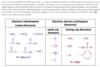
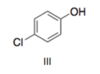
According to Mikes notes, the Halogens are weak Ortho Para directors, which means they are electron donors. So why is it when we are determining acidity these halogens are considered withdrawers? I thought this Cl would act as a donor, and decrease the acidity? How do we know when to consider this halogen as electronegative? or as a donor according the the O/P chart?
-
CycleTrack and SDN are teaming up to make medical school admissions more transparent and accessible! Read the announcement to learn how we’re supporting the future of CycleTrack’s free application-tracking tools .
You are using an out of date browser. It may not display this or other websites correctly.
You should upgrade or use an alternative browser.
OChem Withdrawing and Donating Question
Started by raysoflight
Get help with your application
Use all the free resources available to you from SDN: articles, guides, expert advising, forums discussions, and school research.
So halogens are a weird exception in that they are electron WITHDRAWING (slightly) due to inductive effects because of their electronegativity, but because they have an extra lone pair, they can actually donate that to the ring leading to ortho/para direction (the reason for this is if you draw out the resonance structures, there is higher electron density at the ortho/para positions making those positions more nucleophilic). Experimentally, it just happens to be that the inductive effects are much stronger than the resonance effects so they are considered withdrawing groups. Halogens are the only exception we need to know, any other electron withdrawing groups will direct meta and electron donating groups will direct ortho/para. Hope that helps!
When dealing with acidity, I tell my students 3 words,,,,,EXAMINE THE ANION. The halogens do indeed increase acidity because they can remove electron density from the anion, and make it less negative. This will translate into making it more stable, thus the compound is more acidic. A stable anion more readily forms !!! When dealing with directing influences on a benzene ring, we do indeed get some electron withdrawal from a halogen , but resonance competes. Two factors are at work. The inductive effect operates to raise the energy barrier of the transition state, thus the reaction is a bit slower.....BUT.......resonance effects help stabilize the intermediate in the ortho and para pathway to a greater extent than the meta pathway. An extra resonance form is produced. Thus , a halogen does deactivate a molecule somewhat, BUT since an additional resonance form is seen in the ortho-para pathway, we see the major product distribution as ortho-para . . Another group that you should know is called the nitroso group.....NO. This group works in an analogous fashion to the halogens. If you are curious,,,,,,a Fluorobenzene is about as reactive as benzene alone. Why ? Not such an easy answer, but although electron withdrawing, the overlap of a carbon 2p orbital with a fluorine 2p orbital is similar in size, and very energetically favorable ! Not so with the large 5p orbital on iodine !!!!According to Mikes notes, the Halogens are weak Ortho Para directors, which means they are electron donors. So why is it when we are determining acidity these halogens are considered withdrawers? I thought this Cl would act as a donor, and decrease the acidity? How do we know when to consider this halogen as electronegative? or as a donor according the the O/P chart?
I hope this helps.
Dr. Jim Romano
Halogens are an exception. They are EWGs but direct ortho/para. I attached a chart that should make is easier to understand what belongs where.
(although the chart says its donating group, ignore that, halogens are EWGs, they are just paired up with ERGs bc of where they direct)!!
Attachments
Thank you everyone!!! It makes sense now! 🙂