Prism

This forum made possible through the generous support of SDN members, donors, and sponsors. Thank you.

MedPR

Membership Revoked
Removed
10+ Year Member
Joined
Dec 1, 2011
Messages
18,577
Reaction score
57
Points
4,641
  1. Pre-Podiatry
M1wKf.jpg


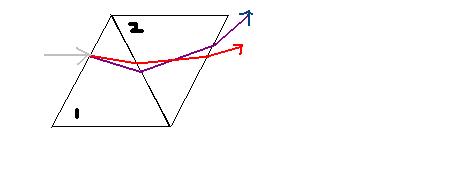
Two identically shaped prisms are juxtaposed as shown below. Biolet light exits the system above red light, because the average index of refraction of prism 2 is:

A. less than prism 1; light is dispersed more in prism 1
B. less than prism 1; light is dispersed less in prism 1
C. more than prism 1; light is dispersed more in prism 1
D. more than prism 1; light is dispersed less in prism 1

Answer:D
 
M1wKf.jpg


Two identically shaped prisms are juxtaposed as shown below. Biolet light exits the system above red light, because the average index of refraction of prism 2 is:

A. less than prism 1; light is dispersed more in prism 1
B. less than prism 1; light is dispersed less in prism 1
C. more than prism 1; light is dispersed more in prism 1
D. more than prism 1; light is dispersed less in prism 1

Answer:D

Has to be D no?
 
It is D (highlight "Answer:") but I don't understand why.

I understand that n1lambda1=n2lambda2, but I'm not able to make the connection with multiple prisms where the rays refract in opposite directions.
 
It is D (highlight "Answer:") but I don't understand why.

I understand that n1lambda1=n2lambda2, but I'm not able to make the connection with multiple prisms where the rays refract in opposite directions.

My train of thought when I first saw this was to think that the violet light in prism 2 would meet the red light again. However, the violet light not only meets the red light, it also passes it too, leading me to believe that prism 2 simply has a larger n than prism 1
 
My train of thought when I first saw this was to think that the violet light in prism 2 would meet the red light again. However, the violet light not only meets the red light, it also passes it too, leading me to believe that prism 2 simply has a larger n than prism 1

So the greater n in prism 2 combined with the fact that violet has shorter wavelength then red is why the violet bends so much more than red at the prism1-prism2 interface?
 
So the greater n in prism 2 combined with the fact that violet has shorter wavelength then red is why the violet bends so much more than red at the prism1-prism2 interface?

Yes that's the correct logic. The EM wave with the shorter wavelength with experience more 'bending' at the interface of a prism than one with a longer wavelength.
 
Top Bottom