
Agree. I'm not certain exactly how to define "best." These are solid groups that are going nowhere (TN, TX and NC at least), but they're not rolling out the red carpet, and you can make more in smaller groups or employed with a hospital if that's your criterion. I'd rather work for most of these groups than academia, but I'm also not totally cut out for anything that big, as in, they're all probably too big for my taste.I forgot about this thread, haha.
The theme of the past 15 years has just been insane consolidation in American medicine. Then the pandemic accelerated the process further.
When I look at this list:
PROG (NJ)
ROA (MA/NH)
SERO (NC)
MRO (MN)
TOPA (TX)
Tennessee Oncology (TN)
My first thought, honestly, is not "these are the best" but "these are who's left".
In the past, part of the reputation of these groups stemmed from their size and infrastructure, which is also how they still survive. It's not worth ranking them, really. At least not to me. There's no point.
Unless the ranking is based on "who can continue to hold out the longest"?
-
CycleTrack and SDN are teaming up to make medical school admissions more transparent and accessible! Read the announcement to learn how we’re supporting the future of CycleTrack’s free application-tracking tools .
You are using an out of date browser. It may not display this or other websites correctly.
You should upgrade or use an alternative browser.
You should upgrade or use an alternative browser.
Private practice "rankings"
Started by Radiator20
Get help with your application
Use all the free resources available to you from SDN: articles, guides, expert advising, forums discussions, and school research.
I think Penn took them over.PROG is a shadow of itself and I believe is now part of a larger organization.
In philadelphia, and Boston, Penn or Harvard will make deals with many outlying hospitals to run their departments. Sometimes The universities pay these hospitals a fee and then will keep all the radonc billing,now at university rates. That’s why proff only groups like roa of New England are destined to fail.I think Penn took them over.
Last edited:
In philadelphia, and Boston, Penn or Harvard will make deals with many outlying hospitals to run their departments. The universities pay hospitals some type of fee and then keep all the billings, which they bill at university rates. That’s why proff only groups like roa of New England are destined to fail.
Im new to a competitive city as a non-resident. The writing seems on the wall for PP groups in every field. I just dont see how you can compete with giants that have huge names +/- affiliations with huge names. Maybe it is different in rural areas.
The few PP groups in town that seem to do well have crazy leverage due to some nuanced aspect of their field. A good example here is the neurosurgery group because you cant have level 1 trauma without neurosurgery.
What is the opposite of leverage? 🤣 😢
Big name academics are cool with community hospitals running their own inpatient psych etc, but they can squeeze a lot more out of radonc than the hospital can.Im new to a competitive city as a non-resident. The writing seems on the wall for PP groups in every field. I just dont see how you can compete with giants that have huge names +/- affiliations with huge names. Maybe it is different in rural areas.
The few PP groups in town that seem to do well have crazy leverage due to some nuanced aspect of their field. A good example here is the neurosurgery group because you cant have level 1 trauma without neurosurgery.
What is the opposite of leverage? 🤣 😢

In philadelphia, and Boston, Penn or Harvard will make deals with many outlying hospitals to run their departments. The universities pay hospitals some type of fee and then keep all the billings, which they bill at university rates. That’s why proff only groups like roa of New England are destined to fail.
I agree in theory, and there are many many many examples of this practice arrangement currently in play.Im new to a competitive city as a non-resident. The writing seems on the wall for PP groups in every field. I just dont see how you can compete with giants that have huge names +/- affiliations with huge names. Maybe it is different in rural areas.
The few PP groups in town that seem to do well have crazy leverage due to some nuanced aspect of their field. A good example here is the neurosurgery group because you cant have level 1 trauma without neurosurgery.
What is the opposite of leverage? 🤣 😢
However...we should never, ever, underestimate the level of incompetence of organizations and people in charge can reach. Just...hall of fame level idiocy.
The "correct" way to play the game (in my opinion) is for a hospital to join up with an academic system in some kind of joint venture or true network integration. Whatever gives the hospital the leverage to negotiate better contracted technical rates, as well as enter into the "too big to fail" realm.
The downside to that arrangement would be if the individual hospital takes a "bad" deal in the JV, or if "the system" takes too big of a piece of the network pie, so even though they're getting better rates, the skim makes it not worth it.
The next best would be as @RickyScott described - a mutated version of a PSA where the university medical group staffs a non-network hospital and pays a fee to do so. The university gets access to that patient population and the hospital has a presumably stable staffing arrangement with a deep bench for vacation and call coverage.
The dumbest arrangement, and hopefully uncommon, would be a hospital staffed by a medical group in a PSA arrangement but without "paying a fee" or some other benefit. Well...I guess it's not fair to make a blanket statement like that. It's the "dumbest" if the academic medical group and the hospital don't "actively manage" the partnership, because each side is constrained by organizational red tape that can lead to suboptimal outcomes.
Now...what's good for "the hospital" and "the university medical group" - those are VERY different things than "what's good for the individual doctor".
None of this is generally good for the individual doctor, unless you want to have zero responsibility on the practice management side and are OK with paying a tremendous cost in doing so.
(which is totally ok of course, many docs don't want to have to worry about any business things)
Let’s say virtua hospital in cherry hill New Jersey makes 5 million off xrt, but if Penn runs the department and bills pts at penns own negotiated rates, they can make 10 million. There is room for a deal that works in both parties financial interests ie jim Metz pays virtua 7 mill/year. this is where the Astro model can really screw the specialty because it provides further fuel to the fire in which hospital xrt departments are worth more to the university with a proton at the mothership than the hospital. It further encourages hospitals to sell off/rent out their xrt departments.
Why not just sell the entire hospital? A lot of departments like inpt psych loose money and a lot of hospitals and their boards want to remain independent.
Why not just sell the entire hospital? A lot of departments like inpt psych loose money and a lot of hospitals and their boards want to remain independent.
Last edited:
How do I know @RickyScott will never be a hospital CEO?Let’s say virtua hospital in cherry hill New Jersey makes 5 million off xrt, but if Penn runs the department and bills the pts at their negotiated rates, they can make 10 million. There is room for a deal that works in both parties financial interests ie jim Metz pays virtua 7 mill/year. this is where the Astro model can really screw the specialty because it provides further fuel to the fire in which hospital xrt deprarents are worth more to the university with a proton machine than the hospital itself and further encourages hospitals to sell off/rent out their xrt departments.
Why not just sell the entire hospital. A lot of departments loose money and a lot of hospitals and their boards don’t want to sell.
Because this is clearly the best/most mutually beneficial arrangement.
Therefore, it must never be done nor mentioned ever again.
Let’s say virtua hospital in cherry hill New Jersey makes 5 million off xrt, but if Penn runs the department and bills the pts at their negotiated rates, they can make 10 million. There is room for a deal that works in both parties financial interests ie jim Metz pays virtua 7 mill/year. this is where the Astro model can really screw the specialty because it provides further fuel to the fire in which hospital xrt deprarents are worth more to the university with a proton machine than the hospital itself and further encourages hospitals to sell off/rent out their xrt departments.
Why not just sell the entire hospital. A lot of departments loose money and a lot of hospitals and their boards don’t want to sell.
Very interesting I wonder if we’ll see that, didn’t think about that. I was more thinking that ROCR will shift patients within departments that have both modalities to protons.

He’s smart!How do I know @RickyScott will never be a hospital CEO?
Because this is clearly the best/most mutually beneficial arrangement.
Therefore, it must never be done nor mentioned ever again.
This really is UPenn’s business strategy. Other strategies- the mdacc way- include licensing the university name for a franchise fee to anyone willing to pay 3 million, but hospitals can get screwed by such arrangements. There should be a podcast on affiliate agreements/takeovers.Very interesting I wonder if we’ll see that, didn’t think about that. I was more thinking that ROCR will shift patients within departments that have both modalities to protons.
Last edited:
Let’s say virtua hospital in cherry hill New Jersey makes 5 million off xrt, but if Penn runs the department and bills pts at penns own negotiated rates, they can make 10 million. There is room for a deal that works in both parties financial interests ie jim Metz pays virtua 7 mill/year. this is where the Astro model can really screw the specialty because it provides further fuel to the fire in which hospital xrt departments are worth more to the university with a proton at the mothership than the hospital. It further encourages hospitals to sell off/rent out their xrt departments.
Why not just sell the entire hospital? A lot of departments like inpt psych loose money and a lot of hospitals and their boards want to remain independent.
and the hosp employed docs will now work for Penn which after hearing what they get paid might actually be worse than losing ones license to practice.
You’d probably have to sell the whole hospital at that point. I don’t think they allow for carve outs of unprofitable portions
I’m surprised that ROA-NE is pro fees only. I never interviewed with them but they seem to have good docs and have heard good things about them. I always thought they had technical like SERO with great compensation and great geography, if you’re at one of the sites that is spitting distance from Boston.
A very good analysis, but a very depressing one for community docs. All of these arrangements mean essentially zero leverage for the community doc and a best case arrangement of essentially being a satellite academic.I agree in theory, and there are many many many examples of this practice arrangement currently in play.
However...we should never, ever, underestimate the level of incompetence of organizations and people in charge can reach. Just...hall of fame level idiocy.
The "correct" way to play the game (in my opinion) is for a hospital to join up with an academic system in some kind of joint venture or true network integration. Whatever gives the hospital the leverage to negotiate better contracted technical rates, as well as enter into the "too big to fail" realm.
The downside to that arrangement would be if the individual hospital takes a "bad" deal in the JV, or if "the system" takes too big of a piece of the network pie, so even though they're getting better rates, the skim makes it not worth it.
The next best would be as @RickyScott described - a mutated version of a PSA where the university medical group staffs a non-network hospital and pays a fee to do so. The university gets access to that patient population and the hospital has a presumably stable staffing arrangement with a deep bench for vacation and call coverage.
The dumbest arrangement, and hopefully uncommon, would be a hospital staffed by a medical group in a PSA arrangement but without "paying a fee" or some other benefit. Well...I guess it's not fair to make a blanket statement like that. It's the "dumbest" if the academic medical group and the hospital don't "actively manage" the partnership, because each side is constrained by organizational red tape that can lead to suboptimal outcomes.
Now...what's good for "the hospital" and "the university medical group" - those are VERY different things than "what's good for the individual doctor".
None of this is generally good for the individual doctor, unless you want to have zero responsibility on the practice management side and are OK with paying a tremendous cost in doing so.
(which is totally ok of course, many docs don't want to have to worry about any business things)
These arrangements may mean a 50% decrease in pay for some.
A pertinent question is how far can these monster institutions reach. Philadelphia to Lancaster, PA is 1:45 distance. This may be the future of medicine, feeling fortunate to be associated with an academic institution, while working hours away from a major city, and with minimal emphasis on academic practice in your career.
Lancaster is big relatively. Obviously, a place like PENN understands the value of maintaining brick and mortal within a 500K population metro area. But what about smaller places? Other academic places have taken over smaller rural hospitals, stripped services, staffed with minimal good faith and then bailed if it's not working financially for the mother ship.
The consolidation is the issue. Everybody will pay more. There will be effective marketing that quality has improved. Patients may in fact believe that quality has improved. Value of care, physician compensation and autonomy all decrease.
I'm afraid that it will be absolutely critical for docs to unionize at a large scale if consolidation continues.
It’s time to unionize in rad onc.A very good analysis, but a very depressing one for community docs. All of these arrangements mean essentially zero leverage for the community doc and a best case arrangement of essentially being a satellite academic.
These arrangements may mean a 50% decrease in pay for some.
A pertinent question is how far can these monster institutions reach. Philadelphia to Lancaster, PA is 1:45 distance. This may be the future of medicine, feeling fortunate to be associated with an academic institution, while working hours away from a major city, and with minimal emphasis on academic practice in your career.
Lancaster is big relatively. Obviously, a place like PENN understands the value of maintaining brick and mortal within a 500K population metro area. But what about smaller places? Other academic places have taken over smaller rural hospitals, stripped services, staffed with minimal good faith and then bailed if it's not working financially for the mother ship.
The consolidation is the issue. Everybody will pay more. There will be effective marketing that quality has improved. Patients may in fact believe that quality has improved. Value of care, physician compensation and autonomy all decrease.
I'm afraid that it will be absolutely critical for docs to unionize at a large scale if consolidation continues.
Or just have a professional organization that actually and effectively represents our employees interests.It’s time to unionize in rad onc.
Astro proposal picks winners and losers and inevitably will transfer patients to high cost centers by creating conditions for buyousts. Btw Anyone know how city of hopes takes over cancer treatment centers going and if they are rolling out pps exemption to these centers?A very good analysis, but a very depressing one for community docs. All of these arrangements mean essentially zero leverage for the community doc and a best case arrangement of essentially being a satellite academic.
These arrangements may mean a 50% decrease in pay for some.
A pertinent question is how far can these monster institutions reach. Philadelphia to Lancaster, PA is 1:45 distance. This may be the future of medicine, feeling fortunate to be associated with an academic institution, while working hours away from a major city, and with minimal emphasis on academic practice in your career.
Lancaster is big relatively. Obviously, a place like PENN understands the value of maintaining brick and mortal within a 500K population metro area. But what about smaller places? Other academic places have taken over smaller rural hospitals, stripped services, staffed with minimal good faith and then bailed if it's not working financially for the mother ship.
The consolidation is the issue. Everybody will pay more. There will be effective marketing that quality has improved. Patients may in fact believe that quality has improved. Value of care, physician compensation and autonomy all decrease.
I'm afraid that it will be absolutely critical for docs to unionize at a large scale if consolidation continues.

In the end, the house always wins, even if you think you won a few hands!
The main problem, as I see it, is that there is virtually zero "business" education/training in the modern "doctor path" in America, outside of the folks choosing MD/MBA dual degree programs.A very good analysis, but a very depressing one for community docs. All of these arrangements mean essentially zero leverage for the community doc and a best case arrangement of essentially being a satellite academic.
These arrangements may mean a 50% decrease in pay for some.
A pertinent question is how far can these monster institutions reach. Philadelphia to Lancaster, PA is 1:45 distance. This may be the future of medicine, feeling fortunate to be associated with an academic institution, while working hours away from a major city, and with minimal emphasis on academic practice in your career.
Lancaster is big relatively. Obviously, a place like PENN understands the value of maintaining brick and mortal within a 500K population metro area. But what about smaller places? Other academic places have taken over smaller rural hospitals, stripped services, staffed with minimal good faith and then bailed if it's not working financially for the mother ship.
The consolidation is the issue. Everybody will pay more. There will be effective marketing that quality has improved. Patients may in fact believe that quality has improved. Value of care, physician compensation and autonomy all decrease.
I'm afraid that it will be absolutely critical for docs to unionize at a large scale if consolidation continues.
Even worse, the "hidden curriculum" of medical school and residency is one that actively discourages business acumen...heck, in many cases, it's not hidden, it's in plain sight.
Coupled with consolidation, each year there are tens of thousands of newly minted physicians who have assumed since their white coat ceremony that they will be W2 employees.
On the hospital side, with the Silver Tsunami, you have Gen-X and Millennial administrators who only know "employed providers".
On the government side, Stark Law and AKS are murky and have instilled fear in doctors who already think the "moral high ground" is one where even thinking about business is evil.
Long story short: not only consolidation but the CULTURE that encouraged consolidation means everyone is already paying more, and will only pay more and more every year...for equal or less quality medicine.
The sad reality is that there's a "win-win-win" scenario for hospitals/doctors/patients that can come from various practice arrangements that are barely being utilized currently. Most docs are now employed, then the majority of the minority remainder are professional services - then everything else.
But successfully designing, negotiating, executing, and maintaining "other" joint venture/practice arrangement models requires physicians and administrators to have a business acumen and risk tolerance that is very rare to find in 2023.
Well, the risk environment is quite different than it was 30 years ago.risk tolerance that is very rare to find in 2023
Factor in med school costs (or advanced age and often family with MD/PhDs), consolidation, capital costs, payment trends, proposed payment models by ASTRO, over training with ready availability of replacement docs (in radonc at least) and a get ours and sell to private equity culture among the most established private docs and this is not a good space for risk.
30 years ago, you could be the first radonc in a region (or close to it), establish a rep, be the only one willing to work in a location, and leverage your local hospital if you wanted to (several docs did this).
Seems like sero is mostly hospital based. Do they own freestanding centers?I’m surprised that ROA-NE is pro fees only. I never interviewed with them but they seem to have good docs and have heard good things about them. I always thought they had technical like SERO with great compensation and great geography, if you’re at one of the sites that is spitting distance from Boston.
They probably have ownership in some of the hospital based facilities. This was not an uncommon arrangement 15 years ago.Seems like sero is mostly hospital based. Do they own freestanding centers?

What is the opposite of leverage? LUBE. LOTS OF LUBE.
Seriously though, I checked out with the # lyfe and thank goodness too.
I refuse to be a hopeless W2 begging for pro-only partnership while generating fat profits for the schmucks ahead of me in line.
Seriously though, I checked out with the # lyfe and thank goodness too.
I refuse to be a hopeless W2 begging for pro-only partnership while generating fat profits for the schmucks ahead of me in line.
D
deleted1111261
SERO always had 2-3 locations that were always non-partner, I know this from 2010 when I was interviewed by them. They offered it, I declined, and a week after I signed a contract, they offered a partnership track job.
I am fairly certain if they are offering a employed job, it’s it one of those sites.
I am fairly certain if they are offering a employed job, it’s it one of those sites.
any details on what the partnership track looks like?SERO always had 2-3 locations that were always non-partner, I know this from 2010 when I was interviewed by them. They offered it, I declined, and a week after I signed a contract, they offered a partnership track job.
I am fairly certain if they are offering a employed job, it’s it one of those sites.
Inova- I referred a patient there for a t5 lesion. The chair insisted on treating with protons beacause pt had a hx of keytudaSERO is now cashing in on the glut of rad oncs and new grads by offering employed non-partner positions. Another private practice in DC (I think INOVA) are offering proton fellowships. Everyone wants to cash in!
D
deleted1111261
This sounds like inovaInova- I referred a patient there for a t5 lesion. The chair insisted on treating with protons beacause pt had a hx of keytuda
D
deleted1111261
Used to be 4 years and then 6 years of buying into practice. May have changedany details on what the partnership track looks like?
The best part of the inova proton "fellowship" was requirement/listing of providing doc-of-the-coverage for the photon serviceSERO is now cashing in on the glut of rad oncs and new grads by offering employed non-partner positions. Another private practice in DC (I think INOVA) are offering proton fellowships. Everyone wants to cash in!
Used to be 4 years and then 6 years of buying into practice. May have changed
Sounds biblical.
#
D
deleted1111261
My old practice in DC suburbs (Southern Maryland) looking for someone for partner track position. Freestanding centers, busy, prostate brachy is a big plus. Partial tech without buy-in (based on global contracts). They earn median-ish, but super lifestyle oriented. Let me know if interested and I can direct you.

So why did you leave? I know I know… I still had to inquire!My old practice in DC suburbs (Southern Maryland) looking for someone for partner track position. Freestanding centers, busy, prostate brachy is a big plus. Partial tech without buy-in (based on global contracts). They earn median-ish, but super lifestyle oriented. Let me know if interested and I can direct you.
D
deleted1111261
Married June 2018
Always wanted to live out west
So we did that
And eventually realized family more important than the mountains (for us)
Always wanted to live out west
So we did that
And eventually realized family more important than the mountains (for us)
Married June 2018
Always wanted to live out west
So we did that
And eventually realized family more important than the mountains (for us)
Man, I guess for some people everything west of the Hudson is "out west."My old practice in DC suburbs (Southern Maryland) looking for someone for partner track position. Freestanding centers, busy, prostate brachy is a big plus. Partial tech without buy-in (based on global contracts). They earn median-ish, but super lifestyle oriented. Let me know if interested and I can direct you.
D
deleted1111261
Arizona and Washington are west! No?Man, I guess for some people everything west of the Hudson is "out west."
I think the guy above was asking why you left Maryland, which I think most would not consider west. 😉Arizona and Washington are west! No?
D
deleted1111261
I left Maryland to move west!I think the guy above was asking why you left Maryland, which I think most would not consider west. 😉
I thought that was the question: “why did you leave?”
That's funny - I had this exact conversation with my spouse.
I'm lifelong East Coast but love "the West". Looked at residency and then jobs out there.
Even though we both love it, in particular Colorado, we knew it would be the wiser long-term choice to stay on this side of the country due to family.
It's "the same old song" from me at this point, but this is why I get so upset when the "oversupply naysayers" hit us with "well you can get a job as long as you don't geographically restrict yourself!"
Like yeah, ok, if you're trying to talk a 20-something medical student into RadOnc, who isn't married/doesn't have children yet, I find that particular argument abhorrent. Most of them will be like "oh yeah I totally could live anywhere to do something I love!"
Uh huh. Let's revisit that sentiment a decade later, with a spouse, maybe a kid or two, maybe some aging parents.
Geographic restriction is no less unpleasant if you’re unmarried as a rad onc.
Well-educated professionals generally want to live in places with other well-educated professionals. This is particularly true for people of color, blacks, Hispanics, Asians of all sorts, or Caucasian immigrants, just look at the gravitational pull of coastal VHCOL cities, big heartland cities to a lesser extent (Denver, Phoenix, Chicago, Austin), versus small town America. Rad oncs and IMG H1B holders are probably the only physicians that have little to no say in where they live, although the IMG’s only have restricted geography for 3 years, whereas rad oncs are restricted indefinitely until retirement or bread lines arrive.
Well-educated professionals generally want to live in places with other well-educated professionals. This is particularly true for people of color, blacks, Hispanics, Asians of all sorts, or Caucasian immigrants, just look at the gravitational pull of coastal VHCOL cities, big heartland cities to a lesser extent (Denver, Phoenix, Chicago, Austin), versus small town America. Rad oncs and IMG H1B holders are probably the only physicians that have little to no say in where they live, although the IMG’s only have restricted geography for 3 years, whereas rad oncs are restricted indefinitely until retirement or bread lines arrive.
Last edited:

Totally agree that geographic restriction is an issue. When I applied, I thought I could live anywhere. I had already moved for undergrad and med school. No big deal. 6-7 years later it's a different story. I've got a family now that I can't just uproot. If things don't work out, I can't just move my entire family across the state or country.
Radonc: 7 years a slave.Sounds biblical.
#
Toil under your Master you shall
Wages limited you will receive
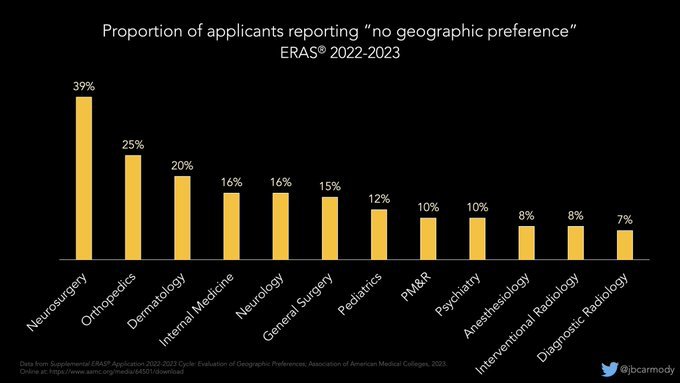
Even in neurosurg where you spend almost all your waking hours working, vast majority of applicants have strong geographical preferences for residency, let alone jobs.
D
deleted1111261
Of course anything that doesn’t pay a million seems to be regarded as #GTFO, one of the best things about being in a group is being in a group.
We were like SERO, but worked a lot less (and earned less). We had 10 weeks off, we covered each other, reviewed each other, socialized together and some sense with the younger docs, grew up together.
Non-pecuniary pleasures have a lot of value for people, and when you have a singular focus you may miss out on wonderful relationships and experiences. I’d take that job over my current one - where I earn more and have more autonomy - but we simply have to be in MI. Group practice with the wrong group can be hell. With the right group, it’s can be defining and life altering. I think many academic docs have that same feeling - putting up with many of the negatives, for the positives of being part of something bigger.
To each their own.
Why not both? #Of course anything that doesn’t pay a million seems to be regarded as #GTFO, one of the best things about being in a group is being in a group.
We were like SERO, but worked a lot less (and earned less). We had 10 weeks off, we covered each other, reviewed each other, socialized together and some sense with the younger docs, grew up together.
Non-pecuniary pleasures have a lot of value for people, and when you have a singular focus you may miss out on wonderful relationships and experiences. I’d take that job over my current one - where I earn more and have more autonomy - but we simply have to be in MI. Group practice with the wrong group can be hell. With the right group, it’s can be defining and life altering. I think many academic docs have that same feeling - putting up with many of the negatives, for the positives of being part of something bigger.
To each their own.
D
deleted1111261
I don’t know that too many hospitals will pay $1m within 1 hour of the district
Even in neurosurg where you spend almost all your waking hours working, vast majority of applicants have strong geographical preferences for residency, let alone jobs.
View attachment 374307
This is a little different and IMO hard to generalize to this conversation.
Preference signaling is now yet another way students game ERAS to try to match where they want. It wasn’t surprising to see “no preference” scale with competitiveness of the field.
Ain't no neurosurgeons in my neck of the woods. It's also easy to have no geographic preference when bfe isn't on the table to begin with.This is a little different and IMO hard to generalize to this conversation.
Preference signaling is now yet another way students game ERAS to try to match where they want. It wasn’t surprising to see “no preference” scale with competitiveness of the field.
I’ve lost track of supervision requirements debate, but did they really help out job market over past 10y?Radiology and psychiatry have no geographic preference because they can be fully remote.
I too, would be happy to provide MD services for Marshfield, WI if I could log off and go for a walk in Central Park.
