

-
 The 2026-2027 MD School Specific Threads are now live in the School Specific Discussions forum. The 2025-2026 cycle threads can be found here.
 -
 Scholarship Access: Becoming a Student Doctor course
Free access to comprehensive medical school prep. Eligible students include AAMC FAP recipients and HS graduates from underserved areas. Apply today.
You are using an out of date browser. It may not display this or other websites correctly.
You should upgrade or use an alternative browser.
You should upgrade or use an alternative browser.
Schools average Step 1 scores
Started by PhilzCoffeeAddict


I believe you can pay for it via USNEWS grad compass or whatever it's called and get access to the average step scores. Just remember that they are entirely self reported and could be significantly different (although I can verify two schools on the list since their numbers matched when I went to the interview).
I attached a picture that has the info you need from their website--I got it from someone on sdn but I forgot who (If anyone will remind me I will gladly tag them).
I attached a picture that has the info you need from their website--I got it from someone on sdn but I forgot who (If anyone will remind me I will gladly tag them).
Attachments
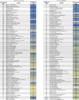

here is the other issue. This says very little about the schools considering the schools with sky high step scores are also schools with sky high MCAT matriculants.

I know my own school's Step 1 average well, and I can tell you it's off my 7 points on this list, so take it with a grain of salt.
Of course, a school's Step 1 average is a product of their curriculum, the students' academic calibre, or both. In the end, Step 1 = you.
Of course, a school's Step 1 average is a product of their curriculum, the students' academic calibre, or both. In the end, Step 1 = you.

I know my own school's Step 1 average well, and I can tell you it's off my 7 points on this list, so take it with a grain of salt.
Of course, a school's Step 1 average is a product of their curriculum, the students' academic calibre, or both. In the end, Step 1 = you.
Several schools at which I interviewed are included here, and the stats I received on interview day are higher by roughly 5 points in all cases.
And which one would that be? Is that the official released? Is that the score gamed in any fashion? do they hold back people that dont perform? There is no transparency on the way the scores are reported.This is school dependent and not necessarily true. For example, Stony Brook's median mcat is a 514 but their average step score is higher than Mt. Sinai's (519 median mcat).
This is from a few years ago.
View attachment 210550
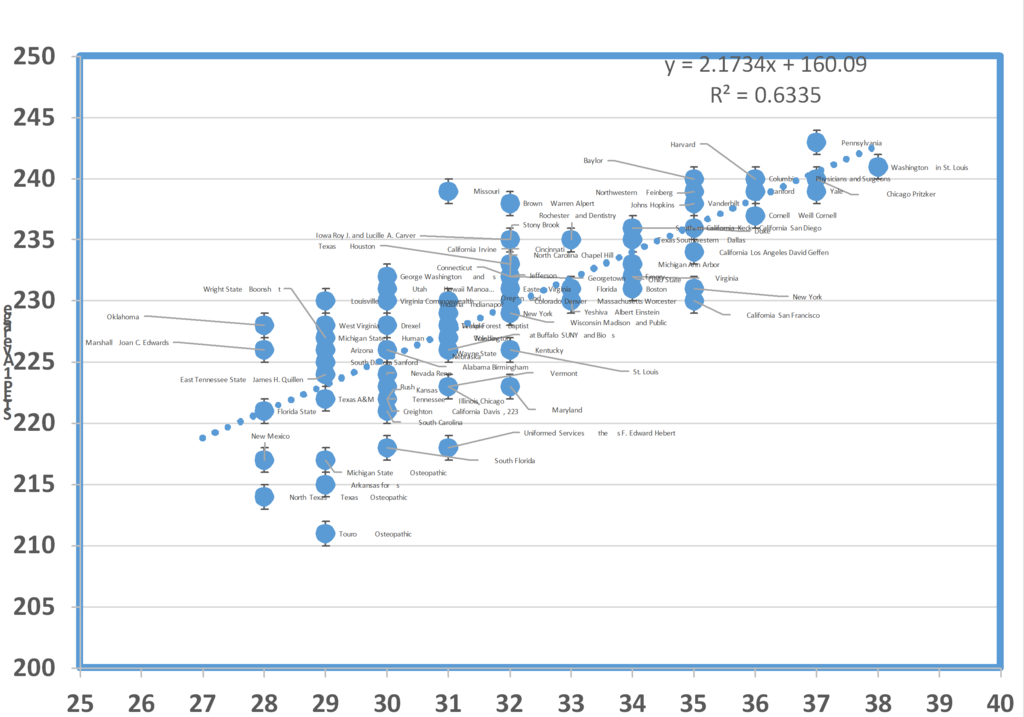
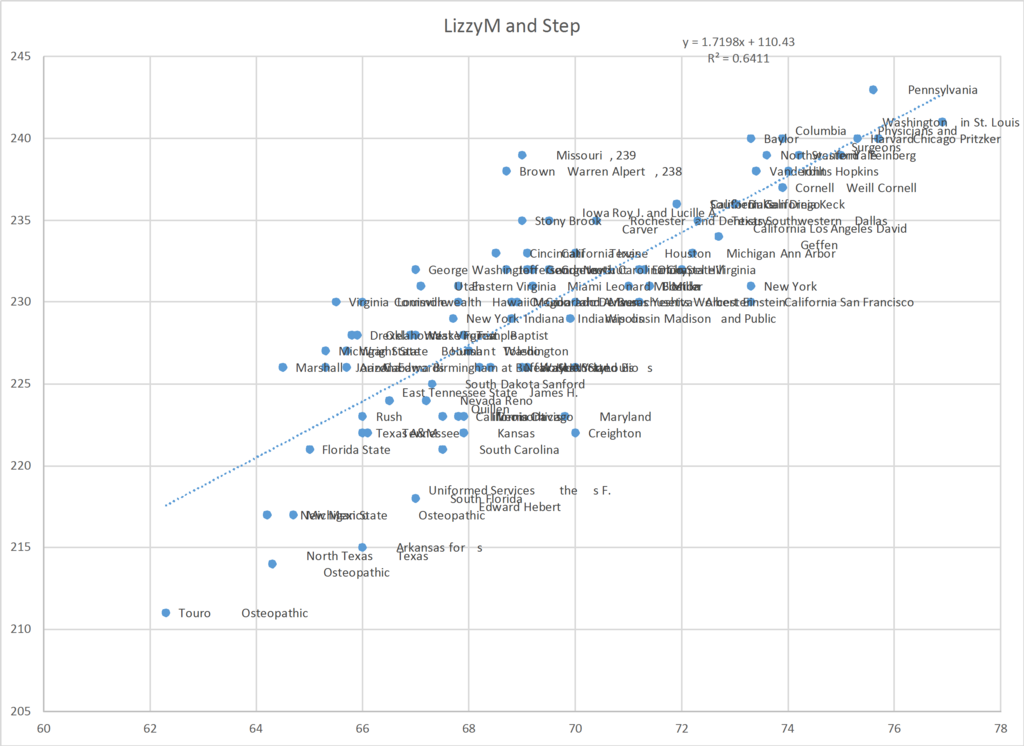
With all the limitations in mind of the quality of the data and my abstraction method Just look at Missouri. They are hitting way above their median mcat would predict. And apparently it isnt something that is a fluke for one year. What are they doing? Are they better liars? Curious Minds want to know. But I think the most illuminating thing out of this entire conversation is that Medical schools publish input data- MCAT, GPA and such but do not publish performance data on the STEPs? Why not? Why rely on data like percent passing the step or percent completing medical training in 4 years. If they are so sure of their performance or quality of education provided, why not publish the data?
And which one would that be? Is that the official released? Is that the score gamed in any fashion? do they hold back people that dont perform? There is no transparency on the way the scores are reported.
The scores for those two specific schools I mentioned are accurate for that year actually. I'm not saying it's transparent or it's equivalent. All I'm saying is that "the schools with sky high step scores are also schools with sky high MCAT matriculants." does not hold true for every school on that list. If anything it further proves the point that it doesn't matter too much where you go to school.
Last edited:

The US Snooze "data" is neither standardized nor reliable.
It is self-reported. Schools may choose to define their test takers any way they please (first time only, before May only...).
It is self-reported. Schools may choose to define their test takers any way they please (first time only, before May only...).
Thank you guys! This was very helpful
Advertisement - Members don't see this ad

On top of the MCAT differences and self-reporting, I'd add that even if the numbers are valid, similar schools generally don't have big enough differences to make this part of your matriculation decision. A 234 vs 238 for example is not going to change where you get residency interviews. It's only for crazy high outliers (like Mizzou being +20 over similar places) that its even worth noticing.
Where step scores come in handy is anytime you see a school with top notch applicants scoring poorly (in which case something is very wrong with the curriculum) or when random mid-low tier schools score highly (in which case they are doing something right). Everything else is probably noise

That data is from 2016 though too, so it’s over a year old, but uses the current rankings and is missing a number of schools. Maybe that’s why a lot of it doesn’t match up?
An interesting one I didn’t see on there was FIU who report an average step 1 of 240 despite having an average Mact around 509. They claim this is a result of their unique curriculum and taking step after their 3rd year...
An interesting one I didn’t see on there was FIU who report an average step 1 of 240 despite having an average Mact around 509. They claim this is a result of their unique curriculum and taking step after their 3rd year...
A lot of the students said that since Step 1 focuses on a clinical applications of knowledge it helps to have gone through rotations and actually apply/see what you’ve learn in the clinic. Plus I imagine have the knowing what you you want to match in helps light a fire under some people.Can any current med student comment on this? Would taking the step 1 after a year of clinicals actually help?
But that’s just what I heard during my interview

I believe you can pay for it via USNEWS grad compass or whatever it's called and get access to the average step scores. Just remember that they are entirely self reported and could be significantly different (although I can verify two schools on the list since their numbers matched when I went to the interview).
I attached a picture that has the info you need from their website--I got it from someone on sdn but I forgot who (If anyone will remind me I will gladly tag them).
ayyyyy, I organized that image. Check out the original thread for comments about its validity
School Average Step 1 vs USNWR Rank
I guess an important thing to note is that the data is from USNWR, so who knows how accurate those numbers are. I lot of people were claiming those numbers can be "messaged" by schools to appear better. I think the take away is that you can score well on step no matter where you go, you just have to abandon class/lecture and know First Aid cold before you even arrive in school.

A lot of the students said that since Step 1 focuses on a clinical applications of knowledge it helps to have gone through rotations and actually apply/see what you’ve learn in the clinic. Plus I imagine have the knowing what you you want to match in helps light a fire under some people.
But that’s just what I heard during my interview
Of course there's a chicken or egg conundrum in the 'Step 1 Score' versus 'Knowing what specialty you want' issue as well. It's all well and good to decide you want ortho or derm at the start of MS3, but if you don't have the scores to back it up, then you probably haven't made the best use of the year. Or it's flipside - How do you even know you've always wanted to be an ENT until you have a STEP score that makes it possible? 😎
EVMS, Damn.

This is school dependent and not necessarily true. For example, Stony Brook's median mcat is a 514 but their average step score is higher than Mt. Sinai's (519 median mcat).
That's a median. Aka the middle number of ~200 students at each school. You are presenting it like those are meaningfully different, and they really aren't. The standard deviations on those numbers is overlapping so much.
Same really gets into Step 1 scores. 1) those scores are very individually driven. 2) that is an average, or a median with a standard deviation of likely +/- 10 points at a minimum
You can't really look at a 235 vs 230 average and really say anything different between the two schools
According to most of the peer reviewed, published studies that I have seen including the ones below , MCAT scores do indeed correlate with Step 1 score , however the correlation is moderate at best. It is not a a huge leap of faith to state that good standardized test takes may in fact be good standardized test takers.I never said that anything was different between the schools. What I was simply saying was that there are too many variables to predict step 1 scores. I was refuting the statement that high mcat scores correlate to step 1 scores.
Do MCAT scores predict USMLE scores? An analysis on 5 years of medical student data
http://www.internationalgme.org/Resources/Pubs/Donnon et al (2007) Acad Med.pdf
Its a little ridiculous to take self reported step one means, medians or modes or what ever it is they are reporting whilest excluding god knows what and say that it completely disproves academic research that points at the opposite conclusion. Its like looking at self reported penis sizes and saying that clearly the actual research on the question is wrong because in this survey everyone has 12 inch dongs.That's fine. But there are so many schools that fit outside this criteria that you stating:
"here is the other issue. This says very little about the schools considering the schools with sky high step scores are also schools with sky high MCAT matriculants."
Is incorrect because this is not always the case. Just look at Mayo.
But yes you are right, there will be outliers. And those are the schools to be interested in if they are either cooking their numbers really well or actually providing medical education that is outstanding.
Advertisement - Members don't see this ad
Ahhh yes. Exceptions disprove trends.Is incorrect because this is not always the case. Just look at Mayo.
In a related question, should average step score be used as a metric when choosing where to matriculate?
No. unless it is missu,brown and baylor.In a related question, should average step score be used as a metric when choosing where to matriculate?
absolutely notIn a related question, should average step score be used as a metric when choosing where to matriculate?

Unlike many people here, I do think step 1 averages should be taken into consideration. Maybe it shouldn’t be in your top 5 on your priority list of where to choose, but YES, it should be considered. If a school has a rep of taking students and consistently having them score at a certain level, that speaks about the school as a whole. I don’t understand why people would argue that average step 1 score should not even be considered. Extreme example but Think about if the Med school you are thinking about had an average step 1 score of 200 (barely passing). You’re telling me that shouldn’t be a consideration when choosing schools??In a related question, should average step score be used as a metric when choosing where to matriculate?
1) The std devs are much, much bigger than the differences in means between similar schoolsUnlike many people here, I do think step 1 averages should be taken into consideration. Maybe it shouldn’t be in your top 5 on your priority list of where to choose, but YES, it should be considered. If a school has a rep of taking students and consistently having them score at a certain level, that speaks about the school as a whole. I don’t understand why people would argue that average step 1 score should not even be considered. Extreme example but Think about if the Med school you are thinking about had an average step 1 score of 200 (barely passing). You’re telling me that shouldn’t be a consideration when choosing schools??
2) If one school has a considerably lower average than another you're considering, you personally will likely score similarly regardless of which you choose. Chances are the gap is mostly from one school having much lower average GPA/MCAT and/or the students typically do less individual prep (like maybe the school is heavy on matching primary care).
To me it would be a massive mistake to give this any weight for most decisions (there might be a rare exception like Mizzou vs Kansas). Your personal academic abilities and background, and the SketchyMicro and Pathoma and First Aid and UWorld that you use, is going to be exactly the same. Pick the school with better location or cost or student happiness or whatever else >> step scores.
As an analogy, would you pick your college based on the average MCAT they report? I wouldn't. Some schools are much higher than others, but I think that reflects on the type of student they enroll and the amount of time people prep from MCAT-specific review materials. I would not think it meant their premed classes were way better at teaching you MCAT content.
I'm not familiar with Mizzou vs Kansas situation, is it a case where one school has significantly lower matriculant MCAT but also a significantly higher Step 1 score? Would this be a situation where the school's curriculum, regardless of how unconventional it is, be considered an asset since it likely increases step scores?1) The std devs are much, much bigger than the differences in means between similar schools
2) If one school has a considerably lower average than another you're considering, you personally will likely score similarly regardless of which you choose. Chances are the gap is mostly from one school having much lower average GPA/MCAT and/or the students typically do less individual prep (like maybe the school is heavy on matching primary care).
To me it would be a massive mistake to give this any weight for most decisions (there might be a rare exception like Mizzou vs Kansas). Your personal academic abilities and background, and the SketchyMicro and Pathoma and First Aid and UWorld that you use, is going to be exactly the same. Pick the school with better location or cost or student happiness or whatever else >> step scores.
They have similar incoming characteristics and a 15point Step 1 spread. But those are two outliers, and frankly There are probably 15 things that come up before you would get to this point.I'm not familiar with Mizzou vs Kansas situation, is it a case where one school has significantly lower matriculant MCAT but also a significantly higher Step 1 score? Would this be a situation where the school's curriculum, regardless of how unconventional it is, be considered an asset since it likely increases step scores?
Curriculum
Clinical Rotation Quality
Mandatory attendance
Recorded lectures
Time off for Step
NBME Vs In house exams
Tutition
Proximity to family
Proximity to a major airport
Home residency programs of specialties you are interested in.
Research opportunities.
COL
Commute times
Ability to schedule aways - and how many can you get in.
There is an absurd amount of things that I would evaluate before even coming to Step 1 differences, and honestly some of the above things will already influence step scores.
The reality of the matter is
1. very few people will get multiple acceptances.
2. Money , curriculum and location probably are sooo important on the list of things you should be deciding on that they drown out any weight you would potentially place on step score differentials.
It's an example of similar schools that have repeatedly had a giant gap in reported step 1 scores (like 222 vs 238 iirc). My guess is that Mizzou "teaches to the test" as a top priority, they're a huge outlier. For something like this I'd notice the difference but that's an extreme. If the numbers you've heard from two similar schools are like 230 vs 235 or something, you should decide based on winter weather more than that.I'm not familiar with Mizzou vs Kansas situation, is it a case where one school has significantly lower matriculant MCAT but also a significantly higher Step 1 score? Would this be a situation where the school's curriculum, regardless of how unconventional it is, be considered an asset since it likely increases step scores?
Advertisement - Members don't see this ad
I would not pick a school based on their reporting MCAT score just like I wouldn’t pick a Med school based of their average Step 1 score. But that average would be considered if we were compraring apples to apples. MCAT scores in a premed program has much more variety that play a role besides the quality of premed school program than step scores do for medical school programs imo.As an analogy, would you pick your college based on the average MCAT they report? I wouldn't. Some schools are much higher than others, but I think that reflects on the type of student they enroll and the amount of time people prep from MCAT-specific review materials. I would not think it meant their premed classes were way better at teaching you MCAT content.

I would not pick a school based on their reporting MCAT score just like I wouldn’t pick a Med school based of their average Step 1 score. But that average would be considered if we were compraring apples to apples. MCAT scores in a premed program has much more variety that play a role besides the quality of premed school program than step scores do for medical school programs imo.
Do you know what the strongest predictors of Step 1 performance are? Score on the NBME CBSE, % UWorld Qbank questions correct, preclinical grades, and financial need, in that order. Some of those might have something to do with the school you attend. Good test takers will do well, and weak test takers will benefit from a school that gives them plenty of dedicated study time and teaches to the test (it's also been thrown around that having core clerkships before Step 1 has helped prepare). However, overall, were talking about moderately strong correlations and the info that is available about Step 1 averages at schools isn’t the as reliable or robust as it could be. Just not worth having this discussion at all, imo.
Last edited:
6
663404
EVMS, Damn.
I just finished first semester at EVMS. We only use NBME subject exams for classes. I'm guessing that's why?
It's kinda awesome in that regard.
That's awesome. I interviewed there and loved it! Ended up going elsewhere for financial and family reasons.I just finished first semester at EVMS. We only use NBME subject exams for classes. I'm guessing that's why?
It's kinda awesome in that regard.

here is the other issue. This says very little about the schools considering the schools with sky high step scores are also schools with sky high MCAT matriculants.
Of course, a school's Step 1 average is a product of their curriculum, the students' academic calibre, or both. In the end, Step 1 = you.
^This
A student is not going to get a higher step score just because he attended a med school with a higher avearage - and vice versa.
Similar threads
- Replies
- 5
- Views
- 4K


