Advertisement - Members don't see this ad
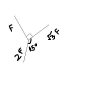
The arrows shown below represent all the force vectors
that are applied to a single point. Which of the following
could NOT be true of the point? (Note: sin 150° = 0.5;
cos 150 = -root3/2
A. The point is moving at a constant velocity.
B. The point is not moving.
C. The point is accelerating at a constant rate.
D. The point is not accelerating.
The correct (or incorrect) answer is C. I figured out the answer because choices a, b, and d are essentially the same thing. But I would like to know the scientific solutions.
All replies are appreciated.
that are applied to a single point. Which of the following
could NOT be true of the point? (Note: sin 150° = 0.5;
cos 150 = -root3/2
A. The point is moving at a constant velocity.
B. The point is not moving.
C. The point is accelerating at a constant rate.
D. The point is not accelerating.
The correct (or incorrect) answer is C. I figured out the answer because choices a, b, and d are essentially the same thing. But I would like to know the scientific solutions.
All replies are appreciated.