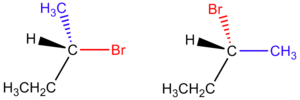
Can someone put the meaning of diastereomers, enantiomers, meso compounds, constitutional isomers and anything else of that sort in layman's terms? Thanks!
Can someone put the meaning of diastereomers, enantiomers, meso compounds, constitutional isomers and anything else of that sort in layman's terms? Thanks!
Enatiomer - Non-superimposable mirror images. They are molecules that have the exact same formula but they're arranged differently. Meaning if they were placed side-by-side you couldn't twist them in anyway that would get them to perfectly overlap.
Meso Compounds: These are compounds that have internal plane of symmetry. Consider the following image. Notice how the bottom half is the mirror image of the top half. Meso compounds are not optically active. Why?
Just write the configuration of the two chiral centers (Designated with * in the following image). The top chiral center has an S-configuration, while the bottom chiral center has an R-configuration. In conclusion, these two chiral centers rotate light the same number of degrees but in opposite direction. The end result is a compound that has no optical activity.
Diastereomers: Are compounds that have the same configuration at one or more chiral centers, but opposite configuration at others. Consider the following image. Notice that there are two diastereomers for the given compound. Let's see if the above definition applies:
-Compare the lower left compound to the top compound--The bottom chiral center has the exact configuration as that of tthe top compound, but the top chiral center has an opposite configuration (Notice how the location of H and OH are switched). Since this compound has the same configuration at the bottom chiral center and the opposite configuration at the top chiral center it qualifies as an diastereomer.
-Compare the lower right compound to the top compound--The top chiral center has the exact configuration as that of tthe top compound, but the bottom chiral center has an opposite configuration (Notice how the location of H and OH are switched). Since this compound has the same configuration at the bottom chiral center and the opposite configuration at the top chiral center it qualifies as an diastereomer.
In the above post, notice that each of the two diastereomers are considered enantiomers of each other. So, what is the difference between diastereomers and enantiomers?
Remember we said that diastereomers have the same configuration at one or more chiral centers, but opposite configuration at others.
Enantiomers on the other hand have opposite configuration at ALL chiral centers.
The Trans Isomer does NOT have an internal plane of symmetry. Think about it; One Cl group is above the ring and the other is below the ring; whereas, if you put a mirror in between you should either see both groups above the ring or both groups below the ring, which is the case for Cis Isomers. Since the Trans Isomer does not have an internal plane of symmetry, it can NOT be a meso compound. So, it's optically active! You can double check this, by determining the configurations at each of the chiral centers. Both chiracl centers will either be R or both will be S. So, they're both rotating light the same number of degrees in the SAME direction. Thus, they won't cancel each other out, which means the compound will be optically active.
awesome, thanks. yeahh... I was just giving a random example actually. While we're on the stereochemistry topic, just as practice, in the two examples posted by razblo, the first one is S and the second is R, correct?
awesome, thanks. yeahh... I was just giving a random example actually. While we're on the stereochemistry topic, just as practice, in the two examples posted by razblo, the first one is S and the second is R, correct?