
TBR Electrostatics Passage 1

This forum made possible through the generous support of SDN members, donors, and sponsors. Thank you.

MedPR

Membership Revoked
Removed
10+ Year Member
Joined
Dec 1, 2011
Messages
18,577
Reaction score
57
Points
4,641
  1. Pre-Podiatry
If the wire is moving within a constant magnetic field, why would there be any current?

Also, I know how to determine that the protons will migrate to the top of the rod and the electrons will migrate to the bottom of the rod, but how do you know that the induced current flows counterclockwise? In other words, how do you know that the protons moving upwards means counterclockwise current?

Uw2Rs.jpg


T0X95.jpg


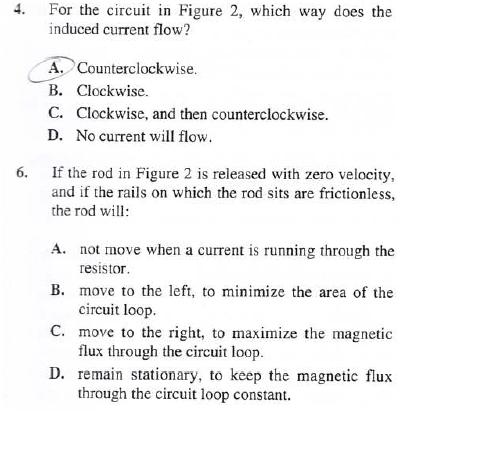
4. A
6. D

So again, if the magnetic flux remains constant, how can a current be induced?
 
I hated this question. I only understood it when I started looking at my old physics (class) notes and my professor gave this example. Those are RAILS on the side of the bar. So it's like this:

TVj6V.png


you see now how magnetic flux changes as the bar moves? the reason it's counterclockwise is because current is flow of positive charge, not electrons. this, i'm sure you remember, is an old convention before they knew what charge is.

so given this information, does #6 make sense now?
 
Yea, I see how magnetic flux changes, since flux = BA.

However, I still don't understand the current flow. I know that conventional current flow is the direction of protons, but I don't understand how protons migrating to the top of the rod means that protons are moving counterclockwise. I mean, I'm guessing counteclockwise because they will go up and out of the rod, then turn left onto that wire and go back around and re-enter through the bottom of the rod? But how do you know/why don't they go to the right when they leave the rod?
 
GMIkA.jpg


they don't go to the right because there is no closed circuit there.

think about a battery in a simple one way circuit. if one of the wires is removed so that the circuit is open, why does the current stop flowing? Because electrons at the end of the wire have no where to go! they are not going to leap off the wire, so they just stop and nothing happens. if you plug in another wire that closes the circuit, then they take that path instead of the path that leads nowhere.

i'd like to correct you on one minor detail. protons aren't actually moving in a current. it is solely electrons.
 
GMIkA.jpg


yes? i don't understand how you are seeing it, but this is how i see it.

That's what I figured. How do you know the protons won't go to the right and exit the circuit?
 
I understand no.4 fine, but don't understand no. 6

What does area have to do this? Are they suggesting that the magnetic field is increasing..? What?
 
I understand no.4 fine, but don't understand no. 6

What does area have to do this? Are they suggesting that the magnetic field is increasing..? What?

It's asking if this configuration was left to flop around, no energy input, no force, no forward velocity, what happens?

Will the bar spontaneously move on the rails forward? Backward? Sit in place?

Well lets look at Lenz's law. It states that a Bfield will tend to remain the same. So when a Bfield is being reduced, a current will develop that will increase the Bfield so that it tries to remain constant. And vice versa for increasing.

Here, Bfield is constant. There is no change in flux, either. Will the bar move? No! Bfield tends to remain the same and therefore this bar will reflect this constancy and not move.
 
Oh, right. Thanks chiddler 🙂

Just to be sure, even when the rod moves, the magnetic field is not changing but since the magnetic flux is, there is induced EMF and current.
 
yes, according to the equation you provided earlier: Flux = B*A and faraday's law Emf =change in flux / time
 
just so you're not misinformed.. there are no protons moving in the charge. A positive charge is merely an absence of electrons, like how cold is an absence of heat.

Protons don't flow in an electric current, only electrons. We have however the misfortune of a system that forced us to use the conventions of the past before this was understood.

If the current flows in one direction, there are only electrons flowing the exact opposite direction.
 
Chiddler!!! Excellent explanation. To the point and highly informative.

There are basically two ways to solve question #4.

1) Use the right hand rule to determine that positive current would flow up the rod and then decide that once it gets to the top of the rod, it has to turn left rather than right because there is an open circuit (with infinitely high resistance) to the right and current will choose the path of least resistance. It ends up flowing around a clockwise loop.

2) Use Lenz's law and note that as the rod moves to the right there an increase in the flux into the page (the Xs). Lenz's law, as stated earlier by Chiddler, aims to keep flux constant (like Le Chateliers principle really) so the induced current needs to create a flux coming out of the page. If you take your right hand and curl your fingers in a way where your thumb points out from the page, then your fingers are curling in a counterclockwise direction, telling you that the induced current must be counterclockwise.

Like most of you, I HATED this passage back when I first saw it. But once you get it, it's an excellent passage that makes you realize how simple these concepts can be if you stick to the basics.
 
Some additional information you may find useful...he already discusses lenz's law for you nicely so I wont bother with that but I will add this...

If the system compensates by gaining X (into the page magnetic field) the induced current is clockwise

If it compensates by gaining O (out of the page) then it's counterclockwise

if it gains down arrow (magnetic field point down) then it's clockwise

Gains up, counter.

these are the four scenarios that are associated with lenzs law and induced current I believe. they can all be verified with the right hand rule.

Number 6 got me the first time around too.
 
Some additional information you may find useful...he already discusses lenz's law for you nicely so I wont bother with that but I will add this...

If the system compensates by gaining X (into the page magnetic field) the induced current is clockwise

If it compensates by gaining O (out of the page) then it's counterclockwise

if it gains down arrow (magnetic field point down) then it's clockwise

Gains up, counter.

these are the four scenarios that are associated with lenzs law and induced current I believe. they can all be verified with the right hand rule.

Number 6 got me the first time around too.


Are these rules independent of the direction you are entering/exiting the field?
 
Are these rules independent of the direction you are entering/exiting the field?


correct me if i'm wrong, but i'm pretty sure it doesn't matter if you enter/exit from the left or right in this case since the point of lenzs law is to compensate. By gaining X you compensate by getting more O and so on. My strategy worked so far in the tbr problems involving lenz law. As long as you are entering/exiting to induce the current.

in case my other post sounds confusing, what i mean is in problem four example, the system is gaining X so it's going to compensate by getting O which will induce a counterclockwise current.
 
If the system compensates by gaining X (into the page magnetic field) the induced current is clockwise

If it compensates by gaining O (out of the page) then it's counterclockwise

EXCELLENT, EXCELLENT, EXCELLENT point ColeSmalls! That's what you need to know in a small, easy-to-carry nutshell.
 
Top Bottom