

You are using an out of date browser. It may not display this or other websites correctly.
You should upgrade or use an alternative browser.
You should upgrade or use an alternative browser.
The prescription opioid epidemic in a nutshell
Started by 101N

Get help with your application
Use all the free resources available to you from SDN: articles, guides, expert advising, forums discussions, and school research.
not sure why this was in purple.Wasn't Oxycontin safer than Oxycodone IR? I seem to remember hearing about that...
yes, it was billed that way. no peaks and troughs, better pain relief. no need to take as much...
same way that both methadone and Opana ER were billed as safer than oxycodone or hydromorphone.
in fact, one ER director from a fairly renowned institution in NY recommended discharging ER patients home with 3-4 doses of methadone instead of a 7 day course of Percocet "because of prolonged action allowed better longer term pain relief with fewer doses so less likely to overdose"...

Advertisement - Members don't see this ad

Iowa doctor pays $100,000 after accused of improperly prescribing pain pills
Federal officials say Dr. Paul Lottes hasn't been charged with a crime, but agreed to pay $100,000 to settle allegations of overprescribing opioids.
amp.desmoinesregister.com

It's sad that these are always DEA busts and never reprimands from the medical board.
Often one follows the other.. if you read through the states disciplinary actions you will see lots of discipline based on opioids. At least in the states I’ve been in. The Most common disciplinary actions are opioid related, failing to report sanctions or legal issues in other states and having alcohol problems.

Green Twp. doctor who prescribed 'unjustifiable' amounts of pain pills sentenced to 3 years
Dr. George Griffin had twice drawn the attention of the state medical board for prescribing excessive amounts of pain drugs, the judge said.
amp.cincinnati.com
No mention amounts or what these dangerous combinations were. Just that he broke the “the law”. The problem here is there is “no law” about maximum amounts and which combinations can be prescribed, only guidelines. It all falls to the judgements of the medical boards and prosecutors who have a hard on to make a name for themselves. Now maybe he did break some laws but seeing these puff bull**** articles with no facts excoriating people is infuriating .
I wish they would set some hard limits.. but they don’t want it to fall back on them they would rather let the prescribers be the sacrificial lamb and then say “hey you prescribed too much”.
I wish they would set some hard limits.. but they don’t want it to fall back on them they would rather let the prescribers be the sacrificial lamb and then say “hey you prescribed too much”.
I'm not thinking it is such a great idea to somewhat defend these "physicians" without looking at all the details by diverting the argument to requiring hard limits.
I could not find the legal documents revolving around this case, but in one news article, a patient stated he was prescribed 360 OxyContin and 140 Percocet per month by the inestimable Dr Griffin
I could not find the legal documents revolving around this case, but in one news article, a patient stated he was prescribed 360 OxyContin and 140 Percocet per month by the inestimable Dr Griffin
I am not saying to defend him. I’m saying it’s very frustrating when they prosecute someone publicly without giving any details.
typically there are court filings that I can find with a little searching, and those describe what the individual was prescribing. I didn't see anything posted yet regarding legal documents.
I'm not really thinking that these DEA or DOJ have it easy. its a lot of work.
when you read their documents, inevitably there is something that all of us would agree is not quality medical care...
I'm not really thinking that these DEA or DOJ have it easy. its a lot of work.
when you read their documents, inevitably there is something that all of us would agree is not quality medical care...

Long Island Doctor, 75, Who Worked From Car Accused of Murdering 5 Patients
A Long Island doctor is facing murder charges after five patients allegedly died between 2016 and 2018 due to prescriptions he wrote. George Blatti, 75, was arraigned Thursday on five counts of murder in the second degree and 11 counts of reckless endangerment in the first degree. Blatti was...
 www.nbcnewyork.com

We finally have a verdict...
The study, reported in the journal Injury, looks at the relationship between pain pill prescriptions and injury-related deaths, including unintentional deaths and suicides involving drugs, in all 50 states and the District of Columbia from 2006 through 2017. "This is the first study to combine national mortality and opioid data to investigate the relationship between legally obtained opioids and injury-related mortality," the authors write. "In every state examined, there was no consistent relationship between the amount of prescription opioids delivered and total injury-related mortality or any subgroups, suggesting that there is not a direct association between prescription opioids and injury-related mortality."

 reason.com

 pubmed.ncbi.nlm.nih.gov
Injury. 2021 Mar 10;S0020-1383(21)00233-3.
doi: 10.1016/j.injury.2021.03.018. Online ahead of print.
Affiliations expand
Methods: Cross-sectional time-series data was compiled using state-level mortality data from the Centers for Disease Control and Prevention Multiple Causes of Death database and prescription opioid shipping data to each state using the US Department of Justice Automated Reports and Consolidated Ordering System Retail Drug Summary reports from 2006 to 2017, with opioids shipped used as a proxy for local opioid consumption. Oxycodone and hydrocodone amounts were converted to morphine equivalent doses (MEDs). Our primary outcome was an association between MEDs and injury mortality rates at the state-level. We analyzed total injury-related deaths and subgroups of unintentional deaths, suicides, and homicides. We modeled the data using fixed effects regression to reduce bias from unmeasured differences between states.
Results: Data were available for all states and the District of Columbia. Opioid deliveries increased through 2012 and then declined. Total injury-related mortalities have been increasing steadily since 2012. Opioid MEDs did not show a consistent or statistically significant relationship with injury-related mortality, including with any subgroups of unintentional deaths, suicides, and homicides.
Conclusion: In every state examined, there was no consistent relationship between the amount of prescription opioids delivered and total injury-related mortality or any subgroups, suggesting that there is not a direct association between prescription opioids and injury-related mortality. This is the first study to combine national mortality and opioid data to investigate the relationship between legally obtained opioids and injury-related mortality. The US opioid epidemic remains a significant challenge that requires ongoing attention from all stakeholders in our medical and public health systems.
Keywords: Injury mortality; Mortality; Opiates; Opioid epidemic; Opioids; Overdose; Population-based analysis; Prescription opioids; Trauma.
Copyright © 2021. Published by Elsevier Ltd.
The study, reported in the journal Injury, looks at the relationship between pain pill prescriptions and injury-related deaths, including unintentional deaths and suicides involving drugs, in all 50 states and the District of Columbia from 2006 through 2017. "This is the first study to combine national mortality and opioid data to investigate the relationship between legally obtained opioids and injury-related mortality," the authors write. "In every state examined, there was no consistent relationship between the amount of prescription opioids delivered and total injury-related mortality or any subgroups, suggesting that there is not a direct association between prescription opioids and injury-related mortality."
A New Study Finds No Relationship Between Opioid Prescriptions and Unintentional Injury Deaths
It has long been clear that the conventional understanding of the "opioid crisis," which focuses on patients who inadvertently become…
reason.com
Opioids and Injury Deaths: A population-based analysis of the United States from 2006 to 2017 - PubMed
In every state examined, there was no consistent relationship between the amount of prescription opioids delivered and total injury-related mortality or any subgroups, suggesting that there is not a direct association between prescription opioids and injury-related mortality. This is the first...
pubmed.ncbi.nlm.nih.gov
Injury. 2021 Mar 10;S0020-1383(21)00233-3.
doi: 10.1016/j.injury.2021.03.018. Online ahead of print.
Opioids and Injury Deaths: A population-based analysis of the United States from 2006 to 2017
Evelyn I Truong 1, Sami K Kishawi 2, V P Ho 3, Roshan S Tadi 4, David F Warner 5, Jeffrey A Claridge 2, Esther S Tseng 6Affiliations expand
- PMID: 33814132
- DOI: 10.1016/j.injury.2021.03.018
Abstract
Introduction: In the United States, the opioid epidemic claims over 130 lives per day due to overdoses. While the use of opioids in trauma patients has been well-described in the literature, it is unknown whether prescription opioid use is associated with mortality after trauma. We hypothesized that legally obtained prescription opioid consumption would be positively associated with injury-related deaths in the United States.Methods: Cross-sectional time-series data was compiled using state-level mortality data from the Centers for Disease Control and Prevention Multiple Causes of Death database and prescription opioid shipping data to each state using the US Department of Justice Automated Reports and Consolidated Ordering System Retail Drug Summary reports from 2006 to 2017, with opioids shipped used as a proxy for local opioid consumption. Oxycodone and hydrocodone amounts were converted to morphine equivalent doses (MEDs). Our primary outcome was an association between MEDs and injury mortality rates at the state-level. We analyzed total injury-related deaths and subgroups of unintentional deaths, suicides, and homicides. We modeled the data using fixed effects regression to reduce bias from unmeasured differences between states.
Results: Data were available for all states and the District of Columbia. Opioid deliveries increased through 2012 and then declined. Total injury-related mortalities have been increasing steadily since 2012. Opioid MEDs did not show a consistent or statistically significant relationship with injury-related mortality, including with any subgroups of unintentional deaths, suicides, and homicides.
Conclusion: In every state examined, there was no consistent relationship between the amount of prescription opioids delivered and total injury-related mortality or any subgroups, suggesting that there is not a direct association between prescription opioids and injury-related mortality. This is the first study to combine national mortality and opioid data to investigate the relationship between legally obtained opioids and injury-related mortality. The US opioid epidemic remains a significant challenge that requires ongoing attention from all stakeholders in our medical and public health systems.
Keywords: Injury mortality; Mortality; Opiates; Opioid epidemic; Opioids; Overdose; Population-based analysis; Prescription opioids; Trauma.
Copyright © 2021. Published by Elsevier Ltd.
part of their conclusion is that people are not killing themselves over not getting opioids, if there is no correlation...
 www.clinicalkey.com
does not change the opinion that opioids should not be initiated on the chronic pain population.
one can question whether forced opioid reduction should be performed on Legacy patients.
illicit drug use is most likely confounding all data points.
I continue to believe that we need to change our societal mores that state that 1. all pain is bad and 2. all pain needs to be eliminated with a narcotic.
ClinicalKey
www.clinicalkey.com
Our study had several important limitations. First, we assume that the oxycodone and hydrocodone shipments tracked by ARCOS were all used for legally prescribed purposes. However, ARCOS cannot distinguish if these opioids were illegally diverted or misused upon reaching the end user or if they were taken across state lines. ARCOS also by definition does not track illegally manufactured or distributed opioids such as street heroin or clandestinely-produced fentanyl. Since the CDC characterizes the opioid epidemic since 2010 as strongly driven by heroin and synthetic opioids like fentanyl [29] , this may suggest that legally obtained oxycodone and hydrocodone, both derived from opium poppy alkaloids, do not significantly contribute to the mortality from traumatic mechanisms. A second important limitation is that our data were limited to state-level analyses. We assumed that within-state variation would introduce fewer confounding factors than a between-states comparison. However, just as there are many immeasurable differences between states, there may also be a higher degree of variation between rural, suburban, and urban areas within a single state. Future studies might focus on the comparison of geographical or political regions that are less cofounded by variation, such as an urban to rural comparison or a comparison between individual metropolitan areas. Nevertheless, because legislation surrounding opioid prescribing limits typically occurs at the state level, we felt that state-level analysis would provide important value to the discussion on opioids and trauma and should be able to detect the presence of large or significant trends. Thirdly, we were not able to examine non-fatal injury rates during the study period, and it is possible that opioid use is associated with non-fatal injury without an effect on mortality. If opioids are strongly related to non-fatal injuries, this relationship would have been overlooked by our analysis and would require data beyond the scope of this project.
does not change the opinion that opioids should not be initiated on the chronic pain population.
one can question whether forced opioid reduction should be performed on Legacy patients.
illicit drug use is most likely confounding all data points.
I continue to believe that we need to change our societal mores that state that 1. all pain is bad and 2. all pain needs to be eliminated with a narcotic.
part of their conclusion is that people are not killing themselves over not getting opioids, if there is no correlation...
ClinicalKey
does not change the opinion that opioids should not be initiated on the chronic pain population.
one can question whether forced opioid reduction should be performed on Legacy patients.
illicit drug use is most likely confounding all data points.
I continue to believe that we need to change our societal mores that state that 1. all pain is bad and 2. all pain needs to be eliminated with a narcotic.
You're going to tell people that they should just wait around until society changes its mores? Then what?
How's that different from telling people to go pound sand?
Advertisement - Members don't see this ad
You're going to tell people that they should just wait around until society changes its mores? Then what?
How's that different from telling people to go pound sand?

Taking painkillers away from those in desperate need is a cruel health policy | Rajesh Munglani
Nice’s new guidelines prescribing exercise over drugs for chronic sufferers risk causing more distress, says pain medicine consultant Rajesh Munglani
Taking painkillers away from those in desperate need is a cruel health policy | Rajesh Munglani
Nice’s new guidelines prescribing exercise over drugs for chronic sufferers risk causing more distress, says pain medicine consultant Rajesh Munglaniwww.theguardian.com
Perhaps the only thing worse than telling someone that their pain is "in their head" is that their pain is "socially constructed."
If his knees are as bad as the article suggests, then the British healthcare system is at fault for not approving his TKA just because he is 55.Taking painkillers away from those in desperate need is a cruel health policy | Rajesh Munglani
Nice’s new guidelines prescribing exercise over drugs for chronic sufferers risk causing more distress, says pain medicine consultant Rajesh Munglani
If his knees are as bad as the article suggests, then the British healthcare system is at fault for not approving his TKA just because he is 55.
PRP might have helped.
Perhaps, but he already got an autologous "stem cell" injectionPRP might have helped.
Perhaps, but he already got an autologous "stem cell" injection
At least the NHS paid for it.
for those chronic nonmalignant patients not already on chronic opioid therapy, i tell them that narcotics are too risky and it would be irresponsible and wrong of me to start them on them.You're going to tell people that they should just wait around until society changes its mores? Then what?
How's that different from telling people to go pound sand?
im going to tell them about the thousands of people who have been referred to me for alternatives for opioids because they developed tolerance and they dont work any more
im going to tell them about the thousands of people who i have seen because their previous prescriber cant anymore - because they lost their license or are in jail due to inappropriate prescribing - who are basically screwed.
im going to try to get them engaged in their own care, rather than rely on a dangerous drug, because they wont get better by a pill or needle. tell them that pain is a part of life and does not have to be so damaging.
Legacy patients are a different category. they have already been screwed over. their care has to be more individualized - it might be effecting no change at all to opioid cessation (for OIH) to rotation to butrans. taper to a reasonable dose may be best option....

PROP’s Disproportionate Influence on U.S. Opioid Policy: The Harms of Intended Consequences
A website by clinicians dedicated to hospice and palliative care research, news and opinion.
Conclusion
Despite being turned back from an effort to bluntly reduce opioid prescribing by the FDA in 2013 based on a lack of scientific evidence for its position (17,18), PROP has had a disproportionate effect on opioid policy in the Untied States for almost a decade. PROP found a willing federal regulatory partner in the CDC, and while PROP may not have “secretly written” the 2016 CDC Pain Guidelines (75), they certainly enjoyed disproportionate representation on CDC’s review panels and Core Expert Group (23-25) in a process that lacked transparency (22, 23, 26, 27). When the CDC admitted that its Pain Guideline had been widely misapplied (40) and joined the FDA in a call against forced opioid tapers (42, 43, 45), PROP doubled down on its rhetoric (46), dismissing legitimate concerns about potential harms in a performative manner (75) that encouraged their ongoing misapplication, while assailing PROP’s critics (76, 77). All of this has occurred as PROP members have repeatedly concealed relevant conflicts of interest, including key conflicts that should have been disclosed during the process of drafting the CDC Pain Guidelines (48-54).
Given this, at a minimum, PROP should no longer enjoy a prominent role in guiding future opioid policy in the United States. This is a particularly urgent concern, as Roger Chou has been linked to authorship of CDC’s New Pain Guidelines, which have not yet been released to the public (78). Chou’s involvement in yet another set of Guidelines and CDC’s recurrent lack of transparency (79) in identifying the new Guidelines’ authors should alarm all advocates who support access to pain medications for all patients with a medically legitimate indication for opioid therapy.
Beyond limiting PROP’s role in developing future, potentially harmful opioid policy, a reasonable individual would be justified in wondering to what extent PROP bears culpability for the harms that arose from misapplications of the 2016 CDC Pain Guidelines. In our country, civil suits – like class action lawsuits, for example – only require a preponderance of the evidence – that is something is “more likely than not” - as the burden of proof for liability. It is more likely than not that PROP’s efforts to affect opioid policy helped shape the CDC Guidelines, which CDC has admitted were misapplied harmfully (40). It is also more likely than not that PROP’s performative advocacy efforts contributed to misapplication of the CDC Guidelines. And it is more likely than not that widespread misapplication of the CDC Guidelines resulted in harms with attendant civil liability. This would expose PROP to civil liability with a potentially enormous settlement if a class action suit were to arise from those harmed by the misapplication of the CDC Guidelines. Perhaps that is why PROP member, Andrew Kolodny, and others have worked so hard recently to create plausibly deniability (75) in the wake of the damaging February 12, 2021, MMWR Report (2).
Interesting to reflect on where this thread has taken us almost a decade later...as we fight our next pain-related epidemics (cluneal neuralgia and Modic-related back pain) I hope we learn from this conversation.

 thehill.com
"The reduction in opioid prescriptions, however, did not reduce overdose deaths. In fact, from 2012 to 2021, overdose deaths soared from 41,000 to 100,000, with most deaths now resulting from illegal synthetic opioids — fentanyl and its analogs. Fighting the “war on opioids” at every physician’s office was a terrible mistake, and an unintended consequence has been to increase the suffering of many patients with chronic diseases whose long-term pain management depends on access to opioids. How did we get to this point?"
The opioid crackdown leaves chronic pain patients in limbo
Overzealous policies to limit opioids have significantly hampered pain control for 18 million patients with moderate to severe chronic pain.
thehill.com
"The reduction in opioid prescriptions, however, did not reduce overdose deaths. In fact, from 2012 to 2021, overdose deaths soared from 41,000 to 100,000, with most deaths now resulting from illegal synthetic opioids — fentanyl and its analogs. Fighting the “war on opioids” at every physician’s office was a terrible mistake, and an unintended consequence has been to increase the suffering of many patients with chronic diseases whose long-term pain management depends on access to opioids. How did we get to this point?"

LOL on the pain related epidemics.Interesting to reflect on where this thread has taken us almost a decade later...as we fight our next pain-related epidemics (cluneal neuralgia and Modic-related back pain) I hope we learn from this conversation.
The opioid crackdown leaves chronic pain patients in limbo
Overzealous policies to limit opioids have significantly hampered pain control for 18 million patients with moderate to severe chronic pain.
"The reduction in opioid prescriptions, however, did not reduce overdose deaths. In fact, from 2012 to 2021, overdose deaths soared from 41,000 to 100,000, with most deaths now resulting from illegal synthetic opioids — fentanyl and its analogs. Fighting the “war on opioids” at every physician’s office was a terrible mistake, and an unintended consequence has been to increase the suffering of many patients with chronic diseases whose long-term pain management depends on access to opioids. How did we get to this point?"
Sad that people are still dying, but better that they off themselves with street drugs, rather than die on something that has my name on the bottle. Sounds selfish, but unless the government does drastic tort reform, I will write very few opioids, even if I see midlevels doing them incorrectly.
ignored in that article is that the vast number of deaths is from fentanyl.
64% of overdose deaths were from illicit fentanyl.
64% of 100,000 deaths means that 32,000 overdose deaths were from non-fentanyl drugs.
how many overdose deaths were there in 2010, before fentanyl started showing up in the US?
if you said 38,000, you would be right.
this current pandemic is not driven by physicians not writing opioids, it is being driven by people - intentionally or otherwise - dying from illicit fentanyl.
64% of overdose deaths were from illicit fentanyl.
64% of 100,000 deaths means that 32,000 overdose deaths were from non-fentanyl drugs.
how many overdose deaths were there in 2010, before fentanyl started showing up in the US?
if you said 38,000, you would be right.
this current pandemic is not driven by physicians not writing opioids, it is being driven by people - intentionally or otherwise - dying from illicit fentanyl.
ignored in that article is that the vast number of deaths is from fentanyl.
64% of overdose deaths were from illicit fentanyl.
64% of 100,000 deaths means that 32,000 overdose deaths were from non-fentanyl drugs.
how many overdose deaths were there in 2010, before fentanyl started showing up in the US?
if you said 38,000, you would be right.
this current pandemic is not driven by physicians not writing opioids, it is being driven by people - intentionally or otherwise - dying from illicit fentanyl.
It shows a complete failure/non-effect of the CDC guidelines. They had no impact on deaths from non-fentanyl opioids but reduced prescribing instead.
So you’re telling me a government policy had unintended tragic consequences? Say it ain’t so.. surely if we make sudafed hard to get that will stop the amphetamine problem at least ..
And I would also mention that at least some of the fentanyl overdoses can be traced back to the demand for good old roxy 30s which are rare as hens teeth these days but still in high demand (because you knew what you were getting ironically). But you can find counterfeit ones made with fentanyl. For those that don’t know this is what got prince.
And I would also mention that at least some of the fentanyl overdoses can be traced back to the demand for good old roxy 30s which are rare as hens teeth these days but still in high demand (because you knew what you were getting ironically). But you can find counterfeit ones made with fentanyl. For those that don’t know this is what got prince.
D
deleted875186
It is some strange logic that the opioid defenders use to justify this risky medicine.
1. Get people hooked on opioids
2. Have no evidence that the opioids legitimately helping long term
3. Measure overdose deaths from illicit drugs over the past decade while physician prescribing went down.
4. Assume that tapering off patients from high risk medicine has caused all these people to kill themselves with illicit drugs.
5. Use this to justify prescribing more opioids to these legacy patients
…. I’m truely baffled.
1. Get people hooked on opioids
2. Have no evidence that the opioids legitimately helping long term
3. Measure overdose deaths from illicit drugs over the past decade while physician prescribing went down.
4. Assume that tapering off patients from high risk medicine has caused all these people to kill themselves with illicit drugs.
5. Use this to justify prescribing more opioids to these legacy patients
…. I’m truely baffled.
It is some strange logic that the opioid defenders use to justify this risky medicine.
1. Get people hooked on opioids
2. Have no evidence that the opioids legitimately helping long term
3. Measure overdose deaths from illicit drugs over the past decade while physician prescribing went down.
4. Assume that tapering off patients from high risk medicine has caused all these people to kill themselves with illicit drugs.
5. Use this to justify prescribing more opioids to these legacy patients
…. I’m truely baffled.
But no one has justified any benefit to the CDC guidelines. Why? What good effect did the 2016 guidelines produce?
Advertisement - Members don't see this ad
D
deleted875186
True, but we also don’t have a lot of evidence for many treatments in medicine. Is the risk of addiction to opioids enough to justify limiting their use? If we truly believe in “do no harm”, why would we prescribe these medications without proof they will help. Chronic pain existed before the rise of opioids, why do we think there is a tsunami of chronic pain now, instead of just a bunch of people that got hooked on opioids.But no one has justified any benefit to the CDC guidelines. Why? What good effect did the 2016 guidelines produce?
And it's mostly just in the USA.True, but we also don’t have a lot of evidence for many treatments in medicine. Is the risk of addiction to opioids enough to justify limiting their use? If we truly believe in “do no harm”, why would we prescribe these medications without proof they will help. Chronic pain existed before the rise of opioids, why do we think there is a tsunami of chronic pain now, instead of just a bunch of people that got hooked on opioids.
you can make suppositions. look at data.But no one has justified any benefit to the CDC guidelines. Why? What good effect did the 2016 guidelines produce?
note the gradual increase over time, but the sharp increase starting in 2012, 4 years before CDC "guidelines" came out.
this is the OD deaths by drug. note when the overall rate of fentanyl deaths started skyrocketing in 2015, before CDC guidelines - people were increasingly dying from fentanyl before they came out.
---
the blue line is the prescription opioid deaths. the graph after 2017 looks like it is headed downwards.
here is a closer look at prescription opioid deaths in greater detail:
note the downturn after 2017.
given that the upturn in deaths started before the CDC guidelines came out or had an effect, it is a reach to say that the CDC guidelines alone caused ppl to turn to illicit opioids and die.
and fact of the matter, any patient who is willing to go out and obtain illicit opioids is probably an addict that we shouldnt have ever started prescribing opioids.
you can make suppositions. look at data.
View attachment 346545
note the gradual increase over time, but the sharp increase starting in 2012, 4 years before CDC "guidelines" came out.
View attachment 346543
this is the OD deaths by drug. note when the overall rate of fentanyl deaths started skyrocketing in 2015, before CDC guidelines - people were increasingly dying from fentanyl before they came out.
---
the blue line is the prescription opioid deaths. the graph after 2017 looks like it is headed downwards.
here is a closer look at prescription opioid deaths in greater detail:
View attachment 346544
note the downturn after 2017.
given that the upturn in deaths started before the CDC guidelines came out or had an effect, it is a reach to say that the CDC guidelines alone caused ppl to turn to illicit opioids and die.
and fact of the matter, any patient who is willing to go out and obtain illicit opioids is probably an addict that we shouldnt have ever started prescribing opioids.
What specific effect of the CDC 2016 guidelines do you believe accounts for these results?
Did the Guidelines cause any intended effect or unintended effect? If yes, did the effects improve or worsen the policy's endeavored outcomes?
Did access to medical care get better or worse for pain patients?
Is stupid doing the same thing and expecting a different result or should the guidelines be revised to improve the results that they seek to achieve?
Last edited:
there is the unintended effect of politicization of opioid use.
there needed to be a "correction" from the free wheeling "opioids never cause addiction" / "COT patients never suffer consequences of opioid use" mantra.
you can argue that it swung the other way too much. but to not acknowledge the issue would have been more problematic.
most importantly, it did not address the underlying issue - we use too many opioids for chronic noncancer pain.
we should be changing the norms regarding casual opioid use and we should not be starting them on chronic nonmalignant pain, except in situations that border on palliative
------
interesting nugget - the WHO estimated that 115,000 people worldwide died of opioid overdose in 2017.

 www.who.int
47,600 Americans died of opioid overdose in 2017.
there are 330 million americans and 7.9 billion people worldwide. we make up 4.4% of the worlds population.
yet we had 41% of the opioid overdose deaths.
(oh and for those who think "well, everyone else is dying from alcohol - the US ranks 50th out of 183 countries in alcohol related deaths. better than France, Germany, Russia but worse than UK, Ireland, Australia)
there needed to be a "correction" from the free wheeling "opioids never cause addiction" / "COT patients never suffer consequences of opioid use" mantra.
you can argue that it swung the other way too much. but to not acknowledge the issue would have been more problematic.
most importantly, it did not address the underlying issue - we use too many opioids for chronic noncancer pain.
we should be changing the norms regarding casual opioid use and we should not be starting them on chronic nonmalignant pain, except in situations that border on palliative
------
interesting nugget - the WHO estimated that 115,000 people worldwide died of opioid overdose in 2017.
Opioid overdose
The term “opioids” includes compounds that are extracted from the poppy seed as well as semisynthetic and synthetic compounds that can interact with opioid receptors in the brain.
Worldwide, about 500 000 deaths are attributable to drug use. More than 70% of these deaths are related to opioids, with more than 30% of those deaths caused by overdose. According to WHO estimates, approximately 115 000 people died of opioid overdose in 2017.
47,600 Americans died of opioid overdose in 2017.
there are 330 million americans and 7.9 billion people worldwide. we make up 4.4% of the worlds population.
yet we had 41% of the opioid overdose deaths.
(oh and for those who think "well, everyone else is dying from alcohol - the US ranks 50th out of 183 countries in alcohol related deaths. better than France, Germany, Russia but worse than UK, Ireland, Australia)
Also don’t forget the impact of online forums, bluelight started way back in ‘97.
D
deleted875186
Perhaps the biggest error is to assume overdose deaths are associated with the CDC guidelines. I’ve never seen anyone actually connect the two, only wrote opinion pieces that seem to suggest one caused the other.What specific effect of the CDC 2016 guidelines do you believe accounts for these results?
Did the Guidelines cause any intended effect or unintended effect? If yes, did the effects improve or worsen the policy's endeavored outcomes?
Did access to medical care get better or worse for pain patients?
Is stupid doing the same thing and expecting a different result or should the guidelines be revised to improve the results that they seek to achieve?
Drug use in society is prevalent, why do we assume all these overdoses are coming from former chronic pain patients. Perhaps even more overdose deaths would have occurred over the last 5 years if the CDC did not make these guidelines and we have a large supply of fentanyl on the streets and a large supply of pharmaceutical opioids being diverted.
I was reading the comments on a Mike Rowe facebook post where he helped a random painter at the airport try to find new employees. He had 20-30 open spots starting at $22/hr with no experience but couldn't find anyone willing to work.
This comment struck me as relevant to this discussion:
"There are thousands of stories just like this. I'm in the auto collision industry and we can't find sober help. Unless we start to allow drug addicted employees I'm afraid my industry is a dying trade. It seems most young people are above staying clean and getting dirty?" - J. Christensen
People just wanna get high to escape and will do whatever is easiest/safest/cheapest for them. This is getting worse as life has become more stressful for most Americans.
This comment struck me as relevant to this discussion:
"There are thousands of stories just like this. I'm in the auto collision industry and we can't find sober help. Unless we start to allow drug addicted employees I'm afraid my industry is a dying trade. It seems most young people are above staying clean and getting dirty?" - J. Christensen
People just wanna get high to escape and will do whatever is easiest/safest/cheapest for them. This is getting worse as life has become more stressful for most Americans.
~35000 of the opiate deaths were illicits.there is the unintended effect of politicization of opioid use.
there needed to be a "correction" from the free wheeling "opioids never cause addiction" / "COT patients never suffer consequences of opioid use" mantra.
you can argue that it swung the other way too much. but to not acknowledge the issue would have been more problematic.
most importantly, it did not address the underlying issue - we use too many opioids for chronic noncancer pain.
we should be changing the norms regarding casual opioid use and we should not be starting them on chronic nonmalignant pain, except in situations that border on palliative
------
interesting nugget - the WHO estimated that 115,000 people worldwide died of opioid overdose in 2017.
Opioid overdose
The term “opioids” includes compounds that are extracted from the poppy seed as well as semisynthetic and synthetic compounds that can interact with opioid receptors in the brain.
47,600 Americans died of opioid overdose in 2017.
there are 330 million americans and 7.9 billion people worldwide. we make up 4.4% of the worlds population.
yet we had 41% of the opioid overdose deaths.
(oh and for those who think "well, everyone else is dying from alcohol - the US ranks 50th out of 183 countries in alcohol related deaths. better than France, Germany, Russia but worse than UK, Ireland, Australia)
Of the 12600, how many were patients being prescribed the medication?
How many of those were palliative care?
I know the more drugs prescribed, the more they can find their way to the street.
Perhaps the biggest error is to assume overdose deaths are associated with the CDC guidelines. I’ve never seen anyone actually connect the two, only wrote opinion pieces that seem to suggest one caused the other.
Drug use in society is prevalent, why do we assume all these overdoses are coming from former chronic pain patients. Perhaps even more overdose deaths would have occurred over the last 5 years if the CDC did not make these guidelines and we have a large supply of fentanyl on the streets and a large supply of pharmaceutical opioids being diverted.
How could such smart people (the CDC Core Working Group) make such a fundamental cognitive error about attribution of effects?
#GovernmentHow could such smart people (the CDC Core Working Group) make such a fundamental cognitive error about attribution of effects?
why do you think they made an error?
i shudder to think of the state of affairs that would have occurred if we had continued in our course of unacknowledged uncontrolled opioid prescribing to everyone on top of the illicit fentanyl use.
i shudder to think of the state of affairs that would have occurred if we had continued in our course of unacknowledged uncontrolled opioid prescribing to everyone on top of the illicit fentanyl use.
why do you think they made an error?
i shudder to think of the state of affairs that would have occurred if we had continued in our course of unacknowledged uncontrolled opioid prescribing to everyone on top of the illicit fentanyl use.
The guidelines didn't have any measurable impact on any of the stated objectives they identified when they made them---OD's and addiction did not go down. Prescribing went down, but it didn't impact any key outcomes. So, so what? It was a big nothing burger but a lot of people got rich, got promotions, published articles, got tenure, collected expert witness fees. It was a huge COI boondoggle and didn't move the needle on any outcome.
Why celebrate bad public policy?
Moving forward with the new 2022 CDC Guidelines I think everyone will realize that Government interference in physician medical decision-making has no positive effect.
are you so sure that the overdose rate from prescription medications did not go down?
look closely at the blue line in the graph above.
or look at this graph (esp the solid line):
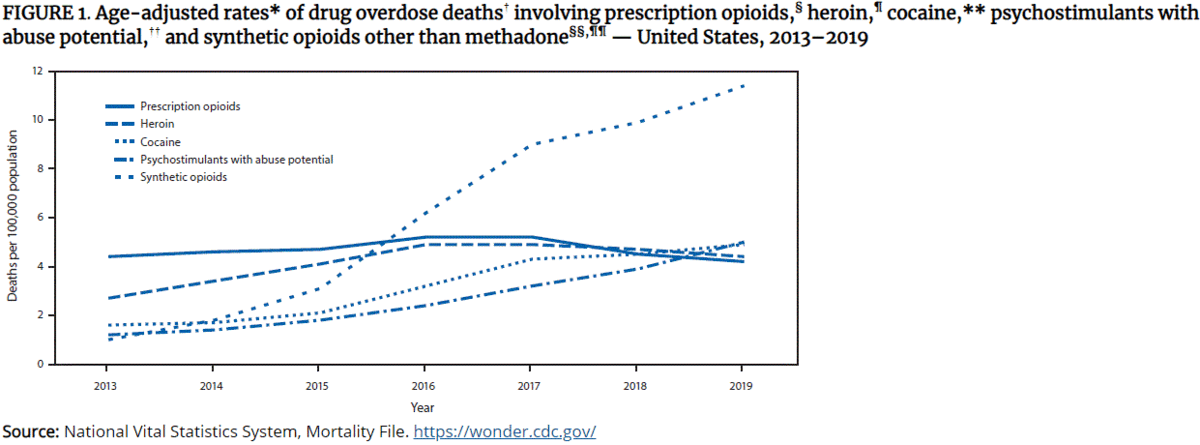
which is the only line going down?
look closely at the blue line in the graph above.
or look at this graph (esp the solid line):
which is the only line going down?
are you so sure that the overdose rate from prescription medications did not go down?
look closely at the blue line in the graph above.
or look at this graph (esp the solid line):
View attachment 346651
which is the only line going down?
Why do you believe that all of those "prescription" overdoses had valid prescriptions? I think "prescription opioids" is a garbage term. I think most of those people who said that they had valid RX's were addicts and criminals not legitimate patients.
Last edited:
Advertisement - Members don't see this ad
probably.
some people may have been getting valid prescriptions for opioids but were using them for their opioid addiction.
dont you think its wise that we clean up and stop dishing out opioids to addicts?
some people may have been getting valid prescriptions for opioids but were using them for their opioid addiction.
dont you think its wise that we clean up and stop dishing out opioids to addicts?
probably.
some people may have been getting valid prescriptions for opioids but were using them for their opioid addiction.
dont you think its wise that we clean up and stop dishing out opioids to addicts?
Why are you prescribing opioids to addicts? Suboxone? Methadone?
Anyone of us that prescribes opioids are prescribing to some addicts, whether you know it or notWhy are you prescribing opioids to addicts? Suboxone? Methadone?
please re read what i wrote.Why are you prescribing opioids to addicts? Suboxone? Methadone?
it may help if i add the word "unintentionally".
Anyone of us that prescribes opioids are prescribing to some addicts, whether you know it or not
Like "straight-up addicts"--criminals with impulse control disorders undeserving of pity--or "pain-addicts" medicalized miserable people deserving of pity?
Similar threads


- Replies
- 30
- Views
- 5K
- Replies
- 2
- Views
- 1K
