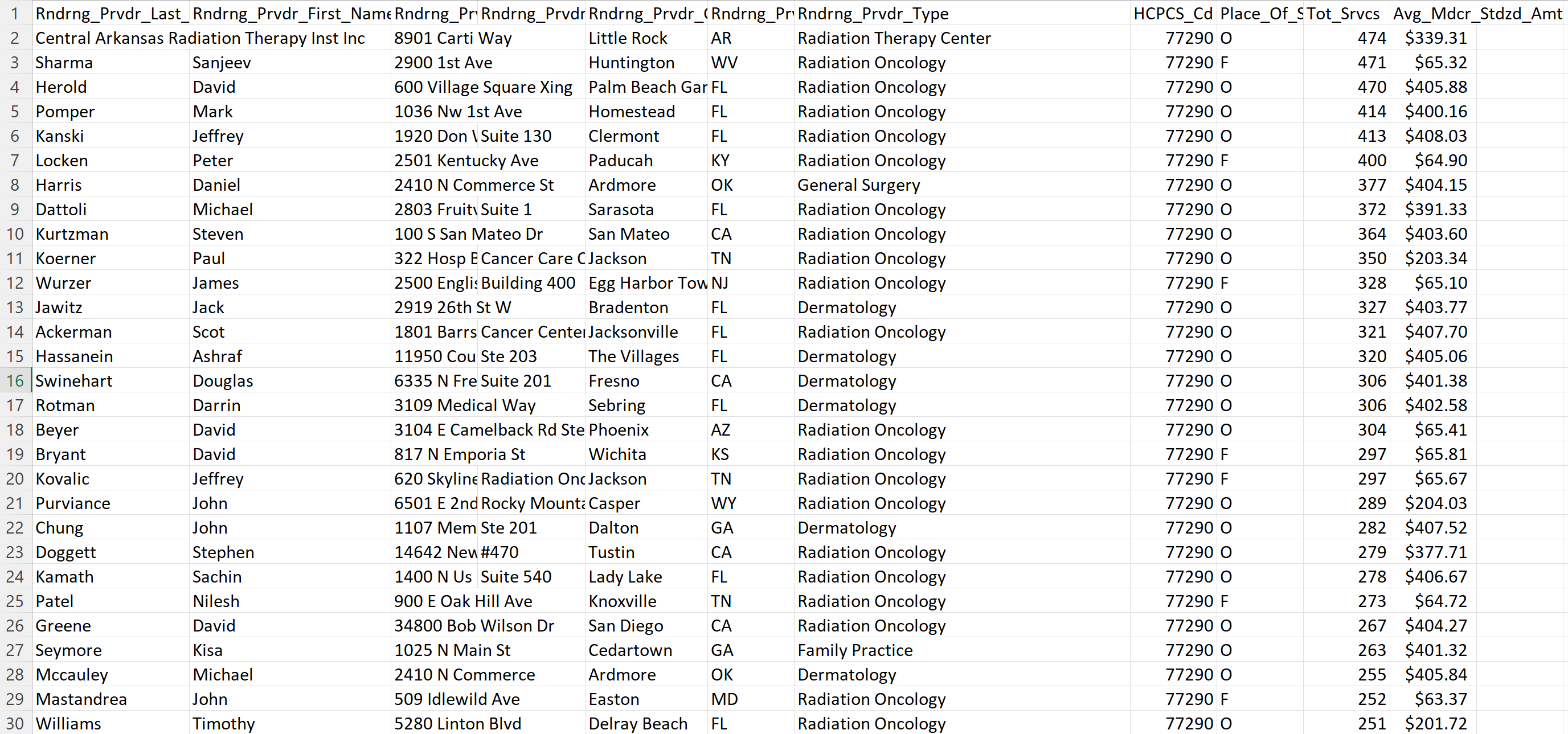
Top 30 Complex Sim Users in America: 7 Are Derm/Fam Prac

This forum made possible through the generous support of SDN members, donors, and sponsors. Thank you.
Get help with your application

Use all the free resources available to you from SDN: articles, guides, expert advising, forums discussions, and school research.

TheWallnerus

e^(iπ) + 1 = 0
Lifetime Donor
7+ Year Member
Advertisement - Members don't see this ad
This confirms some suspicions I had. This is 2019 data.


Take
Tot_Srvcs x Avg_Mdcr_Stdzd_Amt = Total Reimbursement
from Medicare for Code 77290 (complex simulation) alone

ADsGPNB.png
 
But...the ABR tells us our entire training system and board certification pathway is designed to keep radiation away from those dastardly non-RadOncs!

You mean to tell me...that might not be true?

No! The ABR would never massage the truth like that. We must ensure PGY4s continue to take time away from learning clinical medicine to memorize all the proteins involved in non-homologous end joining! Otherwise, almost 1/3 of the top users of therapeutic radiation might be non-RadOncs. Can't have that.
 
Based also on the discussion in the other thread ... It seems very likely these CMS spreadsheets are highly flawed.

I'm not saying that there isn't derm and family practice (how?) doing this, just that it seems more likely a data entry (or more likely attribution) error. Could there be rad oncs under the same NPI?

Edit: Quick search of the General Surgeon and Family Practice folks, looks like both are running derm clinics and at least the surgeon directly advertises Superficial RT.

Edit2: Okay, feels like something is rotten in the state of Denmark
 
Last edited:
Advertisement - Members don't see this ad
I'm not saying that there isn't derm and family practice (how?) doing this
The simple fact is when an MD submits a code to a payor… whether the payor is private or Medicare… no one checks the MD’s CV or board certification. We all have state licenses to practice medicine AND surgery. I don’t practice surgery, but I have an official license to do so.

Regarding your point about “flawed” spreadsheets, yes I have found many flaws. It is surprising how many rad oncs I personally know (or know of) have been listed under Medicare as diagnostic radiology eg. A leading California rad onc is listed as a pediatric hematologist. A UAB rad onc is listed as a gynecologic oncologist. All these were probably an error by a credentialing person at the start of their career that has been overlooked and just never corrected. What I am saying is that Medicare never chases these “ped hem oncs” or “gyn oncs” or “radiologists” down for billing a shi*t ton of rad onc codes.
 
People who started medical school after the year 2000 or so, and especially RadOncs who are abnormally cloistered in academic spaces (vs other specialties), really have a hard time understanding the concept that a license to practice medicine means a license to practice ANY medicine.

You don't need to finish a residency program.

You don't need board certification.

To get a license to practice medicine AND surgery, you just need to pass all USMLE exams and have 1-2 years of supervised training in a GME-accredited program. That's it.

You are legally allowed to do anything you want thereafter.

Residency training and board certification are important for hospital privileges, protection against malpractice suits, and getting reimbursed from private insurance companies.

But literally any licensed doctor can purchase and use (and bill Medicare for) any superficial XRT machine (any machine, really, but the risk for malpractice suit loss gets higher with real linacs).
 
The simple fact is when an MD submits a code to a payor… whether the payor is private or Medicare… no one checks the MD’s CV or board certification. We all have state licenses to practice medicine AND surgery. I don’t practice surgery, but I have an official license to do so.

Regarding your point about “flawed” spreadsheets, yes I have found many flaws. It is surprising how many rad oncs I personally know (or know of) have been listed under Medicare as diagnostic radiology eg. A leading California rad onc is listed as a pediatric hematologist. A UAB rad onc is listed as a gynecologic oncologist. All these were probably an error by a credentialing person at the start of their career that has been overlooked and just never corrected. What I am saying is that Medicare never chases these “ped hem oncs” or “gyn oncs” or “radiologists” down for billing a shi*t ton of rad onc codes.
Yeah, makes you think the people responsible for reducing Medicare fraud would be real interested.

Low hanging fruit
 
Based also on the discussion in the other thread ... It seems very likely these CMS spreadsheets are highly flawed.

I'm not saying that there isn't derm and family practice (how?) doing this, just that it seems more likely a data entry (or more likely attribution) error. Could there be rad oncs under the same NPI?

Edit: Quick search of the General Surgeon and Family Practice folks, looks like both are running derm clinics and at least the surgeon directly advertises Superficial RT.

Edit2: Okay, feels like something is rotten in the state of Denmark

Several of the rad oncs listed here are doing lots of derm rads. If you really wanna see crazy stuff, pull the data from the old days when electronic brachy was reimbursing 20k+ per case.
 
What about the average reimbursed amount number? Highly variable?

Makes me think at least some of these docs (the folks getting reimbursed ~$65/pt) just seeing 70% Medicare patients and decent volume and keeping patients on f/u because of where they are.

I was leading Medicare biller in my area, but far below many others in terms of dollars/patient.

Edit: Nevermind, missed point that data for 77290 only.
 
Last edited:
ANd god forbid we prescribe a drug. I know
Radoncs who won’t prescribe narcotics
I know...A LOT of Radiation Oncologists who won't prescribe narcotics.

The number of times in residency I heard "that's a problem for MedOnc" or "that's a problem for their PCP" was astounding.

People wonder why we're viewed as technicians.
 
Wanted to point out something no one has mentioned.

All the rad onc CPT codes billed by non-ROs in America contribute to CMS's RO spending tally; this is likely not an insignificant amount. There are vast swaths of derms (in the Medicare spreadsheets) billing 77290's to Medicare.

However, likely many of the diagnosis codes used by non-ROs will never be covered under RO-APM.

So, ironically, if APM comes to pass, it will only affect radiation oncologists doing radiation oncology but will not (at least in the beginning) affect other specialists doing radiation oncology.

What a country.
 
Wanted to point out something no one has mentioned.

All the rad onc CPT codes billed by non-ROs in America contribute to CMS's RO spending tally; this is likely not an insignificant amount. There are vast swaths of derms (in the Medicare spreadsheets) billing 77290's to Medicare.

However, likely many of the diagnosis codes used by non-ROs will never be covered under RO-APM.

So, ironically, if APM comes to pass, it will only affect radiation oncologists doing radiation oncology but will not (at least in the beginning) affect other specialists doing radiation oncology.

What a country.
 

Attachments

  • B3D05CC4-52A7-481B-A6D4-44325493F196.jpeg
    B3D05CC4-52A7-481B-A6D4-44325493F196.jpeg
    124.8 KB · Views: 153
Advertisement - Members don't see this ad
The simple fact is when an MD submits a code to a payor… whether the payor is private or Medicare… no one checks the MD’s CV or board certification. We all have state licenses to practice medicine AND surgery. I don’t practice surgery, but I have an official license to do so.

Regarding your point about “flawed” spreadsheets, yes I have found many flaws. It is surprising how many rad oncs I personally know (or know of) have been listed under Medicare as diagnostic radiology eg. A leading California rad onc is listed as a pediatric hematologist. A UAB rad onc is listed as a gynecologic oncologist. All these were probably an error by a credentialing person at the start of their career that has been overlooked and just never corrected. What I am saying is that Medicare never chases these “ped hem oncs” or “gyn oncs” or “radiologists” down for billing a shi*t ton of rad onc codes.
Correct - use of CPT/HCPCS codes are “specialty agnostic”
 
many rad oncs are just straight afraid to prescribe a pain medication. I don't get it
Agreed - with that said, if med onc has already prescribed it I prefer not to add myself as another cook in that kitchen for refills etc and prefer those get refilled by med onc.

How many of you guys are agreeing to write for DME, home health orders etc? We run such a lean operational that I don’t have nursing support to help me with the multitude of orders needed for this stuff and tend to have my med onc colleagues do it or their PCP. Would be curious to see what you all do. Last time I did it for a patient who needed 8Gy x 1 to a bone met, I was still getting calls from home health for orders like 6 months after I had treated the patient and he was under chemo.
 
Agreed - with that said, if med onc has already prescribed it I prefer not to add myself as another cook in that kitchen for refills etc and prefer those get refilled by med onc.
I will write if they aren't writing, but it's really bad practice to have multiple docs writing narcs and it will show up in the pdmp/e-forsce databases. It's best to let med onc manage it if they have already started those meds.

No reason why we shouldn't write though if it's xrt related however and they aren't on opioids. That's just bad patient care and makes us look bad as a specialty
 
I will write if they aren't writing, but it's really bad practice to have multiple docs writing narcs and it will show up in the pdmp/e-forsce databases. It's best to let med onc manage it if they have already started those meds.

No reason why we shouldn't write though if it's xrt related however and they aren't on opioids. That's just bad patient care and makes us look bad as a specialty
Totally agreed - I even end up writing if for my rad onc partners in my same office if they’re unwilling to, agree it’s bad form.

However in case that med onc has already written narcs, i just contact them and they refill it. Keeps things clean and patients like how we coordinate their care.
 
Totally agreed - I even end up writing if for my rad onc partners in my same office if they’re unwilling to, agree it’s bad form.

However in case that med onc has already written narcs, i just contact them and they refill it. Keeps things clean and patients like how we coordinate their care.
I write narcs routinely for the concurrent patients. It just makes since b/c they come in the dept everyday. I am sure they appreciate us not punting that b/c it is a pain in the you know what to manage. When I punt antibiotics and inpatient admission, hopefully they remember me writing narcs...
 
Aside from narcs discussion: How many of you are writing for DME, home health orders etc? I write for hospice, do advanced care planning etc as needed but more interested to hear about the ongoing home health and DME orders which are usually longitudinal.
 
Aside from narcs discussion: How many of you are writing for DME, home health orders etc? I write for hospice, do advanced care planning etc as needed but more interested to hear about the ongoing home health and DME orders which are usually longitudinal.
I write for lymphedema clinic for breast pts if needed, HHC for peg tubes, pretty much anything directly related to the area we are treating
 
Aside from narcs discussion: How many of you are writing for DME, home health orders etc? I write for hospice, do advanced care planning etc as needed but more interested to hear about the ongoing home health and DME orders which are usually longitudinal.
Not often, but I've written for home health. Occasional wheelchair or walker script but sometimes rec for out of pocket walker from Walmart all that's needed. I never order O2 as pulm area IMO and if declining pt, hospice will incorporate for comfort.

Issue with patients that need home health referral is that any appointment is a hardship. So punting to PCP who they will see in 3 weeks probably not best.

Lymphedema referral is standard. May refer for cording even before XRT if evident at consultation. Have ordered prosthetic bras.

I say nobody better to manage pain meds of acute XRT related pain than the radonc. Now if it becomes hard to ween off of narcs months after treatment with chronic pain complaints, then palliative care if available.
 
I routinely order narcs (duh).

I'll do anti-depressants for palliative patients who likely have less than a year or two (Wellbutrin is my go-to, I'll consider Ritalin if the prognosis is less than 6 months but if I feel a patient is more appropriate for Ritalin than Wellbutrin I'm sending them to Palliative Care/Hospice anyway).

Referrals for lymphedema, speech path, "regular" PT, pelvic floor therapy, wound care, HBO. Looking for a local acupuncture place but have been coming up empty. I write for various nutritional supplements (whatever my RD puts on my desk).

Advanced care planning, handicapped placards. PEG tubes like @medgator said. Definitely hospice referrals.

DME is tricky. Wigs - yes. Various other things requested by PT as needed. Haven't written for home O2 since I was an intern but I would if asked. Home health...I haven't personally done that in my current job. If things are going down the home health road, I loop in my social worker and she makes things happen. It's very rare that a patient comes to me needing home health and hasn't already been intercepted by MedOnc/PCP and had it started. Regarding my random social work requests - sometimes I need to sign things, often I do not. I've asked her to get our patients everything from support groups to temporary housing to alcohol addiction counseling/rehab.

I'm sure I'm forgetting things but - I view my role as a short-term PCP. It's one of the things I liked about RadOnc. Very few other doctors have patients coming to their office on an outpatient basis daily, for weeks at a time. I'm also in a community setting where many of the medical practices are affiliated but not under one large, consolidated system. It's not ideal under the best of times, and right now is not the best of times. I've watched A LOT of care get delayed or forgotten, patients hanging out in the wind, things not happening "like normal". So I tell the patients (and my staff) that even if we can't make something happen, we can at least grease the wheels, and help make sure "the system" doesn't let someone down.

If that means I'm ordering lower extremity dopplers every now and again...so be it.

 
Aside from narcs discussion: How many of you are writing for DME, home health orders etc? I write for hospice, do advanced care planning etc as needed but more interested to hear about the ongoing home health and DME orders which are usually longitudinal.
All the time.

Do it very proactively, rather than have them fail at home and end up at some other hospital delaying everything. Get them help in the home to maximize their care. O2? Why not? Walking desaturation test and a piece of paper to fill out. That’s about it. Send them to pulm, but let them breathe in the meantime.

I’m not sure why there would be hesitation. Usually the home health folks just send an order or two that you co-sign in the EMR or print/fax back. Hasn’t been a high time suck for me.
 
Last edited:
I routinely order narcs (duh).

I'll do anti-depressants for palliative patients who likely have less than a year or two (Wellbutrin is my go-to, I'll consider Ritalin if the prognosis is less than 6 months but if I feel a patient is more appropriate for Ritalin than Wellbutrin I'm sending them to Palliative Care/Hospice anyway).

Referrals for lymphedema, speech path, "regular" PT, pelvic floor therapy, wound care, HBO. Looking for a local acupuncture place but have been coming up empty. I write for various nutritional supplements (whatever my RD puts on my desk).

Advanced care planning, handicapped placards. PEG tubes like @medgator said. Definitely hospice referrals.

DME is tricky. Wigs - yes. Various other things requested by PT as needed. Haven't written for home O2 since I was an intern but I would if asked. Home health...I haven't personally done that in my current job. If things are going down the home health road, I loop in my social worker and she makes things happen. It's very rare that a patient comes to me needing home health and hasn't already been intercepted by MedOnc/PCP and had it started. Regarding my random social work requests - sometimes I need to sign things, often I do not. I've asked her to get our patients everything from support groups to temporary housing to alcohol addiction counseling/rehab.

I'm sure I'm forgetting things but - I view my role as a short-term PCP. It's one of the things I liked about RadOnc. Very few other doctors have patients coming to their office on an outpatient basis daily, for weeks at a time. I'm also in a community setting where many of the medical practices are affiliated but not under one large, consolidated system. It's not ideal under the best of times, and right now is not the best of times. I've watched A LOT of care get delayed or forgotten, patients hanging out in the wind, things not happening "like normal". So I tell the patients (and my staff) that even if we can't make something happen, we can at least grease the wheels, and help make sure "the system" doesn't let someone down.

If that means I'm ordering lower extremity dopplers every now and again...so be it.

Couldn’t have said it better, but will add that just haven’t had much luck with Ritalin or (modafinil) vs decadron. Wellbutrin is a good antidepressant without nausea, sexual side effects, and promotes alertness, but recently have beeen referring pts for ketamine infusions and TMS, and find them much more effective.
 
Couldn’t have said it better, but will add that just haven’t had much luck with Ritalin or (modafinil) vs decadron. Wellbutrin is a good antidepressant without nausea, sexual side effects, and promotes alertness, but recently have beeen referring pts for ketamine infusions and TMS, and find them much more effective.
You like TMS? I was told last week one of those just became available in my area. My only experience with it was briefly in med school on a psych rotation, and I couldn't tell if the level of evidence behind it was good enough at the time. I don't know if we do ketamine around here...I'll need to check. This is super helpful to hear!

Modafinil is something I'll consider for severe fatigue, but I don't think it has the same level of mood enhancement as the others. I feel like this is a weird area for RadOnc. Either prognosis is good enough that a PCP should be doing it (unless it's a disease site you'll follow long term, like p16+ tonsil), or prognosis is poor enough that Palliative Care/Hospice should be quarterbacking it. I don't find the "sweet spot" of prognosis and verbalizing a desire for help with mood to be a common thing, maybe a couple of times a month?

Now...if TMS and ketamine infusions are on the table...hmm.
 
Advertisement - Members don't see this ad
I routinely order narcs (duh).

I'll do anti-depressants for palliative patients who likely have less than a year or two (Wellbutrin is my go-to, I'll consider Ritalin if the prognosis is less than 6 months but if I feel a patient is more appropriate for Ritalin than Wellbutrin I'm sending them to Palliative Care/Hospice anyway).

Referrals for lymphedema, speech path, "regular" PT, pelvic floor therapy, wound care, HBO. Looking for a local acupuncture place but have been coming up empty. I write for various nutritional supplements (whatever my RD puts on my desk).

Advanced care planning, handicapped placards. PEG tubes like @medgator said. Definitely hospice referrals.

DME is tricky. Wigs - yes. Various other things requested by PT as needed. Haven't written for home O2 since I was an intern but I would if asked. Home health...I haven't personally done that in my current job. If things are going down the home health road, I loop in my social worker and she makes things happen. It's very rare that a patient comes to me needing home health and hasn't already been intercepted by MedOnc/PCP and had it started. Regarding my random social work requests - sometimes I need to sign things, often I do not. I've asked her to get our patients everything from support groups to temporary housing to alcohol addiction counseling/rehab.

I'm sure I'm forgetting things but - I view my role as a short-term PCP. It's one of the things I liked about RadOnc. Very few other doctors have patients coming to their office on an outpatient basis daily, for weeks at a time. I'm also in a community setting where many of the medical practices are affiliated but not under one large, consolidated system. It's not ideal under the best of times, and right now is not the best of times. I've watched A LOT of care get delayed or forgotten, patients hanging out in the wind, things not happening "like normal". So I tell the patients (and my staff) that even if we can't make something happen, we can at least grease the wheels, and help make sure "the system" doesn't let someone down.

If that means I'm ordering lower extremity dopplers every now and again...so be lol
Very nice summary. I would venture that this type of comprehensive supportive practice occurs more commonly in the community than the Ivory Tower where most of this is outsourced to somebody else. In many community settings, there really isn't anyone else.
 
All the time.

Do it very proactively, rather than have them fail at home and end up at some other hospital delaying everything. Get them help in the home to maximize their care. O2? Why not? Walking desaturation test and a piece of paper to fill out. That’s about it. Send them to pulm, but let them breathe in the meantime.

I’m not sure why there would be hesitation. Usually the home health folks just send an order or two that you co-sign in the EMR or print/fax back. Hasn’t been a high time suck for me.
Yes, I think many of us do this quite regularly. Issue w home health is that it’s an ongoing set of orders every few months - I’ve gotten ongoing order requests 6 months + after I’ve seen them for palliation. I discuss those with med onc or
Very nice summary. I would venture that this type of comprehensive supportive practice occurs more commonly in the community than the Ivory Tower where most of this is outsourced to somebody else. In many community settings, there really isn't anyone else.
agreed - there are also different integrated settings even in community environment. For instance, in my office, we’ve got rad onc, med onc and various types of surgery all in one clinic and in a single clinic hallway - including med onc APPs; social work down the hall too and supportive/palliative care in the next office in same building. There really isn’t much of a barrier between physicians or their teams as some/most of the posters describe here
 
You like TMS? I was told last week one of those just became available in my area. My only experience with it was briefly in med school on a psych rotation, and I couldn't tell if the level of evidence behind it was good enough at the time. I don't know if we do ketamine around here...I'll need to check. This is super helpful to hear!

Modafinil is something I'll consider for severe fatigue, but I don't think it has the same level of mood enhancement as the others. I feel like this is a weird area for RadOnc. Either prognosis is good enough that a PCP should be doing it (unless it's a disease site you'll follow long term, like p16+ tonsil), or prognosis is poor enough that Palliative Care/Hospice should be quarterbacking it. I don't find the "sweet spot" of prognosis and verbalizing a desire for help with mood to be a common thing, maybe a couple of times a month?

Now...if TMS and ketamine infusions are on the table...hmm.
A lot of my pts refuse a “drug” but willing to try tms. From my understanding evidence behind it is quite substantial.
 
Here you go Derm's IG-SRT in Chicago area. Derm will say Goodbye to Moh's lol...
BTW, this reminds me of Urorad...

 
Here you go Derm's IG-SRT in Chicago area. Derm will say Goodbye to Moh's lol...
BTW, this reminds me of Urorad...

One of the BCBS insurers recently released a statement that image guidance is not covered for superficial RT. I suspect that will be the case everywhere soon.
 
One of the BCBS insurers recently released a statement that image guidance is not covered for superficial RT. I suspect that will be the case everywhere soon.

Agree - ASTRO Coding resource is explicit about this as well (see excerpt below). Derm just constantly overbills for things and gets away with it.

"Additionally, billing image guidance and tracking services with superficial radiation therapy are only indicated when precise target localization is medically necessary. For instance, this can be implemented when very precise localization of the target in three-dimensions is necessary due to tight margins and immediately adjacent organs at risk, and when the chosen technology is capable of identifying that target movement/position or critical organ motion. Therefore, superficial treatment of skin cancers does not meet these requirements to be billed with image guidance and tracking."
 
Agree - ASTRO Coding resource is explicit about this as well (see excerpt below). Derm just constantly overbills for things and gets away with it.

"Additionally, billing image guidance and tracking services with superficial radiation therapy are only indicated when precise target localization is medically necessary. For instance, this can be implemented when very precise localization of the target in three-dimensions is necessary due to tight margins and immediately adjacent organs at risk, and when the chosen technology is capable of identifying that target movement/position or critical organ motion. Therefore, superficial treatment of skin cancers does not meet these requirements to be billed with image guidance and tracking."
Totally agree.

But why would derms read the coding guide for another specialty (or be bound by it)? What if the derms have a coding guide saying something opposite (I have no idea if they do).
 
Totally agree.

But why would derms read the coding guide for another specialty (or be bound by it)? What if the derms have a coding guide saying something opposite (I have no idea if they do).
Yep, they make their own guides up (and papers that publish using it). Their guidelines aren't grounded in these nuances, or valuations. In fact, I've seen data that they do a lot of daily 77280 for their SRT - that's an inappropriate use of the code DAILY, and 77280 is valued with CT time, which they do not use/have.
 
Yep, they make their own guides up (and papers that publish using it). Their guidelines aren't grounded in these nuances, or valuations. In fact, I've seen data that they do a lot of daily 77280 for their SRT - that's an inappropriate use of the code DAILY, and 77280 is valued with CT time, which they do not use/have.

My wife has worked for billing companies which were hired by CMS to audit derm practices using RT. She even had her own government laptop with special passwords, etc.

The level of tomfoolery/shenanigans/ballyhoo that went on with those practices would shame even the most aggressive radonc practice. It's a whole 'nother level in the derm world.
 
My wife has worked for billing companies which were hired by CMS to audit derm practices using RT. She even had her own government laptop with special passwords, etc.

The level of tomfoolery/shenanigans/ballyhoo that went on with those practices would shame even the most aggressive radonc practice. It's a whole 'nother level in the derm world.
I wonder if CMS could squeeze more out of auditing dermRT than the entire RO-APM.
 
My wife has worked for billing companies which were hired by CMS to audit derm practices using RT. She even had her own government laptop with special passwords, etc.

The level of tomfoolery/shenanigans/ballyhoo that went on with those practices would shame even the most aggressive radonc practice. It's a whole 'nother level in the derm world.

Absolutely. Back in the heyday of xoft everybody got ebx. It was well known derms were calling everything cancer or "can't rule out cancer." I used to do work for a local insurer and had a derm threaten me for basically blowing up his srt practice because I blocked him from billing an established pt, igrt, and simple sim charge EVERY FRACTION. The proforma for these machines doesnt rrally make sense vs mohs unless you fraudulently bill at minimum igrt but I know many were/are adding daily sim and established pt notes as well.
 
Absolutely. Back in the heyday of xoft everybody got ebx. It was well known derms were calling everything cancer or "can't rule out cancer." I used to do work for a local insurer and had a derm threaten me for basically blowing up his srt practice because I blocked him from billing an established pt, igrt, and simple sim charge EVERY FRACTION. The proforma for these machines doesnt rrally make sense vs mohs unless you fraudulently bill at minimum igrt but I know many were/are adding daily sim and established pt notes as well.

"I blocked him from billing an established pt, igrt, and simple sim charge EVERY FRACTION"

Good thing you did, because that was precisely what would get my wife involved back in the day. Many, many practices did it.
 
"I blocked him from billing an established pt, igrt, and simple sim charge EVERY FRACTION"

Good thing you did, because that was precisely what would get my wife involved back in the day. Many, many practices did it.


now you know why evicore exists.
 
Nah. I don’t think Evicore is for egregious things. That’s what they sell you - “see this derm practice”. The reality is they are making people do complex isodose plans for brains and bones, minimizing use of technology to reduce dose to critical structures (IMRT, IGRT, motion management, etc.)

Let’s not credit them for fixing DermRads…
 
Advertisement - Members don't see this ad
Nah. I don’t think Evicore is for egregious things. That’s what they sell you - “see this derm practice”. The reality is they are making people do complex isodose plans for brains and bones, minimizing use of technology to reduce dose to critical structures (IMRT, IGRT, motion management, etc.)

Let’s not credit them for fixing DermRads…
Some physician (originally a rads afaik) found an opportunity and both parties exploited to screw everyone else, collectively
 
Nah. I don’t think Evicore is for egregious things.

their presence absolutely curtails egregious things. radiation billing is insanely open to abuse. we know this, literally discussed above with dermrads.


i am no fan of evicore, but let's not get it twisted.

if it was truly free rein, with no oversight, what do you think would happen (hint, go to a typical florida freestanding center and see what they do when a Medicare patient walks in!)

cha-ching.
 
their presence absolutely curtails egregious things. radiation billing is insanely open to abuse. we know this, literally discussed above with dermrads.


i am no fan of evicore, but let's not get it twisted.

if it was truly free rein, with no oversight, what do you think would happen (hint, go to a typical florida freestanding center and see what they do when a Medicare patient walks in!)

cha-ching.
Says the guy ignoring PPS exempt and proton center financial toxicity...at least we know who's paying your satellite salary!

15-20 fx bone met and protons for breast and prostate both bad
 
  • Like
Reactions: OTN