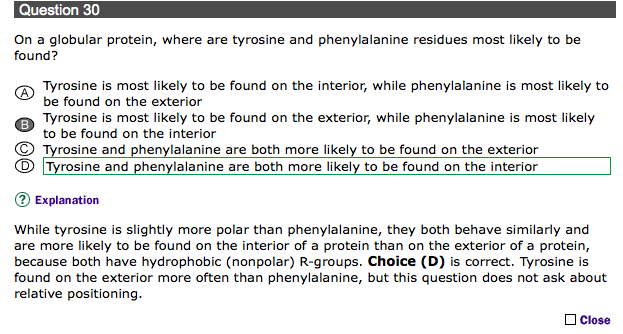
Good question. For a globular protein, there is the theory proposed by Pauling and Mirsky that hydrogen bonding holds the protein together (particularly the secondary structure) and that water molecules incorporate into the structure to facilitate H-bonding. However, in the Kauzmann hypothesis, the driving force behind tertiary structure is hydrophobic interactions and entropic in nature (free water has greater entropy). Kauzmann proposes that hydrophilic R-groups (such as tyrosine) will fold into the core of the protein to hydrogen-bond with other protic side chains and in doing so release the previously bound water molecules to the surrounding solution. The enthalpy is essentially unchanged, but there is an increase in water's entropy that drives this folding theory. So by the Kauzmann hypothesis, you can support choice D listed above. However, the Kauzmann hypothesis suggests that all protic/polar side chains can exist in the core, which is just not the case. It also fails to fully address the entropy change when the protein folds away from water (reducing the protein's entropy). This likely explains why the two opposing theories exist.
Given that this particular topic is brand new to the MCAT (was introduced with MR5), you can bet it is a great candidate to be best tested.