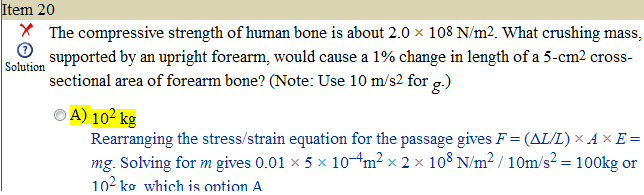
typicalindian Full Member 10+ Year Member Joined Dec 25, 2010 Messages 2,338 Reaction score 17 Points 4,641 Medical Student Apr 26, 2012 #1 Advertisement - Members don't see this ad I feel pretty dumb for asking this but anyways... why is the value for area 5.0x10^-4? Don't they tell you that the cross sectional area is 5.0 cm...which should be 5.0x10^-2m..no?
Advertisement - Members don't see this ad I feel pretty dumb for asking this but anyways... why is the value for area 5.0x10^-4? Don't they tell you that the cross sectional area is 5.0 cm...which should be 5.0x10^-2m..no?
MrNeuro Full Member 10+ Year Member Joined Mar 17, 2010 Messages 606 Reaction score 5 Points 4,571 Location Danger Zone MD/PhD Student Apr 26, 2012 #2 You need to convert to m^2 and cm^2 to m^2 is 10000 cm^2 in 1 m^2 Upvote 0 Downvote
W wanderedtoolong Full Member 10+ Year Member Joined May 22, 2011 Messages 656 Reaction score 21 Points 4,601 Medical Student Apr 26, 2012 #3 I got this one wrong too! Didn't even think about it- just glanced at the answer and figured I'd made a stupid calculation error. Now that you've pointed it out, yeah, what gives!? Upvote 0 Downvote
I got this one wrong too! Didn't even think about it- just glanced at the answer and figured I'd made a stupid calculation error. Now that you've pointed it out, yeah, what gives!?
W wanderedtoolong Full Member 10+ Year Member Joined May 22, 2011 Messages 656 Reaction score 21 Points 4,601 Medical Student Apr 26, 2012 #4 oooh now I see. . . Upvote 0 Downvote
typicalindian Full Member 10+ Year Member Joined Dec 25, 2010 Messages 2,338 Reaction score 17 Points 4,641 Medical Student Apr 26, 2012 #5 MrNeuro said: You need to convert to m^2 and cm^2 to m^2 is 10000 cm^2 in 1 m^2 Click to expand... ohhhh ok 🙁 thanks Upvote 0 Downvote
MrNeuro said: You need to convert to m^2 and cm^2 to m^2 is 10000 cm^2 in 1 m^2 Click to expand... ohhhh ok 🙁 thanks
P pfaction Full Member 10+ Year Member Joined Mar 14, 2010 Messages 2,225 Reaction score 79 Points 4,641 Location WV Resident [Any Field] Apr 26, 2012 #6 I had no idea as I also got this wrong. I saw cm^-2 but didn't factor it in, ****s. Upvote 0 Downvote
MedPR Membership Revoked Removed 10+ Year Member Joined Dec 1, 2011 Messages 18,577 Reaction score 57 Points 4,641 Pre-Podiatry Apr 26, 2012 #7 Always had a hard time with this. It helps to write it out a few times until you get used to it. (5cm^2)*(10^-2m/cm) = 5*10-2cm*m (5*10^-2cm*m)*(10^-2m/cm) = 5*10^-4m^2 Upvote 0 Downvote
Always had a hard time with this. It helps to write it out a few times until you get used to it. (5cm^2)*(10^-2m/cm) = 5*10-2cm*m (5*10^-2cm*m)*(10^-2m/cm) = 5*10^-4m^2
B BrianK0220 Full Member 10+ Year Member Joined Sep 24, 2010 Messages 123 Reaction score 0 Points 0 Aug 9, 2012 #8 How does delta L divided by L = 0.01? I don't see how that's equal to a one percent change in length. Wouldn't delta L alone equal 0.01? Upvote 0 Downvote
How does delta L divided by L = 0.01? I don't see how that's equal to a one percent change in length. Wouldn't delta L alone equal 0.01?
brownbaglunch Full Member 10+ Year Member Joined Sep 11, 2010 Messages 115 Reaction score 37 Points 4,661 Resident [Any Field] Aug 9, 2012 #9 BrianK0220 said: How does delta L divided by L = 0.01? I don't see how that's equal to a one percent change in length. Wouldn't delta L alone equal 0.01? Click to expand... Delta L is one percent of the original length: Upvote 0 Downvote
BrianK0220 said: How does delta L divided by L = 0.01? I don't see how that's equal to a one percent change in length. Wouldn't delta L alone equal 0.01? Click to expand... Delta L is one percent of the original length:
B BrianK0220 Full Member 10+ Year Member Joined Sep 24, 2010 Messages 123 Reaction score 0 Points 0 Aug 9, 2012 #10 Perfect, God bless you! Upvote 0 Downvote