AAMC physics question pack 24

This forum made possible through the generous support of SDN members, donors, and sponsors. Thank you.

bellowbruins

Full Member
7+ Year Member
Joined
Sep 28, 2016
Messages
17
Reaction score
1
Points
4,696
  1. Pre-Medical
Advertisement - Members don't see this ad
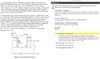
So, the question asks which of the following changes to the circuit will decrease the electric field between teh electrodes by the greatest amount?

A. Increasing L by a factor of 2

B. Decreasing L by a factor of 2

C. Increasing R by a factor of 2

D. Decreasing R by a factor of 2.


I got the answer correct but when i read the solution i dont know where does E= (V-IR)/ L comes from. I only know E= V/L or at least i can substitute ohm's law E= IR/L. I dont see that V-IR coming from. lol please help.
 
The electric field for this problem is equal to the delta V divided by L.

So E = (V final - V initial)/L
They decided to call V initial as being = IR I guess? Ohms law. Do you have a screenshot of the problem?
 
Here is the problem. I also got it right but not super sure how.
 

Attachments

  • AAMC Physics QPack #24.JPG
    AAMC Physics QPack #24.JPG
    128.6 KB · Views: 333
I think we're supposed to think about the electrodes as being akin to the parallel plates of a capacitor. Even if you increase the resistance and decrease the current, eventually you're still going to have the same build up of charge regardless. So really the electric field is just a function of the capacitance, and we know that increasing the distance between plates decreases the capacitance???
 
I can see from their equation how it works mathematically, but I didn't know the equation, and probably won't at test time. But I think you're right about capacitance, since it is determined by geometric factors (plate size, L).
 
Yeah, they're definitely talking about it as analogous to a capacitor. The equation that they give is the equation you use to find the voltage across a capacitor in a series where there's also a resistor.

If there was no resistor there, then the voltage across the plates would be equal to the voltage of the battery (EMF). But since there is a capacitor, the voltage is equal to the voltage of the EMF - the voltage across the resistor. According to Ohm's Law, the voltage in the resistor is IR.

So voltage in a capacitor that is in series with a circuit is = EMF - IR.

Because E = V * distance between plates L, E = (EMF-IR)/L
 
Top Bottom