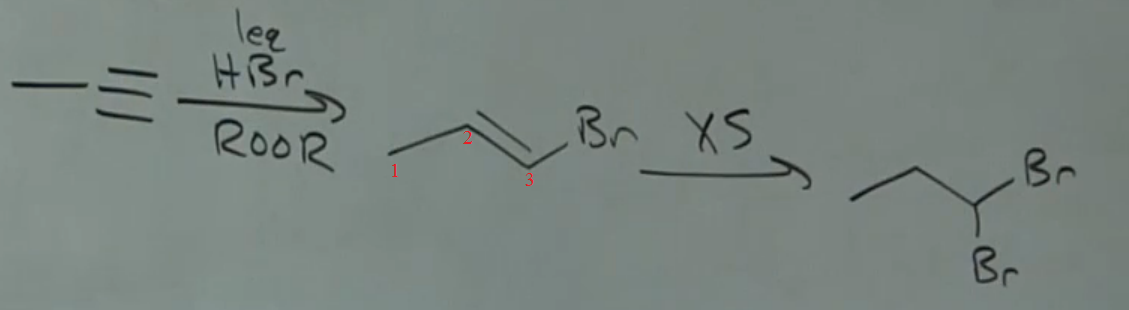
This is poorly written.....confusing indeed. Assuming the author of the problem meant excess HBr/ ROOR.....it was simply 2 consecutive anti-Markovnikov additions. Anti-Markovnikov addition only works when HBr/ROOR is used. This reaction is very very important to know, and is used in organic synthetic procedures on a wide scale.
Sorry Dr. Romano, I thought I had it figured out but I'm still confused. I didn't understand the reasoning as to why the second anti-Markovnikov addition had added an H to #2 carbon when both 2+3 are equally substituted. I googled around and it seemed that they would produce a equal mixture of product if the carbons were equally substitued, but the carbons in the examples that I saw were both secondary carbons.
Based on the picture above I would have guessed the second anti-Mark reaction would have added the hydrogen to #3 to form a secondary carbocation and produce 1,2 dibromopropane since both carbons are equally substituted, whereas adding the hydrogen to #2 would be less favorable because of the formation of a primary carbocation (which I believe leads to the formation of the final product depicted above). How am I viewing this wrong? Wouldn't the primary carbocation undergo a hydride shift anyways to become 1,2 dibromopropane and not the answer above? I just don't seem how the final answer is correct 🙁
This goes through a radical intermediate, not a carbocation intermediate.
The intermediate formed also has the radical on the most substituted carbon because, in the mechanism, the bromine adds first, not the hydrogen as we're used to seeing.
The radical does not for on the carbon with the bromine. It's more stable there because it is on the secondary carbon, not the primary carbon.
Take a look at the mechanism. Hope it helps.
The radical does not for on the carbon with the bromine. It's more stable there because it is on the secondary carbon, not the primary carbon.
Take a look at the mechanism. Hope it helps. View attachment 194712