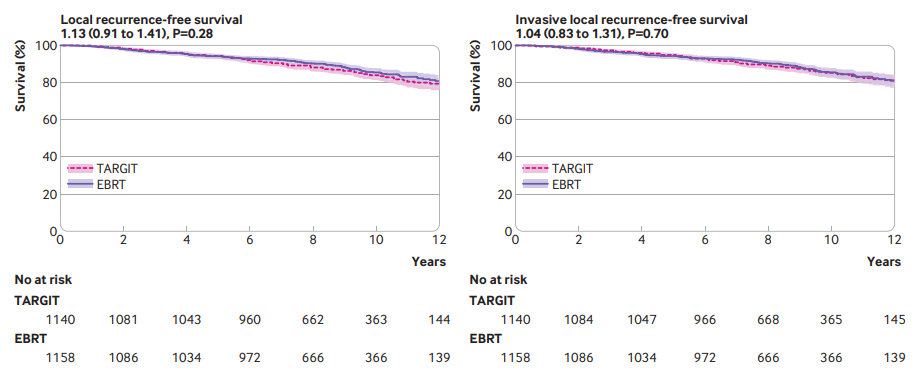
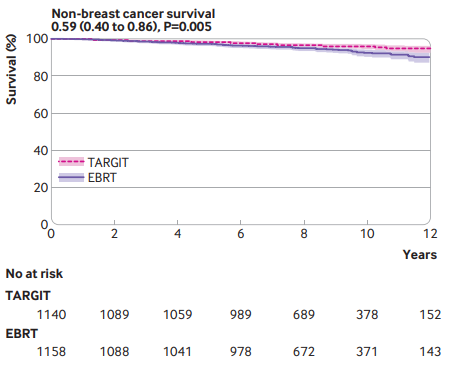
We designed the trial as a non-inferiority trial. Non-inferiority trials in cancer are performed to test new treatments that have obvious non-oncological advantages, such as better access, convenience, or quality of life for the patient, or reduced costs for the healthcare system. The non-inferiority statistical test for such a comparison is not meant to check for superiority, but to assess if the difference is within an acceptable margin and the experimental treatment is not meaningfully worse than the control. Therefore, whether the difference seen between the two randomised arms is statistically significant is not relevant here. As long as the absolute difference is not clinically significant, the new treatment would be deemed non-inferior.
27 Any chosen non-inferiority margin must be one that clinicians and patients agree is an acceptable difference for the sake of the other benefits. These benefits might include lower toxicity, better cosmetic outcome, better quality of life, and overall patient preference. Therefore, in the original protocol, non-inferiority was specified as being achieved if the difference in the binomial proportions of local recurrence rate at five years did not cross a stringent margin of 2.5% in absolute terms; that is, local recurrence risk with TARGIT-IORT minus local recurrence risk with EBRT should not be more than 0.025 (2.5%). In the 2013 analysis, an even more rigorous criterion was used, specifying that the upper 90% confidence interval of the absolute difference must not exceed 0.025 (2.5%).
The 2.5% non-inferiority margin in the TARGIT-A trial is a relevant, relatively stringent margin. Patient preference studies in the United States, Australia, and Europe suggest that 2.5% is an acceptable margin.
282930 Importantly, it is widely regarded as a safe margin because it is well established that a local recurrence difference of less than 10% at five years does not worsen breast cancer survival
31; that is, when the risk in arm A minus the risk in arm B is less than 0.1 (10%). A large increase in local recurrences (>10% at five years) is required to lead to increased mortality because they can be effectively treated. For example, a 20% increase in local recurrence (a risk increase by 0.2) would cause a 5% increase in deaths (a mortality risk increase by 0.05)
31; this was the basis for the ethics approval of this trial. In the ELIOT trial, which also investigated intraoperative radiotherapy, the non-inferiority margin was set at 7%.
15 In recently reported trials of systemic therapy, the margin of a 3% difference in disease-free survival was considered acceptable.
32 /quote]