Calling all Chemistry Majors

Started by CeeEstee0
Get help with your application

Use all the free resources available to you from SDN: articles, guides, expert advising, forums discussions, and school research.

CeeEstee0

Nerdfighter
10+ Year Member
Advertisement - Members don't see this ad
So, I like chemistry. I have performed well in the coursework, and absolutely loved the labs to death. I have declared it as my major in college, and I need advice. I am coming up on the summer of my senior year. (Four months!)

I would appreciate the advice of any Chemistry majors. What can I do to prepare? Are there any books you recommend reading? Anything that would be useful on college?

(I have already memorized the periodic table).
 
So, I like chemistry. I have performed well in the coursework, and absolutely loved the labs to death. I have declared it as my major in college, and I need advice. I am coming up on the summer of my senior year. (Four months!)

I would appreciate the advice of any Chemistry majors. What can I do to prepare? Are there any books you recommend reading? Anything that would be useful on college?

(I have already memorized the periodic table).

get a good general chemistry textbook (i recommend raymond chang) and go ahead and start teaching yourself from chapter 1 to the end of the book. This is what your going to be doing in general chemistry first year of undergraduate anyway. Then do every practice problem at the end of each chapter while remembering the main concepts. This will prepare you a hell of alot for general chemistry your first year in college. (believe me your gonna be teaching yourself 90% of it), lectures are so pointless until you get to upper division.

Don't try and teach yourself organic chemistry or anything, its a waste of time. You need a solid foundation in general chemistry to do well in organic. Additionally, find ACS exams or high end school exams like MIT and try doing the problems they have there. Don't worry if you get most of them wrong, just try to do one problem at a time and understand what your doing. Believe me the questions you'll see on chem exams in college (as a chem major) will be different than your premed collegues. Your tests will be harder, however you'll also learn ALOT more and the teachers that teach chemistry major chem classes are usually more forgiving about grades.
 
There really isn't much you need to do or should do. If your high school chemistry education has been adequate, you will do well. If you feel that you are somehow lacking in very basic concepts, such as dimensional analysis, I would suggest doing some review. Otherwise, you should be plenty well prepared.

By the way, there is no need to memorize the periodic table. If you are well acquainted with the characteristics of the groups and general periodic trends, you will know everything about the periodic table you need to know for college. Just don't sweat it. Study hard, and you'll make whatever grade you desire.
 
Advertisement - Members don't see this ad
get a good general chemistry textbook (i recommend raymond chang)

In high school, we used Zumdahl. I didn't take general chemistry in college, but instead, took a more accelerated course because I had AP credit. We used Silverberg. It's a very pretty book, but I don't know if it's as good as Zumdahl.
 
Chemistry texts are interesting creatures. Each one's quality can be subjective. I'd recommend David Klein's general chemistry book and his organic texts when you get to it. For gen chem, I also used Nivaldo Tro, Zumdahl, and who could forget Linus Pauling?
 
Although I have never used Pauling's text, my high school chemistry swore by it and used it occasionally. From what I saw of it and can remember, it is a little more dense than your average introductory college text.
 
you sound like me 8 years ago 😉

if you're not 100% dead-set on being a doctor i would caution against majoring in just chemistry as it doesn't usually translate directly to a decently-paying career, at least not without some sort of grad school first. i ended up doing something completely different for my first career after getting my chem degree. but if it's what you love then go for it, i don't have any regrets!

one book (for fun) i would recommend for summer reading is Demon Under the Microscope

could also start looking at research opportunities at your future college, and look for fellowships to shoot for

if you have AP chem credit you should consider going straight into organic (if your college allows). saves you a year of work not having to do gen chem again, and getting organic done sooner can be somewhat helpful for starting research sooner as well.
 
I didn't go to high school and majored in Biochem. I have read numerous chem textbooks and organic chem books and taught orgo for 2 years and gen chem for 1 year. Pauling book is the best. You can buy it for 8 bucks at 1/2 price books. Also if you can read "The Nature of the Chemical Bond" by him. Awesome, awesome book.
Good luck.
 
Although I have never used Pauling's text, my high school chemistry swore by it and used it occasionally. From what I saw of it and can remember, it is a little more dense than your average introductory college text.

It is by no means the best text for a person who simply wants to finish their chemistry prereqs and matriculate. But for someone who has developed a passion for the mystery that is chemistry, it is one of a kind.
 
(I have already memorized the periodic table).

SO not necessary. Always provided. You end up "memorizing" the important elements anyways. Save your memory for more important/difficult things, like Shrodinger's equation and it's many derivations -_-"

I will go ahead and say HS Chemistry stops being similar to college chem after gchem. ochem, pchem, inorganic, etc... are a whole other aspect. So rather than enjoy the courses from HS, you should think about whether you enjoyed the thought processes and ways you studied for them. That part remains fairly similar.
 
http://www.khanacademy.org/
go to that website if you want to get ahead. If you really have the motivation, I'm pretty sure you can understand everything that needs to be understood and teach yourself organic chemistry before you even take it. Honestly, in my opinion, you do need a basis of the lewis structures for organic chemistry, but for the most part, it is mostly your first semester of gen chem where you learn the basis for organic. I'm a biochem major with a year and a half left to go! Woohoo for chem majors!! 😀
 
Here is what you do.

Nothing. Go travel. Hang out with your friends. It's basically the last summer you have to not have to jump through hoops and needing to be productive.
 
Here is what you do.

Nothing. Go travel. Hang out with your friends. It's basically the last summer you have to not have to jump through hoops and needing to be productive.

This. But if you are serious about getting ahead, have at least a good understanding in algebra, do well in inorganic and organic and it will be a cakewalk after that. Except physical chemistry, no one gets out of that unscathed....
 
Thanks everybody! I have ordered the Raymond Chang text, and Demon under the Microscope.

And no worried, my friends and I are going to Puerto Rico after a road trip to D.C., so fun stuff is being planned as well.

Thanks again! CHEMISTRY FTW!
 
So, I like chemistry. I have performed well in the coursework, and absolutely loved the labs to death. I have declared it as my major in college, and I need advice. I am coming up on the summer of my senior year. (Four months!)

I would appreciate the advice of any Chemistry majors. What can I do to prepare? Are there any books you recommend reading? Anything that would be useful on college?

(I have already memorized the periodic table).

OP, many programs are different between school. I always found I got the best advice from seniors/graduate students who majored in chem (from same UG). I met a bunch through doing research and organization.
 
Advertisement - Members don't see this ad
I'd just sit tight and enjoy the summer. If you're super motivated, you can always try contacting professors to see if they have any space in their lab for a volunteer. I think a biochem degree is more versatile. If you have a gap year and want to spend time in a lab, you'll have more skills that will directly translate. Chemistry lab skills seem to be mostly useful for chemistry labs. The courses are also easier, they have more bio requirements and fewer upper level chem requirements, which is a good thing if you're not very good at calculus. You can watch videos on khan academy but that may not be an ideal summer.
 
Here is what you do.

Nothing. Go travel. Hang out with your friends. It's basically the last summer you have to not have to jump through hoops and needing to be productive.

Agreed. This thread makes me ashamed to have majored in chem. All this doing itthe ahead stuff is silly, everyone knows that real chem majors do it from behind (orgo joke lololololz)
 
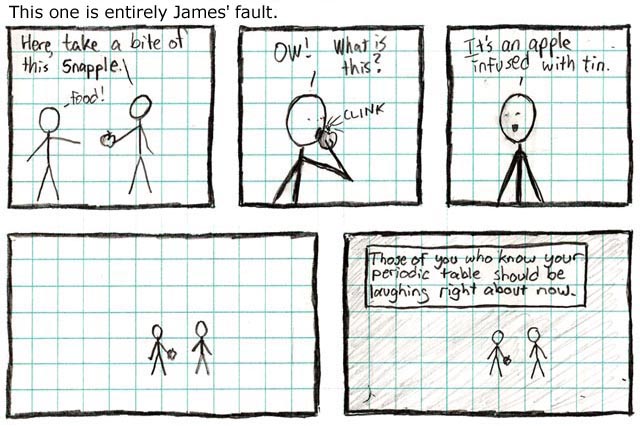
snapple.jpg
 
get a good general chemistry textbook (i recommend raymond chang) and go ahead and start teaching yourself from chapter 1 to the end of the book. This is what your going to be doing in general chemistry first year of undergraduate anyway. Then do every practice problem at the end of each chapter while remembering the main concepts. This will prepare you a hell of alot for general chemistry your first year in college. (believe me your gonna be teaching yourself 90% of it), lectures are so pointless until you get to upper division.

What in the hot holy hell kind of advice is this? OP, don't pre-read or pre-study or pre-anything. Do whatever you want during the summer, be it traveling, hanging out with friends, or whatever else kids these days are doing. Take AP Chem if you have the chance and that should prepare you well enough for gen chem that you won't have to study a whole lot. Also, go to lecture. Seriously, unless they post their lectures+slides online, it's worth your time to go especially as a freshman.
 
What in the hot holy hell kind of advice is this? OP, don't pre-read or pre-study or pre-anything. Do whatever you want during the summer, be it traveling, hanging out with friends, or whatever else kids these days are doing. Take AP Chem if you have the chance and that should prepare you well enough for gen chem that you won't have to study a whole lot. Also, go to lecture. Seriously, unless they post their lectures+slides online, it's worth your time to go especially as a freshman.

Seriously. I think this thread has some of the WORST advice I have ever seen. OP you really shouldn't be doing ANYTHING chemistry related until you start college (you'll get plenty of it there!!). DON'T start reading and for the love of god don't look for research projects to start on (seriously?!).

you sound like me 8 years ago 😉

if you're not 100% dead-set on being a doctor i would caution against majoring in just chemistry as it doesn't usually translate directly to a decently-paying career, at least not without some sort of grad school first. i ended up doing something completely different for my first career after getting my chem degree. but if it's what you love then go for it, i don't have any regrets!

one book (for fun) i would recommend for summer reading is Demon Under the Microscope

could also start looking at research opportunities at your future college, and look for fellowships to shoot for

if you have AP chem credit you should consider going straight into organic (if your college allows). saves you a year of work not having to do gen chem again, and getting organic done sooner can be somewhat helpful for starting research sooner as well.

This wins the award for the worst of the worst advice. Not a good job market for chemsitry majors? Seriously? Chemists ranked #2 on some list as greatest GROWING field and greating GROWING salaries (guess what #1 was? Doctors!). I took a year off between medical school and college, and despite going to a no-name University I received ~20 job interviews with salaries ranging from $40k/year - $90k/year STRAIGHT OUT OF COLLEGE. Unfortunately the higher ones weren't so keen on my possible medical school since they required 18 months of training. I ended up taking one for $25/hour.

As for gen chem, I would actually recommend taking it even if you killed the AP test. It will give you time to review the basics and develop a solid foundation that will facilitate the rest of your chemistry knowledge. I saw some really, really smart people struggle like heck because they decided to take organic chemistry in their freshman year and they just didn't do well. Take gen chem and take the time to do well. With less pressure you should be able to learn calculus really well too.