
Advertisement - Members don't see this ad
Here’s a classic question from Dr. Jim Romano’s collection — a great test of your understanding of cell potentials under standard conditions:
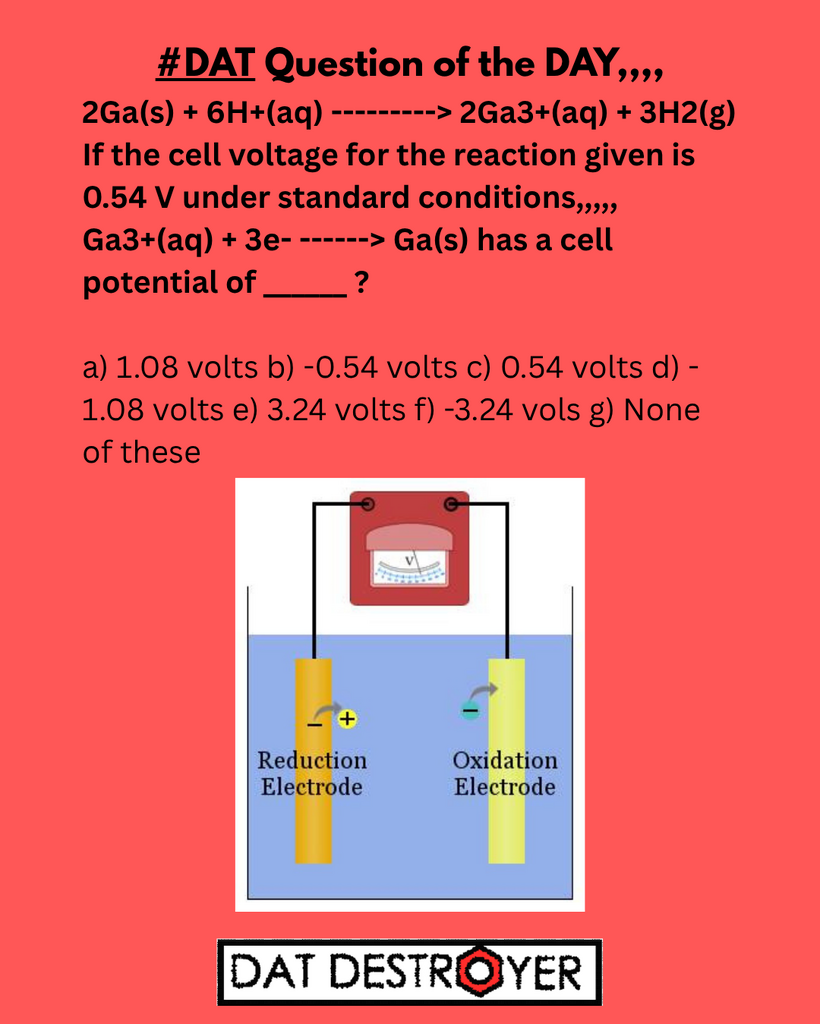
2Ga(s) + 6H⁺(aq) → 2Ga³⁺(aq) + 3H₂(g)
If the cell voltage for this reaction is 0.54 V under standard conditions, what is the cell potential for the following half-reaction?
Ga³⁺(aq) + 3e⁻ → Ga(s)
a) 1.08 V
b) -0.54 V
c) 0.54 V
d) -1.08 V
e) 3.24 V
f) -3.24 V
g) None of these
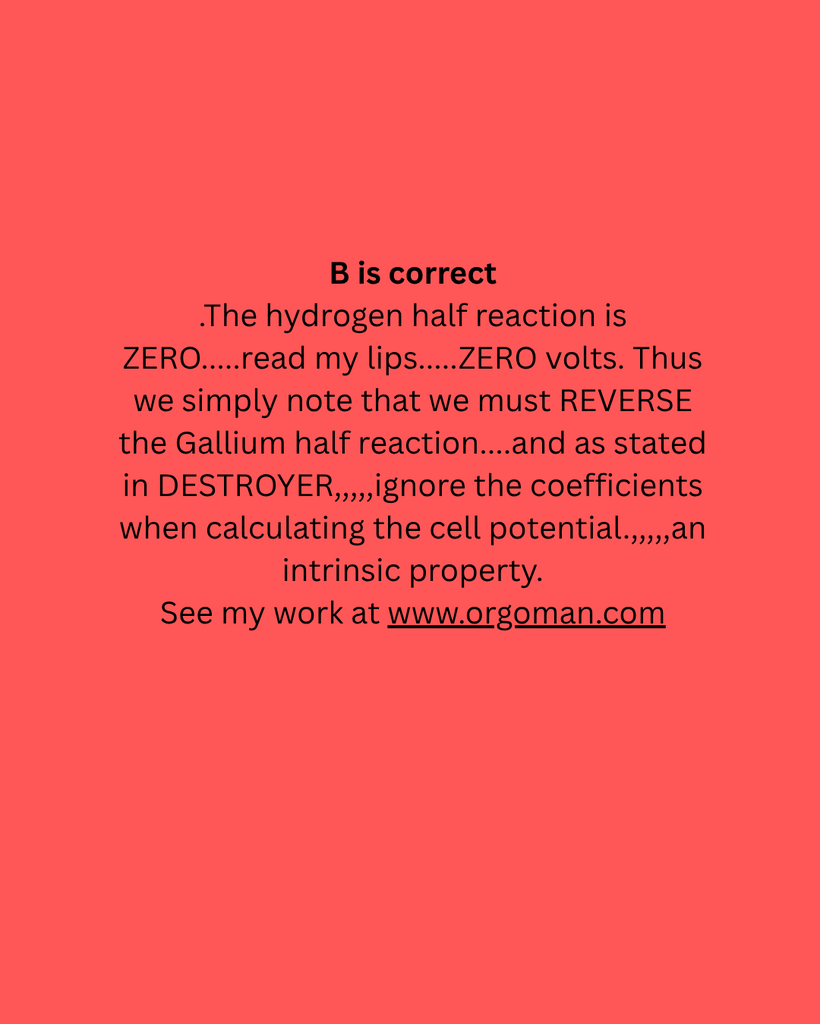
✅ B is correct.
The hydrogen half-reaction is zero volts — read my lips — zero volts.
We simply note that we must reverse the gallium half-reaction, and as stated in the DAT Destroyer, ignore the coefficients when calculating cell potential — it’s an intrinsic property.
Keep studying hard, and see more of Dr. Romano’s detailed explanations at www.Orgoman.com.
2Ga(s) + 6H⁺(aq) → 2Ga³⁺(aq) + 3H₂(g)
If the cell voltage for this reaction is 0.54 V under standard conditions, what is the cell potential for the following half-reaction?
Ga³⁺(aq) + 3e⁻ → Ga(s)
a) 1.08 V
b) -0.54 V
c) 0.54 V
d) -1.08 V
e) 3.24 V
f) -3.24 V
g) None of these
✅ B is correct.
The hydrogen half-reaction is zero volts — read my lips — zero volts.
We simply note that we must reverse the gallium half-reaction, and as stated in the DAT Destroyer, ignore the coefficients when calculating cell potential — it’s an intrinsic property.
Keep studying hard, and see more of Dr. Romano’s detailed explanations at www.Orgoman.com.

