
- Joined
- Dec 1, 2011
- Messages
- 18,577
- Reaction score
- 57
- Points
- 4,641
- Pre-Podiatry




Ok I have a few questions about this figure.
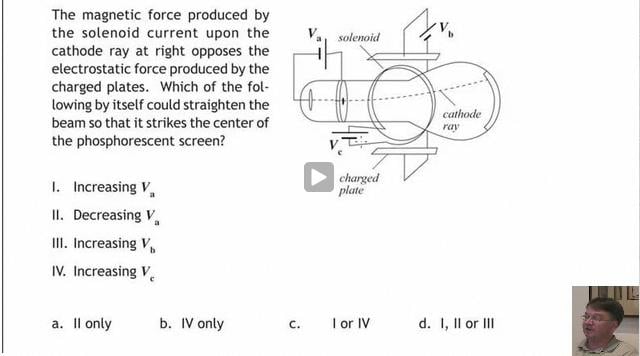
1. How do you know the top plate of Vb is the positive plate, besides the fact that the cathode ray deflects toward it?
Ok, I guess just one question. Thanks.
The battery symbol - it's a convention to have the positive side as a long thin line, negative as a shorter, sometimes thicker one.
I knew it had something to do with that. This is a convention I've never really understood. I thought the convention was that negative charges move out of the "longer line" and around through the circuit to the "shorter line"?
Yes, it's a bit messed up. The convention is that we are talking about positive charges. These are the one that move from positive to negative terminal. In reality the opposite happens - electrons move the opposite way.
Ok so the convention for circuits is that positive charges move from the long line to the short line. The long line then is the cathode?
And the reason the plate closer to the longer line is positive is because as positive charges move out of the battery they build up on the plate before they are able to move on through the circuit?
MedPr, what's the answer ?! I drew the force, than an electron would experience in each field within each circuit.
i said increasing Vb only.
increasing Vb
it's C. Increasing the speed at which the electron is shot increases the force from the Bfield on the electron and makes it go opposite of the Efield = lower. Also, increasing Bfield strength will also push it downwards.
Berkreviewteach. Here.
MedPr, what's the answer ?! I drew the force, than an electron would experience in each field within each circuit.
i said increasing Vb only.
That is an excellent thought-inducing question. It is conceptual and makes you look at a complicated device in a simple manner, which is exactly what you need to do on the MCAT. Whoever wrote it did a fantastic job. Where is it from?
it's C. Increasing the speed at which the electron is shot increases the force from the Bfield on the electron and makes it go opposite of the Efield = lower. Also, increasing Bfield strength will also push it downwards.
Berkreviewteach. Here.
About Va: The force felt due to the electric field on the electron is antiparallel. It's "straight" in the first place. So I don't see how increasing the acceleration would "straighten" the path.
Ok, the electric field created by Vc induces an upward force on the electron, doesn't it. So an increase in Vc, would lead to a greater force deflection upward. So how does that "straighten the path"
About Va: The force felt due to the electric field on the electron is antiparallel. It's "straight" in the first place. So I don't see how increasing the acceleration would "straighten" the path.
Ok, the electric field created by Vc induces an upward force on the electron, doesn't it. So an increase in Vc, would lead to a greater force deflection upward. So how does that "straighten the path"
Ok, yeah, so it doesn't have much to do with Vc, I understand that...but what's Va got to do with this? The electric field due to Va is parallel, already in direction of the motion of the desired path! Increase velocity does not "straighten the path"...
Ok, yeah, so it doesn't have much to do with Vc, I understand that...but what's Va got to do with this? The electric field due to Va is parallel, already in direction of the motion of the desired path! Increase velocity does not "straighten the path"...
Wait, a minute, MedPr, the "force due to the electric field" is pointing from left to right, isn't it? I really, really think-almost 90% sure it is. Just by the designation of the battery potential, you can tell. It's not pointing "upward"
Dude, your explanation is suddenly in favor of Vc, as chiddler originally explained not Va as you indicate. I'm ok with letting this question die...
Yeah, but then C isn't the answer. It's A & D, like you said-those choices don't include Vc. I don't think this questions is as well modeled as originally credited. I think the Kaplan question I sent you earlier via message is testing the same thing. Thanks for putting up with me, though.


