
-
CycleTrack and SDN are teaming up to make medical school admissions more transparent and accessible! Read the announcement to learn how we’re supporting the future of CycleTrack’s free application-tracking tools .
You are using an out of date browser. It may not display this or other websites correctly.
You should upgrade or use an alternative browser.
You should upgrade or use an alternative browser.
ESMO 2024
Started by Palex80

Get help with your application
Use all the free resources available to you from SDN: articles, guides, expert advising, forums discussions, and school research.
Advertisement - Members don't see this ad

I feel like my rectal volume is probably stable to up over the last several years. Surgeons are the ones being turned into endoscopists in distal diseaseOPERA update shows 80% organ preservation at 5y with RCT & brachy.
They control practice patterns here. If they believe in w/w, PROSPECT has no relevance and your volume should be at least stable. Mine are up a touch but that’s because we lost 2 community surgeons in our state and have more total volume coming in.I feel like my rectal volume is probably stable to up over the last several years. Surgeons are the ones being turned into endoscopists in distal disease
Esophagus is more open. Our GI oncs are split 50/50. Half don’t find ESOPEC convincing and half do. By chance, my esophageal volume is up a ton since it came out because of a flood of people who are not FLOT candidates. In the long run, I expect to lose volume here.
I don’t think the above pancreas trial will change anything anywhere. Chemo alone and CRT with chemo were both already neoadjuvant options. The trial showed equivalence with little nuggets to support either approach. People on both extremes will use it to support their current practice.
Re rectal: at center with skilled surgeon , maybe 10-15-% or less of rectal cancers require an Apr. future of radonc in gi is not good.
Are you implying watch and wait is only for APR? LAR syndrome is real and many high volume centers are doing it for most rectal patients, not just the APR patients.Re rectal: at center with skilled surgeon , maybe 10-15-% or less of rectal cancers require an Apr. future of radonc in gi is not good.
Do you have suggested criteria for rad oncs to raise WW in tumor board for an LAR eligible patient? Like coloanal or low anastomosis.Are you implying watch and wait is only for APR? LAR syndrome is real and many high volume centers are doing it for most rectal patients, not just the APR patients.
My rectal and esophagus volume has been down tremendously. I work with very good GI/Surg oncs and for now they are very pro Prospect trial for all upper rectal cases it seems.
med oncs are excited about FLOT for esophagus, surgeons seem indifferent.
med oncs are excited about FLOT for esophagus, surgeons seem indifferent.
It seems like a spectrum in our center(s). I've been surprised at how willing the colorectal surgeons are to potentially avoid surgery, especially the "low" LAR patients (ie, 4-6cm from the verge). Other than the true PROSPECT candidates (T2/T3, N0-N1, clear CRM, high-mid/high rectum), most of these patients are getting managed with ChemoRT as a part of their care in the hope of avoiding surgery. I've also been seeing an increasing number of low T2N0 patients.Do you have suggested criteria for rad oncs to raise WW in tumor board for an LAR eligible patient? Like coloanal or low anastomosis.
Sometimes I feel like CRS sees these patients as similar to anal cancer patients.

The best data are simply the outcomes data. The largest prospective studies have consistently show a roughly 50% reduction in chronic bothersome bowel symptoms without surgery. We all focus on risks of continence, but the most bothersome symptoms patients report are clustered bowel movements, cramping, and diarrhea. It’s interesting to note, the largest datasets I am aware of still showed 25-33% of non surgical patients experience chronic grade 2+ “LAR syndrome.” So, looks like surgery may have taken the wrap for some of our outcomes all along.Do you have suggested criteria for rad oncs to raise WW in tumor board for an LAR eligible patient? Like coloanal or low anastomosis.
I’ll be honest, I’m not sure what you could site to change a surgeons mind. They either think it’s a good idea or they don’t. Oncologic outcomes won’t be better and if they think their patients do pretty good after surgery (a very common belief), you will be hard pressed to get them to think they could do better without.

Fresh from the Presidential:

HypoG-01 shows that
- nodal RT with moderate hypofractionation (40 Gy ib 15Fx) is safe
- although not powered for this, mod. HypoFx in HypoG-01 actually showed superior oncological results. Perhaps mod. HypoFx is not only as safe as normofractionated RT, but actually even more effective. Perhaps some immunomodulatory effect hidden there as well?
- arm lympedema is a true issue and it‘s good to have some more data on that
- other toxicities (pneumonitis, plexopathy) are very seldom with modern techniques
Early data had already been reported at ESTRO2023, but it’s good to see the 5y data now.
HypoG-01 shows that
- nodal RT with moderate hypofractionation (40 Gy ib 15Fx) is safe
- although not powered for this, mod. HypoFx in HypoG-01 actually showed superior oncological results. Perhaps mod. HypoFx is not only as safe as normofractionated RT, but actually even more effective. Perhaps some immunomodulatory effect hidden there as well?
- arm lympedema is a true issue and it‘s good to have some more data on that
- other toxicities (pneumonitis, plexopathy) are very seldom with modern techniques
Early data had already been reported at ESTRO2023, but it’s good to see the 5y data now.
Last edited:
Two more interesting presentations from randomized trials
1. Inhalative steroids for prevention of pneumonitis in NSCLC stage III


This is potentially a practice-changing trial, in my opinion.
Some criticism came up:
a) The patients did not receive sequential Durvalumab in the trial. This has however to do with the availability of Durvalumab in China, according to the presenter. It is as it is, I guess.
b) The rates of pneumonitis in both arms were quite high, leading to the assumption that perhaps the quality of RT was not good in the trial.
However, I did some digging and found, that this is (likely) the trial:
 clinicaltrials.gov
And if you look at the "endpoints", you will find:
clinicaltrials.gov
And if you look at the "endpoints", you will find:
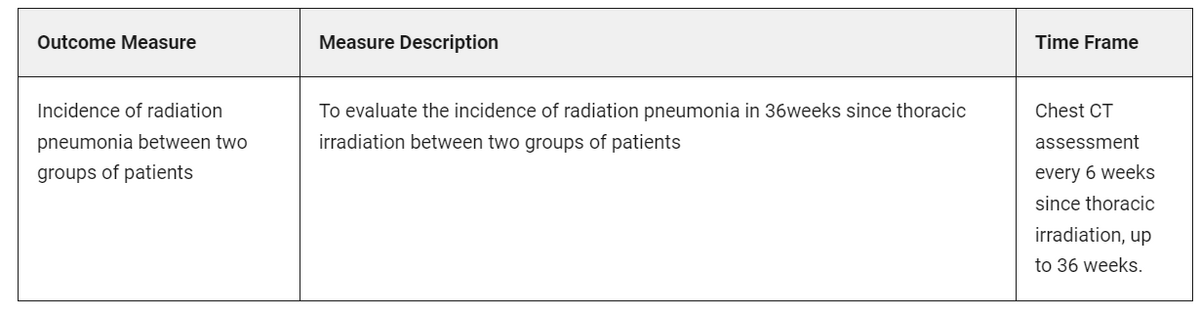
So I think, the "Pneumonitis" reported in the trial was purely pneumonitis on follow-up imaging.,
It is left to us to guess, if a 20% absolute increase in grade III-pneumonitis on imaging, will also result in clinically relevant symptoms.
c) I have no idea what dose of steroids were given, they say BID inhalation of beclomethasone. I will have to look at beclomethasone products that we have available over here, I guess...
2. Chemotherapy schedules for RCT in stage III NSCLC in elderly patients


Efficacy looks pretty much the same, but toxicity was higher and QoL inferior in the arm with Nab-Paclitaxel, thus no escalation of systemic treatment necessary.
1. Inhalative steroids for prevention of pneumonitis in NSCLC stage III
This is potentially a practice-changing trial, in my opinion.
Some criticism came up:
a) The patients did not receive sequential Durvalumab in the trial. This has however to do with the availability of Durvalumab in China, according to the presenter. It is as it is, I guess.
b) The rates of pneumonitis in both arms were quite high, leading to the assumption that perhaps the quality of RT was not good in the trial.
However, I did some digging and found, that this is (likely) the trial:
ClinicalTrials.gov
clinicaltrials.gov
So I think, the "Pneumonitis" reported in the trial was purely pneumonitis on follow-up imaging.,
It is left to us to guess, if a 20% absolute increase in grade III-pneumonitis on imaging, will also result in clinically relevant symptoms.
c) I have no idea what dose of steroids were given, they say BID inhalation of beclomethasone. I will have to look at beclomethasone products that we have available over here, I guess...
2. Chemotherapy schedules for RCT in stage III NSCLC in elderly patients
Efficacy looks pretty much the same, but toxicity was higher and QoL inferior in the arm with Nab-Paclitaxel, thus no escalation of systemic treatment necessary.
Last edited:
I def have had success with inhaled steroids for mildly symptomatic RPTwo more interesting presentations from randomized trials
1. Inhalative steroids for prevention of pneumonitis in NSCLC stage III
View attachment 392400
View attachment 392401
This is potentially a practice-changing trial, in my opinion.
Some criticism came up:
a) The patients did not receive sequential Durvalumab in the trial. This has however to do with the availability of Durvalumab in China, according to the presenter. It is as it is, I guess.
b) The rates of pneumonitis in both arms were quite high, leading to the assumption that perhaps the quality of RT was not good in the trial.
However, I did some digging and found, that this is (likely) the trial:
And if you look at the "endpoints", you will find:ClinicalTrials.gov
View attachment 392405
So I think, the "Pneumonitis" reported in the trial was purely pneumonitis on follow-up imaging.,
It is left to us to guess, if a 20% absolute increase in grade III-pneumonitis on imaging, will also result in clinically relevant symptoms.
c) I have no idea what dose of steroids were given, they say BID inhalation of beclomethasone. I will have to look at beclomethasone products that we have available over here, I guess...
2. Chemotherapy schedules for RCT in stage III NSCLC in elderly patients
View attachment 392402
View attachment 392403
View attachment 392404
Efficacy looks pretty much the same, but toxicity was higher and QoL inferior in the arm with Nab-Paclitaxel, thus no escalation of systemic treatment necessary.
Advertisement - Members don't see this ad
Postmastectomy RT over 3 weeks is fine - so long we don't use protonsFresh from the Presidential:
View attachment 392330
HypoG-01 shows that
- nodal RT with moderate hypofractionation (40 Gy ib 15Fx) is safe
- although not powered for this, mod. HypoFx in HypoG-01 actually showed superior oncological results. Perhaps mod. HypoFx is not only as safe as normofractionated RT, but actually even more effective. Perhaps some immunomodulatory effect hidden there as well?
- arm lympedema is a true issue and it‘s good to have some more data on that
- other toxicities (pneumonitis, plexopathy) are very seldom with modern techniques
Early data had already been reported at ESTRO2023, but it’s good to see the 5y data now.


