
-
CycleTrack and SDN are teaming up to make medical school admissions more transparent and accessible! Read the announcement to learn how we’re supporting the future of CycleTrack’s free application-tracking tools .
You are using an out of date browser. It may not display this or other websites correctly.
You should upgrade or use an alternative browser.
You should upgrade or use an alternative browser.
Low Step 1
Started by sleepysloth_md

Get help with your application
Use all the free resources available to you from SDN: articles, guides, expert advising, forums discussions, and school research.
- Status
- Not open for further replies.
According to the 2014 Charting Outcomes, you have like an 85-90% chance of matching with a 208 step1 score.
So no need to worry, you will probably match.
So no need to worry, you will probably match.
208/230+ will get you about 10 interviews if you apply broadly and you will match if u rank all 10....its sad but true...i guess anesthesia has really come to this....
no one will go to the ortho forum and ask what their chances are with 208 step 1....no offense
no one will go to the ortho forum and ask what their chances are with 208 step 1....no offense
Advertisement - Members don't see this ad
208/230+ will get you about 10 interviews if you apply broadly and you will match if u rank all 10....its sad but true...i guess anesthesia has really come to this....
no one will go to the ortho forum and ask what their chances are with 208 step 1....no offense
No kidding. Anesthesia has never been close to as competitive as ortho.
No kidding. Anesthesia has never been close to as competitive as ortho.
Neither did i think it will only be as competitive as family med....
we need to take a stand man. I love this specialty and i hate where its heading, i want the smartest and the brightest to be going into anesthesia.
D
deleted171991
No offense but, besides the lifestyle and hate for clinics, there is no way the bright ones will ever go into anesthesia again. If anything drives me nuts it's playing second fiddle to less intelligent surgeons and administrators. I went into critical care to feel smart again.Neither did i think it will only be as competitive as family med....
we need to take a stand man. I love this specialty and i hate where its heading, i want the smartest and the brightest to be going into anesthesia.
D
deleted641888
Neither did i think it will only be as competitive as family med....
we need to take a stand man. I love this specialty and i hate where its heading, i want the smartest and the brightest to be going into anesthesia.
The average Step score for matched applicants in anesthesiology is still around 230 (national Step 1 average being 227-228), which is middle-of-the-road in terms of competitiveness. It's a lot like IM where there's a broader range of competitive/non-competitive programs and applicants, and the top programs still attract students who did very well on their board exams (>250/260s Steps). I did well on Step 1/2/3 and that knowledge seemed to carry over to the ITE this year as an intern.

The average Step score for matched applicants in anesthesiology is still around 230 (national Step 1 average being 227-228), which is middle-of-the-road in terms of competitiveness. It's a lot like IM where there's a broader range of competitive/non-competitive programs and applicants, and the top programs still attract students who did very well on their board exams (>250/260s Steps). I did well on Step 1/2/3 and that knowledge seemed to carry over to the ITE this year as an intern.
Just matched this year, and agree with the above. It's still a highly regarded field at my medical school (top 10-20), and it's still pretty competitive at the top with high board scores > 240/250.
The average Step score for matched applicants in anesthesiology is still around 230 (national Step 1 average being 227-228), which is middle-of-the-road in terms of competitiveness. It's a lot like IM where there's a broader range of competitive/non-competitive programs and applicants, and the top programs still attract students who did very well on their board exams (>250/260s Steps). I did well on Step 1/2/3 and that knowledge seemed to carry over to the ITE this year as an intern.
I think you can say this about almost any field....there were several 250+ in my med school class that went to top fam med program...still doesn't change the fact that anesthesia is attracting worse and worse candidates....i mean think about how many "i have a low step score what are my chances thread invariably pops up every year"
Neither did i think it will only be as competitive as family med....
we need to take a stand man. I love this specialty and i hate where its heading, i want the smartest and the brightest to be going into anesthesia.
Not sure what data you are basing this on.
The average matched score for FM is 218.
The average matched score for Anesthesia is 230, which is very similar to IM, Med-Peds, General Surgery, Emergency Medicine, etc.
Anesthesia has never been one of the most competitive specialties, but it's certainly not bottom of the pack either. And just like IM, there is a big spread in anesthesia, with most of the good programs having scores in the 230+ range.
No offense but, besides the lifestyle and hate for clinics, there is no way the bright ones will ever go into anesthesia again. If anything drives me nuts it's playing second fiddle to less intelligent surgeons and administrators. I went into critical care to feel smart again.
I do not agree with your generalization. I know at least 3 people from my school who matched into Anesthesia this year with 250+ Step 1 scores. One had 260+ and matched into one of the top programs in anesthesiology. Personally, I know that my own stats are decent enough to give me a shot at most fields, but I have an interest in anesthesiology and not in, say, vascular surgery.
I'm glad you were able to find something you enjoyed more (critical care). It sounds like anesthesiology was not a good fit for your personality. That doesn't mean it's not a good fit for everyone.
Last edited:
D
deleted171991
I hate that the NRMP publishes only the average scores, but not the standard deviations. So all the statistically-challenged can argue how they know people with scores of 300+ who went into some not-so-hot specialty. I call the latter phenomenon the Bernie Sanders syndrome (of tweenagers). There is much emotion and little thinking at that age, no offense. That's why people don't really fall in love after the age of 30, once their fontanelles close.I think you can say this about almost any field....there were several 250+ in my med school class that went to top fam med program...still doesn't change the fact that anesthesia is attracting worse and worse candidates....i mean think about how many "i have a low step score what are my chances thread invariably pops up every year"
Also, unless one can get into the same top programs as the 300+ did, the specialty experience will be much different. I would argue that, in anesthesia, there are probably just a handful of programs that open doors anywhere in the country, allowing the graduate to pick and choose between good jobs.
The average graduate from the average program will get an average job, which is the one that makes many posters here sooo happy and optimistic.
It reminds me somewhat of law, another profession where it's difficult to quantify somebody's skills and competency, another profession where graduates from the top 20 schools do well while the rest struggle or worse.
Last edited by a moderator:

I hate that the NRMP publishes only the average scores, but not the standard deviations. So all the statistically-challenged can argue how they know people with scores of 300+ who went into some not-so-hot specialty. I call the latter phenomenon the Bernie Sanders syndrome (of tweenagers). There is much emotion and little thinking at that age, no offense. That's why people don't really fall in love after the age of 30, once their fontanelles close.
Also, unless one can get into the same top programs as the 300+ did, the specialty experience will be much different. I would argue that, in anesthesia, there are probably just a handful of programs that open doors anywhere in the country, allowing the graduate to pick and choose between good jobs.
The average graduate from the average program will get an average job, which is the one that makes many posters here sooo happy and optimistic.
It reminds me somewhat of law, another profession where it's difficult to quantify somebody's skills and competency, another profession where graduates from the top 20 schools do well while the rest struggle or worse.
You saying I can't fall in love again? That makes me sad...🙁
I would argue that, in anesthesia, there are probably just a handful of programs that open doors anywhere in the country, allowing the graduate to pick and choose between good jobs.
Does Michigan fall into that list? Would like to stay close to family.
I hate that the NRMP publishes only the average scores, but not the standard deviations. So all the statistically-challenged can argue how they know people with scores of 300+ who went into some not-so-hot specialty. I call the latter phenomenon the Bernie Sanders syndrome (of tweenagers). There is much emotion and little thinking at that age, no offense. That's why people don't really fall in love after the age of 30, once their fontanelles close.
Also, unless one can get into the same top programs as the 300+ did, the specialty experience will be much different. I would argue that, in anesthesia, there are probably just a handful of programs that open doors anywhere in the country, allowing the graduate to pick and choose between good jobs.
The average graduate from the average program will get an average job, which is the one that makes many posters here sooo happy and optimistic.
It reminds me somewhat of law, another profession where it's difficult to quantify somebody's skills and competency, another profession where graduates from the top 20 schools do well while the rest struggle or worse.
Take a look at the charting outcomes which has bar graphs for step 1 and 2 scores for US seniors and independent applicants. Way more data than only average scores.
Take a look at the charting outcomes which has bar graphs for step 1 and 2 scores for US seniors and independent applicants. Way more data than only average scores.
Since people are claiming that anesthesia and FM are on the same level of competitiveness...
Anesthesia:

Family Med:

EM, for comparison:

Last edited:
Advertisement - Members don't see this ad

I hate that the NRMP publishes only the average scores, but not the standard deviations.
Look at the Charting Outcomes document from the NRMP. They have charts with median and interquartiles. Last published in 2014.
D
deleted171991
Not like in your teens or tweens. 🙂You saying I can't fall in love again? That makes me sad...🙁
D
deleted171991
You're right. I missed that.Take a look at the charting outcomes which has bar graphs for step 1 and 2 scores for US seniors and independent applicants. Way more data than only average scores.
D
deleted171991
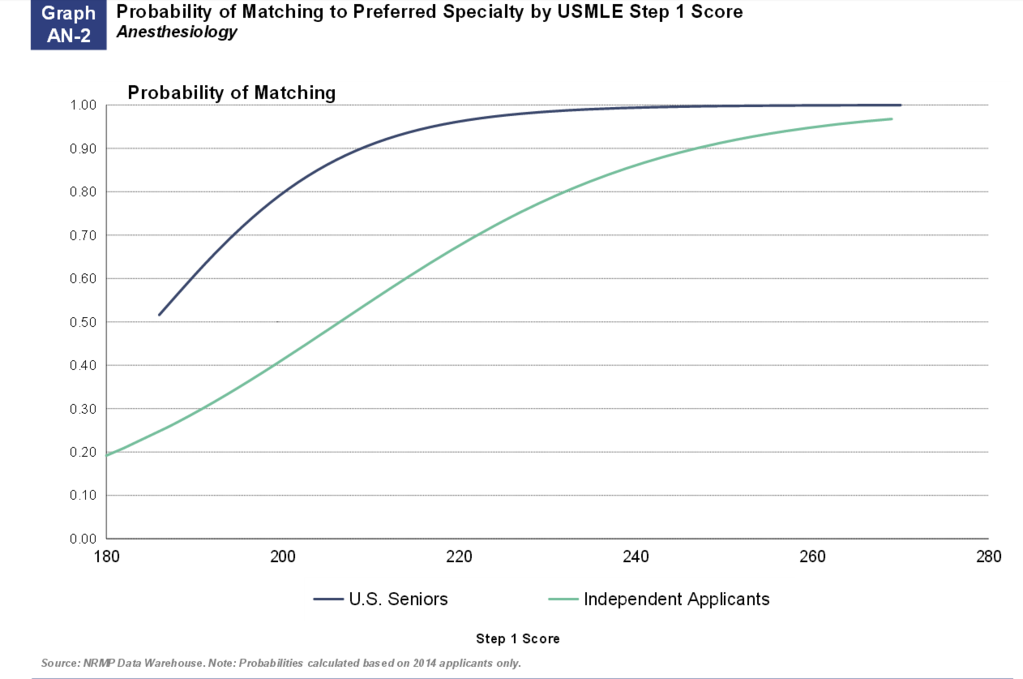
This is for the "Will I match with this Step 1 score?" whiners:
D
deleted171991
Some Step 2 numbers, too:
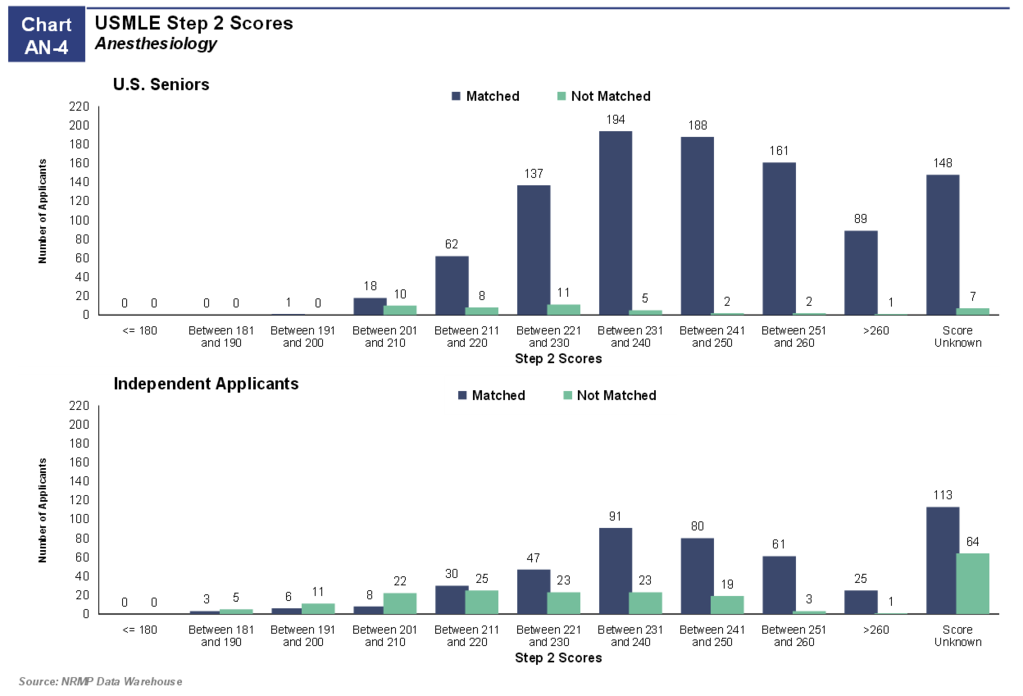
The source for all the graphs is http://www.nrmp.org/wp-content/uploads/2014/09/Charting-Outcomes-2014-Final.pdf
The source for all the graphs is http://www.nrmp.org/wp-content/uploads/2014/09/Charting-Outcomes-2014-Final.pdf
Does Michigan fall into that list? Would like to stay close to family.
Interviewed there, michigan is easily a top program. I got the impression that it was very strong in general and well balanced. I thought pretty highly of Dr Tremper and he seems to be very well known. He is also a strong advocate for his residents
I liked the programs that made an effort to learn your name instead of reading it in front of you ten seconds before they said hello. I also liked the places where the chair and/or the pd made an effort to talk to the applicants. Michigan did both
Last edited:
No offense but, besides the lifestyle and hate for clinics, there is no way the bright ones will ever go into anesthesia again. If anything drives me nuts it's playing second fiddle to less intelligent surgeons and administrators. I went into critical care to feel smart again.
Not if we can magically find a way to make anesthesia lucrative... hahha

To be honest with you, The American Board of Anesthesiology has changed its Board Certification process. One of the thing that the board as changed is that the CA-1 residents have to take the basic exam at the end of their CA-1 year in order to move on to the next level. The exam consists of basic anesthesia knowledge that mirror the effect of the USMLE step 1 exam. Therefore, a lot of PD will analyze your step 1 score more than a excellent step 2 score. Sorry, but a low USMLE step 1 score is tough to get into anesthesia. Even for SUNY downstate.
Interested as to why the continued Downstate hate? I've seen this topic brought up several times on this forum....
Interested as to why the continued Downstate hate? I've seen this topic brought up several times on this forum....
Have u seen their residency class in last couple years?
would it be difficult to match into a texas residency program with this score, I am a tx resident, so I would assume it would be okay but can anyone shine some light on this?
D
deleted641888
would it be difficult to match into a texas residency program with this score, I am a tx resident, so I would assume it would be okay but can anyone shine some light on this?
I interviewed at almost all of the Texas programs. Honestly, I can only think of one program that is not as competitive (due to location), but anecdotally, I know a few people in your score range who did well on aways there and did not match. Texas programs are pretty solid for the most part, IMO.

ER has overtaken Anesthesiology in terms of competitiveness. The graphs prove it. Gas is more competitive than FM but isn't that because every specialty sans Pediatrics is more competitive than FM?
just 3-4 years ago EM=GAS in terms of Board scores for matching into the specialty.
e
just 3-4 years ago EM=GAS in terms of Board scores for matching into the specialty.
e
ER has overtaken Anesthesiology in terms of competitiveness. The graphs prove it. Gas is more competitive than FM but isn't that because every specialty sans Pediatrics is more competitive than FM?
just 3-4 years ago EM=GAS in terms of Board scores for matching into the specialty.
e
I think FFP and Consegliere had a little bit to do with that...i mean if i was reading this forum and was on the fence i wouldn't go into anesthesia
Advertisement - Members don't see this ad
I think FFP and Consegliere had a little bit to do with that...i mean if i was reading this forum and was on the fence i wouldn't go into anesthesia
Yeah the posts here made me really consider vascular, ent and em. Didn't like them though
ER has overtaken Anesthesiology in terms of competitiveness. The graphs prove it. Gas is more competitive than FM but isn't that because every specialty sans Pediatrics is more competitive than FM?
just 3-4 years ago EM=GAS in terms of Board scores for matching into the specialty.
And before that, EM was more competitive than Gas (see 2005 or 2007 data).
The two are so close that it's within the realm of statistical variation. I don't think you can definitively conclude that one is more competitive than the other based on one data point alone.
2014: Gas 230 Step 1/241 Step 2, EM 230/243 (average across all specialties: 230/243)
2011: Gas 226/235, EM 223/234 (average across all specialties: 226/235)
2009: Gas 224/230, EM 222/230 (average across all specialties: 225/231)
2007: Gas 220/223, EM220/227 (average across all specialties: 221/226)
2005: Gas 216, EM 220 (Step 2 data not provided for 2005)
At the end of the day, the vast majority of applicants are matching into anesthesia because they want to, not because they have to. I know that I could match into a solid EM program, but the issue is that I don't have a desire to do EM.
Last edited:
Yeah the posts here made me really consider vascular, ent and em. Didn't like them though
Same boat here. Have you matched already?
I did take a hard look at other specialties after reading all the doom & gloom on here (mainly IM subspecialties and Surg subspecialties) but it's hard to want to match into something you have little interest in.
But at the end of the day, you have to realize that it's the same 3-4 people spreading all the doom & gloom on here, and to base your life decisions on the complaints of 3-4 strangers on a forum without doing your own research is not exactly a great idea.
Same boat here. Have you matched already?
I did take a hard look at other specialties after reading all the doom & gloom on here (mainly IM subspecialties and Surg subspecialties) but it's hard to want to match into something you have little interest in.
But at the end of the day, you have to realize that it's the same 3-4 people spreading all the doom & gloom on here, and to base your life decisions on the complaints of 3-4 strangers on a forum without doing your own research is not exactly a great idea.
Have you run the math on your life-changing decision? Do you really know what you are getting into? If you have a spouse pulling in $200K or more then it doesn't matter what specialty you pick as you have options.
Anesthesiology at one time was a great specialty. No longer. These days it is average to below average at best. Yes, there are still some great opportunities in this field for those fortunate enough to become Chairs or Partners at a top earning group. But, those opportunities are rare and difficult to obtain to these days. More than likely you will end up with an average type job earning average type income (let's even assume 1 standard deviation higher than average). Where does that leave you? What does your job entail day to day? What will your future income be like in a specialty dominated by Nurse getting their doctorates in Anesthesia?
So while the Sun is still shining on the specialty there are dark clouds over the horizon about rain down hard on your parade. All I am asking you to do is bring along an umbrella.
And before that, EM was more competitive than Gas (see 2005 or 2007 data).
The two are so close that it's within the realm of statistical variation. I don't think you can definitively conclude that one is more competitive than the other based on one data point alone.
2014: Gas 230 Step 1/241 Step 2, EM 230/243 (average across all specialties: 230/243)
2011: Gas 226/235, EM 223/234 (average across all specialties: 226/235)
2009: Gas 224/230, EM 222/230 (average across all specialties: 225/231)
2007: Gas 220/223, EM220/227 (average across all specialties: 221/226)
2005: Gas 216, EM 220 (Step 2 data not provided for 2005)
At the end of the day, the vast majority of applicants are matching into anesthesia because they want to, not because they have to. I know that I could match into a solid EM program, but the issue is that I don't have a desire to do EM.
We agree that EM is worse than GAS in terms of a career. I have no idea how gullible med students end up doing EM. I think it's from too much TV and not enough clinical time in the ER. The majority of EM even at high acuity hospitals is either babysitting or being a triage nurse.
http://rhetoricandcivilization.blogspot.com/2015/12/anesthesiologists-and-crnas-not_8.html
"In conclusion, the economy, the medical field and patients all around the country would be better off if CRNAs would be given responsibility in place of anesthesiologists. The time and money spent on medical school is unnecessary when CRNAs are doing (or can do) nearly all that anesthesiologist can."
"In conclusion, the economy, the medical field and patients all around the country would be better off if CRNAs would be given responsibility in place of anesthesiologists. The time and money spent on medical school is unnecessary when CRNAs are doing (or can do) nearly all that anesthesiologist can."
Last edited:

Maybe the OP should just go into IM then subspecialize. That would be a logical choice and still lead to a rewarding career.
Last edited:
To answer the Op's question "What are my chances" the answer is based on his/her Step-2 score.
Another bomb on Step-2 and the OP will not likely match into Anesthesiology.
Another bomb on Step-2 and the OP will not likely match into Anesthesiology.
Last edited:
More than likely you will end up with an average type job earning average type income (let's even assume 1 standard deviation higher than average). Where does that leave you?
Worst-case scenario...anesthesiologists are paid $200k to do the work they do now?
That probably sounds absolutely terrible to the older physicians who were used to earning much more in private practice, but for those of us about to enter residency now and who have never experienced the golden era of medicine, the perspective has changed.
If you have a spouse pulling in $200K or more then it doesn't matter what specialty you pick as you have options.
I think we can both agree on that point. 😉
Last edited:
http://rhetoricandcivilization.blogspot.com/2015/12/anesthesiologists-and-crnas-not_8.html
"In conclusion, the economy, the medical field and patients all around the country would be better off if CRNAs would be given responsibility in place of anesthesiologists. The time and money spent on medical school is unnecessary when CRNAs are doing (or can do) nearly all that anesthesiologist can."
I have no idea why a nurse is so concerned with how much it costs to train a doctor. Really their concern should be about how weak their training is, especially in light of how quickly they can finish
D
deleted171991
I used to feel bad because of this. But now I realize that it's actually good when somebody challenges a career-defining decision the way the "doom and gloomers" do it. I wish somebody had actually done this with me, instead of painting the rosy pink picture almost 10 years ago. I would have still chosen anesthesia, but going through that process, and debate and inner fight, would have made me not regret even a bad outcome.I think FFP and Consegliere had a little bit to do with that...i mean if i was reading this forum and was on the fence i wouldn't go into anesthesia
When I went into CCM, I had to defend my decision from interviewers who wanted to know why this attending would eat **** for a year in a subspecialty that he doesn't really need, that won't necessarily further his career. And I needed to convince myself, too. So I looked at myself and said to myself: the one thing where I always ran circles around many is medical knowledge. What I enjoy most in medicine is not actually saving people's lives, it's being thanked for it. And so on. This is how I arrived to CCM, one of the worst rotations of my anesthesia residency, the one I swore never to practice again after my CA-2 month. And now, less than 2 months before graduation, it was one of the best decisions of my life. I have just watched the latest episode of Gray's soap opera and I completely understood the moment where Edwards' musician friend says that the studio is his place, it's where he feels the most like himself, and Edwards says that the OR is hers, and how even the smell of disinfectant makes her feel good. The ICU is that place for me. And I still enjoy going to work, despite all the things I don't like in critical care, many of which you can read about in this very section.
So y'all should say Thank You to all the doom and gloomers, because they/we make it easy to live with your decision afterwards. Whatever will happen to anesthesia in the next 25 years, you will only have pleasant surprises. You know why you chose this specialty, despite all the gloom and hate and whine. You know what you love about it, why you put up with everything, why there wasn't a better choice for you. We made you do your homework about it, instead of just telling you how awesome it all is, and what rock stars we anesthesia attendings are, like most dinguses let their students and observers believe. We actually made you pay attention to the truth, to what's outside of the Matrix.
So please say Thank You, the same way I do to all those who give me sincere advice, even if wrong, even if disagreeing. The intention matters a lot, and the intentions here are good... Except for @Consigliere's. 🙂
Last edited by a moderator:
I used to feel bad because of this. But now I realize that it's actually good when somebody challenges a career-defining decision the way the "doom and gloomers" do it. I wish somebody had actually done this with me, instead of painting the rosy pink picture almost 10 years ago. I would have still chosen anesthesia, but going through that process, and debate and inner fight, would have made me not regret even a bad outcome.
When I went into CCM, I had to defend my decision from interviewers who wanted to know why this attending would eat **** for a year in a subspecialty that he doesn't really need, that won't necessarily further his career. And I needed to convince myself, too. So I looked at myself and said to myself: the one thing where I always ran circles around many is medical knowledge. What I enjoy most in medicine is not actually saving people's lives, it's being thanked for it. And so on. This is how I arrived to CCM, one of the worst rotations of my anesthesia residency, the one I swore never to practice again after my CA-2 month. And now, less than 2 months before graduation, it was the best decision of my life. I have just watched the latest episode of Gray's soap opera and I completely understood the moment where Edwards' musician friend says that the studio is his place, it's where he feels the most like himself, and Edwards says that the OR is hers, and how even the smell of disinfectant makes her feel good. The ICU is that place for me. And I still enjoy going to work, despite all the things I don't like in critical care, many of which you can read about in this very section.
So y'all should say Thank You to all the doom and gloomers, because they/we make it easy to live with your decision afterwards. Whatever will happen to anesthesia in the next 25 years, you will only have pleasant surprises. You know why you chose this specialty, despite all the gloom and hate and whine. You know what you love about it, why you put up with everything, why there wasn't a better choice for you. We made you do your homework about it, instead of just telling you how awesome it all is, and what rock stars we anesthesia attendings are, like most dinguses let their students and observers believe. We actually made you pay attention to the truth, to what's outside of the Matrix.
So please say Thank You, the same way I do to all those who have given me sincere advice, even if wrong, even if disagreeing. The intention matters a lot, and the intentions here are good... Except for Consigliere's. 🙂
What's CCM like in term of malpractice risks. ICU patients are more likely to have bad outcomes. Of course the cause of the bad outcome likely happened before they get admitted to the ICU. But when patients sue, they like to list as many doctors involved in their care as possible. So I'm curious as to your experience with malpractice. Is ICU malpractice insurance cost higher than anesthesia?
Like you, I hated ICU during residency. But as an attending, I do think I would enjoy it more. I might consider going back for it if reimbursements for anesthesia drops precipitously.
Worst-case scenario...anesthesiologists are paid $200k to do the work they do now?
That probably sounds absolutely terrible to the older physicians who were used to earning much more in private practice, but for those of us about to enter residency now and who have never experienced the golden era of medicine, the perspective has changed.
I think we can both agree on that point. 😉
Let's say you earn $300K. Now, factor in loan repayment, taxes, 401K, health insurance, FICA, etc. and you are left with a lot less than you may realize. Now, if you want middle class with that income then no problem. But, what I do everyday is a lot harder than FM or IM does in their office. Yet, the pay differential just isn't there any longer. Ask a FM the last time he had a code or near code situation? For me, it's every week as most of my patients are elderly ASA4 undergoing surgery. What about malpractice risk? Ask a FM the last time he truly worried about a mega dollar lawsuit? For me, it's daily as I do peripheral nerve blocks, central lines, intubations, etc. where there is no room for error.
If you practice at a same day surgery center the stress level will be a lot lower than at a high acuity medical center. It used to be the money was the differential for that high acuity and stress; not so much any longer. These days Mednax could care less about your stress level while you "supervise" 4 new graduate CRNAs who have more confidence than actual skill.
I'm glad you would work in this specialty for $200K but the real question is what do you have to do to earn that money? Are you sitting your own cases for $350K or running around like a mad dog all day while your overlords pocket the differential. This is why I say over and over again to do a fellowship so you are employable both in Academics and Private Practice as the latter is nowhere as good as it used to be.
http://www.taxformcalculator.com/tax/300000.html
D
deleted171991
I had exactly the same concern. I was expecting CCM to be very litigious. It's actually less, because of what you said: the bad stuff has already happened. People are actually very grateful for everything you do to save their loved ones, and they tend to understand when it doesn't work out, as long as you keep them in the loop. People only expect bad surprises from an ICU hospitalization, while it's completely the opposite for the bread and butter elective surgery.What's CCM like in term of malpractice risks. ICU patients are more likely to have bad outcomes. Of course the cause of the bad outcome likely happened before they get admitted to the ICU. But when patients sue, they like to list as many doctors involved in their care as possible. So I'm curious as to your experience with malpractice. Is ICU malpractice insurance cost higher than anesthesia?
Like you, I hated ICU during residency. But as an attending, I do think I would enjoy it more. I might consider going back for it if reimbursements for anesthesia drops precipitously.
So overall litigiousness is lower than in anesthesia, AFAIK. We have much stronger personal relationships with the families, and people tend not to sue doctors they like, despite bad outcomes.
Last edited by a moderator:
Advertisement - Members don't see this ad
D
deleted171991
Good Day At Work
http://www.blog.greatzs.com/2016/04/good-day-at-work.html
http://www.blog.greatzs.com/2016/04/good-day-at-work.html
http://rhetoricandcivilization.blogspot.com/2015/12/anesthesiologists-and-crnas-not_8.html
"In conclusion, the economy, the medical field and patients all around the country would be better off if CRNAs would be given responsibility in place of anesthesiologists. The time and money spent on medical school is unnecessary when CRNAs are doing (or can do) nearly all that anesthesiologist can."
Are u surprised? Because Im not...same can be arg
I used to feel bad because of this. But now I realize that it's actually good when somebody challenges a career-defining decision the way the "doom and gloomers" do it. I wish somebody had actually done this with me, instead of painting the rosy pink picture almost 10 years ago. I would have still chosen anesthesia, but going through that process, and debate and inner fight, would have made me not regret even a bad outcome.
When I went into CCM, I had to defend my decision from interviewers who wanted to know why this attending would eat **** for a year in a subspecialty that he doesn't really need, that won't necessarily further his career. And I needed to convince myself, too. So I looked at myself and said to myself: the one thing where I always ran circles around many is medical knowledge. What I enjoy most in medicine is not actually saving people's lives, it's being thanked for it. And so on. This is how I arrived to CCM, one of the worst rotations of my anesthesia residency, the one I swore never to practice again after my CA-2 month. And now, less than 2 months before graduation, it was one of the best decisions of my life. I have just watched the latest episode of Gray's soap opera and I completely understood the moment where Edwards' musician friend says that the studio is his place, it's where he feels the most like himself, and Edwards says that the OR is hers, and how even the smell of disinfectant makes her feel good. The ICU is that place for me. And I still enjoy going to work, despite all the things I don't like in critical care, many of which you can read about in this very section.
So y'all should say Thank You to all the doom and gloomers, because they/we make it easy to live with your decision afterwards. Whatever will happen to anesthesia in the next 25 years, you will only have pleasant surprises. You know why you chose this specialty, despite all the gloom and hate and whine. You know what you love about it, why you put up with everything, why there wasn't a better choice for you. We made you do your homework about it, instead of just telling you how awesome it all is, and what rock stars we anesthesia attendings are, like most dinguses let their students and observers believe. We actually made you pay attention to the truth, to what's outside of the Matrix.
So please say Thank You, the same way I do to all those who give me sincere advice, even if wrong, even if disagreeing. The intention matters a lot, and the intentions here are good... Except for @Consigliere's. 🙂
Well said.
Let's say you earn $300K. Now, factor in loan repayment, taxes, 401K, health insurance, FICA, etc. and you are left with a lot less than you may realize. Now, if you want middle class with that income then no problem. But, what I do everyday is a lot harder than FM or IM does in their office. Yet, the pay differential just isn't there any longer. Ask a FM the last time he had a code or near code situation? For me, it's every week as most of my patients are elderly ASA4 undergoing surgery. What about malpractice risk? Ask a FM the last time he truly worried about a mega dollar lawsuit? For me, it's daily as I do peripheral nerve blocks, central lines, intubations, etc. where there is no room for error.
If you practice at a same day surgery center the stress level will be a lot lower than at a high acuity medical center. It used to be the money was the differential for that high acuity and stress; not so much any longer. These days Mednax could care less about your stress level while you "supervise" 4 new graduate CRNAs who have more confidence than actual skill.
I'm glad you would work in this specialty for $200K but the real question is what do you have to do to earn that money? Are you sitting your own cases for $350K or running around like a mad dog all day while your overlords pocket the differential. This is why I say over and over again to do a fellowship so you are employable both in Academics and Private Practice as the latter is nowhere as good as it used to be.
http://www.taxformcalculator.com/tax/300000.html
187k take home pay for 300k salary is not just "middle class"...avg middle class earns roughly 50 to 75k pretax. At 187k take home pay...you are at least upper middle class, and there shouldn't be anything reasonable that you can't afford to provide for your family. Or am i missing something here?
And also correct me if im wrong, 350k to 400k is not farfetch after more than 3 to 6yrs of experience. With that kind of income and my spouse earning potential greater than 120k, i think i will live better than the avg middle class family.
Now whether or not i deserve more money for the risk im taking, that's a whole another debate.
But really congrats to you all that made a shyt ton of money doing this, I've curtailed my expectations and my sleeves are rolled.
187k take home pay for 300k salary is not just "middle class"...avg middle class earns roughly 50 to 75k pretax. At 187k take home pay...you are at least upper middle class, and there shouldn't be anything reasonable that you can't afford to provide for your family. Or am i missing something here?
And also correct me if im wrong, 350k to 400k is not farfetch after more than 3 to 6yrs of experience. With that kind of income and my spouse earning potential greater than 120k, i think i will live better than the avg middle class family.
Now whether or not i deserve more money for the risk im taking, that's a whole another debate.
But really congrats to you all that made a shyt ton of money doing this, I've curtailed my expectations and my sleeves are rolled.
Yes, $187K after tax is upper middle class. In addition, I think $350K is a very realistic salary for a fellowship trained Anesthesiologist especially Peds, pain or Cardiac. If you add in your spouse's income of $100K+ then your lifestyle should be pretty good.
Now, as for what the job entails I doubt you fully grasp it at this point. Supervising 4 rooms is not a fun way to spend your career and if you can make a living covering 2 rooms (academic) or doing your own cases then I recommend that route.
Yes, $187K after tax is upper middle class. In addition, I think $350K is a very realistic salary for a fellowship trained Anesthesiologist especially Peds, pain or Cardiac. If you add in your spouse's income of $100K+ then your lifestyle should be pretty good.
Now, as for what the job entails I doubt you fully grasp it at this point. Supervising 4 rooms is not a fun way to spend your career and if you can make a living covering 2 rooms (academic) or doing your own cases then I recommend that route.
Was your estimate of 350k for PP or for academic? I was under the impression that academic anesthesiologists were more like 250-300k but also with an easier lifestyle/workload to match.
- Status
- Not open for further replies.
Similar threads


- Replies
- 1
- Views
- 1K

- Replies
- 3
- Views
- 759

