
-
CycleTrack and SDN are teaming up to make medical school admissions more transparent and accessible! Read the announcement to learn how we’re supporting the future of CycleTrack’s free application-tracking tools .
You are using an out of date browser. It may not display this or other websites correctly.
You should upgrade or use an alternative browser.
You should upgrade or use an alternative browser.

Get help with your application
Use all the free resources available to you from SDN: articles, guides, expert advising, forums discussions, and school research.
D
deleted1002574
What was the original post saying? It has been taken down (the one Dr. Stiles was responding to)
Advertisement - Members don't see this ad
What was the original post saying? It has been taken down (the one Dr. Stiles was responding to)
If I recall correctly, it was a MSKCC physician telling NYC medicine doctors that MSKCC is willing to accept transfers to help out. No initial clarification bout whether it was "regular" cancer patients, "regular" non cancer patients, or COVID +/- patients.
Seemed pretty benign, but from Stiles response you can tell there may be some bad blood there.
If I recall correctly, it was a MSKCC physician telling NYC medicine doctors that MSKCC is willing to accept transfers to help out.
Seemed pretty benign, but from Stiles response you can tell there may be some bad blood there.
Completely agree. I think it was benign, but triggering to a surgeon from a competing hospital.

Protons for all no matter what the data shows!

The MSK does have that superior EKG policy thoughlet’s say mskcc steals a pt, macroscopically are we worse off- yes! Because whatever health services they render are almost surely going to be more expensive than anyone else.

Rad Onc Twitter
Hah, hate to defend the academicians, but the Cedars guys are solid and the training there is top-notch. This is probably an anomaly, but they are all well-pedigreed, decent guys who look out for their residents. From what I've heard, all the recent grads landed jobs/geographies of choice, and I...
 forums.studentdoctor.net

Protons for all no matter what the data shows!
some people would IMPT everything if they could, maybe a sprinkle tinkle of carbon ion boost. You know the angle
The MSK does have that superior EKG policy though
Rad Onc Twitter
Hah, hate to defend the academicians, but the Cedars guys are solid and the training there is top-notch. This is probably an anomaly, but they are all well-pedigreed, decent guys who look out for their residents. From what I've heard, all the recent grads landed jobs/geographies of choice, and I...
i wonder if you’re a cancer patient and someone put you on trazodone for insomnia and you came in with a priapism, will msk still do an ekg? You know it! $$$$

The MSK does have that superior EKG policy though
Rad Onc Twitter
Hah, hate to defend the academicians, but the Cedars guys are solid and the training there is top-notch. This is probably an anomaly, but they are all well-pedigreed, decent guys who look out for their residents. From what I've heard, all the recent grads landed jobs/geographies of choice, and I...
She took that EKG Tweet down with the quickness.
would love to see the rates that mskcc negotiated for ekgs! will have to remember if we ever get price transparency.She took that EKG Tweet down with the quickness.

She took that EKG Tweet down with the quickness.
Oh, ah, ah, ah, ah!
Am hearing some rumors that phase III proton trials for prostate are totally negative.Protons for all no matter what the data shows!
Am hearing some rumors that phase III proton trials for prostate are totally negative.
heard that too, many are saying it. They will bury data like they already bury their institutional data.
Am hearing some rumors that phase III proton trials for prostate are totally negative.
heard that too, many are saying it. They will bury data like they already bury their institutional data.
Advertisement - Members don't see this ad
you can't cure prostate cancer without protons
heard a few rumors about people trying
let's just say that it.......did not go well
heard a few rumors about people trying
let's just say that it.......did not go well
also sure they are actuallyu worse in terms of rectal toxicity so not not sure how that will be dealt withAm hearing some rumors that phase III proton trials for prostate are totally negative.
also sure they are actuallyu worse in terms of rectal toxicity so not not sure how that will be dealt with
BuT YoU JUst NeED TO seE OuR DAta With SpacoAR!*
* I'm fine with spaceOAR, but it's not going to move the needle in proton vs. photon. I 100% anticipate this angle though because Miami proton, Knoxville/Nashville proton are basically 100% spaceOAR for all patients. If the subgroup analysis shows spaceOAR plus protons to be lowest rate of rectal toxicity then you bet all your student loan money this will be the rallying cry.
Last edited:
Negative... for any drawbacks.Am hearing some rumors that phase III proton trials for prostate are totally negative.
In an unplanned, post-hoc, subset analysis we found that among 6 patients with bilateral hip prostheses there was a non-significant trend toward decreased Grade 2 acute bladder toxicity in the proton group. These data are hypothesis generating and should be tested with a larger cohort of registry patients in perpetuity.
Early toxicity and patient reported quality-of-life in patients receiving proton therapy for localized prostate cancer: a single institutional review of prospectively recorded outcomes - PMC
We report prospectively captured clinical toxicity and patient reported outcomes in a single institutional cohort of patients treated for prostate cancer with proton beam therapy (PBT). This is the largest reported series of patients treated mostly ...
 www.ncbi.nlm.nih.gov
rectal bleeding requiring laser was Grade 2. 15 of 200 pts. This is pencil beam protons with invasive rectal maneuvers- all pts treated with rectal; balloons?. I have gone 10 years without pt needing a laser and not using space oar or rectal balloons. I am sure proton studies will try to claim IMRT has like 20% late grade 2 toxicities.
Hmm, why this study not in the red journal- major center, check, most up to date proton experience with latest techniques, check, 95% of red journal is trash, check, so why not replace one of those articles ?
Last edited:

No surprise there. 1308 and the breast study will be too. The recent esophagus randomized trial was positive and actually had some rhyme and reason, unlike the others.Am hearing some rumors that phase III proton trials for prostate are totally negative.
What was the esophagus trial?No surprise there. 1308 and the breast study will be too. The recent esophagus randomized trial was positive and actually had some rhyme and reason, unlike the others.
No surprise there. 1308 and the breast study will be too. The recent esophagus randomized trial was positive and actually had some rhyme and reason, unlike the others.
Esophageal trial was a Bayesian trial here https://ascopubs.org/doi/full/10.1200/JCO.19.02503
I think there are precisely 0 rad oncs who can decipher this trial. I seriously would like to understand, as I think we will see this more and more
The stats methodology paper (ref 18) is here with a preview of the headache:
With stats, insurance policies, or a bookie- trying to hide/deceive with complexity.
this is why we need medicare for all.
no more BS
Except they would probably be exempt from that:

Comparison of PPS-Exempt Hospitals, NCI-Designated Hospitals, and Other Hospitals That Provide Cancer Care
This cohort study compares the characteristics and postoperative outcomes of hospitals affiliated with Prospective Payment System (PPS)-exempt cancer centers, other hospitals affiliated with National Cancer Institute (NCI)-designated cancer centers, and other hospitals that provide cancer care in...
Esophageal trial was a Bayesian trial here https://ascopubs.org/doi/full/10.1200/JCO.19.02503
I think there are precisely 0 rad oncs who can decipher this trial. I seriously would like to understand, as I think we will see this more and more
The stats methodology paper (ref 18) is here with a preview of the headache:
View attachment 301696
Is this the trial where there were no differences in patient reported side effects, no survival differences or PFS advantages, but some sort of "total treatment burden" metric or something?
I can potentially see protons for pre op esophagus...more than prostate. Glad they're doing a P3 trial though.
A lot of noise about the lymphocyte count and stuff now for thoracic radiation...this is the next selling point/angle for protons for esophagus and lung until the P3 trials are done. We already have one negative sort of phase III trial in stage III lung, but more to come I suppose.
What was the original post saying? It has been taken down (the one Dr. Stiles was responding to)
It said something along the lines of "We're accepting stable, floor patients with cancer for transfer. We won't steal your patients!"
Is this the trial where there were no differences in patient reported side effects, no survival differences or PFS advantages, but some sort of "total treatment burden" metric or something?
I can potentially see protons for pre op esophagus...more than prostate. Glad they're doing a P3 trial though.
A lot of noise about the lymphocyte count and stuff now for thoracic radiation...this is the next selling point/angle for protons for esophagus and lung until the P3 trials are done. We already have one negative sort of phase III trial in stage III lung, but more to come I suppose.
Yes, I have questions, but also questions about my questions.

Guess what the lung proton trial was... MDACC Bayesian.
From the lung proton protocol:
https://ascopubs.org/doi/full/10.1200/JCO.2017.74.0720?url_ver=Z39.88-2003&rfr_id=ori:rid:crossref.org&rfr_dat=cr_pub 0pubmed
It's simpler with log normal (unsee log and go with normal if confusing) Normal distribution(Median, Variance) [I think anyway...] These are just conditional on data ie "|data" nomenclature. It also looks like flat priors were used for gamma, and a normal prior for beta (God help me I dunno??? ). "^" i think means "estimator" / actual data points. They then look at IGAXT (photon) vs IGAPT (protons) failure rates at 24 months and whoever has the greater prb of control wins?
Very confusing
 Not sure exactly what is going on... The esophageal proton trial is even more confusing b/c of the summation of multiple treatment burdens.
 Advertisement - Members don't see this ad
Esophageal trial was a Bayesian trial here https://ascopubs.org/doi/full/10.1200/JCO.19.02503
I think there are precisely 0 rad oncs who can decipher this trial. I seriously would like to understand, as I think we will see this more and more
The stats methodology paper (ref 18) is here with a preview of the headache:
View attachment 301696
I am no statistician, but I think all they did was pre-specify 7 adverse event categories... e.g. A-fib, PNA, anastomotic leak, radiation pneumonitis etc... and then pre-specify how "bad" each grade of each toxicity is relative to each other... e.g. Grade 2 pneumonitis = 12; whereas anastomatic leak = 21 (didn't look up real numbers... I just made up these up). The did this all a priori before accruing patients. Then, after the follow up is complete, each patient essentially has a toxicity score (they call it "total toxicity burden" TTB), which is the sum of all of the scores for each of that patient's individual toxicities. This allows them to compare apples to apples and so that the can say patient A had more total toxicity than patient B (assuming that you buy their scoring system). Based on this, they were able to show that the patients treated on trial with protons had >99% chance of of having a lower mean TTB than those treated with IMRT. It actually seems like a pretty clever way of getting power to compare toxicities.
At least that is my understanding... I encourage anyone to correct me if I am wrong.
I really think we need more discussion like this, since it's creeping in. I think it's much more complicated than that b/c they have a weird/Bayesian way to describe the prior and posterior distributions . They aren't, in my understanding, looking at point estimates and then comparing CIs (typical / frequentist way), but comparing mean TTB posteriors that are funky functions (inv. gamma distribution ??? pg 9) with their own set priors see screenshots from the protocol:I am no statistician, but I think all they did was pre-specify 7 adverse event categories... e.g. A-fib, PNA, anastomotic leak, radiation pneumonitis etc... and then pre-specify how "bad" each grade of each toxicity is relative to each other... e.g. Grade 2 pneumonitis = 12; whereas anastomatic leak = 21 (didn't look up real numbers... I just made up these up). The did this all a priori before accruing patients. Then, after the follow up is complete, each patient essentially has a toxicity score (they call it "total toxicity burden" TTB), which is the sum of all of the scores for each of that patient's individual toxicities. This allows them to compare apples to apples and so that the can say patient A had more total toxicity than patient B (assuming that you buy their scoring system). Based on this, they were able to show that the patients treated on trial with protons had >99% chance of of having a lower mean TTB than those treated with IMRT. It actually seems like a pretty clever way of getting power to compare toxicities.
At least that is my understanding... I encourage anyone to correct me if I am wrong.
My main issue is, this is so complicated it is very hard to know what's going on . Maybe you're right, but from the multiple screenshots of the protocol we all see the madness!
From what I know of Bayes, if we take esophageal cancer, I don't see that much toxicity from 50 Gy + chemo and even less with 41.4 Gy. I would have a very skeptical prior that protons would be much better. They have a non-informative prior N (0,100) ,whereas I think we should have an extremely skewed informed prior toward our prior belief that at 50 Gy the difference between the modalities are minimal to non-existent. They had barely any pts:
"145 patients were randomly assigned (72 IMRT, 73 PBT), and 107 patients (61 IMRT, 46 PBT) were evaluable. "
Ask yourself, how many patients would you need to show a difference in post-op complications (POC in the protocol) for 50 Gy Protons vs Photons? Just 107? I think whatever math they did, the prior I would use would be massively informed in favor of no difference.
I would love any more discussion on this and corrections are def. welcome.
Last edited:
That Bayesian trial was not at all the same as the esophagus trial. It's the same word but the methodology is very different if you delve into it.Yes, I have questions, but also questions about my questions.
Guess what the lung proton trial was... MDACC Bayesian.
From the lung proton protocol:
https://ascopubs.org/doi/full/10.1200/JCO.2017.74.0720?url_ver=Z39.88-2003&rfr_id=ori:rid:crossref.org&rfr_dat=cr_pub 0pubmed
View attachment 301722
It's simpler with log normal (unsee log and go with normal if confusing) Normal distribution(Median, Variance) [I think anyway...] These are just conditional on data ie "|data" nomenclature. It also looks like flat priors were used for gamma, and a normal prior for beta (God help me I dunno??? ). "^" i think means "estimator" / actual data points. They then look at IGAXT (photon) vs IGAPT (protons) failure rates at 24 months and whoever has the greater prb of control wins?
Very confusing
I agree, but I thought I was delving into it pretty deeply 🙁That Bayesian trial was not at all the same as the esophagus trial. It's the same word but the methodology is very different if you delve into it.
Please dive on in with me! My main questions are how we get the priors, are they legit, how the data is used to form posteriors, how we compare the posteriors, and how we claim superiority (or is it greater probability in our personal beliefs since it's Bayes).
I thought I was OK at evaluating trials (I even wrote and conducted a phase I/II trial previously), but you guys/gals are leaving me in the dust on this analysis but I greatly appreciate the ongoing discussion.
I don't have the full text of the esophagus trial immediately available. Did they publish the absolute numbers of adverse events? Could one or two bad events be skewing the data/formula if it is weighted heavily in their TTB formula?
Like the Darby breast paper....we get worked up about heart dose (and I agree it's important)...but buried in the supplement you see a mean heart dose of 4-6 Gy was like a 1% absolute increase in cardiac mortality for a 50 year old patient.
I don't have the full text of the esophagus trial immediately available. Did they publish the absolute numbers of adverse events? Could one or two bad events be skewing the data/formula if it is weighted heavily in their TTB formula?
Like the Darby breast paper....we get worked up about heart dose (and I agree it's important)...but buried in the supplement you see a mean heart dose of 4-6 Gy was like a 1% absolute increase in cardiac mortality for a 50 year old patient.
I thought I was OK at evaluating trials (I even wrote and conducted a phase I/II trial previously), but you guys/gals are leaving me in the dust on this analysis but I greatly appreciate the ongoing discussion.
I don't have the full text of the esophagus trial immediately available. Did they publish the absolute numbers of adverse events? Could one or two bad events be skewing the data/formula if it is weighted heavily in their TTB formula?
Like the Darby breast paper....we get worked up about heart dose (and I agree it's important)...but buried in the supplement you see a mean heart dose of 4-6 Gy was like a 1% absolute increase in cardiac mortality for a 50 year old patient.
Count me as a skeptic. I agree that this sounds like 3 card monte. These are the same folks who tell us that RTOG 0415 was statistically significant but somehow clinically insignificant. I wonder if they have an agenda?
Very likely that proton trials will try to suggest that imrt has more toxicity than it really does in order claim benefit of protons. Have very active esophageal service- about 2 cases a month- and very little toxicity from 4140 to large fields. A factor in “toxicity” could be a zealous unblinded radonc hunting through postop record, highly motivated to score “toxicity” in imrt group.
Postop course is not black and white and subject to a lot of subjective interpretation... (you don’t find a difference, you aren’t getting into jco) Complex stats are probably a distraction for highly subjective postop toxicity scoring. Will d/w our esoph surgeon. For example, Can you imagine the incentive to count a little bit of post op aspiration pneumonia in the imrt group as pneumonitis ?
This is probably a perfect example for John Ioannidis.
Postop course is not black and white and subject to a lot of subjective interpretation... (you don’t find a difference, you aren’t getting into jco) Complex stats are probably a distraction for highly subjective postop toxicity scoring. Will d/w our esoph surgeon. For example, Can you imagine the incentive to count a little bit of post op aspiration pneumonia in the imrt group as pneumonitis ?
This is probably a perfect example for John Ioannidis.
Last edited:
Very likely that proton trials will try to suggest that imrt has more toxicity than it really does in order claim benefit of protons. Have very active esophageal service- about 2 cases a month- and very little toxicity from 4140 to large fields. A factor in “toxicity” could be a zealous unblinded radonc hunting through postop record, highly motivated to score “toxicity” in imrt group.
Postop course is not black and white and subject to a lot of subjective interpretation... (you don’t find a difference, you aren’t getting into jco) Complex stats are probably a distraction for highly subjective postop toxicity scoring. Will d/w our esoph surgeon. For example, Can you imagine the incentive to count a little bit of post op aspiration pneumonia in the imrt group as pneumonitis ?
This is probably a perfect example for John Ioannidis.
That's kind of what I was getting at.
I'd like to see hard endpoints like recurrence rates, survival, days of hospitalization, % of patients on long term O2, death within 90 day of surgery, % of patients requiring steroids for radiation pneumonitis, etc.
Also VERY surgeon dependent too as you've said.
Yes, Let’s call a spade a spade. You need hard endpts and you need blinding for this kind of study.That's kind of what I was getting it.
I'd like to see hard endpoints like recurrence rates, survival, days of hospitalization, % of patients on long term O2, death within 90 day of surgery, % of patients requiring steroids for radiation pneumonitis, etc.
Also VERY surgeon dependent too as you've said.
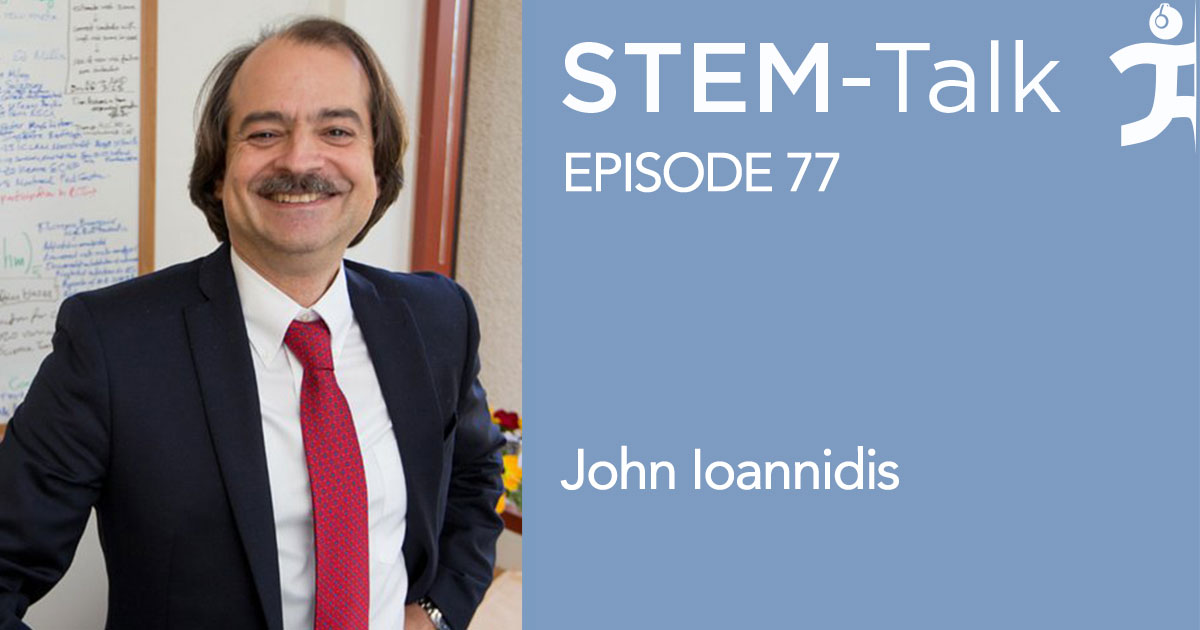
IHMC STEM-Talk Episode 77 with John Ioannidis
Episode 77: John Ioannidis discusses why most published research findings are false
I thought I was OK at evaluating trials (I even wrote and conducted a phase I/II trial previously), but you guys/gals are leaving me in the dust on this analysis but I greatly appreciate the ongoing discussion.
I don't have the full text of the esophagus trial immediately available. Did they publish the absolute numbers of adverse events? Could one or two bad events be skewing the data/formula if it is weighted heavily in their TTB formula?
Like the Darby breast paper....we get worked up about heart dose (and I agree it's important)...but buried in the supplement you see a mean heart dose of 4-6 Gy was like a 1% absolute increase in cardiac mortality for a 50 year old patient.
Count me as a skeptic. I agree that this sounds like 3 card monte. These are the same folks who tell us that RTOG 0415 was statistically significant but somehow clinically insignificant. I wonder if they have an agenda?
Very likely that proton trials will try to suggest that imrt has more toxicity than it really does in order claim benefit of protons. Have very active esophageal service- about 2 cases a month- and very little toxicity from 4140 to large fields. a factor in “toxicity” is a zealous unblinded radonc hunting through postop record, highly motivated to score “toxicity” in imrt group. Postop course is not black and white and subject to a lot of subjective interpretation... (you don’t find a difference, you aren’t getting into jco) Complex stats are probably a cover for highly subjective postop toxicity scoring
This is probably a perfect example for John Ioannidis.
Here is the problem. We have someone who is obviously academically oriented, knows their stuff, and wrote & conducted ph 1/2 trials, but still cannot decipher these papers (along with the rest of us here). It's not that Bayes is inherently bad (though I do not strictly oppose Bayesianism per se), but it's so absolutely foreign to anything we have learned. It's like hockey players who have skated their whole life trying to figure skate (YES I have seen The Cutting Edge so don't even go there!)
It's doubly worrisome that it's the proton trials that are pushing these and that it so easily passed into JCO and our literature while literally nobody knows what's going on.

Man, thanks for posting this random Bayesian stuff. I don't understand it either. What happened to the ease of reporting physician and patient reported toxicity outcomes?
I have no idea how to use their composite score or whatever in a knowledgable manner.
I have no idea how to use their composite score or whatever in a knowledgable manner.
Man, thanks for posting this random Bayesian stuff. I don't understand it either. What happened to the ease of reporting physician and patient reported toxicity outcomes?
I have no idea how to use their composite score or whatever in a knowledgable manner.
Right, this formula is even worse than the one used for calculating my RVU’s, which I will never understand.
I Think that is what they did when they assumed gamma-psi (i.e. the 'modality difference for recurrent toxicity') has N(0,100) (i.e. a normal distribution with a mean of 0). Essentially, their prior was there was (on average) no difference between the arms.I think whatever math they did, the prior I would use would be massively informed in favor of no difference.
I Think that is what they did when they assumed gamma-psi (i.e. the 'modality difference for recurrent toxicity') has N(0,100) (i.e. a normal distribution with a mean of 0). Essentially, their prior was there was (on average) no difference between the arms.
Thanks for the reply. I think non-informative prior (like flat or uniform priors) was a skeptical prior of sorts, but that an informed prior skewing much toward no difference (which I think fits with most rad onc beliefs) would have a different distribution than N(0 ,100). Meaning, the non-informative prior is not skeptical enough hence the need for only 107 patients. Intuitively, it seems the prior was not informed /skeptical enough of our prior belief that there is only minimal difference at this dose.
For Gamma distributions (see Gamma Intro) we need the shape and scale parameters right? I think they used some that we may disagree with (again need some tutorial here).
Advertisement - Members don't see this ad
I repeat. I've never been more happy to not be employed doc.
You employed docs think you'll see any of this that goes straight to your hospital admin? Doubt it. But PLEASE use this to at least not let them cut your pay.
I'll explain it to you in a nutshell. There are many courses like the Vail course and RSNA workshop that explain this much better than I do, however. The lung trial was Bayesian randomization, which relies on "immature" data for randomization in efforts to even out the groups in terms of x variables. The esophageal trial was Bayesian group sequencing design, pertaining only to the analytic component. It does not affect randomization and provide a bias that way. Basically the major plus of running a trial the latter way is that it's more "sensitive" to being stopped early if there's a difference in the endpoints found on interim analysis. That's exactly what seems to have happened in the esophagus trial - there happened to be a TTB difference and thus the trial was stopped after accrual of not many patients, because the effect size was so high. And IMHO the TTB endpoint was a brilliant one. Making an endpoint like "CTCAE grade 3+ cardiopulmonary events" requires an absurd sample size and does not take into account the duration and severity of those side effects. In other words, if you're enrolled in a trial that has the CTCAE based endpoint, and you happen to get a grade 3 lung toxicity... Followed by a grade 4 cardiac event, grade 4 sepsis, grade 4 anastomotic leak, etc, it's counted the same way as a patient who got grade 3 lung toxicity and nothing else. Is this the right way to conduct a trial? I think not. Only TTB actually encompasses all these things that could happen for x period of time after CRT or surgery.I agree, but I thought I was delving into it pretty deeply 🙁
Please dive on in with me! My main questions are how we get the priors, are they legit, how the data is used to form posteriors, how we compare the posteriors, and how we claim superiority (or is it greater probability in our personal beliefs since it's Bayes).
Pretty brilliant if you think about it. Too bad the phase III trial is evaluating OS, because there's little chance that'll be positive. But TTB means a lot nevertheless, people just can't appreciate the brilliance behind that endpoint.
And lastly, I believe this is a real finding. If there was such a huge difference in post-op complications from MDACC surgeons, just imagine how much the difference between protons and IMRT would be if a lower-volume surgeon treated the patient...
I'll explain it to you in a nutshell. There are many courses like the Vail course and RSNA workshop that explain this much better than I do, however. The lung trial was Bayesian randomization, which relies on "immature" data for randomization in efforts to even out the groups in terms of x variables. The esophageal trial was Bayesian group sequencing design, pertaining only to the analytic component. It does not affect randomization and provide a bias that way. Basically the major plus of running a trial the latter way is that it's more "sensitive" to being stopped early if there's a difference in the endpoints found on interim analysis. That's exactly what seems to have happened in the esophagus trial - there happened to be a TTB difference and thus the trial was stopped after accrual of not many patients, because the effect size was so high. And IMHO the TTB endpoint was a brilliant one. Making an endpoint like "CTCAE grade 3+ cardiopulmonary events" requires an absurd sample size and does not take into account the duration and severity of those side effects. In other words, if you're enrolled in a trial that has the CTCAE based endpoint, and you happen to get a grade 3 lung toxicity... Followed by a grade 4 cardiac event, grade 4 sepsis, grade 4 anastomotic leak, etc, it's counted the same way as a patient who got grade 3 lung toxicity and nothing else. Is this the right way to conduct a trial? I think not. Only TTB actually encompasses all these things that could happen for x period of time after CRT or surgery.
Pretty brilliant if you think about it. Too bad the phase III trial is evaluating OS, because there's little chance that'll be positive. But TTB means a lot nevertheless, people just can't appreciate the brilliance behind that endpoint.
And lastly, I believe this is a real finding. If there was such a huge difference in post-op complications from MDACC surgeons, just imagine how much the difference between protons and IMRT would be if a lower-volume surgeon treated the patient...
That is a good explanation. Thanks (really). It will help me when I look back over things.
I'll explain it to you in a nutshell. There are many courses like the Vail course and RSNA workshop that explain this much better than I do, however. The lung trial was Bayesian randomization, which relies on "immature" data for randomization in efforts to even out the groups in terms of x variables. The esophageal trial was Bayesian group sequencing design, pertaining only to the analytic component. It does not affect randomization and provide a bias that way. Basically the major plus of running a trial the latter way is that it's more "sensitive" to being stopped early if there's a difference in the endpoints found on interim analysis. That's exactly what seems to have happened in the esophagus trial - there happened to be a TTB difference and thus the trial was stopped after accrual of not many patients, because the effect size was so high. And IMHO the TTB endpoint was a brilliant one. Making an endpoint like "CTCAE grade 3+ cardiopulmonary events" requires an absurd sample size and does not take into account the duration and severity of those side effects. In other words, if you're enrolled in a trial that has the CTCAE based endpoint, and you happen to get a grade 3 lung toxicity... Followed by a grade 4 cardiac event, grade 4 sepsis, grade 4 anastomotic leak, etc, it's counted the same way as a patient who got grade 3 lung toxicity and nothing else. Is this the right way to conduct a trial? I think not. Only TTB actually encompasses all these things that could happen for x period of time after CRT or surgery.
Pretty brilliant if you think about it. Too bad the phase III trial is evaluating OS, because there's little chance that'll be positive. But TTB means a lot nevertheless, people just can't appreciate the brilliance behind that endpoint.
And lastly, I believe this is a real finding. If there was such a huge difference in post-op complications from MDACC surgeons, just imagine how much the difference between protons and IMRT would be if a lower-volume surgeon treated the patient...
What would be the mechanism for less anastomotic leaks with proton versus photon? I can't wrap my mind around that one.
I can see post op lung issues.
Maybe they can report some TTB-like metrics on the current P3, even though maybe not powered for it?
Protons for pre op esophagus doesn't give me *ahem* heartburn the way it does for prostate, right sided breast, and left sided whole breast with no nodes.
Last edited:
What would be the mechanism for less anastomotic leaks with proton versus photon? I can't wrap my mind around that one.
I can see post op lung issues.
Maybe they can report some TTB-like metrics on the current P3, even though maybe not powered for it?
Protons for pre op esophagus doesn't give me *ahem* heartburn the way it does for prostate, right sided breast, and left sided whole breast with no nodes.
I'll explain it to you in a nutshell. There are many courses like the Vail course and RSNA workshop that explain this much better than I do, however. The lung trial was Bayesian randomization, which relies on "immature" data for randomization in efforts to even out the groups in terms of x variables. The esophageal trial was Bayesian group sequencing design, pertaining only to the analytic component. It does not affect randomization and provide a bias that way. Basically the major plus of running a trial the latter way is that it's more "sensitive" to being stopped early if there's a difference in the endpoints found on interim analysis. That's exactly what seems to have happened in the esophagus trial - there happened to be a TTB difference and thus the trial was stopped after accrual of not many patients, because the effect size was so high. And IMHO the TTB endpoint was a brilliant one. Making an endpoint like "CTCAE grade 3+ cardiopulmonary events" requires an absurd sample size and does not take into account the duration and severity of those side effects. In other words, if you're enrolled in a trial that has the CTCAE based endpoint, and you happen to get a grade 3 lung toxicity... Followed by a grade 4 cardiac event, grade 4 sepsis, grade 4 anastomotic leak, etc, it's counted the same way as a patient who got grade 3 lung toxicity and nothing else. Is this the right way to conduct a trial? I think not. Only TTB actually encompasses all these things that could happen for x period of time after CRT or surgery.
Pretty brilliant if you think about it. Too bad the phase III trial is evaluating OS, because there's little chance that'll be positive. But TTB means a lot nevertheless, people just can't appreciate the brilliance behind that endpoint.
And lastly, I believe this is a real finding. If there was such a huge difference in post-op complications from MDACC surgeons, just imagine how much the difference between protons and IMRT would be if a lower-volume surgeon treated the patient...
Ok, say I give all this to you? Are we saying this type of Bayesian sequential design is good only for prelim studies? If so why is that?
The ph3 NRG-GI 006 also led by the same PI Dr. Steven Lin is reverting back to "old school" stats. The primary endpoints are now good ol' K-M OS and CTCAE 5.0 (not TTB) toxicity!
What is your guess on what is going on? Like I said, I think the Bayesian design may bring up too many questions for standard of care, but also allows less numbers for pre-ph3 data (needed only 107 patients). Sample size reqs for GI006 is double at 300.
Would love to hear your opinion on this change in ph3.
