Recent Complication

This forum made possible through the generous support of SDN members, donors, and sponsors. Thank you.

pgg

Laugh at me, will they?
Administrator
Volunteer Staff
20+ Year Member
Joined
Dec 15, 2005
Messages
17,554
Reaction score
27,726
Points
8,756
Location
Home again
  1. Attending Physician
Advertisement - Members don't see this ad
All right I'll do my part and post a case. 🙂


Nothing crazy or esoteric. Just a simple case with a complication ... I was not the primary for the patient but was involved at various points.


Young, healthy ASA 1 patient here for an ACL repair with hamstring graft. We offer nerve blocks of one kind or another to all of our ACL repairs - usually no sciatic unless the repair is done with a hamstring graft. Sometimes they get femoral catheters and a take-home disposable pump depending on who's doing the case. This patient was offered single shot femoral and sciatic blocks (nerve stim techniques, no ultrasound).

Femoral block first, easy, 15 mL 0.5% ropivacaine + 2 mg preservative-free dexamethasone additive.

Sciatic block second, difficult. First person tries a classic approach, can't get it. I'm nearby, go to help, attempt an infragluteal approach, get nothing. First person tries again, eventually gets a good plantar flexion twitch at 0.4 mA. 25 mL 0.5% ropivacaine + 2 mg PF dexamethasone.

Patient gets an LMA for surgery. Tourniquet up at 300 mmHg for 107 minutes.

Wakes up, good blocks, no pain, goes home.

Telephone f/u on POD 1, he has some odd 4/10 "tightness" discomfort over his anterolateral lower leg. Knee pain is OK on oral meds. Hmm.

POD 2, he's in for evaluation. The femoral block is totally resolved. The sciatic block is resolved, except he has still has some painful numbness in the sural distribution and foot drop (2/5 motor strength with dorsiflexion of his foot).

A helpful person involved in the case 🙂 tells him he has nerve damage from the block.


What now? What do you tell the patient, any exam/study/referral you want? When?
 
Last edited:
Really dumb question I think I know the answer to, but want verification... I saw this in the drug shortage thread as well.

PF = preservative free?

Thanks! I think this case is above my MS2 head, but I'll enjoy following along as I can.
 
Going to take a stab at this on. First where was the tourniquet located? Sounds like nerve damage in the lateral femoral cutaneous distribution. Perform a neuro exam locating isolating which nerve is involved. Second neurology consult with EMG study, trying to confirm whether Axonetmesis or Neuronetmesis vs (likely Neurapraxia) secondary to tourniquet inflation. The EMG study likely will take a few weeks. Speak with his PCP probably needs limited duty until his EMG results come back. Thank goodness you and the surgeon are covered under the Feres Doctrine.
 
Last edited:
Really too early for EMG.

Chances are she will be much better by the time you get the EMG. Sciatic nerve is one tough sucka.

T of 300 can certainly do it... so don't think it was definitively the block.

Your orthopod is a d ick.
 
Advertisement - Members don't see this ad
Going to take a stab at this on. First where was the tourniquet located?

ACL repair, standard thigh tourniquet.

Sounds like nerve damage in the lateral femoral cutaneous distribution.

pgg said:
painful numbness in the sural distribution and foot drop (2/5 motor strength with dorsiflexion of his foot).

Not LFC


Second neurology consult with EMG study, trying to confirm whether Axonetmesis or Neuronetmesis vs (likely Neurapraxia) secondary to tourniquet inflation. The EMG study likely will take a few weeks. Speak with his PCP probably needs limited duty until his EMG results come back. Thank goodness you and the surgeon are covered under the Feres Doctrine.

Assuming you could get the EMG whenever you want, when do you want it, now or later, why?

Feres Doctrine is great, unless you're the patient. 😉


Noyac said:
I agree but I wish the ones that were feeling bullied would chime in.

It's only been an hour 🙂
 
It's only been an hour 🙂

this past week is the most clinically oriented the forum has been in years. They have had plenty of opportunities to contribute. The ones that have participated have impressed me but I am not impressed in the least with the participation of the whiners.
 
The only reason to get an early EMG is to document a pre-existing condition and to asses recovery over time.
 
Did not see that you outlined the nerve distibution. Emg later approximetly 3 weeks. Neuro exam now neuro consult now. Give it more time their is nothing you can give now.
 
If you have her in your office and have an USD handy... you may elect to take a look. Especially at the site where you took your passes. You can exclude compressive vascular injury and other gross morphologic changes to the nerve in question. It's easy, cheap and can give you important info early.

Good thread so far, btw. 👍
 
If you have her in your office and have an USD handy... you may elect to take a look. Especially at the site where you took your passes. You can exclude compressive vascular injury and other gross morphologic changes to the nerve in question. It's easy, cheap and can give you important info early.

Good thread so far, btw. 👍

Sounds like peroneal distribution--I'm thinking it's a positioning/surgical-handling etiology. (Check out this month's Anesthesiology pages 918-923). I'd want to rule out a serious complication, i.e. compartment syndrome? Put some eyes on the patient and leg.

EMG can wait. Neurontin or similar is probably okay in interim. Call regularly. All IMHO.
 
Sounds like peroneal distribution--I'm thinking it's a positioning/surgical-handling etiology. (Check out this month's Anesthesiology pages 918-923). I'd want to rule out a serious complication, i.e. compartment syndrome? Put some eyes on the patient and leg.

EMG can wait. Neurontin or similar is probably okay in interim. Call regularly. All IMHO.

Wouldnt a compartment syndrome come with some other symptoms? Like severe pain in the area under pressure. This case doesn't have any other symptoms.

I didn't read the study some if I'm wrong then I may need to read.
 
Well. I've never performed a block nor positioned a pt for a case like this but I'll give it an intern shot.

Foot drop- caused by peroneal nerve injury; the peroneal is a branch of the sciatic; you performed a sciatic block it's possible that it was damaged, but I wouldn't expect an isolated foot drop, I would expect a more broad list of symptoms that included foot drop

numbness in sural nerve distribution- well, the sural nerve is somewhat superficial if I remember correctly and what I've seen in the limited number of arthroscopy cases there has been an L-shaped brace that the knee/leg rests in and I've also seen a boot that the ankle rests in while the knee is free;in all instances the braces been well padded but maybe improper positioning may have caused some compressive damage to the nerve

however it would be nice to attribute both symptoms to one cause
 
numbness in sural nerve distribution- well, the sural nerve is somewhat superficial if I remember correctly and what I've seen in the limited number of arthroscopy cases there has been an L-shaped brace that the knee/leg rests in and I've also seen a boot that the ankle rests in while the knee is free;in all instances the braces been well padded but maybe improper positioning may have caused some compressive damage to the nerve

👍 Was going to suggest a possible compression injury, although I didn't know about the brace. Lack of repositioning pressure point on leg during surgery as well
 
Well. I've never performed a block nor positioned a pt for a case like this but I'll give it an intern shot.

Foot drop- caused by peroneal nerve injury; the peroneal is a branch of the sciatic; you performed a sciatic block it's possible that it was damaged, but I wouldn't expect an isolated foot drop, I would expect a more broad list of symptoms that included foot drop

numbness in sural nerve distribution- well, the sural nerve is somewhat superficial if I remember correctly and what I've seen in the limited number of arthroscopy cases there has been an L-shaped brace that the knee/leg rests in and I've also seen a boot that the ankle rests in while the knee is free;in all instances the braces been well padded but maybe improper positioning may have caused some compressive damage to the nerve

however it would be nice to attribute both symptoms to one cause

This is what I was thinking.


P.S. I didn'treply earlier because I'm on vacation with non-keyboard device and a slow Internet connection.


Keep the clinical threads coming!
 
Advertisement - Members don't see this ad
If it was a compartment syndrome it would be kind of late. Peroneal nerve injury sounds probable. So how do you differentiate between a compressive nueropathy vs local anesthetic nerve injury? For the juniors. Whats the significance of differentiating?
From Iphone
 
In this instance, anesthetic nerve injury doesn't seem too likely just based on the localization of the neuropathy and the location of the injection site (I assume inferior gluteal?), correct?

I don't know about differentiating otherwise, if the injection site and peripheral neuropathy sync up
 
So I'll cut to the chase, there aren't any real twists here, but there are a couple other things worth talking about.


He got a careful neuro exam that showed severe dorsiflexion weakness and dense numbness over the anterolateral lower leg and foot. Normal sensation over the medial lower leg (saphenous/femoral), heel & sole of foot (tibial). Normal achilles reflex (tibial). No sensory or motor deficits above the knee.

So as of POD2 he had a severe, isolated peroneal neuropathy.

We didn't see any point in subjecting him to EMG studies immediately; as sevo mentioned, early on they're only good for documenting evidence of a pre-existing deficit, which we knew he didn't have. Also, it's a painful study, so doing it at the 3-4 week mark is IMO a reasonable approach. (This thought process was discussed this with him, and offered him the option of immediate EMG studies, but he declined.)

At this point we had some hope that there would be some improvement over a few weeks. Typically, when we consent our patients, we quote a 1:10000 - 1:20000 risk of some kind of persistent weakness or numbness due to direct complications of a nerve block, most of which are expected to improve to some degree. Prognosis for positioning injuries don't seem to be as good.

The basic differential at this point had just 4 things on the list
1) direct injury from the nerve block
2) positioning injury intra- or post-op
3) direct injury from the surgery itself
4) tourniquet injury

Of these, we greatly doubted 3 & 4. The surgical incisions were nowhere near the usual path of the common peroneal nerve, and the tourniquet time wasn't outrageous at 107 minutes. (400+ has been identified as a risk factor for injury.)

We were dubious that it was the nerve block itself for a couple reasons. One, the patient was only lightly sedated and reported zero discomfort with injection (normal injecting pressures, too). Two, 0.4 mA doesn't suggest intraneural position. Three, the twitch was a plantar flexion, which suggests the needle tip was closer to the tibial 1/2 rather than the peroneal 1/2 of the sciatic nerve. Although we had a few minutes of trouble locating the sciatic nerve, when the needle finally got into the right spot, it was totally routine.

It really had the appearance of a positioning injury, since the symptoms were so consistent with a classic head-of-the-fibula common peroneal compression injury. (On the ITEs, AKTs, and written exam, this often shows up as a positioning injury for an improperly padded patient in lithotomy, where the stirrup compresses the nerve at the knee.)

I don't think the injury was intraop positioning - the way this surgeon does his ACLs the knee is totally free and moved almost constantly. Postop, there was just a soft dressing.

My feeling was that the injury occurred well after he left the operating room, probably after he got home. He had solid, effective femoral and sciatic nerve blocks, and I bet he inadvertently had his leg up against something hard for an extended period while sleeping or watching TV.


A few weeks after surgery he saw a neurologist. In the interim he had no improvement, and actually presented once to our ER with burning neuropathic pain in the sural distribution. The neurologist did conduction studies at about the 4-5 week mark. The results were consistent with the exam - severe peroneal motor deficit, severe sural deficit. Normal sciatic function above the knee, normal tibial sensory & motor function, normal femoral function above the knee.

I suppose it is POSSIBLE that the sciatic nerve block, performed way up at the hip, directly injured only the portion of the sciatic nerve that would give rise to the common peroneal, but a far more likely explanation is that the injury occurred at the head of the fibula, where most common peroneal injuries happen.


Which leads me (finally) to my main point in posting this case:

As I mentioned above, I'm pretty confident that the injury occurred after he left the hospital. One of the underappreciated risks of nerve blocks is that the insensate body part is vulnerable to heat, cold, or compression injury. It's very important that patients (and their caregivers / ride home, if possible) get good postop instructions emphasizing this. Ultimately, there's only so much we can do, but having the existence of those instructions documented somewhere is a good thing. Bonus points for written handouts.
 
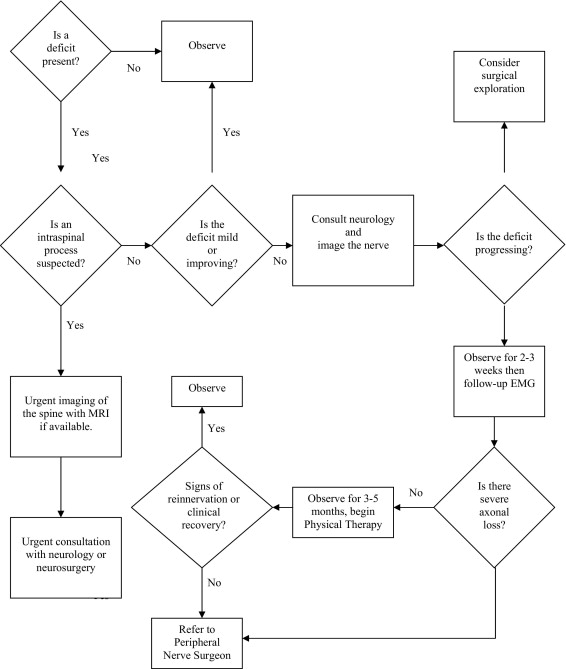
1-s2.0-S1098733907005937-gr1.jpg

Sorenson EJ. Neurological injuries associated with regional anesthesia. Reg Anesth Pain Med 2008; 33: 442–8

Just did a presentation on this for the end of my neuro rotation. My understanding--basically, immediate neuro exam and consult, immediate nerve conduction study and emg study to document previous axonal pathology. If deficit is severe or progressive then consider a compressing process or complete transection. Otherwise, follow up nerve conduction+emg after ~3 weeks when new axonal pathology would develop.
 
Thanks for sharing 🙂

Edit: these clinical cases are really screwing up my studying though!
 
Last edited:
So I'll cut to the chase, there aren't any real twists here, but there are a couple other things worth talking about.


He got a careful neuro exam that showed severe dorsiflexion weakness and dense numbness over the anterolateral lower leg and foot. Normal sensation over the medial lower leg (saphenous/femoral), heel & sole of foot (tibial). Normal achilles reflex (tibial). No sensory or motor deficits above the knee.

So as of POD2 he had a severe, isolated peroneal neuropathy.

We didn't see any point in subjecting him to EMG studies immediately; as sevo mentioned, early on they're only good for documenting evidence of a pre-existing deficit, which we knew he didn't have. Also, it's a painful study, so doing it at the 3-4 week mark is IMO a reasonable approach. (This thought process was discussed this with him, and offered him the option of immediate EMG studies, but he declined.)

At this point we had some hope that there would be some improvement over a few weeks. Typically, when we consent our patients, we quote a 1:10000 - 1:20000 risk of some kind of persistent weakness or numbness due to direct complications of a nerve block, most of which are expected to improve to some degree. Prognosis for positioning injuries don't seem to be as good.

The basic differential at this point had just 4 things on the list
1) direct injury from the nerve block
2) positioning injury intra- or post-op
3) direct injury from the surgery itself
4) tourniquet injury

Of these, we greatly doubted 3 & 4. The surgical incisions were nowhere near the usual path of the common peroneal nerve, and the tourniquet time wasn't outrageous at 107 minutes. (400+ has been identified as a risk factor for injury.)

We were dubious that it was the nerve block itself for a couple reasons. One, the patient was only lightly sedated and reported zero discomfort with injection (normal injecting pressures, too). Two, 0.4 mA doesn't suggest intraneural position. Three, the twitch was a plantar flexion, which suggests the needle tip was closer to the tibial 1/2 rather than the peroneal 1/2 of the sciatic nerve. Although we had a few minutes of trouble locating the sciatic nerve, when the needle finally got into the right spot, it was totally routine.

It really had the appearance of a positioning injury, since the symptoms were so consistent with a classic head-of-the-fibula common peroneal compression injury. (On the ITEs, AKTs, and written exam, this often shows up as a positioning injury for an improperly padded patient in lithotomy, where the stirrup compresses the nerve at the knee.)

I don't think the injury was intraop positioning - the way this surgeon does his ACLs the knee is totally free and moved almost constantly. Postop, there was just a soft dressing.

My feeling was that the injury occurred well after he left the operating room, probably after he got home. He had solid, effective femoral and sciatic nerve blocks, and I bet he inadvertently had his leg up against something hard for an extended period while sleeping or watching TV.


A few weeks after surgery he saw a neurologist. In the interim he had no improvement, and actually presented once to our ER with burning neuropathic pain in the sural distribution. The neurologist did conduction studies at about the 4-5 week mark. The results were consistent with the exam - severe peroneal motor deficit, severe sural deficit. Normal sciatic function above the knee, normal tibial sensory & motor function, normal femoral function above the knee.

I suppose it is POSSIBLE that the sciatic nerve block, performed way up at the hip, directly injured only the portion of the sciatic nerve that would give rise to the common peroneal, but a far more likely explanation is that the injury occurred at the head of the fibula, where most common peroneal injuries happen.


Which leads me (finally) to my main point in posting this case:

As I mentioned above, I'm pretty confident that the injury occurred after he left the hospital. One of the underappreciated risks of nerve blocks is that the insensate body part is vulnerable to heat, cold, or compression injury. It's very important that patients (and their caregivers / ride home, if possible) get good postop instructions emphasizing this. Ultimately, there's only so much we can do, but having the existence of those instructions documented somewhere is a good thing. Bonus points for written handouts.

So, do you think he will get better?

I doubt it. Looks like he will end up with chronic pain. I wonder if motor will come back. Has a "nerve translocation" been offered to him?

I have had positioning injuries. The ones I have seen, motor & sensory, start getting better by the next day.

I don't see myself ever consenting for a nerve block.
 
A pain-free injection and exploration for the nerve means that needle trauma or intrafascicular injection is highly unlikely. I mean, you all know the estimated incidence of actual nerve injury related to peripheral nerve blocks and even when they do occur the most apparent risk factors (pre-existing neuropathy, diabetes, etc.) do not exist in this patient.

When I want an EMG, that's when I'm consulting the neurologist. Painful numbness, though atypical, is still confounded by the inflammation/edema of surgery. It blows my mind how often the nerve block is implicated in the context of long tourniquet times at such high pressures. I mean, lets consider the possibility but nerve ischemia makes a lot more sense to me than anything else we're doing to the patient.

Many are all too ready to compromise their professionalism in attempt to re-direct litigation--even in the unlikely event that it will occur.
 
Last edited by a moderator:
all us guided blocks whenever possible - do u really want someone fishing with a needle in you just because you dont know how to use/have available ultrasound?

also for this case, a popliteal(or just superior to it )sciatic block under us is technically easy and effective with minimal risk (but i would have put twice as much steroid in it for a total of 8mg dex)

in the end for this case, you dont really know what caused the symptoms, fact is someone was poking blindly with a needle near the sacrum - where there are sciatic nerve/other exiting nerve roots and structures - who knows where you are without ultrasound? who knows what you hit.. you probably DIDNT cause the sx but cant rule it out since its a blind technique in my mind

go lower in the leg, use ultrasound, im sure you do lots of knees and this seems like a more safe simple approach to me
 
all us guided blocks whenever possible - do u really want someone fishing with a needle in you just because you dont know how to use/have available ultrasound?

also for this case, a popliteal(or just superior to it )sciatic block under us is technically easy and effective with minimal risk (but i would have put twice as much steroid in it for a total of 8mg dex)

in the end for this case, you dont really know what caused the symptoms, fact is someone was poking blindly with a needle near the sacrum - where there are sciatic nerve/other exiting nerve roots and structures - who knows where you are without ultrasound? who knows what you hit.. you probably DIDNT cause the sx but cant rule it out since its a blind technique in my mind

go lower in the leg, use ultrasound, im sure you do lots of knees and this seems like a more safe simple approach to me

Let's be clear; you cannot rule out a block etiology if you placed the block under ultrasound. The incidence of peripheral nerve injury following blockade is shown in the literature to be the same whether using nerve. stim. or ultrasound techniques (or in concert).
 
Advertisement - Members don't see this ad
all us guided blocks whenever possible - do u really want someone fishing with a needle in you just because you dont know how to use/have available ultrasound?

also for this case, a popliteal(or just superior to it )sciatic block under us is technically easy and effective with minimal risk (but i would have put twice as much steroid in it for a total of 8mg dex)

in the end for this case, you dont really know what caused the symptoms, fact is someone was poking blindly with a needle near the sacrum - where there are sciatic nerve/other exiting nerve roots and structures - who knows where you are without ultrasound? who knows what you hit.. you probably DIDNT cause the sx but cant rule it out since its a blind technique in my mind

go lower in the leg, use ultrasound, im sure you do lots of knees and this seems like a more safe simple approach to me


Where is your EVIDENCE For thse statements? There is not a single controlled study showing better safety with U/S vs. NS only blocks. In fact, experienced Anesthesiologists like myself have been doing NS assisted nerve blocks for decades with an excellent safety record.

I think U/S guided blocks are great but don't let that technology lull you into thinking safety is greatly enhanced; you still need to pay attention to all parameters like Injection pressure, patient complaints, NS reading less than 0.2, etc. when doing any block.

Perhaps, the addition of an injection pressure device should be added for Sciatic blocks? I've used this device a few times and find it helpful:


lightweight and easy to use BSmart™ has been designed to provide significant clinical information at a fantastic value.
bsmartphoto.jpg
 
For Sciatic blocks performed preoperatively I no longer add anything to my local especially if a tourniquet is being used for the case. The patients gets PLAIN Ropivacaine or Bupivacaine.

For Diabetics I'm doing less Sciatic blocks preoperatively and only add them if absolutely needed in the PACU. This decision is a personal one based on risk/reward or benefit/complication of doing a sciatic block for post op pain control.
 
So, do you think he will get better?

I don't think so.

I doubt it. Looks like he will end up with chronic pain. I wonder if motor will come back. Has a "nerve translocation" been offered to him?

No, but it may be at some point in the future, depending on what his consultant specialists recommend. It's up to them and the patient.

I have had positioning injuries. The ones I have seen, motor & sensory, start getting better by the next day.

From what I understand expected prognosis is generally opposite that - nerve injuries related to blocks tend to improve over time, but the kind of severe neuropathy you get from a positioning injury has a poorer prognosis.

Certainly being 6-7 weeks out right now, without much improvement, make me less optimistic he'll get better. But - in the grand scheme of nerve injuries, 6 weeks isn't that long.

I don't see myself ever consenting for a nerve block.

I go back and forth on that thought myself ... there's no question that the patients who get blocks are more satisfied with surgery. This is the first serious complication I've witnessed first hand, and I'm pretty convinced it was not related to the block needle or local - though the block probably was the major risk factor for a postop positioning injury.


EdPierce said:
all us guided blocks whenever possible

Maybe. It's certainly not a standard of care, and maybe it won't ever be. That said, I use u/s for all of my blocks now that it's available everywhere I work. I get fewer failed blocks and they're easier. But I learned with the nerve stim technique and there's tons of good data supporting its safety.

I have no reason to believe had u/s been used in this case the outcome would've been different.
 
I read one study where authors argued that the incidence of intranueral injection may actually be higher under ultrasound, as the operator can inject quite close to the nerve but not have a perfect view of exactly where the needle tip is.
 
Perhaps, the addition of an injection pressure device should be added for Sciatic blocks? I've used this device a few times and find it helpful:


lightweight and easy to use BSmart™ has been designed to provide significant clinical information at a fantastic value.
bsmartphoto.jpg

Thanks for bringing that up, I meant to address disposable manometer devices ...

The case is still being reviewed and a formal RCA is going to be done. At this point, the two things I'll probably formally recommend are
- standardized printed postop instructions for all nerve block patients
- routine use of such an injection pressure monitoring device

Again I don't think the injury was caused by the injection itself so the use of an injection manometer wouldn't have prevented this injury IMO - but there doesn't seem to be much of a down side to using one, other than cost. Retail price for the BSmart is about $10 per unit.

Anyone have firsthand experience with the BSmart or other brands?
 
Is your RCA not discoverable, like M&M, or what? Could the patient use what y'all find in the analysis in litigation?

RCAs are not discoverable, purely a quality assurance and improvement tool.

In any case, litigation is not a possibility due to Feres Doctrine.
 
why are you guys using PF Dexamethasone? I'm assuming it is being used prophylactically to prevent 'inflammation' or nerve injury.

If that's the case, why not use a Depo steroid, such as Depomedrol (it will likely stay there longer).....
 
We used those manometer things with one attending where I trained. Seemed pretty cool but not sure how useful they were. Not sure on any data that shows they decrease risk either. When us was introduced at the program they pretty much disappeared.

For that pressure monitor contraption, kinda looks like a pain. Saw one dude who devised a really clever system for injection pressures. He would take a 20cc syringe with 10 cc local and 10cc air and inject it as to compress the 10cc of air into around 5cc of air. Got him his target pressure. Think you can play with an Aline transducer to see what kind of pressure it generates. Maybe I'll do that next week if I have a case with an Aline.
 
Advertisement - Members don't see this ad
Two, 0.4 mA doesn't suggest intraneural position.

I disagree, 0.4mA in the sciatic is often intraneural.

10$ for a manometer?? that's crazy, i just inject with a 10cc needle (less pressure needed) by 1 or 2cc aliquots and rarely use more than 15cc never more than 20cc
 
RCAs are not discoverable, purely a quality assurance and improvement tool.

In any case, litigation is not a possibility due to Feres Doctrine.

Duh, I forgot you're AD! And, also - reading is fundamental. You mentioned the Feres Doctrine above! My bad.
 
why are you guys using PF Dexamethasone? I'm assuming it is being used prophylactically to prevent 'inflammation' or nerve injury.

If that's the case, why not use a Depo steroid, such as Depomedrol (it will likely stay there longer).....

Accidental intravascular administration of particulate steroids.
 
I disagree, 0.4mA in the sciatic is often intraneural.

10$ for a manometer?? that's crazy, i just inject with a 10cc needle (less pressure needed) by 1 or 2cc aliquots and rarely use more than 15cc never more than 20cc

I agree. I never take .4mA, especially with a good USD view. If I'm getting a patellar snap @ .6mA and I know I'm where I need to be with my needle via USD (especially if I'm UNDER the femoral nerve), I see NO advantage of pushing the needle deeper.

I see this as a great safety mechanism of USD nerve blocks.... I don't care what the literature says.

Experience tells me I can get a GREAT block @ .6-.7mA if I can SEE LA beeing deposited correctly (in the case of a femoral nerve block, depositing under the nerve = better block than from above).

I see no reason to push further and get .5mA (which is what I actually go for if I don't have a strong patellar snap at higher amperage).
 
It doesn't happen often, but who here has done an ISB under USD that wouldn't stimulate...?

Yet had a great picture?

and then deposited your LA?

and the patient woke up with a great block?

This has been reported in the literature.
 
Anybody still doing Lumbar Plexus catheters?

Why can a nerve stimulator only technique fail you AND put your patient at risk if you are putting in these catheters? Would USD guided approach provide a layer of safety in these situations?
 
all us guided blocks whenever possible - do u really want someone fishing with a needle in you just because you dont know how to use/have available ultrasound?

also for this case, a popliteal(or just superior to it )sciatic block under us is technically easy and effective with minimal risk (but i would have put twice as much steroid in it for a total of 8mg dex)

in the end for this case, you dont really know what caused the symptoms, fact is someone was poking blindly with a needle near the sacrum - where there are sciatic nerve/other exiting nerve roots and structures - who knows where you are without ultrasound? who knows what you hit.. you probably DIDNT cause the sx but cant rule it out since its a blind technique in my mind

go lower in the leg, use ultrasound, im sure you do lots of knees and this seems like a more safe simple approach to me

Most ridiculous post ever!
 
I'm nearby, go to help, attempt an infragluteal approach, get nothing

For knees requirering sciatics, I think a infragluteal or high pop are the way to go. They preserve more hamstring fxn. Particualrly important if you are getting them to walk on POD # 0. Best scenario, IMO, is to take the sciatic just proximal of it's bifurcation... which would require USD to actually SEE this bifurcation.
 
For Sciatic blocks performed preoperatively I no longer add anything to my local especially if a tourniquet is being used for the case. The patients gets PLAIN Ropivacaine or Bupivacaine.

For Diabetics I'm doing less Sciatic blocks preoperatively and only add them if absolutely needed in the PACU. This decision is a personal one based on risk/reward or benefit/complication of doing a sciatic block for post op pain control.

I agree. I did a closed claims deal a while back and we noticed that with regional blocks (which were very rare) the incidence of nerve injury was markedly greater when epi was added.

With that being said, I have started to add decadron to some of my blocks.
 
I agree. I did a closed claims deal a while back and we noticed that with regional blocks (which were very rare) the incidence of nerve injury was markedly greater when epi was added.

With that being said, I have started to add decadron to some of my blocks.

+1

Epi in your mix + high T pressures (I can't believe some orthopods are putting them as high as 400mmhg 😱) is a recepie for badness.

I've been coming down on my total mg dose for a lot of blocks with the addition of PF decadron. I'm really liking decadron.
 
Advertisement - Members don't see this ad
Top Bottom